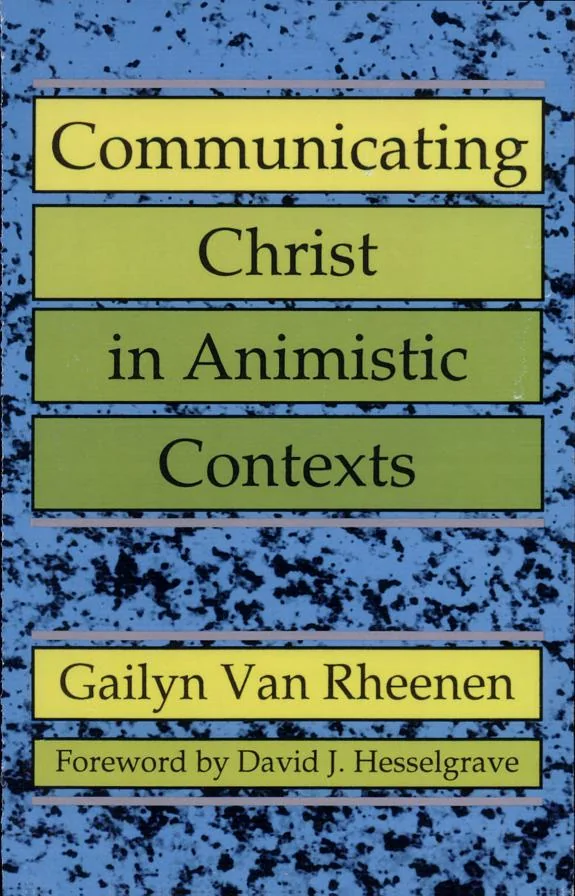
Communicating Christ in Animistic Contexts
 83
83

Communicating Christ in Animistic Contexts
Gailyn Van Rheenen’s *Communicating Christ in Animistic Contexts* tackles a crucial, often overlooked area of theological engagement. The book’s strength lies in its rigorous integration of biblical exegesis, systematic theology, and anthropological method. Van Rheenen doesn't shy away from the complexities of translating Christian concepts into cultural lexicons deeply rooted in animistic thought. One particularly salient point is his analysis of the implications of biblical angelology and demonology for understanding spirit hierarchies in animistic societies. However, the dense academic style, while thorough, may present a barrier to readers seeking more immediately practical, anecdotal guidance. Despite this, the work provides an essential intellectual toolkit for anyone grappling with the theological and cultural nuances of mission in animistic settings. It serves as a solid, if demanding, resource.
📝 Description
83
Gailyn Van Rheenen's 1991 book analyzes Christian theology within animistic belief systems.
This book builds a scholarly framework for understanding and engaging with cultures where animism is prevalent. It analyzes the intersection of Christian theology and animistic worldviews from biblical, theological, and anthropological viewpoints. The work scrutinizes how Christian doctrines about God, spirits, and salvation can be communicated effectively within animistic frameworks. It examines the nature of spiritual powers, intermediary beings, and the human relationship with the divine in these contexts. The book addresses the widespread presence of animistic beliefs in various forms, from New Age movements to traditional practices in regions like Haiti and East Asia. It is relevant for scholars of comparative religion, missiologists, theological students, and anthropologists. Individuals involved in cross-cultural ministry or theological education who encounter animistic worldviews will also find it useful.
Published in 1991, this work emerged during a period of heightened academic interest in global religious phenomena. It specifically addresses the challenges of indigenizing Christianity within cultures deeply shaped by animistic thought. The book engages with the widespread presence of animistic beliefs, whether in traditional practices or modern movements, seeking to bridge understandings between distinct spiritual systems.
💡 Why Read This Book?
• Gain a biblically-grounded approach to understanding animistic worldviews, learning how Van Rheenen uses specific scriptural passages to address concepts like spirit intermediaries. • Grasp the anthropological distinctions Van Rheenen draws between various animistic expressions, such as Haitian Vodou and Chinese ancestor veneration, to better contextualize communication. • Develop theological frameworks for presenting Christian doctrine, as exemplified by the book's exploration of communicating the nature of God and salvation in contrast to animistic cosmologies.
⭐ Reader Reviews
Honest opinions from readers who have explored this book.
❓ Frequently Asked Questions
What is the primary focus of Gailyn Van Rheenen's *Communicating Christ in Animistic Contexts*?
The book focuses on providing a biblical, theological, and anthropological foundation for effectively communicating Christian messages within cultures that hold animistic beliefs, addressing the challenges of translation and understanding.
When was *Communicating Christ in Animistic Contexts* first published?
The work was first published in 1991, reflecting scholarly discussions on global religions and missiology prevalent at that time.
What types of animistic beliefs are discussed in the book?
The book references a range of animistic beliefs, including New Age mysticism, occultism, Haitian voodooism, Chinese ancestor veneration, and Japanese Shintoism.
What academic disciplines does the author draw upon?
The author integrates insights from biblical studies, systematic theology, and cultural anthropology to build his arguments.
Who would benefit most from reading this book?
Scholars of religion, missionaries, theological students, and anthropologists interested in cross-cultural communication and the study of animistic traditions would find this book valuable.
Does the book offer practical steps for ministry?
While grounded in practical theological and anthropological concerns, the book's primary aim is to provide a foundational understanding and analytical framework, rather than a step-by-step manual.
🔮 Key Themes & Symbolism
Bridging Worldviews
This theme centers on the fundamental challenge of articulating Christian tenets to individuals whose spiritual understanding is shaped by animism. Van Rheenen explores how concepts like the nature of God, creation, and redemption are perceived differently when filtered through a worldview that attributes spiritual essence to natural phenomena and objects. The work emphasizes the need for careful cultural analysis to ensure meaningful communication.
Theological Anthropology
A significant portion of the book addresses how human beings are understood within both Christian and animistic frameworks. It investigates differing views on the soul, spirit, and the body, and how these understandings influence perceptions of sin, healing, and salvation. The text examines the implications of these diverse anthropological models for theological discourse.
Spirituality and Power
The work studies the pervasive belief in spiritual forces and powers inherent in animistic cultures. Van Rheenen contrasts this with biblical portrayals of divine and demonic powers, analyzing how beliefs about intermediaries, ancestral spirits, and nature spirits interact with Christian concepts of angels, demons, and God's sovereignty. This theme is crucial for understanding spiritual warfare and deliverance ministries.
Biblical Hermeneutics
Central to the book is the application of sound biblical interpretation to the specific challenges posed by animistic contexts. Van Rheenen advocates for a method that respects the biblical text while remaining sensitive to cultural hermeneutics, ensuring that theological truths are conveyed accurately and relevantly, avoiding syncretism while fostering genuine understanding.
💬 Memorable Quotes
Direct passages from the work, attributed to the author.
“Animistic beliefs are widespread, even today.”
— This observation, made early in the work, underscores the contemporary relevance of understanding animism, moving it beyond a historical curiosity to a living spiritual reality influencing global populations.
“A rigorous, biblical, theological, and anthropological foundation.”
— This phrase captures the multi-disciplinary approach Van Rheenen employs, highlighting his commitment to academic thoroughness in addressing complex cross-cultural theological issues.
“Ministering in animistic contexts.”
— This phrase directly addresses the practical application of the book's scholarly findings, indicating its purpose is to equip individuals for effective engagement in specific cultural and spiritual environments.
“Whether in New Age mysticism, occultism, Haitian voodooism, Chinese ancestor veneration, or Japanese Shintoism...”
— This enumeration demonstrates the broad scope of animistic expressions the book intends to cover, showcasing its effort to analyze diverse manifestations of the phenomenon.
“The book presents a foundation for ministering...”
— This interpretation emphasizes the book's role as a preparatory guide, offering the essential theoretical and analytical tools needed before undertaking practical ministry in culturally diverse settings.
🌙 Esoteric Significance
Tradition
While not strictly an esoteric text in the Hermetic or Kabbalistic sense, this work engages with systems of belief that often intersect with esoteric practices. It situates itself within the broader tradition of comparative religion and theological anthropology, examining how spiritual realities are perceived and mediated. The book’s departure lies in its explicit Christian theological framework, seeking to understand animism not as an alternative path, but as a context for Christian proclamation.
Symbolism
In animistic contexts, potent symbols often revolve around nature, ancestors, and intermediaries. The book implicitly engages with symbols of spiritual power, such as masks or totems in some traditions, and the symbolic weight attributed to natural elements like trees, rivers, or mountains. It also touches upon the symbolic representation of spiritual hierarchies and the human connection to the divine through rituals and offerings.
Modern Relevance
Contemporary thinkers in fields like postcolonial theology, critical theory of religion, and global Pentecostalism continue to grapple with the issues Van Rheenen raised. His work remains relevant for scholars and practitioners seeking to understand the spiritual field of many non-Western societies, informing discussions on religious pluralism, interfaith dialogue, and the challenges of contextualizing faith in increasingly interconnected yet spiritually diverse global communities.
👥 Who Should Read This Book
• Missiologists and cross-cultural workers seeking a robust theological and anthropological framework for engaging with animistic societies, benefiting from the book’s analysis of communication challenges. • Students of comparative religion and theology interested in understanding the diverse expressions of animism and their interaction with major world religions, particularly Christianity. • Anthropologists of religion who wish to explore the theoretical underpinnings of spiritual belief systems and their impact on social and cultural practices, finding value in the book’s interdisciplinary approach.
📜 Historical Context
Published in 1991, *Communicating Christ in Animistic Contexts* emerged during a vibrant period of theological and anthropological discourse concerning global Christianity. The late 20th century saw a growing awareness of the limitations of Western-centric theological models when applied to diverse cultural contexts, particularly in the Global South. Van Rheenen’s work contributed to this scholarly conversation, which included contemporaries like Lamin Sanneh, who emphasized the translating power of Christianity, and Lamin O. Sanneh, who explored the indigenization of the faith. The book addressed the challenge posed by pervasive animistic worldviews, which differed significantly from secularized Western thought. While not facing overt censorship, such works often navigated complex debates about syncretism versus inculturation within missionary circles and academic theology, engaging with ongoing discussions about the role of cultural anthropology in theological education.
📔 Journal Prompts
Animistic worldviews and their perception of spiritual essences.
The theological implications of communicating Christian doctrine across cultural divides.
Biblical narratives concerning spiritual powers and their resonance in animistic contexts.
Comparing anthropological understandings of the human person in Christian versus animistic frameworks.
Reflecting on the concept of intermediaries in various belief systems discussed.
🗂️ Glossary
Animism
The belief that natural objects, phenomena, and the universe itself possess a distinct spiritual essence or soul, often leading to the worship of these entities or their perceived spirits.
Theological Anthropology
The branch of theology concerned with the nature of humanity, its origin, purpose, and relationship with God, examined within a specific theological tradition.
Missiology
The academic study of Christian missions, including its theology, history, and practice, often focusing on evangelism and church planting in diverse cultural contexts.
Syncretism
The blending of beliefs and practices from different religions or ideologies, often resulting in a new religious form or interpretation.
Inculturation
The process by which a religion or ideology is adapted to a specific local culture, seeking to express its truths in culturally relevant forms without compromising its core tenets.
Cosmology
A theory or doctrine concerning the origin, structure, and development of the universe, often encompassing both scientific and philosophical or religious perspectives.
Hermeneutics
The theory and methodology of interpretation, especially the interpretation of biblical texts, focusing on principles of understanding meaning within its historical and cultural context.
This book appears in 1 collection
🔮 Readers Also Liked
Browse all →








From the “Animism” Collection
View all →







More Free Sacred Texts & Gnosticism Books
View all →