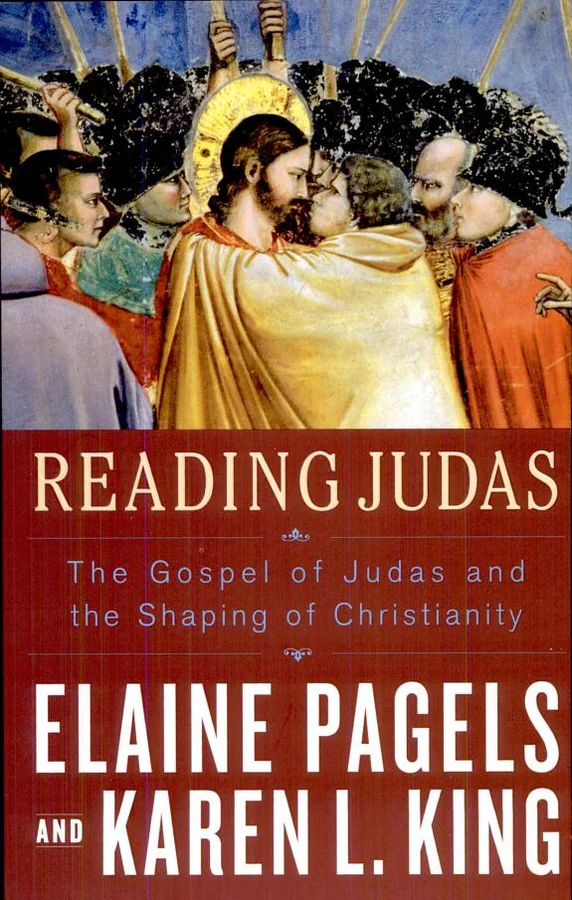
Reading Judas
 72
72

Reading Judas
Elaine Pagels and Karen L. King’s "Reading Judas" offers a vital scholarly entry point into the recently surfaced Gospel of Judas. The strength of the work lies in its meticulous translation and contextualization, particularly King’s careful reconstruction of the fragmented Coptic text. Pagels’ expertise shines in her ability to situate the gospel within the broader spectrum of early Christian thought, moving beyond sensationalism. A point of particular interest is the text’s re-framing of Judas, presenting him not as the archetypal villain but as a confidant of Jesus, tasked with a specific, perhaps liberating, spiritual mission. The limitation, perhaps inherent in the source material itself, is that the gospel’s fragmented nature leaves much open to interpretation, and the authors, while lucid, cannot fully reconstruct every missing piece of its theological argument. The passage discussing Judas’s ascent, as interpreted by the authors, offers a glimpse into a very different soteriology than that which would eventually dominate Christianity. The book serves as an essential, if incomplete, window into a lost tradition.
📝 Description
72
The 2006 discovery of the Gospel of Judas revealed a 2nd century CE text that redefines Judas Iscariot.
This book examines the Gospel of Judas, a Coptic text unearthed in 2006. Unlike traditional accounts, this gospel portrays Judas not as a betrayer but as a special disciple. He was privy to Jesus' secret spiritual teachings, chosen to reveal esoteric knowledge. King and Pagels, both scholars of early Christianity and Gnosticism, provide a translation and interpretation of this fragmented codex.
Their analysis places the Gospel of Judas within the varied beliefs of early Christianity. The text challenges standard interpretations by presenting Judas as Jesus' favored companion. This perspective prompts questions about Jesus' mission, the nature of divine revelation, and the developing doctrines of early Christianity. The book also discusses the Gnostic worldview it reflects, which posits a supreme God separate from the material world, contrasting with orthodox Christian theology.
The Gospel of Judas emerges from a milieu of early Christian Gnosticism. This tradition often viewed the material world as a flawed creation, distinct from a transcendent, true God. Gnostic texts frequently presented secret knowledge (gnosis) as the path to salvation, accessible through enlightened figures. The Gospel of Judas fits this pattern by emphasizing hidden teachings revealed to a select few, offering a counterpoint to more conventional early Christian doctrines and highlighting the diverse spiritual currents of the era.
💡 Why Read This Book?
• Understand the controversial reinterpretation of Judas Iscariot, moving beyond the traditional narrative of betrayal to a figure of esoteric knowledge, as detailed in the analysis of the Gospel of Judas. • Grasp the Gnostic concept of a transcendent, supreme God distinct from the material world's creator, a core tenet explored through the gospel’s cosmology. • Appreciate the scholarly process of translating and interpreting ancient texts, exemplified by Karen L. King's work on the 2nd-century Coptic codex.
⭐ Reader Reviews
Honest opinions from readers who have explored this book.
❓ Frequently Asked Questions
When was the Gospel of Judas discovered and published?
The Gospel of Judas, a 2nd-century Coptic text, was rediscovered in the 1970s and underwent extensive conservation and translation. Its scholarly publication and public unveiling occurred in 2006, sparking widespread interest.
Who are Elaine Pagels and Karen L. King?
Elaine Pagels is a renowned historian of early Christianity, known for her work on Gnostic gospels. Karen L. King is a leading scholar of Gnosticism and early Christian texts, responsible for a key translation of the Gospel of Judas.
What is the main difference between the Gospel of Judas and canonical gospels?
The Gospel of Judas portrays Judas not as a traitor but as Jesus' closest disciple, chosen to reveal secret knowledge. This contrasts with canonical accounts that depict him as the betrayer who handed Jesus over to authorities.
What does the Gospel of Judas reveal about Gnostic beliefs?
It illustrates Gnostic ideas about a hidden, spiritual realm, the inadequacy of the material world's creator, and the importance of secret knowledge (gnosis) for salvation, often transmitted through a select few disciples.
How does the text challenge traditional Christian views of God?
The gospel suggests a dualistic cosmology where the supreme, unknowable God is distinct from the lesser creator of the material world. This challenges the unified, benevolent creator depicted in orthodox traditions.
Is the Gospel of Judas considered canonical scripture?
No, the Gospel of Judas is considered a Gnostic gospel and is not part of the New Testament canon accepted by mainstream Christian denominations. It represents a diversity of early Christian thought.
🔮 Key Themes & Symbolism
Judas as the True Disciple
The gospel reconfigures Judas Iscariot from the archetypal betrayer into Jesus’ most trusted confidant. He is presented as the recipient of esoteric knowledge, uniquely chosen by Jesus to understand and reveal the spiritual mysteries. This interpretation challenges the orthodox narrative that cemented Judas’s infamy, suggesting instead a complex, perhaps even redemptive, role within Jesus’ inner circle and his divine mission.
Gnostic Cosmology and the Divine
The text offers a window into a Gnostic worldview characterized by a supreme, unknowable God residing in a spiritual realm, distinct from the material world and its flawed creator. This dualistic perspective posits that salvation comes not through faith in a physical savior, but through attaining gnosis – secret knowledge – that liberates the soul from the material prison. The work elucidates this separation between the true divine and the demiurgic creator.
Esoteric Knowledge and Salvation
Central to the Gospel of Judas, and explored in "Reading Judas," is the concept of salvation through gnosis. This secret knowledge, revealed by Jesus to select disciples like Judas, is the key to spiritual liberation. The gospel implies that understanding the true nature of the divine and the cosmos, rather than adherence to ritual or dogma, is the path to reuniting the divine spark within humanity with its true source.
The Nature of the Eucharist
The gospel presents a divergent view of the Last Supper and the Eucharist. Instead of a commemoration of sacrifice, it appears to be a mystical communion where Jesus imparts spiritual understanding. The interpretation within "Reading Judas" highlights how this sacred meal, in the Gnostic context, becomes a vehicle for transmitting esoteric teachings essential for the disciple's spiritual journey.
💬 Memorable Quotes
Direct passages from the work, attributed to the author.
“The text refers to the creation of humanity as an error.”
— This interpretation points to the Gnostic dualism, where the material world and its inhabitants are seen as flawed creations of a lesser deity, distinct from the perfect, spiritual field of the true God.
“Jesus' disciples misunderstood his teachings.”
— This highlights a recurring theme in Gnostic texts: the idea that the majority of Jesus' followers grasped only the exoteric, literal meanings, while a select few, like Judas, received the deeper, esoteric spiritual message.
“The gospel speaks of a spiritual kingdom separate from the material world.”
— This concept underscores the Gnostic worldview, which prioritizes the spiritual over the material, viewing the earthly existence as a temporary prison from which the soul seeks liberation through divine knowledge.
💡 Key Ideas
Editorial paraphrase of the work's core concepts — not direct quotes.
Jesus told him, 'But you will surpass all of them. For you will sacrifice the man that belongs to me.'
This line, interpreted within the text, suggests Judas's unique role is not betrayal in the common sense, but a divinely ordained act necessary for Jesus' spiritual mission, possibly involving the release of Jesus' true essence.
The interpretation of the gospel suggests Judas was chosen to understand the cosmos.
This paraphrased concept emphasizes the Gnostic belief that certain individuals were privy to hidden truths about the universe's structure and divine origins, positioning Judas as a recipient of this profound cosmological insight.
🌙 Esoteric Significance
Tradition
This work is deeply rooted in Gnosticism, a diverse set of religious movements prominent in the early centuries CE. It aligns with Gnostic traditions that emphasize salvation through secret knowledge (gnosis) and often present a dualistic cosmology. The Gospel of Judas, as analyzed by King and Pagels, departs from the emerging orthodox Christian narrative by elevating a figure traditionally demonized, suggesting a lineage of thought that prioritized esoteric understanding over communal ritual.
Symbolism
The figure of Judas Iscariot itself becomes a potent symbol, transmuted from betrayer to the possessor of ultimate truth. The text also engages with the symbolism of the material world as a prison, contrasting it with the luminous spiritual realm. The act of 'sacrifice' attributed to Judas is reinterpreted not as a heinous act, but as a necessary, perhaps even liberating, spiritual transaction.
Modern Relevance
Contemporary esoteric and spiritual seekers, particularly those interested in alternative interpretations of Christian history and Gnostic philosophy, draw upon analyses of texts like the Gospel of Judas. Thinkers exploring the nature of consciousness, hidden knowledge, and critiques of institutionalized religion find resonance. The work informs discussions within comparative religion and spirituality studies, offering a counter-narrative to dominant historical accounts.
👥 Who Should Read This Book
• Students of early Christianity and Gnosticism: Gain critical insights into the diversity of beliefs in the 2nd century CE and the interpretive challenges posed by newly discovered texts. • Scholars of religious history: Access a rigorous analysis of the Gospel of Judas, informed by textual criticism and historical context, enhancing understanding of Christian origins. • Readers interested in alternative biblical interpretations: Explore a radical re-evaluation of a central biblical figure and a different vision of Jesus' teachings and divine purpose.
📜 Historical Context
The discovery and translation of the Gospel of Judas occurred in an era marked by intense scholarly interest in the Nag Hammadi library, unearthed in 1945. This collection of Gnostic texts, primarily Coptic translations from Greek originals dating to the 2nd century CE, fundamentally reshaped understandings of early Christianity. The late 20th and early 21st centuries saw a surge in popular engagement with these texts, fueled by works like Elaine Pagels' own "The Gnostic Gospels" (1979), which brought Gnostic perspectives to a wider audience. The Gospel of Judas, with its controversial portrayal of a key biblical figure, inevitably invited comparison and debate against the backdrop of established orthodox Christian theology, which had long condemned Gnosticism as heresy. The reception of the Gospel of Judas in 2006, amplified by media attention and the scholarly collaboration between King and Pagels, positioned it as a significant, albeit debated, artifact of Christian diversity.
📔 Journal Prompts
The transformation of Judas Iscariot from villain to confidant in the Gospel of Judas.
The Gnostic concept of gnosis as the path to salvation.
The dichotomy between the material world and the spiritual realm presented in Gnostic texts.
Jesus' relationship with his disciples as depicted in the Gospel of Judas.
The role of the Eucharist as described in the Gospel of Judas.
🗂️ Glossary
Gnosticism
A diverse set of religious movements prominent in the early centuries CE, characterized by an emphasis on salvation through secret knowledge (gnosis) and often a dualistic worldview separating the spiritual from the material.
Gospel of Judas
A 2nd-century Coptic text that presents a unique narrative of Judas Iscariot as Jesus' closest disciple, chosen to reveal esoteric teachings.
Coptic
The late stage of the Egyptian language, written using a modified Greek alphabet. Many Gnostic texts were preserved in Coptic translations.
Demiurge
In Gnostic cosmology, the lesser deity or craftsman responsible for creating the material world, often seen as ignorant of or hostile to the true, supreme God.
Gnosis
Greek for 'knowledge'; in Gnosticism, it refers to esoteric spiritual insight or direct intuitive knowledge of the divine, considered essential for salvation.
Canonical Gospels
The four books of the New Testament (Matthew, Mark, Luke, John) accepted by mainstream Christianity as authoritative scripture.
Codex
An ancient manuscript book, typically made of papyrus or parchment, consisting of sheets folded and bound together.
This book appears in 1 collection
🔮 Readers Also Liked
Browse all →







From the “Gnostic Gospels” Collection
View all →









More Free Sacred Texts & Gnosticism Books
View all →