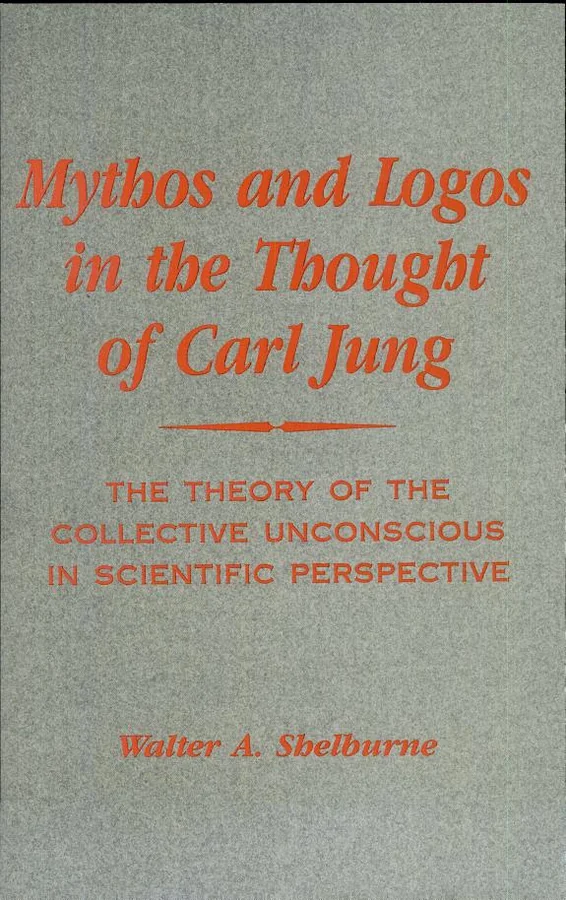
Mythos and Logos in the Thought of Carl Jung
 80
80

Mythos and Logos in the Thought of Carl Jung
Walter A. Shelburne’s "Mythos and Logos in the Thought of Carl Jung" attempts a challenging reconciliation, seeking to bridge the esoteric language of Jungian archetypes with the empirical demands of scientific reason. Shelburne’s strength lies in his systematic dissection of Jung’s core tenets, particularly the collective unconscious, and his earnest effort to present them as intellectually defensible. The book commendably tackles the critical views that have long questioned the scientific import of Jung’s thesis. However, in its pursuit of logical clarity, the work occasionally risks oversimplifying the profoundly mysterious nature of the psyche that Jung himself so carefully navigated. A particularly resonant section examines the clash between Jung's archetypal psychology and James Hillman's later emphasis on the imaginal, highlighting the evolving landscape of depth psychology. While valuable for its intellectual rigor, it may leave those seeking the visceral, numinous experience of myth feeling somewhat detached. Ultimately, Shelburne provides a solid philosophical scaffolding for Jungian thought, though perhaps not its soul.
📝 Description
80
Walter A. Shelburne's 1988 book examines the compatibility of Jung's collective unconscious with a scientific worldview.
Walter A. Shelburne's "Mythos and Logos in the Thought of Carl Jung," published in 1988, offers a detailed academic analysis of Carl Jung's psychological theories. Shelburne addresses the perceived gap between Jung's core ideas, such as the collective unconscious and archetypes, and standard scientific perspectives. The book's objective is to show how these concepts can be understood within a rational, empirical framework, providing a consistent interpretation of Jung's broad intellectual contributions.
This work is aimed at academics, graduate students, and serious researchers in psychology, philosophy, and religious studies who study the fundamental texts of analytical psychology. It is especially useful for those contemplating the philosophical consequences of Jung's theories and trying to align their symbolic aspects with scientific epistemology. Individuals interested in the evolution of psychological thought and the ongoing discussion between myth and reason will find this book valuable. It situates Jung's ideas within 20th-century intellectual currents, contrasting his approach with figures like James Hillman.
Emerging in 1988, this book engaged with Jungian psychology at a time when it was gaining academic traction but still faced skepticism from more rigid scientific viewpoints. Shelburne's study directly confronts the critiques regarding the scientific validity of Jung's theories. By situating Jung's concepts within the broader intellectual currents of the 20th century, the work highlights the persistent tension between empirical science and the symbolic, often mythic, dimensions of the human psyche, a core concern within esoteric philosophical traditions.
💡 Why Read This Book?
• Learn how Carl Jung's concept of the collective unconscious can be defended against scientific critique, as detailed in Shelburne's 1988 analysis, offering a new perspective on psychological rationality. • Understand the philosophical implications of Jung's archetypes by examining their critical reception and Shelburne's arguments for their empirical relevance. • Gain clarity on the divergence between Jung's archetypal psychology and James Hillman's imaginal psychology, as presented in the comparative sections of the book.
⭐ Reader Reviews
Honest opinions from readers who have explored this book.
❓ Frequently Asked Questions
What is the main argument of "Mythos and Logos in the Thought of Carl Jung"?
The book argues that Carl Jung's concept of the collective unconscious and archetypes can be reconciled with a scientific worldview, presenting a rational defense of these psychological theories.
Who was James Hillman in relation to Carl Jung?
James Hillman was a prominent figure in post-Jungian psychology, initially a student of Jung. His work, particularly his 'imaginal psychology,' offered a significant departure from and critique of Jung's archetypal theories, which Shelburne discusses.
When was Walter A. Shelburne's book first published?
"Mythos and Logos in the Thought of Carl Jung" was first published on July 8, 1988.
Does the book discuss Jung's archetypes?
Yes, the book extensively examines Jung's theory of archetypes, considering critical views on their scientific significance and exploring their rational interpretation.
What is the 'collective unconscious' according to Jung and Shelburne?
The collective unconscious, as explored by Shelburne, refers to a hypothesized inherited layer of the unconscious mind, shared by all humans, containing universal patterns or archetypes.
Is this book suitable for beginners in psychology?
While it explores foundational Jungian concepts, the book is written for a more academic audience, suitable for those familiar with psychological theory and philosophical inquiry.
🔮 Key Themes & Symbolism
Archetypes and Scientific Inquiry
Shelburne tackles the challenge of presenting Jung's archetypes, such as the Anima/Animus or the Shadow, as concepts amenable to scientific scrutiny. The work dissects the critical viewpoints questioning their empirical validity, arguing for a framework where these psychic structures can be understood rationally without diminishing their symbolic power. It explores how the universality of archetypes, a core part of Jung's theory, can be seen not as mystical pronouncements but as inherent patterns of human psychological organization.
Mythos vs. Logos: A Synthesis
The core of the book lies in its attempt to harmonize the 'mythos' (mythological narrative and symbolic experience) with 'logos' (rational discourse and scientific understanding). Shelburne examines how Jung's engagement with mythology and religion, often seen as antithetical to scientific thought, can actually inform and enrich a logical understanding of the psyche. The work investigates the tension and potential synergy between these two modes of human expression and cognition.
The Collective Unconscious Defended
Shelburne's thesis strongly defends the concept of the collective unconscious against common criticisms. He aims to demonstrate that this profound idea, central to Jung's analytical psychology, is not merely speculative but can be integrated into a broader, scientifically informed perspective on human consciousness and its shared psychic inheritance. The book provides a detailed examination of the intellectual landscape surrounding this controversial yet influential concept.
Jungian Thought vs. Post-Jungian Developments
A significant aspect of the book involves contrasting Carl Jung's original formulations with later interpretations, notably the work of James Hillman. Shelburne uses this comparison to illuminate the evolving nature of depth psychology and the different ways scholars approach the interpretation of psychic phenomena. This dialogue highlights the ongoing scholarly debate and the diverse philosophical underpinnings within the broader Jungian tradition.
💬 Memorable Quotes
Direct passages from the work, attributed to the author.
“The idea of the collective unconscious can be reconciled with a scientific world outlook.”
— This expresses Shelburne's central objective: to bridge the perceived gap between Jung's mystical-sounding theories and the empirical standards of science, suggesting a rational basis for Jung's most radical concept.
“Examination of Jung’s archetypes considers the chief critical views of the scientific import of Jung’s thesis.”
— This highlights the book's critical engagement with the scientific community's skepticism towards Jungian archetypes, indicating a focus on addressing and refuting these objections head-on.
“Discussion of how the ideas of James Hillman contrast with those of Jung.”
— This points to a comparative analysis within the book, showing how later developments in Jungian thought, particularly Hillman's imaginal psychology, diverge from Jung's original framework.
“The issue of rationality posed by the theory of the collective unconscious.”
— This phrase signifies the book's deep dive into the philosophical challenges Jung's theories present to traditional notions of rationality and scientific proof.
“Shelburne sketches a big picture from Jung’s psychological viewpoint.”
— This suggests the book offers a comprehensive overview and interpretation of Jung's entire psychological system, rather than focusing on isolated concepts.
🌙 Esoteric Significance
Tradition
While not strictly adhering to a single esoteric lineage, Shelburne's work engages with the psychological underpinnings of Western esotericism, particularly as articulated by Carl Jung. Jung himself drew heavily from Gnostic, Hermetic, and alchemical traditions. Shelburne's analysis fits within a broader movement to understand these esoteric symbolic systems through the lens of depth psychology, attempting to find their rational and universal psychological correlates rather than purely mystical interpretations.
Symbolism
The book implicitly engages with the symbolism of archetypes, which are universal psychic patterns. Concepts like the 'Shadow' or the 'Anima/Animus' function as potent symbols within Jung's framework, representing fundamental aspects of the human psyche. Shelburne's work seeks to explain these symbols by exploring their rational structure and potential scientific import, treating them as psychological operators rather than purely mystical entities.
Modern Relevance
Shelburne's efforts to bridge psychology and philosophy remain relevant for contemporary thinkers exploring consciousness studies, transpersonal psychology, and the philosophy of mind. His work provides a foundational text for those seeking to understand the intellectual history behind integrating symbolic and mythological thought with empirical inquiry, influencing scholars and practitioners who continue to grapple with Jung's legacy in a secular, scientific age.
👥 Who Should Read This Book
• Academic researchers in psychology and philosophy of religion seeking to understand the intellectual history of Jungian thought and its critical reception. • Graduate students grappling with the theoretical challenges of analytical psychology and its compatibility with scientific epistemology. • Individuals interested in comparative studies of mythology and psychology, particularly those who wish to explore the rational underpinnings of symbolic systems.
📜 Historical Context
Published in 1988, Walter A. Shelburne's "Mythos and Logos in the Thought of Carl Jung" emerged during a period of robust academic engagement with Jungian psychology, yet also significant skepticism from hard science proponents. The late 20th century saw a growing interest in the humanities' interpretation of psychology, contrasting with the dominant behaviorist or cognitive paradigms. Shelburne's work directly addressed the critical reception of Jung's theories, particularly concerning their scientific merit, engaging with critiques prevalent in philosophical and psychological discourse. Key contemporaries like Hillman were already forging distinct paths within post-Jungian thought, making Shelburne's attempt to synthesize Jung with rationality particularly timely. The book's focus on reconciling myth and reason places it within the broader intellectual current of the era, seeking to validate subjective experience through objective analysis.
📔 Journal Prompts
The reconciliation of mythos and logos in Jung's collective unconscious.
Archetypes as scientific concepts: evaluating Shelburne's defense.
The philosophical implications of Jung's rationality versus Hillman's imaginal approach.
Personal resonance with the concept of a shared, inherited psychic structure.
How can archetypal symbols be understood through both subjective experience and objective analysis?
🗂️ Glossary
Collective Unconscious
A theoretical concept introduced by Carl Jung, positing a layer of the unconscious mind shared by all humanity, containing inherited psychic predispositions and archetypes.
Archetypes
Universal, archaic patterns and images that derive from the collective unconscious and are the psychic counterpart of the instinct. Examples include the Mother, the Hero, and the Trickster.
Logos
In philosophy and psychology, particularly Jungian thought, 'logos' refers to reason, logic, discourse, and the principle of order and intellect.
Mythos
In contrast to logos, 'mythos' refers to narrative, myth, story, and the area of symbolic experience and imagination.
Scientific World Outlook
A perspective grounded in empirical evidence, logical reasoning, and the principles of natural science, often characterized by a skeptical approach to supernatural or purely subjective claims.
Imaginal Psychology
A school of thought, notably advanced by James Hillman, that emphasizes the primacy of the image and the 'imaginal realm' as the basis for psychological experience, often diverging from Jung's archetypal focus.
Analytical Psychology
The school of psychology founded by Carl Jung, focusing on the integration of consciousness and unconscious, the study of archetypes, and the process of individuation.
This book appears in 1 collection
🔮 Readers Also Liked
Browse all →









From the “Collective Unconscious” Collection
View all →




More Free Occult Philosophy Books
View all →