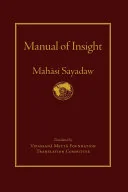
Manual of Insight
 79
79

Manual of Insight
Mahasi Sayadaw's "Manual of Insight" arrives in English translation as a monumental testament to the practical application of Vipassanā. Its strength lies in its sheer comprehensiveness; it leaves no stone unturned in detailing the mechanics of insight meditation, from the most basic ethical considerations to the subtle discernment of mental states. The meticulous step-by-step guidance, particularly in the sections detailing the practice of noting phenomena, offers a clear blueprint for practitioners. However, the sheer volume and systematic nature can, at times, feel somewhat clinical, potentially overwhelming for absolute beginners who might benefit from a gentler introduction. A passage describing the subtle arising and passing of mental objects, while technically precise, highlights this characteristic density. For those committed to a rigorous, analytical approach to meditation, this work is indispensable, offering a detailed map of the contemplative terrain.
This manual is an essential, if demanding, resource for serious Vipassanā practitioners.
📝 Description
79
First published in English in 2016, Manual of Insight details Mahasi Sayadaw's approach to Vipassanā meditation.
This book presents the complete teachings on Vipassanā meditation as articulated by Mahasi Sayadaw. It acts as a guide to cultivating insight meditation, detailing the theory and practice of observing reality to realize impermanence, suffering, and non-self. The text covers ethical conduct, concentration, and wisdom development through mindful awareness.
It is intended for dedicated practitioners of Buddhist meditation, especially those in the Mahasi lineage. Individuals with prior meditation experience seeking a systematic approach to deepen their practice will find it useful. Scholars of Buddhism, comparative religion, and contemplative traditions can use it to study a significant modern Buddhist movement. The book requires a serious commitment from the reader.
Mahasi Sayadaw (1904-1982) was a key figure in the 20th-century "vipassana movement." His method emphasized systematic noting of physical and mental phenomena. This English translation makes his main work available to a wider audience, contributing to the global spread of Theravada Buddhist practices.
Mahasi Sayadaw's approach to Vipassanā meditation is situated within the modern revival of Theravada Buddhist contemplative practices. His method, emphasizing direct observation and systematic noting of experience, aimed to make the path to insight accessible to lay practitioners. This contrasts with some earlier, more monastic traditions. The "vipassana movement" he helped lead democratized access to core Buddhist teachings on suffering and liberation, making them relevant to a global audience.
💡 Why Read This Book?
• Learn the precise, systematic method of Vipassanā meditation as taught by Mahasi Sayadaw, focusing on the Four Foundations of Mindfulness, to gain a direct understanding of reality. • Understand the historical development of the "vipassana movement" starting in the mid-20th century, contextualizing this influential approach to Buddhist practice. • Gain practical instruction on observing impermanence, suffering, and non-self through detailed guidance on noting phenomena, offering a path to mental purification.
⭐ Reader Reviews
Honest opinions from readers who have explored this book.
❓ Frequently Asked Questions
What is the "vipassana movement" mentioned in relation to Manual of Insight?
The "vipassana movement" refers to the widespread popularization and teaching of insight meditation, particularly Vipassanā, during the 20th century. Mahasi Sayadaw was a key figure in this movement, making the practice accessible globally.
When was Manual of Insight first published in English?
The English translation of Manual of Insight was first published on May 17, 2016, making this significant text available to a broader international audience.
What are the Four Foundations of Mindfulness discussed in the book?
The Four Foundations of Mindfulness are the body, feelings, mind, and mental objects. The manual details how to systematically observe each of these as a core practice of Vipassanā.
Is this book suitable for beginners in meditation?
While comprehensive, the book's systematic and detailed nature is best suited for those with some prior meditation experience or a strong commitment to rigorous practice.
Who was Mahasi Sayadaw?
Mahasi Sayadaw (1904-1982) was a prominent Burmese Buddhist monk and meditation teacher, widely recognized as a principal architect of the modern Vipassanā meditation movement.
What is the primary goal of Vipassanā meditation as presented in this manual?
The primary goal is the direct realization of the three characteristics of existence: impermanence (anicca), suffering (dukkha), and non-self (anatta), leading to liberation from suffering.
🔮 Key Themes & Symbolism
Systematic Observation
The manual emphasizes a rigorous, moment-to-moment observation of all physical and mental phenomena. This systematic approach, central to Mahasi Sayadaw's teaching, involves 'noting' experiences as they arise and pass. The goal is to penetrate the conventional understanding of reality and directly perceive its ultimate nature, including impermanence and non-self. This method provides a clear, albeit demanding, framework for dissecting subjective experience.
The Three Characteristics
A central to the practice is the direct experiential realization of anicca (impermanence), dukkha (suffering/unsatisfactoriness), and anatta (non-self). The manual guides practitioners to see these qualities not as abstract doctrines but as observable facts within their own experience. This insight is presented as the key to transcending clinging and aversion, thereby leading to the cessation of suffering.
Ethical Foundation
The text underscores the critical role of ethical conduct (sila) as the indispensable foundation for effective meditation practice. Adherence to precepts cultivates a stable and clear mind, essential for developing concentration (samadhi) and penetrating wisdom (panna). Without a strong ethical base, the deeper insights Vipassanā aims to foster cannot be reliably attained or sustained.
Concentration and Wisdom
Manual of Insight outlines a progressive path where concentration, cultivated through mindful awareness, supports the development of wisdom. As the mind becomes more settled and focused, it gains the clarity needed to discern the true nature of phenomena. This interplay between samadhi and panna is depicted as the engine driving the meditative process towards liberation.
💬 Memorable Quotes
Direct passages from the work, attributed to the author.
“The observation of the arising and passing away of all phenomena, whether physical or mental.”
— This captures the core practice of Vipassanā as taught here: a continuous, direct witnessing of reality's transient nature, aiming to dismantle ingrained illusions about self and permanence.
“Ethical conduct is the essential ground for mental development.”
— This highlights the foundational importance of morality (sila) in the path of meditation, asserting that a clear conscience and disciplined behavior are prerequisites for achieving deep concentration and insight.
“One must see impermanence directly, not merely understand it intellectually.”
— This emphasizes the experiential, rather than theoretical, nature of the insights gained through Vipassanā, stressing direct perception over conceptual knowledge.
“The arising and passing of mental states must be observed without judgment or reaction.”
— This points to the practice of equanimity, a crucial element in observing the mind's fluctuations without becoming entangled in them, fostering detachment.
“Vipassanā leads to the eradication of defilements.”
— This states the ultimate aim of the practice: the purification of the mind by cutting through the root causes of suffering, such as greed, hatred, and delusion.
🌙 Esoteric Significance
Tradition
While rooted in the Theravada Buddhist tradition, Mahasi Sayadaw's methodology can be viewed through an esoteric lens due to its emphasis on direct, transformative experiential knowledge over dogma. The pursuit of liberation (nirvana) via meticulous self-observation and the dissection of phenomenal reality aligns with esoteric aims of inner alchemy and gnosis, seeking ultimate truth through internal exploration rather than external adherence.
Symbolism
The core 'symbolism' lies not in external icons but in the phenomena themselves, interpreted through the lens of the Three Characteristics. Impermanence (anicca) symbolizes the illusory nature of all conditioned existence, suffering (dukkha) highlights the inherent dissatisfaction of clinging, and non-self (anatta) points to the absence of a permanent, independent ego. The practice of 'noting' acts as a symbolic deconstruction of perceived reality.
Modern Relevance
Mahasi Sayadaw's approach continues to be highly relevant in contemporary mindfulness movements and secularized meditation practices, often stripped of their explicit Buddhist philosophical context. Thinkers and practitioners in fields ranging from clinical psychology (e.g., MBCT) to consciousness studies draw upon the principles of systematic observation and non-judgmental awareness he championed, demonstrating the enduring applicability of his techniques.
👥 Who Should Read This Book
• Dedicated practitioners of Buddhist meditation seeking a systematic and detailed guide to Vipassanā, particularly those interested in the Mahasi lineage. • Scholars of comparative religion and Buddhist philosophy looking to understand a key 20th-century development in meditation practice and its theoretical underpinnings. • Individuals committed to intensive self-inquiry and the direct investigation of consciousness, aiming for profound personal transformation through disciplined awareness.
📜 Historical Context
Mahasi Sayadaw's teachings emerged during a period of significant resurgence and global dissemination of Theravada Buddhist meditation practices in the mid-to-late 20th century. Following the independence of Burma (Myanmar) in 1948, there was a national emphasis on reviving Buddhist traditions. Mahasi Sayadaw (1904-1982), based in Yangon, developed a highly systematic and accessible method of Vipassanā meditation that appealed to both lay practitioners and monastics. His approach, often characterized by the continuous 'noting' of sensory and mental experiences, gained international recognition through the efforts of Western students and the establishment of meditation centers. This method became a dominant form of Vipassanā teaching, influencing numerous teachers and schools worldwide, sometimes in contrast to earlier, more complex or esoteric practices. The translation of his comprehensive "Manual of Insight" into English decades after his passing solidifies its position as a foundational text for the global "vipassana movement."
📔 Journal Prompts
The observation of physical sensations as impermanent phenomena.
Noting the arising and passing of mental objects without reaction.
The ethical foundation required for deep concentration.
Directly perceiving non-self in moment-to-moment experience.
The distinction between intellectual understanding and direct insight into suffering.
🗂️ Glossary
Vipassanā
Insight meditation, a core practice in Buddhism aimed at developing wisdom through direct observation of reality.
Mahasi Sayadaw
A highly influential Burmese Buddhist monk (1904-1982) renowned for popularizing a systematic approach to Vipassanā meditation.
Anicca
The Pali term for impermanence, one of the three basic characteristics of existence.
Dukkha
The Pali term for suffering, unsatisfactoriness, or stress, another fundamental characteristic of existence.
Anatta
The Pali term for non-self or no-soul, signifying the absence of a permanent, independent self.
Sila
Ethical conduct or morality, considered a foundational aspect of the Buddhist path.
Samadhi
Concentration or mental absorption, achieved through meditative practice.
Panna
Wisdom or insight, particularly the direct understanding of the true nature of reality.
This book appears in 1 collection
🔮 Readers Also Liked
Browse all →









From the “Vipassana” Collection
View all →





More Free Occult Philosophy Books
View all →