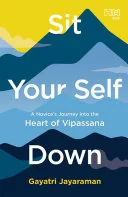
Sit Your Self Down
 81
81

Sit Your Self Down
Gayatri Jayaraman’s account of her Vipassana retreat in the Himalayas offers a refreshingly candid look at the rigors of silent introspection. While many narratives sanitize the discomfort of confronting one's own psyche, Jayaraman embraces the awkwardness and the unexpected emotional debris that surfaces. The humor with which she navigates the initial days, before the full weight of silence descends, is particularly effective. A notable strength lies in her ability to translate the subtle internal shifts into relatable prose. However, the book occasionally struggles to articulate the deeper philosophical underpinnings of Vipassana beyond the immediate personal experience, leaving the reader wanting a more robust exploration of the tradition's tenets. The narrative’s power lies in its raw honesty, though it sometimes feels more like a personal diary than a profound exploration of Buddhist philosophy. Ultimately, "Sit Your Self Down" provides an accessible, if occasionally superficial, glimpse into the challenging practice of intensive meditation.
📝 Description
81
Gayatri Jayaraman's 2020 book chronicles a ten-day Vipassana retreat in the Himalayas.
Gayatri Jayaraman's "Sit Your Self Down" documents a rigorous ten-day Vipassana meditation retreat conducted in the Himalayas. The book moves beyond a simple travel account, concentrating instead on Jayaraman's internal process of observing breath and bodily sensations. This inward turn involves a form of mental housecleaning, as prolonged silence and introspection begin to surface previously unnoticed emotional responses.
The narrative details the challenges and eventual shifts experienced during intensive silent practice. It provides a firsthand look at how sustained attention to the present moment can unravel ingrained thought patterns and bring about a clearer understanding of one's own mental habits. The book is suited for those interested in the practical application of Buddhist meditation techniques and the personal transformation that can arise from such disciplined self-inquiry.
This work is situated within the contemporary revival of Buddhist meditation, particularly Vipassana, a practice rooted in the Theravada tradition. It reflects a broader global interest in mindfulness and self-exploration that has brought these teachings out of monastic contexts and into wider public awareness. Jayaraman's account engages with core Buddhist concepts like impermanence, suffering, and liberation, framed by the disciplined observation of breath and bodily sensations central to the Vipassana path.
💡 Why Read This Book?
• Gain practical insights into the Vipassana method as described by Gayatri Jayaraman during her 2020 Himalayan retreat, learning techniques for observing breath and body. • Experience a relatable, humorous portrayal of confronting difficult thoughts and emotions during prolonged silence, moving beyond generic self-help advice. • Understand the initial stages of a Vipassana course, specifically the challenges faced by nine other women initiates, offering a unique perspective on shared introspection.
⭐ Reader Reviews
Honest opinions from readers who have explored this book.
❓ Frequently Asked Questions
What is Vipassana meditation as depicted in "Sit Your Self Down"?
Vipassana, as described in the book, is a ten-day silent retreat focused on observing breath and bodily sensations to understand the mind's workings and achieve equanimity.
Where did Gayatri Jayaraman undertake her Vipassana course?
The author attended a ten-day Vipassana course in the Himalayas, as detailed in her 2020 book "Sit Your Self Down."
What does 'spring-clean her mind' mean in the context of the book?
It refers to the process of shedding accumulated mental clutter, negative thought patterns, and unresolved emotions that emerge during the intensive meditation period.
What are the main challenges faced during the retreat?
The primary challenges involve absolute silence, intense introspection, confronting unexpected thoughts and emotions, and maintaining focus on breath and body.
Is this book suitable for absolute beginners to meditation?
Yes, the book offers a narrative perspective on the Vipassana experience, making it accessible for beginners curious about the practice and its effects.
When was "Sit Your Self Down" first published?
Gayatri Jayaraman's "Sit Your Self Down" was first published on August 25, 2020.
🔮 Key Themes & Symbolism
The Practice of Vipassana
The book details the practical application of Vipassana, a technique rooted in Theravada Buddhism, emphasizing moment-to-moment awareness of breath and bodily sensations. Jayaraman illustrates how this focused observation can lead to a 'spring-cleaning' of the mind, revealing the impermanent nature of thoughts and feelings. The narrative highlights the discipline required to maintain equanimity amidst internal turbulence, a core tenet of Buddhist psychology.
Confronting the Inner Landscape
Jayaraman's journey into the Himalayas becomes a metaphor for descending into her own psyche. The silence of the retreat amplifies internal dialogues, bringing subconscious patterns and unresolved emotions to the surface. The book captures the often-uncomfortable process of facing these aspects of the self without distraction, a crucial step in self-understanding and potential liberation from mental conditioning.
The Role of Silence and Introspection
Absolute silence is presented not as an absence, but as a potent catalyst for introspection. "Sit Your Self Down" demonstrates how removing external stimuli forces an individual to confront their internal world more directly. This enforced quietude allows for deeper self-inquiry, leading to unexpected revelations and a profound re-evaluation of one's mental habits and emotional responses.
Transformation Through Discipline
The ten-day Vipassana course serves as a crucible for personal transformation. Jayaraman's account underscores that significant inner change is not passive but requires sustained effort and adherence to a structured discipline. The book illustrates how the rigorous practice, despite its challenges, can lead to a fundamental shift in perspective and a more grounded sense of being.
💬 Memorable Quotes
Direct passages from the work, attributed to the author.
“Sharing the rarefied air with nine other women initiates, she begins her journey inward.”
— This highlights the communal yet intensely personal nature of the retreat, setting the stage for individual exploration within a shared, isolated environment.
“She begins her journey inward, learning to focus on her breath and body, and spring-clean her mind.”
— This expresses the core practice of Vipassana as presented in the book: using physical awareness as a tool for mental purification and clarity.
“With good humour and an open mind, she seeks to simply observe her thoughts”
— This points to Jayaraman's initial, perhaps naive, approach to meditation, emphasizing a light-heartedness that will soon be tested by deeper introspection.
“But as days of absolute silence sink into introspection, what comes tumbling out catches her unawares.”
— This foreshadows the unexpected and potentially overwhelming nature of the insights and emotions that arise when external distractions are removed.
“Tugging at the thre”
— This fragment suggests the unraveling of deeply held beliefs or psychological knots, indicating a process of uncovering foundational issues.
🌙 Esoteric Significance
Tradition
While rooted in the Theravada Buddhist tradition, specifically the Vipassana lineage popularized by S.N. Goenka, "Sit Your Self Down" engages with esoteric principles through its focus on subjective experience and mind-body discipline. It aligns with the broader esoteric quest for liberation from the conditioned self through direct experiential knowledge rather than dogma.
Symbolism
The Himalayas serve as a potent symbol of spiritual ascent and isolation, a place conducive to profound introspection. The breath, a fundamental symbol of life and impermanence, becomes the primary anchor for awareness. The 'spring-cleaning' metaphor suggests a purification ritual, clearing away psychic debris to reveal a more essential, unconditioned self.
Modern Relevance
This work is relevant to contemporary mindfulness practitioners, secular Buddhists, and those interested in somatic psychology and contemplative inquiry. It speaks to modern seekers who, like Jayaraman, are drawn to intensive practices for personal growth and mental clarity, bridging traditional techniques with contemporary psychological needs.
👥 Who Should Read This Book
• Individuals curious about Vipassana meditation, seeking an accessible, personal account of a ten-day silent retreat experience. • Readers interested in the psychological challenges and rewards of intensive introspection and confronting one's own thought patterns. • Those exploring self-help and spiritual growth through practical, experiential methods rather than purely theoretical study.
📜 Historical Context
Published in 2020, "Sit Your Self Down" arrived during a period of heightened global interest in mindfulness and contemplative practices, partly fueled by increased awareness of mental health challenges. This era saw a surge in secularized meditation apps and urban retreats, making the ancient techniques of Vipassana accessible to a broad audience. Jayaraman's work engages with this trend, offering a personal narrative grounded in the discipline of a traditional Himalayan retreat. It contrasts with the more academic or purely secularized approaches prevalent at the time, such as those popularized by figures like Jon Kabat-Zinn with MBSR (Mindfulness-Based Stress Reduction). While not directly engaging in polemics, the book implicitly champions the depth achievable through dedicated, silent practice, distinct from the often-fragmented mindfulness consumed daily. The work reflects a broader cultural moment where individuals actively sought profound inner experiences outside of conventional therapeutic or religious frameworks.
📔 Journal Prompts
The initial 'spring-cleaning' of the mind during the Vipassana course: what mental clutter would you aim to address?
Reflecting on the author's humor amidst silence: how can levity aid intense introspection?
The sensation of breath and body: how can focusing on these anchors shift your perspective?
Observing thoughts without judgment: what patterns emerge when you simply watch them?
The significance of the Himalayan setting: what does isolation reveal about the self?
🗂️ Glossary
Vipassana
A traditional Buddhist meditation technique, meaning 'insight' or 'clear seeing,' focused on observing reality as it is through moment-to-moment awareness of breath and bodily sensations.
Anicca
A core Buddhist concept referring to impermanence, the understanding that all phenomena are in a constant state of flux and change.
Dukkha
Often translated as 'suffering,' 'dissatisfaction,' or 'stress,' referring to the inherent unsatisfactoriness of conditioned existence arising from attachment and aversion.
Equanimity
A state of mental calmness and composure, especially in difficult situations, achieved through balanced awareness and non-reactivity.
Introspection
The examination or observation of one's own mental and emotional processes, often intensified during periods of silence and solitude.
Initiates
In this context, refers to the participants beginning the ten-day Vipassana course, undergoing a process of learning and practice.
Sensation
The physical feelings or perceptions experienced in the body, which Vipassana meditation uses as a primary object of observation.
This book appears in 1 collection
🔮 Readers Also Liked
Browse all →









From the “Vipassana” Collection
View all →






More Free Occult Philosophy Books
View all →