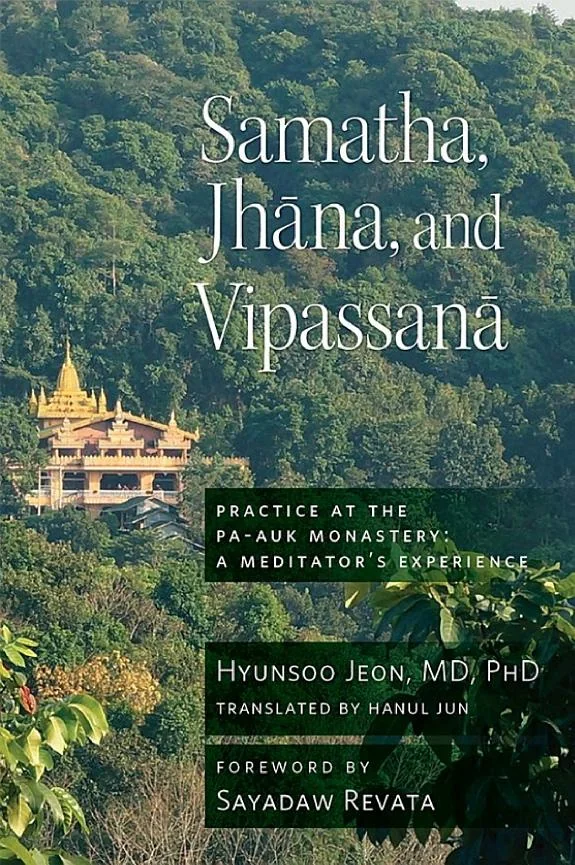
Samatha, Jhana, and Vipassana
 81
81

Samatha, Jhana, and Vipassana
Jeon Hyun-soo's "Samatha, Jhana, and Vipassana" offers a refreshingly direct manual for those seeking to engage with intensive meditation practices. Unlike many texts that offer philosophical overviews, Jeon, a student of the Pa-Auk Monastery, provides a clear, almost clinical, breakdown of the steps involved. The strength lies in its systematic presentation, mirroring the monastic training it describes. One passage detailing the stages of Samatha concentration is particularly effective, providing a tangible roadmap. However, the book occasionally feels overly technical, potentially alienating beginners who might benefit from more introductory context on the underlying Buddhist philosophy. While the author’s background as a psychiatrist is evident in the analytical approach, a touch more warmth or anecdotal illustration could have enhanced reader connection. Nevertheless, for the dedicated practitioner, this handbook delivers a precise guide to a revered meditative path.
📝 Description
81
Hyun-Soo Jeon's 2018 book details the Pa-Auk Monastery's approach to Buddhist meditation.
This text lays out a structured method for Buddhist meditation, closely following the Pa-Auk Monastery tradition. It functions as a practical guide for developing focused attention, known as Samatha, and cultivating insight, Vipassana, through the specific meditative states of Jhana. The book systematically presents complex meditation techniques in clear steps. Its aim is to provide practitioners with the necessary tools for enhancing concentration and achieving deeper self-awareness.
The work is suited for individuals dedicated to serious meditation practice, particularly those interested in the Theravada Buddhist tradition as taught at Pa-Auk Monastery. It will attract meditators looking for a straightforward, organized system to achieve Jhana states and develop Vipassana insight. Readers who favor a methodical, instructional style and have some familiarity with Buddhist philosophy but seek practical application will find it valuable.
Published in 2018, this book is part of a long lineage of Buddhist meditation instruction that saw renewed international interest in the late 20th and early 21st centuries. The Pa-Auk Monastery in Myanmar became a significant center for teaching intensive Samatha and Vipassana practices, drawing students globally. Jeon Hyun-soo's work connects to this contemporary revival of traditional monastic meditation techniques, presenting a modern interpretation accessible to a broader audience.
💡 Why Read This Book?
• Gain a precise, step-by-step methodology for cultivating Samatha concentration, directly applicable to achieving Jhana states, as taught within the Pa-Auk Monastery tradition. • Understand the specific techniques for developing Vipassana insight, moving beyond theoretical concepts to practical application grounded in Jeon Hyun-soo's experience. • Explore the relationship between focused attention and profound insight, as elucidated through the structured progression from initial concentration exercises to deeper understanding.
⭐ Reader Reviews
Honest opinions from readers who have explored this book.
❓ Frequently Asked Questions
What is the primary focus of "Samatha, Jhana, and Vipassana"?
The book's primary focus is providing a clear, step-by-step guide to Buddhist meditation practices, specifically Samatha (concentration), Jhana (absorptive states), and Vipassana (insight), drawing from the Pa-Auk Monastery tradition.
Who is the author, Jeon Hyun-soo?
Jeon Hyun-soo is a practicing psychiatrist and a student of the Pa-Auk Monastery, bringing both clinical and monastic perspectives to his explanation of meditation techniques.
What does 'Jhana' refer to in the context of this book?
Jhana refers to deep states of meditative absorption or concentration that are cultivated through dedicated practice. The book details the progression through these specific states.
Is this book suitable for absolute beginners in meditation?
While comprehensive, the book's systematic and detailed approach is best suited for dedicated practitioners seeking to deepen their existing practice, rather than absolute beginners requiring introductory philosophical context.
When was "Samatha, Jhana, and Vipassana" first published?
The book was first published on August 21, 2018, making it a contemporary handbook on traditional meditation techniques.
What is the significance of the Pa-Auk Monastery connection?
The Pa-Auk Monastery is a renowned center for teaching intensive Theravada Buddhist meditation. Jeon Hyun-soo's affiliation signifies adherence to a specific, well-established lineage and methodology.
🔮 Key Themes & Symbolism
Cultivating Samatha
The book details the foundational practice of Samatha, or calm abiding, which is essential for developing the mental stability required for deeper meditative states. It outlines specific techniques and concentration objects used to quiet the mind, reduce distractions, and foster single-pointedness. This section emphasizes that Samatha is not merely relaxation but an active cultivation of focus, serving as the bedrock upon which Jhana and Vipassana are built.
The Path to Jhana
Central to the text is the exploration of Jhana, the absorptive states of meditation. Jeon Hyun-soo systematically breaks down the progression through these states, detailing the mental factors and qualities that characterize each level of attainment. The book provides practical instructions and criteria for recognizing when one is entering or has entered a Jhana state, presenting them as attainable stages through diligent practice.
Developing Vipassana Insight
Following the cultivation of concentration, the book addresses Vipassana, or insight meditation. It explains how the mental clarity and stability achieved through Samatha and Jhana can be turned towards investigating the nature of reality, particularly the characteristics of impermanence, suffering, and non-self. The emphasis is on direct experiential understanding rather than intellectual comprehension.
The Role of the Teacher
Drawing from the Pa-Auk Monastery tradition, the book implicitly highlights the importance of qualified guidance in meditation. While presented as a handbook, the structured approach and detailed descriptions suggest the value of a teacher's instruction in reading through the subtle stages of Samatha, Jhana, and Vipassana, ensuring correct understanding and practice.
💬 Memorable Quotes
Direct passages from the work, attributed to the author.
“Concentration is the primary tool for investigating the mind.”
— This statement underscores the book's core message: that focused attention is not just about mental calm but is the essential instrument for gaining deeper self-awareness and understanding the workings of consciousness.
“The path moves from stillness to clarity, and then to wisdom.”
— This succinctly captures the progression taught in the book, linking the development of Samatha (stillness) and Jhana (clarity) as prerequisites for the experiential wisdom gained through Vipassana.
“Recognizing the characteristics of phenomena is the heart of insight.”
— This highlights the Vipassana aspect, emphasizing that true insight comes from directly observing and understanding the impermanent, unsatisfactory, and impersonal nature of all experiences.
“Ethical conduct provides the stable ground for meditation.”
— This interpretation points to the foundational importance of morality (sila) in Buddhist practice, suggesting that a clear conscience and disciplined behavior are crucial supports for achieving meditative depth.
“The Jhanas are not an end, but a powerful means.”
— This clarifies the book's perspective on meditative states: while profound, the Jhanas are presented as valuable tools and stages that facilitate the ultimate goal of liberating insight, rather than being the final objective.
🌙 Esoteric Significance
Tradition
This work is firmly situated within the Theravada Buddhist tradition, specifically drawing from the teachings of the Pa-Auk Monastery lineage. While Buddhism is often considered a religion or philosophy, its meditative practices, particularly the attainment of deep absorptive states (Jhana) and insight into ultimate reality (Vipassana), carry profound esoteric dimensions concerning the nature of consciousness and liberation from suffering.
Symbolism
While not overtly symbolic in a Western esoteric sense, the progression through Samatha, Jhana, and Vipassana can be seen as a symbolic journey of the mind. The concentration object in Samatha acts as an anchor, symbolizing focused intent. The Jhana states represent progressively refined levels of consciousness, moving from gross to subtle awareness. Vipassana's focus on the 'three marks of existence' (impermanence, suffering, non-self) symbolizes the dismantling of illusory perceptions of a permanent, independent self.
Modern Relevance
The methods detailed in this book are highly relevant today for practitioners within and outside traditional Buddhist circles seeking structured meditative development. Neuroscientists and psychologists studying attention and consciousness often look to Jhana states as examples of extreme attentional control. Furthermore, contemporary mindfulness-based therapies and contemplative practices often draw, implicitly or explicitly, from the foundational principles of Samatha and Vipassana explored in this text.
👥 Who Should Read This Book
• Dedicated meditators seeking a structured, systematic approach to deepening their practice beyond basic mindfulness, particularly those interested in the Theravada tradition. • Students of the Pa-Auk Monastery's teachings who wish for a written reference to consolidate their understanding of Samatha, Jhana, and Vipassana techniques. • Psychiatrists and psychologists interested in the practical application and potential psychological effects of intensive contemplative practices as described by a peer.
📜 Historical Context
Published in 2018, "Samatha, Jhana, and Vipassana" arrives amidst a global resurgence of interest in traditional Buddhist meditation techniques, particularly those originating from Southeast Asian monastic traditions. The Pa-Auk Monastery in Myanmar, founded by Pa Auk Sayadaw, became a significant international hub for teaching intensive Samatha and Vipassana practices starting in the late 20th century. Jeon Hyun-soo's work directly engages with this lineage, offering a contemporary, accessible manual. This period saw numerous books and retreats focusing on mindfulness (Vipassana) and concentration (Samatha), often presented in secularized forms. However, Jeon's text remains rooted in a specific monastic framework, distinguishing it from broader mindfulness movements and offering a more direct transmission of traditional methods. The work implicitly addresses practitioners seeking rigorous, systematic training aligned with monastic standards, rather than simplified popular adaptations.
📔 Journal Prompts
Reflection on the role of concentration objects in achieving Samatha.
Analysis of the distinguishing factors between the first and second Jhana states.
Personal experience with observing impermanence during Vipassana practice.
How the author's dual background as a psychiatrist and meditator informs the text.
The relationship between ethical conduct (sila) and mental stability for meditation.
🗂️ Glossary
Samatha
A Pali term referring to meditative practice aimed at developing concentration, tranquility, and mental calm (abiding). It is a precursor to insight meditation.
Jhana
Pali term for absorptive states of profound meditative concentration. Typically described in eight progressive levels, representing deep states of mental unification and bliss.
Vipassana
A Pali term meaning 'insight' or 'clear seeing'. It refers to meditative practice focused on developing wisdom into the true nature of reality, often by observing impermanence, suffering, and non-self.
Pa-Auk Monastery
A prominent Buddhist monastery in Myanmar, renowned for its systematic teaching of Samatha and Vipassana meditation according to traditional Theravada methods.
Concentration Object
The specific focus (e.g., breath, color, feeling) used during Samatha meditation to train and stabilize the mind.
Sila
The principle of ethical conduct or morality, considered a fundamental support for developing concentration and wisdom in Buddhist practice.
Three Marks of Existence
The fundamental characteristics of all conditioned phenomena in Buddhist philosophy: impermanence (anicca), suffering or unsatisfactoriness (dukkha), and non-self (anatta).
This book appears in 1 collection
🔮 Readers Also Liked
Browse all →









From the “Vipassana” Collection
View all →





More Free Sacred Texts & Gnosticism Books
View all →