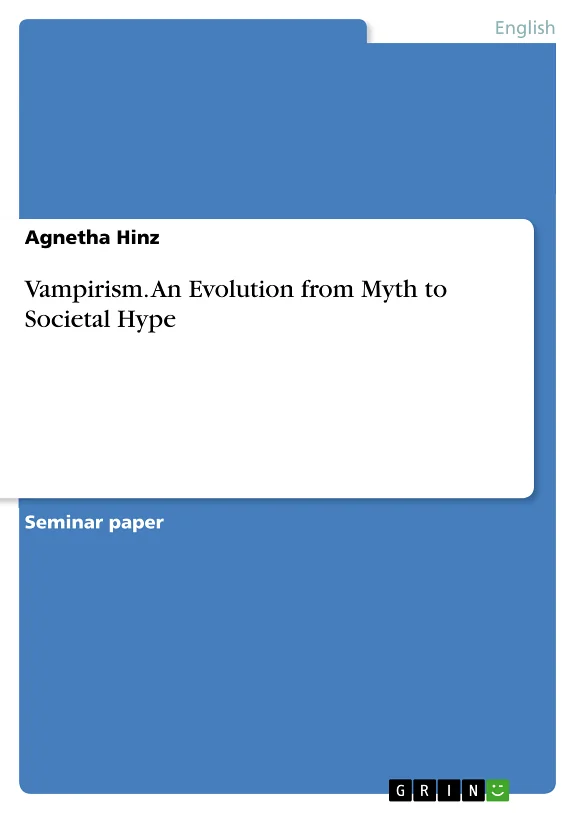
Vampirism. An Evolution from Myth to Societal Hype
 71
71

Vampirism. An Evolution from Myth to Societal Hype
Agnetha Hinz's seminar paper, "Vampirism. An Evolution from Myth to Societal Hype," offers a sharp, academic lens on a figure that has long captivated the public imagination. The strength of this work lies in its precise tracing of the vampire's transformation, particularly its shift from folkloric entity to a complex literary and cinematic icon. Hinz effectively demonstrates how genre evolution, as seen in film, directly impacted the vampire's perceived nature and societal role. A limitation, perhaps inherent to its origins as a seminar paper, is a tendency towards dense academic prose that might deter casual readers. The analysis of the vampire's role in 'Cultural Studies: Life after Death' at the Free University of Berlin provides a particularly insightful anchor, linking the creature to fundamental human anxieties about mortality. It’s a focused study for those who appreciate critical deconstruction of popular myths.
📝 Description
71
Agnetha Hinz's 2013 examination traces the vampire archetype's journey from folklore to modern hype.
Originally a 2013 seminar paper from the Free University of Berlin, Vampirism. An Evolution from Myth to Societal Hype offers a detailed study of the vampire figure. Agnetha Hinz analyzes how this archetype has transformed across history and media, moving beyond simple gothic elements to reveal the socio-cultural anxieties it represents. The book considers the vampire's deep roots in lore, predating modern sensationalism, and follows its path through changing narratives and cultural interpretations.
The work is suited for students of literature, cultural studies, and folklore. It will also interest those curious about how myths adapt to societal shifts and the psychology behind myth making. Readers focused on horror's semiotics and the evolution of mythical creatures will find ample material. Hinz's analysis uses concepts like archetype reinterpretation, genre influence on myth, and the vampire as a reflection of societal fears.
While this work focuses on the evolution of a specific mythical figure, it touches upon broader esoteric concerns regarding death, immortality, and the human fascination with the unknown. The vampire, as a creature existing between life and death, embodies liminality. Hinz's examination of its historical transformations can be seen as a study of how archetypal figures adapt to reflect changing cultural understandings of mortality and the supernatural, a common thread in esoteric thought.
💡 Why Read This Book?
• Gain a structured understanding of the vampire's evolution, from its 2013 academic context at the Free University of Berlin to its enduring cultural presence. • Analyze how cinematic genres, a specific focus of the book, have actively reshaped the vampire archetype across different eras. • Grasp the concept of the vampire as a cultural barometer, reflecting societal anxieties and desires that have changed since the work's original publication.
⭐ Reader Reviews
Honest opinions from readers who have explored this book.
❓ Frequently Asked Questions
When was Vampirism. An Evolution from Myth to Societal Hype first published?
The book, originally a seminar paper, was first published on July 7, 2015. It originated from work done in 2013 at the Free University of Berlin.
What academic institution is associated with this book?
The work originated as a seminar paper from the Free University of Berlin, specifically within the Institut für Englische Philologie, for a course on 'Cultural Studies: Life after Death'.
What is the main focus of Agnetha Hinz's study?
Agnetha Hinz's study focuses on the transformation of the vampire archetype from ancient myth and folklore into its modern manifestations, particularly as influenced by literature and cinema.
Does the book discuss the vampire in different literary genres?
Yes, the book explicitly notes that changes in the vampire's image are evident when considering different genres, particularly in cinematic appearances, which is a key aspect of its evolution.
What grade did the original seminar paper receive?
The original seminar paper, upon which this book is based, received a grade of 1,7 in Germany, indicating a strong academic performance.
What broader subject area does this work fall under?
The work falls under English Language and Literature Studies, with a specific focus on Cultural Studies and the theme of 'Life after Death'.
🔮 Key Themes & Symbolism
Archetypal Metamorphosis
The central theme is the dynamic transformation of the vampire archetype. Hinz tracks how this figure, rooted in ancient fears and folklore, has been continuously reinterpreted. From the monstrous undead of early tales to the complex, often romanticized figures in modern media, the book details how societal values and narrative trends dictate the vampire’s evolving form. This metamorphosis is not random but reflects deeper cultural anxieties and desires regarding mortality, transgression, and the 'other'.
Societal Reflection
Vampirism. An Evolution from Myth to Societal Hype posits the vampire as a powerful cultural mirror. As the work illustrates, changes in the vampire's depiction across different genres, particularly cinema, directly correlate with shifts in societal consciousness. The creature becomes a canvas onto which fears of contagion, foreignness, and existential dread, as well as fascinations with immortality and forbidden desire, are projected and re-examined over time.
Genre Influence
A significant aspect of Hinz's analysis is the lasting impact of genre conventions on the vampire myth. The book highlights how specific literary and cinematic categories—from gothic horror to supernatural romance—have dictated the parameters of vampire representation. The evolution from a purely terrifying entity to a many-sided character demonstrates how narrative frameworks shape our understanding and perception of even the most enduring mythical figures.
The 'Life after Death' Nexus
Originating from a course on 'Life after Death,' the work implicitly engages with humanity's perennial fascination with mortality and the afterlife. The vampire, as an undead entity, occupies a liminal space between life and death, embodying both the fear of oblivion and the allure of eternal existence. Hinz’s examination thus touches upon the psychological and philosophical underpinnings of the myth’s persistence.
💬 Memorable Quotes
Direct passages from the work, attributed to the author.
“The image of the vampire underwent a massive change.”
— This statement captures the core thesis: the vampire is not a static icon but a fluid symbol whose appearance and meaning are continually reshaped by cultural and artistic forces.
“Simply regarding the different genres in which the cinematic vampire appears it becomes clear that those changes are primarily bas[ed on genre].”
— This highlights the direct correlation between narrative framing (genre) and the evolution of the vampire's characteristics and societal role, particularly in film.
“Vampires – Ever since, they exist in human belief.”
— This emphasizes the deep historical and psychological roots of the vampire concept, suggesting its enduring presence stems from fundamental aspects of human consciousness and storytelling.
“Seminar paper from the year 2013 in the subject English Language and Literature Studies - Literature, grade: 1,7, Free University of Berlin (Institut für Englische Philologie), course: Cultural Studies: Life after Death”
— This factual citation grounds the work in specific academic origins, indicating a rigorous scholarly foundation and intellectual context focused on the cultural implications of mortality.
“language: English, abstract: Vampires”
— This indicates the book's primary language and the starting point of its abstract—the pervasive nature of vampire beliefs across cultures and time.
🌙 Esoteric Significance
Tradition
While not explicitly framed within a specific esoteric lineage like Hermeticism or Gnosticism, the work touches upon themes resonant with esoteric thought. The vampire’s existence outside the natural cycle of life and death, its potential for immortality, and its connection to primal energies can be seen as a folkloric manifestation of concepts explored in traditions concerned with transcendence, anima, and the shadow self. The study's origin within a 'Life after Death' course also links it to spiritualist and occult inquiries into post-mortem existence.
Symbolism
The vampire serves as a potent symbol of repressed desires, forbidden knowledge, and the transgression of natural laws—themes often explored in esoteric traditions. Its nocturnal nature symbolizes the unconscious or hidden aspects of the psyche, while its blood-drinking can represent the parasitic consumption of vital energy or the dangerous pursuit of forbidden power. The archetype embodies the seductive allure and inherent peril of confronting the shadow or seeking immortality outside conventional spiritual paths.
Modern Relevance
Contemporary thinkers and practitioners in fields ranging from critical theory to modern occultism continue to draw on the vampire archetype. Its mutable nature allows it to be reinterpreted in relation to power dynamics, systemic exploitation (economic vampires), and identity politics. Subcultures and artistic movements exploring themes of otherness, immortality, and the darker aspects of human nature often reference or embody vampiric imagery, demonstrating the archetype's persistent relevance in understanding contemporary anxieties and desires.
👥 Who Should Read This Book
• Students of Comparative Literature and Cultural Studies seeking an academic framework for analyzing mythical figures. • Film scholars interested in the evolution of horror and supernatural genres and their impact on iconic characters. • Enthusiasts of folklore and mythology looking to understand how ancient legends adapt and reflect contemporary societal concerns.
📜 Historical Context
Agnetha Hinz's work emerges from the academic milieu of 2013, specifically the Free University of Berlin's Institut für Englische Philologie. Its origins as a seminar paper for a 'Cultural Studies: Life after Death' course place it within intellectual currents exploring mortality, belief systems, and the enduring power of myth. This period saw continued academic engagement with popular culture and the semiotics of horror, building upon foundations laid by scholars like Julia Kristeva and her work on the abject. While not a direct contemporary, the shadow of Bram Stoker's 1897 novel "Dracula" looms large, representing a foundational text for the modern vampire. Hinz's paper contributes to ongoing discourse by focusing on the *evolution* of the image, particularly as mediated by filmic genres, offering a specific lens that complements broader folkloric or psychoanalytic studies.
📔 Journal Prompts
The vampire's transformation across genres.
Reflect on the societal anxieties mirrored by the vampire figure.
Analyze the transition from myth to societal hype for the vampire.
Consider the 'Life after Death' context of the vampire archetype.
Examine the cinematic evolution of the vampire as discussed in the text.
🗂️ Glossary
Archetype
A recurring symbol, character type, or motif in literature, art, or mythology that represents universal patterns of human nature and experience.
Folklore
The traditions, customs, and beliefs of a community passed down through generations, often in the form of stories, legends, and rituals.
Myth
A traditional story, especially one concerning the early history of a people or explaining some natural or social phenomenon, and typically involving supernatural beings or events.
Societal Hype
Widespread public excitement, interest, or discussion surrounding a particular phenomenon, often amplified by media and cultural trends.
Genre
A category of artistic composition, as in music or literature, characterized by similarities in form, style, or subject matter.
Liminal State
A transitional or intermediate state or phase, often associated with being on the threshold between two different conditions, such as life and death.
Semiotics
The study of signs and symbols and their interpretation, particularly their meaning and use in communication.
This book appears in 1 collection
🔮 Readers Also Liked
Browse all →








From the “Vampirism” Collection
View all →






More Free Occult Philosophy Books
View all →