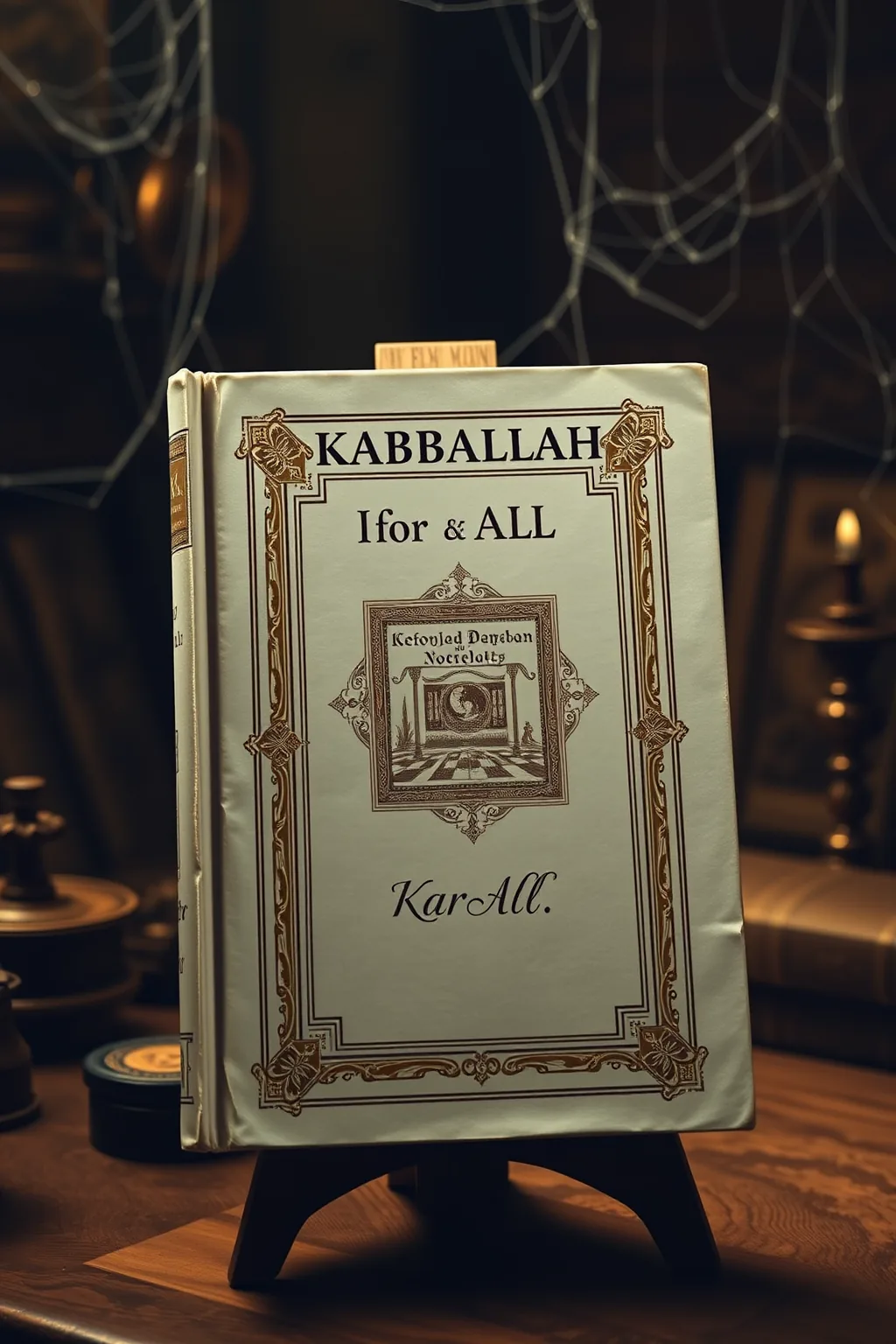
Kabbalah for All
 61
61

Kabbalah for All



Silas Hawthorne, Hermetic Studies Editor, writes: Cengizhan Kaptan's 'Kabbalah for All' is a welcome addition to the esoteric canon, offering a lucid and comprehensive exploration of this profound mystical tradition. Kaptan navigates the complex symbolism of the Kabbalah with remarkable clarity, demystifying concepts such as the Sefirot and the Tree of Life for a modern audience. His approach is both scholarly and spiritually resonant, making the esoteric accessible without sacrificing depth. This work is particularly valuable for those seeking a grounded yet expansive understanding of Jewish mysticism, providing essential insights for both the novice and the seasoned practitioner. It stands as a testament to the enduring power of Kabbalistic thought to offer guidance and illumination.
📝 Description
61
Cengizhan Kaptan's 'Kabbalah for All' appeared around 2023, aiming to demystify Jewish mysticism.
Cengizhan Kaptan's 'Kabbalah for All' presents the mystical and esoteric aspects of Jewish tradition. The book examines Kabbalistic symbolism, including the Tree of Life and divine emanations, discussing their philosophical weight and potential use. It encourages a thoughtful approach to understanding the universe's structure and humanity's role within it.
This work aims to be more than a simple introduction. It guides readers toward a deeper personal grasp of mystical concepts. The book seeks to connect individuals with the subtle forces influencing reality. It provides a way to access ancient teachings that is understandable while still aiming for personal transformation and spiritual insight.
This book engages with Kabbalah, a Jewish mystical tradition that developed in the Middle Ages. Kabbalistic thought seeks to understand the divine nature, the creation of the universe, and the relationship between God and humanity through symbolic interpretation of scripture and mystical contemplation. It often employs a complex system of correspondences, numerology, and cosmology, with the Tree of Life serving as a central diagram for mapping spiritual realms and divine energies. 'Kabbalah for All' appears to interpret these elements for a broader audience.
💡 Why Read This Book?
Unravel the ancient secrets of Jewish mysticism and discover the profound symbolism of the Tree of Life. 'Kabbalah for All' offers an accessible yet deep dive into esoteric knowledge, perfect for spiritual seekers, students of comparative religion, and practitioners of contemplative arts. If you yearn to understand the hidden architecture of reality and your connection to the divine, this book is your essential guide.
⭐ Reader Reviews
Honest opinions from readers who have explored this book.
❓ Frequently Asked Questions
What is the primary focus of 'Kabbalah for All'?
The book focuses on unveiling the core mystical and esoteric principles of Kabbalah, emphasizing its rich symbolism and philosophical underpinnings. It aims to make these ancient teachings accessible to a broad audience.
Is this book suitable for beginners with no prior knowledge of Kabbalah?
Absolutely. Cengizhan Kaptan has meticulously crafted 'Kabbalah for All' to serve as an introductory yet comprehensive guide, explaining complex concepts in an understandable manner for those new to the subject.
What are the main symbolic elements discussed?
The book delves into key Kabbalistic symbols, notably the Tree of Life (Etz Chaim), the ten Sefirot (divine emanations), and the Hebrew alphabet's mystical significance.
Does the book offer practical applications of Kabbalistic teachings?
Yes, while focusing on understanding, 'Kabbalah for All' suggests contemplative practices and ways to integrate Kabbalistic insights into personal spiritual growth and understanding of the cosmos.
Who is the intended audience for this book?
The intended audience includes spiritual seekers, students of mysticism, those interested in Jewish history and philosophy, and anyone eager to explore the deeper layers of existence through an ancient esoteric lens.
🔮 Key Themes & Symbolism
The Tree of Life: A Cosmic Blueprint
The Tree of Life, or Etz Chaim, is presented as the central symbolic map of creation and consciousness within Kabbalah. This theme explores its ten Sefirot, the divine emanations that form the structure of existence, and the pathways connecting them. Kaptan elucidates how this intricate diagram serves as a blueprint for understanding the divine, the human soul, and the intricate interplay between the spiritual and material realms. The text highlights its use as a tool for meditation, self-discovery, and reading through the ascent of consciousness towards the divine source.
Divine Emanations and the Nature of Reality
This theme looks at the concept of the Sefirot, the ten attributes or emanations through which the Ein Sof (the Infinite, Unknowable God) reveals itself and creates the universe. 'Kabbalah for All' meticulously unpacks the distinct qualities of each Sefirah, from Keter (Crown) to Malkuth (Kingdom), illustrating their roles in the cosmic drama. It explores how these divine energies manifest in all levels of existence, offering insights into the fundamental building blocks of reality and the divine presence inherent within it.
The Hebrew Alphabet: Keys to Creation
The book illuminates the profound mystical significance of the Hebrew alphabet, viewed not just as letters but as fundamental forces and channels of divine energy. Kaptan explores the ancient belief that the letters are the very building blocks of creation, imbued with power and meaning. This theme investigates the Gematria, Notarikon, and Temurah – traditional Kabbalistic methods of interpreting scripture and divine wisdom through letter combinations and numerical values, offering a unique perspective on the linguistic and energetic foundations of the universe.
💬 Memorable Quotes
Direct passages from the work, attributed to the author.
“The Tree of Life is the ladder from the mundane to the divine.”
— This highlights the practical, transformative aspect of Kabbalah, positioning the Tree of Life as a spiritual map for ascending consciousness and achieving union with the divine.
“Wisdom is not found, but revealed through focused inquiry.”
— This emphasizes the active, participatory nature of spiritual learning in Kabbalah, suggesting that true understanding comes from diligent study and internal exploration rather than passive reception.
“Every letter hums with the breath of creation.”
— This poetic phrase underscores the belief in the inherent power and creative force embedded within the Hebrew alphabet, portraying it as a living aspect of divine manifestation.
“To know the self is to begin to know the cosmos.”
— This points to the central Kabbalistic tenet of micro-macrocosm correspondence, suggesting that understanding one's inner world is a direct path to comprehending the greater universe.
💡 Key Ideas
Editorial paraphrase of the work's core concepts — not direct quotes.
Within every symbol lies an echo of the Infinite.
This quote suggests that Kabbalistic symbols are not mere representations but carry within them a resonance of the boundless, unknowable divine source, inviting deeper contemplation.
🌙 Esoteric Significance
Tradition
Kabbalah is the quintessential esoteric tradition within Judaism, a mystical interpretation of the Torah and Jewish cosmology. It offers a framework for understanding the divine nature, the creation of the universe, the structure of the soul, and the path of spiritual ascent. Its esoteric nature lies in its symbolic language, allegorical interpretations, and emphasis on direct, often ecstatic, experiential knowledge of the divine, differentiating it from exoteric religious practice.
Symbolism
The symbolism in Kabbalah is exceptionally rich and layered. The Tree of Life (Etz Chaim) is perhaps the most central, representing the emanations of God, the structure of the cosmos, and the human psyche. Other key symbols include the Hebrew letters, seen as divine building blocks, the four worlds (Atzilut, Beriah, Yetzirah, Assiah), and various divine names. These symbols are not static but are understood to be dynamic forces that can be meditated upon to unlock deeper spiritual truths and facilitate transformation.
Modern Relevance
In contemporary times, Kabbalah continues to be relevant as a profound system for personal growth, spiritual inquiry, and understanding the interconnectedness of all things. Its emphasis on self-knowledge, ethical living, and the immanence of the divine speaks to individuals seeking meaning in a complex world. Modern practitioners often adapt its principles for psychological insight, meditative practices, and a deeper appreciation of universal spiritual principles, demonstrating its enduring power to guide individuals toward wisdom and enlightenment.
👥 Who Should Read This Book
This book is a beacon for a diverse range of readers. **Beginners** will find an accessible entry point into the profound world of Kabbalah, with complex concepts explained clearly. **Scholars** of religion and mysticism will appreciate its comprehensive overview and insightful interpretations. **Spiritual seekers** yearning for deeper meaning and connection will discover a roadmap for inner exploration and understanding the divine. **Practitioners** of meditation and contemplative arts will find valuable tools and frameworks to enhance their practice and deepen their spiritual journey.
📜 Historical Context
The study of Kabbalah emerged and flourished within Jewish communities, particularly in medieval Spain and the Ottoman Empire, during periods of significant intellectual and spiritual ferment. Its roots trace back to ancient mystical traditions, but it coalesced into a distinct body of literature and practice from the 12th century onwards, with seminal works like the Zohar profoundly influencing its development. This era saw a yearning for deeper spiritual understanding amidst social and political upheaval, leading mystics to seek direct experiential knowledge of God and the divine realms. The intellectual exchange between Jewish scholars and other philosophical traditions also played a role in shaping Kabbalistic thought. The dissemination of Kabbalistic ideas, though often guarded, eventually spread beyond Jewish circles, influencing Western esotericism, alchemy, and philosophy, demonstrating its enduring appeal and adaptability across cultures and centuries.
📔 Journal Prompts
Reflect on the concept of 'Ein Sof' (the Infinite) and its implications for your understanding of the divine.
Meditate on one of the Sefirot from the Tree of Life. How does its energy manifest in your life?
Consider the Hebrew letter 'Aleph.' What creative potential does this foundational letter represent for you?
How can the principle of micro-macrocosm correspondence (as above, so below) inform your daily actions and perceptions?
Journal about a personal experience where you felt a connection to something larger than yourself, relating it to Kabbalistic concepts of divine emanation.
🗂️ Glossary
Ein Sof
The Kabbalistic term for the Infinite, the Unknowable, the Absolute Godhead beyond all comprehension or description, the primordial source of all existence.
Sefirot
The ten divine emanations or attributes through which the Ein Sof creates and sustains the universe. They form the structure of the Kabbalistic Tree of Life.
Etz Chaim
The Kabbalistic Tree of Life, a diagram representing the ten Sefirot and the pathways connecting them, serving as a map of creation, consciousness, and spiritual ascent.
Malkuth
The tenth Sefirah, often translated as 'Kingdom,' representing the physical world, the manifestation of the divine in our reality, and the receptive aspect of God.
Gematria
A Kabbalistic method of interpreting the Hebrew Bible by assigning numerical values to Hebrew letters and words, seeking deeper meanings through numerical relationships and correspondences.
This book appears in 1 collection
🔮 Readers Also Liked
Browse all →







From the “Kabbalah” Collection
View all →








More Free Kabbalah & Jewish Mysticism Books
View all →