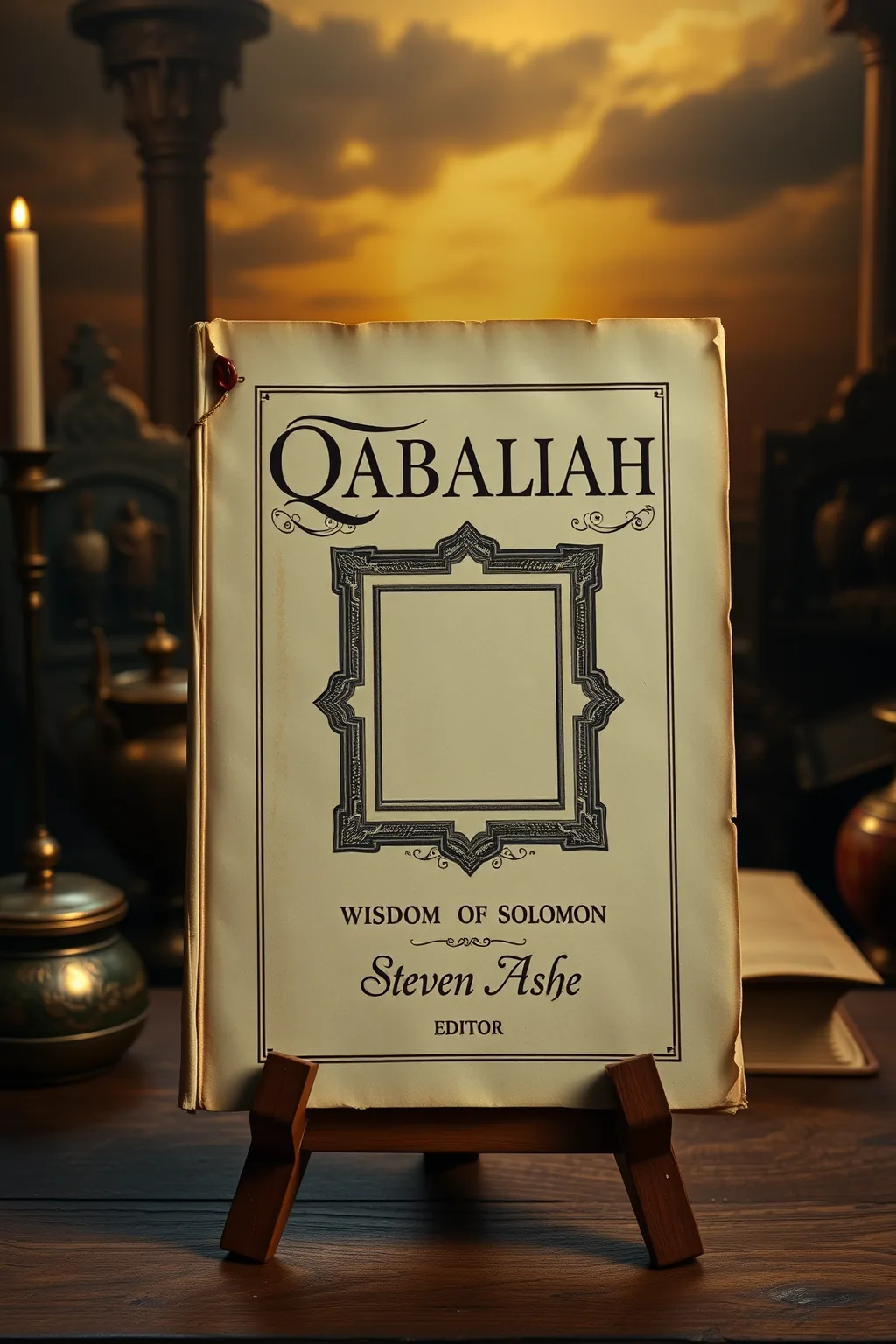
Qabalah - the Testament of Solomon - the Wisdom of Solomon
 62
62

Qabalah - the Testament of Solomon - the Wisdom of Solomon


Lorelei Sage, Contemplative Literature Editor, writes: Steven Ashe's 'Qabalah - The Testament of Solomon - The Wisdom of Solomon' is an indispensable contribution to the Esoteric Library. Ashe masterfully presents these seminal texts, breathing new life into their ancient pronouncements. The edition offers profound insights into the intricate tapestry of Kabbalistic thought, particularly its connections to the wisdom traditions of Solomon. Its strength lies in its clarity and the author's deep understanding of the esoteric currents at play. This work is essential for serious students of Jewish mysticism, occult philosophy, and anyone seeking to explore the foundational texts of Western esotericism.
📝 Description
62
Steven Ashe's 2009 edition presents 'Qabalah - The Testament of Solomon - The Wisdom of Solomon' in full.
This volume gathers Steven Ashe's 2009 edition of 'Qabalah - The Testament of Solomon - The Wisdom of Solomon.' It focuses on the Kabbalistic and Jewish esoteric traditions, specifically knowledge linked to King Solomon. Ashe's editorial work highlights the symbolic language and philosophical ideas within these texts. Readers can examine the structure of creation and spiritual forces as depicted in these writings.
The book details the Sefirot, the orders of angels, and meditative practices central to Jewish mysticism. It aims to connect the material world with the spiritual, offering insights for those interested in the universe's divine plan. The text is intended for serious students, scholars, and practitioners of mysticism.
This work is situated within the rich tradition of Jewish esotericism, particularly Kabbalah. It engages with texts attributed to King Solomon, a figure often associated with divine wisdom and mystical knowledge in various traditions. The content touches upon the structure of divine emanation (the Sefirot) and the celestial realms, concepts central to understanding the Kabbalistic view of creation and spiritual ascent. It reflects a lineage of mystical thought that seeks to grasp the hidden order of the universe and humanity's place within it.
💡 Why Read This Book?
Unlock the secrets of divine wisdom and the structure of the cosmos as revealed through the ancient Kabbalistic traditions. 'Qabalah - The Testament of Solomon' offers profound insights into creation, angelic realms, and personal spiritual ascent. Ideal for seekers of hidden knowledge, scholars of ancient religions, and practitioners looking to deepen their understanding of foundational esoteric texts.
⭐ Reader Reviews
Honest opinions from readers who have explored this book.
❓ Frequently Asked Questions
What is the primary focus of this book?
The book primarily focuses on the esoteric teachings of Kabbalah, exploring the mystical interpretations of the Bible and the spiritual insights attributed to King Solomon, particularly through 'The Testament of Solomon' and 'The Wisdom of Solomon'.
Is this book suitable for beginners in Kabbalah?
While the texts are ancient and profound, Steven Ashe's editorial work aims for clarity, making it accessible to dedicated beginners who are serious about their study of Kabbalah and Jewish mysticism. Prior foundational reading may enhance comprehension.
What makes this edition unique?
This edition is distinguished by Steven Ashe's expert curation and insightful annotations, which bridge the gap between the ancient texts and the modern reader, highlighting the esoteric significance and practical applications of the teachings.
Does the book contain practical exercises?
The book focuses on the theoretical and philosophical aspects of Kabbalah and Solomonic wisdom. While it doesn't contain explicit step-by-step exercises, the knowledge imparted can serve as a profound foundation for meditative and contemplative practices.
What is the historical significance of the Testament of Solomon?
The Testament of Solomon is an ancient Jewish apocryphal work attributed to King Solomon, detailing his knowledge of angels, demons, and the powers of nature, often used in magical and esoteric traditions for protection and invocation.
🔮 Key Themes & Symbolism
The Divine Architecture of Creation
This theme explores the Kabbalistic understanding of the universe as a divinely ordered structure, often visualized through the Tree of Life. It explores the emanation of divine light, the role of celestial beings, and the intricate relationships between the spiritual and material realms. Readers will gain insight into how these ancient texts conceptualize the genesis and ongoing sustentation of existence, offering a framework for understanding cosmic principles and their influence on human life. The exploration of divine names and their power is central to grasping this aspect of creation's blueprint.
Solomonic Wisdom and Mystical Authority
Central to this theme is the figure of King Solomon, not just as a historical ruler but as a paragon of divine wisdom and esoteric knowledge. The texts explore his purported mastery over spiritual forces, his understanding of angelic and demonic realms, and his role as a conduit for divine revelation. This section examines how Solomonic authority is invoked in esoteric traditions, conferring legitimacy and power to magical practices and mystical insights. It highlights the enduring legacy of Solomon as a symbol of enlightened rule and profound spiritual attainment, influencing centuries of occult philosophy.
The Interplay of Celestial and Infernal Forces
This theme investigates the complex relationship between the angelic hosts and the forces often categorized as 'demonic' within the context of ancient Jewish mysticism. 'The Testament of Solomon' is particularly rich in this regard, detailing the hierarchies, names, and functions of various spiritual entities. The book explores how these forces, though seemingly disparate, are understood as integral components of the cosmic order, and how knowledge of them can be utilized for spiritual growth, protection, or even influence. It offers a nuanced perspective on the spiritual landscape, revealing a universe populated by diverse intelligences and energies.
💬 Memorable Quotes
Direct passages from the work, attributed to the author.
“Wisdom is the light of the soul.”
— This aphorism emphasizes the transformative and useful power of true wisdom, suggesting it is not merely intellectual knowledge but a spiritual illumination that guides and enriches one's inner being.
“Know thyself, and know the universe.”
— A classic esoteric maxim, this suggests that self-knowledge is inextricably linked to understanding the greater cosmos, implying that the inner and outer worlds are reflections of each other.
“The tongue that speaks truth shall never be silenced.”
— This emphasizes the enduring power and sacredness of truth, suggesting that integrity and honest communication possess an eternal quality that transcends temporal limitations.
“Ascend not by force, but by grace.”
— This points to the nature of spiritual progress, suggesting that true advancement comes through divine favor and inner receptivity rather than external coercion or forceful exertion.
💡 Key Ideas
Editorial paraphrase of the work's core concepts — not direct quotes.
The gates of heaven are opened by understanding.
This quote highlights the belief that spiritual comprehension and insightful knowledge are the keys to accessing higher areas of consciousness and divine connection.
🌙 Esoteric Significance
Tradition
This work is a central to Western Esotericism, deeply rooted in Jewish Mysticism (Kabbalah) and ancient Solomonic traditions. It explores concepts fundamental to Kabbalistic cosmology, angelology, and the understanding of divine emanations. The texts offer insights into early forms of magical and ritualistic practices attributed to King Solomon, bridging the gap between biblical narratives and later esoteric interpretations of spiritual power and cosmic order.
Symbolism
Key symbols include the divine names, angelic hierarchies, geometric forms associated with creation, and the legendary Temple of Jerusalem as a microcosm of the universe. The Sephirot (divine attributes) are implicitly or explicitly present, representing the stages of divine emanation. Solomon himself symbolizes perfected wisdom and the ability to commune with both the celestial and infernal realms, acting as a conduit for divine knowledge and power.
Modern Relevance
In contemporary esoteric studies, these texts remain vital for understanding the historical development of Kabbalah and its influence on Western occultism. They offer profound symbolic language for exploring consciousness, the nature of reality, and the search for spiritual wisdom. For practitioners, the texts provide a rich source of contemplation and inspiration for understanding spiritual forces and the human potential for divine connection and self-mastery.
👥 Who Should Read This Book
This volume is essential for serious students of Kabbalah and Jewish Mysticism, offering direct access to foundational texts. Scholars of ancient religion, comparative mythology, and the history of esotericism will find invaluable primary source material. Spiritual seekers and practitioners of occult arts who wish to understand the roots of Western magical traditions and their symbolic language will benefit immensely. Beginners with a strong commitment to deep study will find Ashe's edition an accessible yet profound entry point into these ancient mysteries.
📜 Historical Context
The texts comprising 'Qabalah - The Testament of Solomon - The Wisdom of Solomon' emerge from the wide range of ancient Jewish thought, particularly the Hellenistic and early Rabbinic periods. This era (roughly 300 BCE to 300 CE) was a fertile ground for mystical speculation, angelology, demonology, and the development of esoteric interpretations of scripture. The figure of King Solomon, renowned for his wisdom and supposed magical prowess in biblical and post-biblical literature, became a central archetype for divine knowledge and spiritual authority. 'The Testament of Solomon,' likely compiled between the 1st and 4th centuries CE, reflects concerns about spiritual forces and their influence, while 'The Wisdom of Solomon,' part of the Apocrypha, offers a philosophical exploration of divine wisdom. These texts significantly influenced later Kabbalistic traditions, Gnosticism, and various occult practices within Western esotericism, shaping the understanding of the divine, the cosmos, and humanity's place within it for centuries to come.
📔 Journal Prompts
Reflect on the concept of divine wisdom as presented in 'The Wisdom of Solomon.' How does it differ from conventional intelligence?
Consider the figure of King Solomon. What archetypal qualities does he represent, and how might these be integrated into one's own life?
Analyze the descriptions of angelic or demonic entities in 'The Testament of Solomon.' What do these portrayals reveal about the ancient understanding of spiritual forces?
Imagine the Temple of Jerusalem as a microcosm of the universe. What parallels can you draw between its structure and the spiritual realms?
How can the pursuit of esoteric knowledge, as exemplified in these texts, contribute to personal transformation and a deeper connection to the divine?
🗂️ Glossary
Kabbalah
A system of Jewish mysticism that seeks to understand the nature of God and the universe through esoteric interpretations of scripture, often focusing on divine emanations and the structure of creation.
Sephirot
The ten divine emanations or attributes of God in Kabbalistic cosmology, often visualized as a tree, representing the stages through which God manifests in the created universe.
Apocrypha
A collection of ancient books of the Old Testament, not included in the Hebrew Bible, but accepted by some Christian churches as part of the canon. 'The Wisdom of Solomon' is among these.
Angelology
The study of angels, their nature, roles, and hierarchies, a significant component of many religious and esoteric traditions, particularly prominent in the texts presented.
Esotericism
The study of religious or spiritual subjects or practices that are not intended for or understood by the general public; esoteric knowledge is typically reserved for initiates or those with specialized understanding.
This book appears in 1 collection
🔮 Readers Also Liked
Browse all →







From the “Kabbalah” Collection
View all →









More Free Kabbalah & Jewish Mysticism Books
View all →