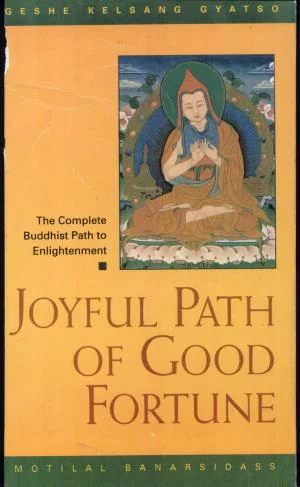
Joyful Path of Good Fortune
 75
75

Joyful Path of Good Fortune
Geshe Kelsang Gyatso’s Joyful Path of Good Fortune is a remarkably thorough distillation of the Mahayana Buddhist path. Its strength lies in its systematic, step-by-step approach, meticulously detailing the Lamrim teachings. The inclusion of relatable stories and analogies, such as the parable of the four friends seeking treasure, makes abstract concepts tangible. However, the text’s deep adherence to a specific lineage, the New Kadampa Tradition, may present a barrier for those seeking a more general or comparative Buddhist study. The constant emphasis on the necessity of a spiritual guide, while central to the tradition, could be perceived as prescriptive by some readers. Despite this, the book offers an unparalleled clarity on the stages of the path to enlightenment for its intended audience. It is a formidable manual for diligent practitioners.
📝 Description
75
Geshe Kelsang Gyatso's 1990 book outlines the complete Buddhist path to enlightenment.
Joyful Path of Good Fortune presents the Mahayana Buddhist path to enlightenment as articulated by Geshe Kelsang Gyatso. The book systematically lays out the stages of meditation and wisdom, drawing from Buddhist scripture. Its structure guides practitioners from initial motivation to the ultimate attainment of enlightenment. The text emphasizes the practical application of Buddhist philosophy in daily life, making complex teachings accessible.
This work is suitable for those new to Buddhist meditation and philosophy, as well as experienced practitioners aiming to deepen their understanding. Individuals interested in ethical living, cultivating compassion, and developing wisdom will find value within its pages. It is particularly relevant for those following the New Kadampa Tradition lineage.
Published in 1990, Joyful Path of Good Fortune arrived during a period of growing Western interest in Eastern spiritual traditions. Geshe Kelsang Gyatso, a central figure in disseminating Kadampa Buddhism globally, authored many significant texts then. The book aligns with the broader resurgence of Buddhist studies in the West. It offers a systematic presentation of teachings, contrasting with more fragmented or academic introductions common in the late 20th century. Its focus on practical application appealed to a growing audience seeking spiritual direction.
💡 Why Read This Book?
• Gain a structured understanding of the complete Mahayana Buddhist path, as presented in the Lamrim teachings, which are systematically outlined from Chapter 1 onwards. • Develop practical meditation techniques for cultivating wisdom and compassion, supported by illustrative stories and analogies found throughout the text. • Learn the essential view of emptiness and how to integrate this profound philosophical understanding into daily life, a core focus from Chapter 10.
⭐ Reader Reviews
Honest opinions from readers who have explored this book.
❓ Frequently Asked Questions
When was Joyful Path of Good Fortune first published?
Joyful Path of Good Fortune was first published in 1990, making it a foundational text in the dissemination of Kadampa Buddhism in the West.
What is the primary Buddhist tradition presented in this book?
The book primarily presents the Mahayana Buddhist path according to the Kadampa tradition, as taught by Geshe Kelsang Gyatso.
Does the book focus on theory or practice?
It strongly emphasizes practical application, offering step-by-step guidance on meditations and integrating Buddhist philosophy into daily life.
Who is Geshe Kelsang Gyatso?
Geshe Kelsang Gyatso is a renowned Buddhist master and scholar who founded the New Kadampa Tradition (NKT) and authored numerous books on Buddhist philosophy and practice.
What does 'Lamrim' mean and why is it important in this book?
Lamrim translates to 'Stages of the Path.' It is a systematic arrangement of all Buddha's teachings, presented in the order of practice, which forms the structural backbone of Joyful Path of Good Fortune.
Is this book suitable for beginners to Buddhism?
Yes, the book is designed to be accessible for beginners, offering clear explanations and practical guidance on the complete Buddhist path to enlightenment.
🔮 Key Themes & Symbolism
The Stages of the Path
Central to this work is the Lamrim, or Stages of the Path, a systematic presentation of all Buddhist teachings arranged for progressive practice. Geshe Kelsang Gyatso meticulously outlines these stages, beginning with the preciousness of human life and progressing through devotion, meditation on emptiness, and the cultivation of the Six Perfections. Each stage builds upon the last, providing a coherent framework for spiritual development from an ordinary state to full enlightenment.
Wisdom and Compassion
The book emphasizes the non-dualistic cultivation of wisdom (prajna) and compassion (karuna). Wisdom, particularly the understanding of emptiness, is presented as the means to eradicate ignorance, the root of suffering. Compassion, the wish for all beings to be free from suffering, provides the motivation and altruistic purpose for seeking enlightenment. These two wings are essential for soaring to enlightenment, as detailed in the sections on the Six Perfections.
The Nature of Reality
A significant portion of the text is dedicated to explaining the Buddhist concept of emptiness (shunyata). This is not nihilism, but rather the absence of inherent existence in all phenomena. Understanding emptiness is presented as the key to unlocking liberation from the cycle of suffering (samsara). The book offers analogies and meditations to help practitioners realize this profound view, as explored in sections discussing the realization of emptiness.
The Role of the Spiritual Guide
Geshe Kelsang Gyatso highlights the indispensable role of a qualified spiritual guide (guru) in the Mahayana path. The guide is seen as the source of blessings and the essential link to the authentic teachings. The book details how to rely on a spiritual guide, emphasizing the importance of devotion and correct connection for accelerating one's progress on the path to enlightenment.
💬 Memorable Quotes
Direct passages from the work, attributed to the author.
“All the teachings of the Buddha are contained within the Lamrim.”
— This statement underscores the comprehensive nature of the Lamrim system. It suggests that by systematically studying and practicing the Stages of the Path, one is engaging with the entirety of the Buddha's profound advice, covering all essential aspects for achieving enlightenment.
“The Six Perfections are the methods for achieving enlightenment.”
— This highlights the practical application of Buddhist philosophy. The Perfections – generosity, ethical conduct, patience, effort, concentration, and wisdom – are not mere ideals but the active means by which a practitioner develops the necessary qualities to attain Buddhahood.
“The preciousness of human life is the foundation for spiritual practice.”
— This emphasizes the unique opportunity that a human existence provides for attaining liberation. The text explains that having the capacity for both suffering and the wisdom to overcome it makes this life exceptionally valuable for spiritual endeavors.
“Cherishing others is the best method for developing compassion.”
— This points to the practical training in altruism. By actively considering the well-being of others as paramount, one cultivates a deep and unwavering sense of compassion, which is a crucial component for spiritual growth and the attainment of enlightenment.
“The view of emptiness is the antidote to ignorance.”
— This positions the understanding of emptiness as the direct countermeasure to the fundamental ignorance that binds beings to suffering. Realizing that phenomena lack inherent existence is presented as the key to dismantling the root cause of dissatisfaction.
🌙 Esoteric Significance
Tradition
This work is firmly situated within the Mahayana Buddhist tradition, specifically the reformed Kadampa lineage as revived and taught by Geshe Kelsang Gyatso. While Mahayana itself contains profound philosophical and meditative systems often considered esoteric by external observers, Gyatso's presentation focuses on making these advanced concepts accessible through structured practice. It departs from purely academic or monastic interpretations by offering a direct, practical guide for lay practitioners seeking enlightenment in this lifetime.
Symbolism
The book frequently employs symbolic language inherent in Buddhist teachings. The 'precious human life' is a potent symbol representing the rare opportunity for spiritual realization. The 'Six Perfections' (Paramitas) function as symbolic representations of the virtues that must be fully developed. Furthermore, the concept of 'emptiness' (shunyata), while philosophical, carries symbolic weight representing the ultimate freedom from conceptual limitations and the illusion of inherent existence.
Modern Relevance
Contemporary Buddhist practitioners, particularly those within the New Kadampa Tradition, continue to draw heavily on Joyful Path of Good Fortune as a primary text. Its clear, structured approach also appeals to individuals from various backgrounds seeking systematic meditation instruction and philosophical depth. Thinkers and meditation teachers focused on mindfulness, compassion cultivation, and the application of Buddhist psychology in secular contexts can find valuable frameworks and techniques within its pages.
👥 Who Should Read This Book
• Practitioners new to Mahayana Buddhism: Those seeking a comprehensive, step-by-step introduction to the path to enlightenment, presented with clarity and practical instruction. • Experienced Buddhist students: Individuals looking to deepen their understanding of core Lamrim teachings and refine their meditation practice with detailed guidance. • Those interested in Kadampa Buddhism: Students and followers of Geshe Kelsang Gyatso and the New Kadampa Tradition seeking an authoritative text on the lineage's path.
📜 Historical Context
Published in 1990, Joyful Path of Good Fortune emerged during a significant period for the global dissemination of Buddhist thought. Geshe Kelsang Gyatso, a scholar and practitioner exiled from Tibet in 1959, was actively establishing the New Kadampa Tradition (NKT) and authoring foundational texts. This era saw a burgeoning Western interest in Eastern religions, often met with academic treatises or fragmented spiritual guides. Gyatso's work provided a systematic, comprehensive presentation of the Mahayana path, specifically within the Kadampa lineage, which had been largely preserved in Tibet. Unlike more general introductions to Buddhism that might have appeared in the 1980s, Gyatso’s texts, including this one, were deeply rooted in specific scriptural commentary and lineage transmission, aiming to provide a complete path for practitioners. His prolific writing aimed to make these teachings accessible to a broad audience seeking practical spiritual guidance.
📔 Journal Prompts
The preciousness of human life: Reflect on the unique opportunities this life offers for spiritual realization.
Cultivating compassion: Consider how the practice of cherishing others can transform your perspective.
Understanding emptiness: Explore the concept of non-inherent existence and its implications for suffering.
The Stages of the Path: Map your current progress against the Lamrim stages presented in the book.
The role of a spiritual guide: Reflect on the qualities of a guide and the importance of connection.
🗂️ Glossary
Lamrim
Tibetan for 'Stages of the Path.' A systematic arrangement of all Buddha's teachings, presented in the order of practice, forming the core structure of this book.
Mahayana
The 'Great Vehicle' of Buddhism, characterized by the aspiration to achieve enlightenment for the benefit of all sentient beings, emphasizing compassion and wisdom.
Emptiness (Shunyata)
The ultimate nature of reality, understood as the absence of inherent, independent existence in all phenomena. It is the direct antidote to ignorance.
Six Perfections (Paramitas)
The six transcendent practices essential for attaining Buddhahood: generosity, ethical conduct, patience, joyful effort, concentration, and wisdom.
Spiritual Guide (Guru)
A qualified teacher who provides essential guidance, blessings, and instructions on the path to enlightenment. Reliance on a guide is emphasized.
Samsara
The cycle of birth, death, and rebirth driven by ignorance, attachment, and aversion. It is characterized by suffering.
Enlightenment (Nirvana)
The ultimate state of liberation from suffering and the cycle of rebirth, characterized by perfect wisdom and compassion.
This book appears in 1 collection
🔮 Readers Also Liked
Browse all →








From the “Meditation” Collection
View all →

![Paul Foster Case The Tarot ( A Key To The Wisdom Of The Ages)[ebook Pdf]](/img/thumb/paul-foster-case-the-tarot-a-key-to-the-wisdom-of-the-ages-ebook-pdf.webp)






More Free Sacred Texts & Gnosticism Books
View all →