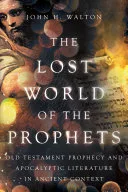
The Lost World of the Prophets
 74
74

The Lost World of the Prophets
John H. Walton's *The Lost World of the Prophets* offers a much-needed corrective to the often-futuristic readings of biblical prophecy. His central argument, that prophets primarily addressed their contemporary audiences and circumstances, is compellingly made. The strength of the book lies in its systematic deconstruction of predictive assumptions, particularly evident in his analysis of how covenantal language functioned in ancient Israel. For instance, Walton's explanation of how pronouncements of judgment or blessing related to Israel's adherence to the Mosaic Law provides a concrete alternative to simple eschatological prognostication. A limitation, however, might be that the rigorous academic tone, while precise, could occasionally feel dense for a lay reader less familiar with comparative ancient Near Eastern studies. Nevertheless, Walton successfully reframes prophetic texts, urging a return to their original communicative intent and practical relevance for believers today.
📝 Description
74
John H. Walton's 2024 book reevaluates biblical prophecy beyond simple future prediction.
Published in 2024, John H. Walton's *The Lost World of the Prophets* reexamines biblical prophecy and apocalyptic literature. Walton moves past common interpretations that focus solely on future prediction, instead applying a scholarly method to uncover the original context and intent behind these prophetic messages. He separates prophecy into predictive, admonitory, and declarative aspects, asking readers to consider how these ancient texts relate to their original audiences and to the present day.
This book is intended for biblical scholars, theologians, and dedicated students of scripture who want a deeper grasp of prophetic writings. It also appeals to those interested in the historical and cultural settings of ancient Israelite prophecy, particularly those unsatisfied with standard interpretations. Readers seeking to understand the practical use of prophetic messages without engaging in speculative eschatology will find this work valuable. Walton's work is part of an ongoing academic conversation about biblical hermeneutics and ancient Near Eastern texts.
This work engages with the esoteric tradition by questioning established interpretive frameworks for sacred texts. It seeks to uncover a deeper, contextually bound meaning in prophecy, moving away from literal or purely predictive readings that have become dominant. By emphasizing the original cultural and linguistic settings, Walton aligns with approaches that value direct engagement with ancient sources, rather than relying on later theological or mystical accretions. The focus on discerning the 'lost world' of the prophets echoes a broader interest in recovering lost knowledge and understanding ancient communication in its own terms.
💡 Why Read This Book?
• Gain a new interpretive framework for biblical prophecy, moving beyond simplistic future-casting by understanding its primary function within ancient Israel's covenantal context, as detailed in Walton's analysis of prophetic discourse. • Reclaim the immediate relevance of prophetic messages by learning how they addressed specific socio-political issues and divine expectations in their original time, a concept central to the book's argument. • Avoid misinterpretations of apocalyptic literature by distinguishing its genre and purpose from standard prophecy, enabling a more accurate engagement with texts like Daniel and Revelation, as explored within the book.
⭐ Reader Reviews
Honest opinions from readers who have explored this book.
❓ Frequently Asked Questions
What is John H. Walton's main argument in 'The Lost World of the Prophets'?
Walton argues that biblical prophets primarily addressed their contemporary audiences and circumstances, focusing on covenant responsibilities and immediate socio-political issues, rather than exclusively predicting distant future events.
How does this book differ from typical interpretations of prophecy?
It challenges the common assumption that prophecy is mainly about foretelling the future, emphasizing its role in admonishing, declaring divine will, and calling for present-day repentance and faithfulness within its original historical context.
What is 'apocalyptic literature' according to this book?
Walton defines apocalyptic literature as a distinct genre, often characterized by symbolic visions, used during times of crisis to convey divine messages, and he differentiates it from standard prophetic pronouncements.
Who is the intended audience for 'The Lost World of the Prophets'?
The book is intended for biblical scholars, theologians, students of scripture, and anyone interested in understanding the historical and cultural context of ancient prophetic messages.
When was 'The Lost World of the Prophets' first published?
The book was first published on February 27, 2024, by InterVarsity Press.
Does the book offer practical applications for modern readers?
Yes, by understanding the original intent and context, readers can better discern how the underlying principles of divine justice, faithfulness, and covenantal living apply to contemporary life.
🔮 Key Themes & Symbolism
Prophecy as Covenantal Communication
This work reframes prophecy not as mere prediction, but as a vital form of communication within the covenantal relationship between God and Israel. Walton emphasizes that prophetic messages were often direct responses to Israel's obedience or disobedience to the Mosaic Law. This perspective shifts the focus from future events to the immediate implications of divine judgment and blessing rooted in covenant stipulations, challenging readers to see prophets as active participants in covenantal discourse.
The 'Lost World' of Ancient Near East
A central theme is reconstructing the cultural, historical, and linguistic milieu of the ancient Near East to understand prophetic utterances accurately. Walton argues that without this contextualization, modern readers project their own assumptions onto texts intended for a different audience and time. Understanding this 'lost world' is crucial for deciphering the prophets' original intent and avoiding anachronistic interpretations, particularly concerning political and social commentary.
Genre Distinction: Prophecy vs. Apocalyptic
The book meticulously distinguishes between classical prophetic literature and apocalyptic literature. Walton explains that while both address divine messages, apocalyptic texts employ unique genre conventions, such as symbolic visions and eschatological frameworks, often appearing during periods of intense crisis. This differentiation is vital for accurate interpretation, preventing the conflation of distinct literary and theological purposes within scripture.
Reclaiming Prophetic Authority
By stripping away layers of speculative interpretation, Walton aims to restore the authentic authority and relevance of the prophets. The work encourages readers to engage with prophetic texts as they were originally delivered – as challenging calls to righteousness, justice, and faithfulness in the here and now. This approach allows for a more profound connection to the prophets' message, emphasizing its enduring ethical and spiritual imperatives.
💬 Memorable Quotes
Direct passages from the work, attributed to the author.
“Prophets were speaking to their own audiences about their own situations.”
— This interpretation captures Walton's core thesis: prophetic messages were primarily addressed to the immediate historical circumstances of the prophet and their listeners, urging a re-evaluation of how we read these texts.
“The nature of prophecy is often misunderstood as exclusively predictive.”
— This highlights the book's critical stance against a dominant hermeneutical approach, suggesting that the predictive element, while present, is often secondary to the prophets' role in covenantal admonition and declaration.
“Understanding the ancient Near Eastern context is key to accurate interpretation.”
— This concept emphasizes the importance of historical and cultural background, a foundational principle for Walton's method, asserting that meaning is deeply embedded in the original setting.
“Prophecy calls for faithfulness in the present.”
— This captures the practical and ethical dimension of prophetic messages as presented by Walton, shifting the reader's focus from future speculation to present-day responsibilities and divine expectations.
💡 Key Ideas
Editorial paraphrase of the work's core concepts — not direct quotes.
Apocalyptic literature uses a distinct symbolic language.
This paraphrase points to Walton's emphasis on genre analysis, underscoring that apocalyptic visions are not to be read as literal forecasts but as symbolic expressions conveying divine truth within a specific literary tradition.
🌙 Esoteric Significance
Tradition
While *The Lost World of the Prophets* is primarily a work of academic biblical scholarship, its rigorous contextual approach and emphasis on the symbolic nature of certain scriptural texts can appeal to esoteric traditions. It aligns with hermeneutic principles found in Gnosticism and Kabbalah, which emphasize uncovering hidden meanings and understanding divine communication through symbolic language rather than literal interpretation. Walton’s work provides a scholarly grounding for appreciating the multi-layered nature of scripture, which esoteric practitioners often seek.
Symbolism
Within the context of esoteric thought, Walton's exploration of prophetic visions, particularly within apocalyptic literature, resonates. The symbolic language he discusses—such as divine encounters described in terms of celestial beings or cosmic upheaval—can be seen as analogous to the symbolic imagery used in Hermeticism or alchemy. These symbols are not merely decorative but are understood as keys to spiritual truths, offering insights into divine order and human destiny when interpreted through appropriate traditional frameworks.
Modern Relevance
Contemporary thinkers and practitioners within fields like comparative mythology, depth psychology (especially Jungian), and certain branches of biblical mysticism find Walton's work valuable. His emphasis on understanding ancient texts within their original cultural 'worldview' encourages a more nuanced appreciation of archetypal narratives and symbolic communication. This approach allows modern esoteric students to engage with biblical narratives not as historical records or predictive prophecies, but as profound expressions of universal spiritual principles and psychological landscapes.
👥 Who Should Read This Book
• Students of comparative religion seeking to understand the specific context and function of prophecy within ancient Israelite culture, as distinct from other ancient Near Eastern divination practices. • Lay readers of scripture who feel traditional interpretations of prophetic texts are inadequate or overly focused on future prediction, and desire a historically grounded approach. • Scholars of ancient Near Eastern languages and cultures interested in how biblical texts engage with and diverge from contemporary literary and theological norms of their time.
📜 Historical Context
Published in 2024, John H. Walton's *The Lost World of the Prophets* enters a contemporary academic conversation that has long grappled with the interpretation of biblical prophecy. The work builds upon decades of scholarship in Ancient Near Eastern studies and biblical hermeneutics, seeking to situate prophetic texts within their original cultural and linguistic frameworks. This approach stands in contrast to earlier, more eschatologically focused interpretations that often detached prophecy from its immediate historical setting. Walton’s methodology aligns with scholars like Kenneth Kitchen, who have emphasized the importance of understanding Old Testament texts through the lens of their contemporaneous ancient Near Eastern parallels. The book's contribution lies in its systematic application of this contextual method to the entirety of prophetic literature, offering a coherent alternative to speculative readings that were prevalent in some theological circles throughout the 20th century.
📔 Journal Prompts
The prophetic admonition regarding covenant faithfulness.
The symbolic visions within apocalyptic literature.
How prophets addressed their contemporary socio-political situations.
The distinction between predictive and declarative prophecy.
Reconstructing the ancient Near Eastern context for biblical texts.
🗂️ Glossary
Covenant
In biblical studies, a formal agreement or treaty, particularly between God and humanity (e.g., the Mosaic Covenant), outlining mutual obligations, promises, and consequences.
Apocalyptic Literature
A genre of literature characterized by symbolic visions, divine revelation, and often eschatological themes, typically arising during times of crisis or persecution.
Hermeneutics
The theory and methodology of interpretation, especially the interpretation of biblical texts, literary works, or texts in general.
Ancient Near East (ANE)
The historical region encompassing Mesopotamia, Egypt, Anatolia, Persia, and the Levant, during antiquity, crucial for understanding biblical cultural context.
Mosaic Law
The body of laws and statutes given to the Israelites by God through Moses, as recorded in the first five books of the Old Testament (the Torah or Pentateuch).
Eschatology
The branch of theology concerned with death, judgment, the end of the world, and the final destiny of the human soul and of humankind.
Genre
A category of artistic composition, as in music or literature, characterized by similarities in form, style, or subject matter.