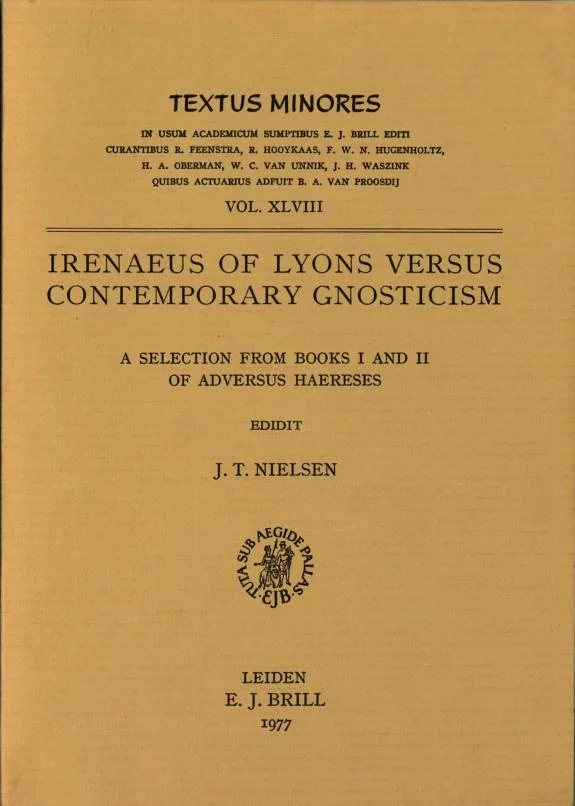
Irenaeus of Lyons versus contemporary Gnosticism
 71
71

Irenaeus of Lyons versus contemporary Gnosticism
The 1977 publication, *Irenaeus of Lyons versus contemporary Gnosticism*, offers a sober, academic dissection of early Christian polemics. Its strength lies in its granular analysis of Irenaeus’s arguments in *Adversus Haereses*, providing clarity on the specific Gnostic systems he was combating. The author successfully delineates the fundamental chasm between Irenaeus's monotheistic, incarnational theology and the complex, often bewildering, cosmogonies and soteriologies of various Gnostic groups. However, the book’s primary limitation is its decidedly historical and theological focus, which may leave readers seeking practical esoteric application wanting. A particularly illuminating passage details Irenaeus's critique of the Gnostic view of the Old Testament God as distinct from and inferior to the supreme God, highlighting a crucial point of divergence. This work serves as an essential, albeit dry, resource for understanding a foundational theological conflict.
📝 Description
71
Published in 1977, this book examines Irenaeus of Lyons's arguments against 2nd-century Gnosticism.
This scholarly work analyzes the theological and philosophical disagreements between the early Christian bishop Irenaeus of Lyons and various Gnostic groups of the second century. The author meticulously details Irenaeus's critiques of Gnostic beliefs, as found in his text *Adversus Haereses*. The book breaks down key Gnostic ideas: their dualistic worldview, the figure of the Demiurge as a lesser creator god, and the importance of secret knowledge, or gnosis, for achieving salvation.
The text is intended for academics, theologians, and advanced students in early Christian history and comparative religion. It also serves those in esoteric traditions who seek a historically grounded perspective on Gnosticism and its early opponents. A basic understanding of Christian theology and the Roman Empire in the 2nd century CE is recommended for full comprehension of the arguments presented.
The discovery of the Nag Hammadi library in 1945 significantly reshaped academic understanding of Gnosticism, moving beyond interpretations solely from figures like Irenaeus. This 1977 book emerged during this period of intense scholarly reevaluation. It engages directly with the historical Irenaeus, a key figure in defining orthodox Christian doctrine, by dissecting his arguments against what he considered heresies. The work thus situates itself within the ongoing academic discourse on the variety of early Gnostic movements and the early Church's response.
💡 Why Read This Book?
• Gain a precise understanding of Irenaeus's arguments against specific Gnostic doctrines, such as the Demiurge, as detailed in his *Adversus Haereses*, which is crucial for appreciating the historical formation of orthodox Christian thought. • Explore the concept of *gnosis* as understood by early Gnostics and how it contrasted with the faith-based salvation emphasized by figures like Irenaeus, offering a nuanced view of early salvation theories. • Grasp the historical context of the 2nd century CE, understanding how the discovery of the Nag Hammadi library in 1945 reshaped scholarly views on Gnosticism and its early opponents.
⭐ Reader Reviews
Honest opinions from readers who have explored this book.
❓ Frequently Asked Questions
What specific Gnostic ideas did Irenaeus of Lyons primarily refute?
Irenaeus of Lyons primarily refuted Gnostic concepts such as the existence of a lesser creator deity (the Demiurge), the doctrine of aeons and their emanations, the idea of a fallen Sophia, and the Gnostic emphasis on secret knowledge (*gnosis*) for salvation, as detailed in his work *Adversus Haereses*.
When was the book 'Irenaeus of Lyons versus contemporary Gnosticism' first published?
The book 'Irenaeus of Lyons versus contemporary Gnosticism' was first published in 1977, a period marked by significant scholarly engagement with newly discovered Gnostic texts.
How does this book help in understanding Gnosticism today?
By presenting Irenaeus's counter-arguments, the book provides critical historical context for understanding the core tenets of early Gnosticism and its theological challenges to nascent Christianity, offering a foundational perspective.
What is the significance of the Nag Hammadi library in relation to this book's subject?
The discovery of the Nag Hammadi library in 1945 provided direct Gnostic texts, influencing the scholarly landscape in which this 1977 book was written, allowing for a more direct comparison with Irenaeus's accounts.
Is this book suitable for someone new to Gnosticism?
While informative, the book assumes some familiarity with theological and historical concepts. Beginners might benefit from introductory materials on Gnosticism before tackling this detailed analysis of Irenaeus's refutations.
What was Irenaeus of Lyons's role in early Christianity?
Irenaeus of Lyons served as the Bishop of Lugdunum (modern Lyon) in the late 2nd century CE and was a key figure in defining orthodox Christian doctrine, particularly through his writings against what he considered heresies, most notably Gnosticism.
🔮 Key Themes & Symbolism
Irenaeus's Polemics
This theme centers on Bishop Irenaeus of Lyons's strategic and theological dismantling of Gnostic systems in the late 2nd century. The work examines his arguments against Gnostic dualism, his defense of the goodness of creation, and his assertion of the singular, good God of the Old and New Testaments. It highlights how Irenaeus utilized scripture and apostolic tradition to counter Gnostic interpretations, establishing a framework for later orthodox Christian thought and providing early Christian apologists with vital polemical tools against perceived heresies.
The Demiurge and Creation
A core concept explored is the Gnostic belief in a subordinate creator deity, the Demiurge, often portrayed as ignorant or malevolent, responsible for the flawed material world. The book contrasts this with Irenaeus's defense of a benevolent, omnipotent God who created the cosmos intentionally and with inherent goodness. This theological divergence is presented as fundamental to the conflict, with Irenaeus stressing divine providence and the integrity of creation against Gnostic denigration of the material realm.
Gnosis versus Faith
This theme dissects the Gnostic soteriological emphasis on *gnosis* – a secret, intuitive, or revealed knowledge – as the means to spiritual liberation and ascent. The work contrasts this with the orthodox Christian emphasis on faith, sacraments, and adherence to apostolic teachings, as championed by Irenaeus. It illuminates how the pursuit of esoteric knowledge was seen by Gnostics as a path to divinity, while for Irenaeus, salvation was rooted in historical events and communal belief.
The Role of Sophia
The intricate myth of Sophia (Wisdom) and her fall from the divine pleroma is a significant element. The book examines how Gnostic traditions often depict Sophia's illicit desire or error as the catalyst for the creation of the material universe and the Demiurge. Irenaeus's refutation of this narrative is analyzed, highlighting his efforts to anchor Christology and cosmology within a consistent, unified divine plan, thereby rejecting the complex, often tragic, genealogies of Gnostic emanations.
💬 Memorable Quotes
Direct passages from the work, attributed to the author.
“Salvation in Gnosticism hinges on attaining secret knowledge, a path distinct from faith in Christ's historical work.”
— This interpretation highlights the contrast between Gnostic *gnosis* and orthodox soteriology. It points to the Gnostic belief that liberation comes through esoteric understanding, versus the Christian emphasis on belief in Jesus Christ's salvific actions.
“The material world, for Gnostics, is an aberration, a prison for the spirit.”
— This captures a central tenet of many Gnostic systems: the inherent negativity and inferiority of the physical realm. It contrasts sharply with the orthodox view of creation as fundamentally good, originating from God.
💡 Key Ideas
Editorial paraphrase of the work's core concepts — not direct quotes.
The Gnostic heresy, in its various forms, fundamentally misunderstands the nature of God and His creation.
This paraphrased concept captures Irenaeus's core critique: Gnosticism, by positing a flawed creator and a corrupt material world, deviates drastically from the orthodox understanding of a singular, good, and all-powerful Deity and a divinely ordained reality.
Irenaeus meticulously refutes the Gnostic lineage of aeons and the myth of Sophia's fall.
This statement summarizes Irenaeus's strategy in *Adversus Haereses*, emphasizing his detailed theological and mythological counter-arguments against the complex Gnostic cosmologies involving divine emanations and the problematic role of the figure of Sophia.
The work explores Irenaeus's consistent defense of the Old Testament God as identical to the God of Jesus Christ.
This paraphrased concept emphasizes Irenaeus's crucial argument against Gnostic dualism, where the Old Testament God was often seen as separate from and inferior to the supreme, unknown God revealed by Christ. Irenaeus affirmed their unity.
🌙 Esoteric Significance
Tradition
This work primarily engages with the historical roots of Gnosticism, a tradition often considered esoteric due to its emphasis on hidden knowledge and complex cosmologies. While the book itself is a historical-theological analysis rather than an esoteric text, it serves as a crucial explication of the early conflicts that shaped both Gnostic and orthodox Christian lineages, providing foundational context for those studying Western esotericism.
Symbolism
Key symbols explored include the Demiurge, often depicted as a craftsman or serpent, representing flawed creation; Sophia, a divine emanation whose fall leads to material existence; and the Pleroma, the spiritual area of divine beings from which Gnostics sought to ascend. The book analyzes how Irenaeus interpreted and countered the symbolic narratives surrounding these figures and realms.
Modern Relevance
Contemporary scholars and practitioners of Western esotericism, particularly those interested in Gnostic traditions, draw heavily on historical analyses like this one. It informs modern interpretations of Gnostic myths, provides context for contemporary Gnostic-inspired movements, and aids in comparative studies of religious and philosophical ideas originating from antiquity.
👥 Who Should Read This Book
• Scholars of early Christian history and theology: To gain a detailed understanding of the theological disputes between Irenaeus and Gnostics, crucial for grasping the formation of Christian doctrine. • Students of comparative religion: To analyze the divergent cosmologies, soteriologies, and epistemologies of early Gnosticism and its orthodox Christian opposition. • Esoteric practitioners interested in Gnosticism: To acquire a historical grounding in the primary refutations of Gnostic beliefs, providing critical context for modern esoteric interpretations.
📜 Historical Context
Published in 1977, *Irenaeus of Lyons versus contemporary Gnosticism* arrived during a resurgence of academic interest in Gnosticism, largely catalyzed by the 1945 discovery of the Nag Hammadi library. This collection provided direct access to Gnostic texts, allowing scholars to compare them with the accounts left by their early opponents. The book engages with this evolving scholarship, situating Irenaeus's critique within the broader context of 2nd-century theological debates. Irenaeus himself, Bishop of Lugdunum in Gaul, was a key figure in articulating an orthodox Christian identity against a diverse array of emerging 'heresies'. His work, *Adversus Haereses*, became a primary source for understanding Gnostic systems, though it represented a hostile perspective. The book implicitly grapples with the challenge of interpreting Gnosticism through the lens of its detractors, acknowledging the historical distance and potential biases involved.
📔 Journal Prompts
Irenaeus's critique of the Demiurge: How does this concept of a flawed creator deity differ from your understanding of divine creation?
The concept of *gnosis*: Reflect on the role of hidden or esoteric knowledge in spiritual traditions you are familiar with.
Irenaeus's refutation of Sophia's fall: Explore the narrative function of divine error or descent in mythological traditions.
The historical opposition between Irenaeus and Gnosticism: Consider how differing interpretations of scripture and divine nature lead to distinct religious paths.
The 2nd-century context: How did the intellectual climate of the Roman Empire shape early Christian and Gnostic thought?
🗂️ Glossary
Gnosticism
A diverse set of religious and philosophical movements prevalent in the first few centuries CE, characterized by a belief in salvation through secret knowledge (*gnosis*) and often featuring dualistic cosmologies and a distinction between a supreme God and a lesser creator deity.
Demiurge
In Gnostic cosmology, the often ignorant or malevolent creator of the material world, distinct from the supreme, transcendent God. Irenaeus strongly refuted this concept.
Adversus Haereses
The major work by Irenaeus of Lyons, written in the late 2nd century CE, which systematically refutes various 'heresies', most notably Gnosticism, from an orthodox Christian perspective.
Gnosis
Greek for 'knowledge'. In Gnosticism, it refers to a special, intuitive, or revealed knowledge believed to be essential for salvation and spiritual liberation.
Aeons
In Gnostic cosmology, divine beings or emanations that constitute the Pleroma, the spiritual area of the supreme God. Their interactions and emanations often form complex mythologies.
Sophia
Greek for 'Wisdom'. In many Gnostic systems, Sophia is a divine being whose fall or error leads to the creation of the material world and the Demiurge.
Orthodoxy
In early Christianity, the body of beliefs and practices that came to be accepted as correct and authoritative, often in contrast to 'heretical' teachings.
This book appears in 1 collection
🔮 Readers Also Liked
Browse all →







From the “Gnosticism” Collection
View all →





More Free Sacred Texts & Gnosticism Books
View all →