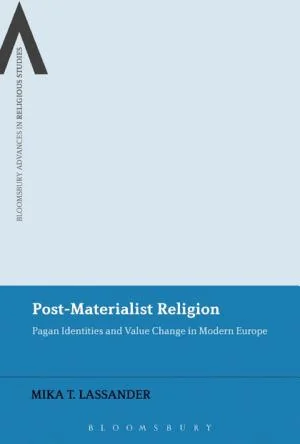
Post-Materialist Religion
 81
81

Post-Materialist Religion
Mika T. Lassander’s Post-Materialist Religion offers a cogent analysis of how societal value changes are reshaping individual worldviews, particularly in the context of declining traditional religiosity in Europe. Lassander adeptly synthesizes sociological and social-psychological theories, presenting a clear argument about the emergence of a new ethos. The work's strength lies in its precise academic language and its focus on verifiable societal trends rather than speculative spiritual claims. However, the book's dense theoretical framework, while intellectually rigorous, might prove challenging for readers unfamiliar with the specific sociological concepts it employs. A particularly illuminating section discusses the shift from extrinsic to intrinsic value orientations, a concept that underpins much of the author’s thesis. Ultimately, Lassander provides a valuable, albeit demanding, examination of contemporary belief systems.
📝 Description
81
Mika T. Lassander's 2016 book analyzes how societal value changes reshape individual spiritual frameworks.
Post-Materialist Religion examines how shifts in societal values influence personal belief systems and spiritual frameworks in contemporary societies. Lassander scrutinizes the impact of large-scale cultural transformations on individual experiences as people search for meaning. This work originated during a time of significant discussion about secularization trends in Europe. It engages with sociological theories about the decline of organized religion and the rise of 'spiritual but not religious' identities. The book addresses the ongoing question of whether society is becoming less religious overall or if new forms of spirituality are simply emerging.
Lassander looks at the connection between societal value shifts and individual beliefs, using theories of secularization and social psychology. The analysis covers the development of morality and core human values as traditional religiosity declines. The author suggests that these changes are leading to a new ethos. The book is aimed at scholars, students, and those interested in the sociology of religion, cultural anthropology, and social psychology.
While not explicitly occult, Lassander's work touches on themes relevant to esoteric thought by examining the transformation of belief systems outside traditional religious structures. It addresses the emergence of new spiritual frameworks and the individual's quest for meaning in a post-materialist world. This intersects with esoteric traditions that often focus on personal spiritual development and alternative paths to understanding existence, particularly as institutionalized religion wanes.
💡 Why Read This Book?
• Understand the sociological underpinnings of modern belief shifts, learning how secularization theories, as discussed by Lassander, explain the decline of traditional religious adherence in favor of new value systems. • Grasp the social-psychological mechanisms behind value development, as explored in the book, to see how interpersonal relations and evolving morality shape contemporary spiritual outlooks. • Gain insight into the emerging post-materialist ethos, a concept Lassander details, offering a framework to analyze the spiritual landscape beyond conventional religious structures.
⭐ Reader Reviews
Honest opinions from readers who have explored this book.
❓ Frequently Asked Questions
What is the primary focus of Post-Materialist Religion?
The book primarily focuses on how societal value changes in modern societies transform individual worldviews and the nature of belief, particularly examining the decline of traditional religiosity in Europe since the mid-20th century.
Which academic fields does Post-Materialist Religion draw upon?
It draws upon sociology, specifically secularization theory, and social psychology, focusing on interpersonal relations, moral development, and basic human values.
When was Post-Materialist Religion first published?
Post-Materialist Religion was first published on May 19, 2016.
What does the book suggest about the future of religion?
The book suggests the emergence of a new ethos driven by societal value shifts, moving beyond traditional religious frameworks and indicating a transformation in how individuals find meaning and structure their beliefs.
Is this book suitable for a general audience?
While accessible to the intellectually curious, the book is primarily geared towards academics and students due to its dense theoretical framework and specialized terminology from sociology and social psychology.
What societal changes does Lassander analyze?
Lassander analyzes long-term societal value changes, particularly the shift away from traditional religious adherence in Europe, and its impact on individual worldviews and moral development.
🔮 Key Themes & Symbolism
Secularization and Value Shifts
The work critically examines the ongoing process of secularization, particularly within European societies, detailing how a decline in traditional religious adherence correlates with fundamental shifts in societal values. Lassander analyzes how this detachment from established religious dogma allows for the formation of new value systems that prioritize individual autonomy and subjective experience over collective dogma, impacting how meaning is constructed.
Social Psychology of Belief
Lassander explores the social-psychological underpinnings of belief formation and moral development. The book explores how interpersonal relations and the evolving nature of basic human values contribute to individuals' worldviews. It posits that as traditional religious structures wane, new psychological frameworks emerge to guide ethical reasoning and social cohesion.
Emerging Post-Materialist Ethos
A central theme is the concept of a post-materialist ethos that arises from these societal transformations. This ethos reflects a move away from purely materialistic concerns towards a greater emphasis on personal fulfillment, self-expression, and subjective well-being. Lassander argues this new framework shapes contemporary spiritual seeking and the definition of a meaningful life beyond religious institutions.
Transformation of Worldviews
The book charts the profound transformation of individual worldviews in contemporary societies. It illustrates how macro-level societal changes, such as economic development and increased education, directly influence micro-level perceptions of reality, spirituality, and purpose. This transformation is presented not as a loss of meaning, but as a redefinition of it.
💬 Memorable Quotes
Direct passages from the work, attributed to the author.
“The decline of traditional religiosity in Europe is accompanied by an emerging ethos.”
— This statement expresses the book's core argument: that the fading of established religious institutions is not creating a void, but rather fostering a new set of values and beliefs that characterize contemporary society.
“Societal value change plays a significant role in the transformations of the individual's worldview.”
— This highlights the book's focus on the macro-level societal influences—the prevailing values and cultural norms—that directly shape individual perceptions and spiritual frameworks.
“The nature of basic human values is being redefined in contemporary modern societies.”
— This points to Lassander's exploration of how fundamental ethical principles and personal values are shifting, moving away from religious dictates towards more secular or individualized understandings.
“Interpersonal relations are central to understanding the development of morality.”
— This emphasizes the social-psychological aspect of the work, suggesting that our ethical frameworks are largely built and maintained through our interactions with others.
“The contemporary individual's worldview is increasingly shaped by factors beyond traditional religious doctrine.”
— This captures the essence of the post-materialist shift, indicating a move towards diverse sources of meaning and belief that are not necessarily tied to established religious narratives.
🌙 Esoteric Significance
Tradition
While not explicitly aligning with a single esoteric lineage, Post-Materialist Religion engages with themes relevant to modern esoteric thought by examining the shift away from dogmatic religious structures. It appeals to Gnostic concerns about the limitations of established doctrines and Hermetic principles of understanding universal laws through observation of societal evolution. The work departs from traditional esotericism by grounding its analysis in empirical sociological and psychological data rather than mystical revelation.
Symbolism
The book does not focus on overt esoteric symbols. Instead, its 'symbols' are conceptual: the 'decline of traditional religiosity' represents the shedding of old forms, while the 'emerging ethos' symbolizes the nascent spiritual and ethical frameworks of the post-materialist individual. The 'transformation of worldviews' acts as a motif for the alchemical process of societal and individual change.
Modern Relevance
Contemporary thinkers and movements exploring the 'spiritual marketplace,' the psychology of secular spirituality, and the ethics of postmodern societies draw on the analytical groundwork laid by Lassander. His work is relevant to scholars of New Age spirituality, those investigating the impact of globalization on belief systems, and researchers examining the rise of humanistic and secular ethical frameworks.
👥 Who Should Read This Book
• Students of sociology and religious studies seeking to understand contemporary shifts in belief beyond simple secularization. • Social psychologists interested in the development of morality and the impact of societal values on individual worldviews. • Individuals questioning traditional religious frameworks and seeking an academic perspective on the evolving field of meaning and spirituality.
📜 Historical Context
Mika T. Lassander's Post-Materialist Religion, published in 2016, arrived amidst a robust academic conversation about secularization, particularly concerning the declining influence of institutionalized religion in Western Europe. The work engages directly with theories proposed by sociologists like Peter L. Berger and scholars examining the rise of 'spiritual but not religious' demographics. It sought to contextualize these trends not merely as a loss of faith, but as a profound societal reorientation. The book's analysis stands in contrast to more traditional religious apologetics and offers a framework for understanding contemporary belief systems that moves beyond simple secularization narratives, highlighting the emergence of new value structures in the wake of religious decline. Its publication provided a timely contribution to understanding the evolving spiritual and ethical landscape.
📔 Journal Prompts
The emerging ethos: How does your personal value system align with or diverge from the post-materialist ethos described by Lassander?
Societal value change: Reflect on a significant societal value shift you have witnessed and its impact on your own worldview.
Transformation of worldviews: How has your understanding of 'meaning' evolved throughout your life, independent of traditional religious structures?
Secularization and morality: Analyze a contemporary ethical dilemma and consider how its resolution might be approached outside of religious doctrines.
Interpersonal relations and values: Consider how your closest relationships have influenced the development of your core personal values.
🗂️ Glossary
Post-Materialist Ethos
A value system characterized by a focus on self-expression, individual autonomy, and quality of life, often emerging in societies where basic material needs are largely met and traditional religious adherence has declined.
Secularization
The process by which religion loses its social and cultural significance, leading to a decline in the influence of religious institutions and beliefs in public life and individual consciousness.
Worldview Transformation
A fundamental change in an individual's perception of reality, their place in the universe, and their underlying assumptions about life, often influenced by societal, cultural, or personal experiences.
Societal Value Change
Alterations in the collective priorities, beliefs, and norms that guide behavior and judgment within a society over time, impacting everything from political discourse to personal ethics.
Interpersonal Relations
The connections, interactions, and relationships between individuals, which play a central role in shaping social behavior, moral development, and the formation of personal values.
Development of Morality
The process through which individuals acquire and refine their understanding of right and wrong, fairness, and ethical principles, influenced by social learning, cognitive development, and cultural context.
Basic Human Values
Fundamental, enduring beliefs about desirable modes of conduct or end-states of existence that guide individuals' lives and are shared to varying degrees across cultures, but can be redefined by societal shifts.
🔮 Readers Also Liked
Browse all →









More Free Sacred Texts & Gnosticism Books
View all →