I Ching
 82
82

I Ching
Kerson Huang's 2014 translation of the I Ching offers a scholarly yet accessible entry into this foundational text of Chinese wisdom. The side-by-side presentation of Chinese characters and English translation is a significant advantage, particularly for those with some familiarity with classical Chinese. Huang's stated intention to use archaeological findings to clarify obscure passages is commendable; the integration of such scholarship lends weight to his interpretations. The poetic quality of the rendition, as claimed, is present, though its success may vary depending on the reader's expectations of classical translation. A notable strength is the introductory section, which provides a solid grounding in the historical and philosophical backdrop. However, the claim of 'dramatic and revealing' might be an overstatement; while insightful, the translation does not radically alter the established understanding of the text. The primary limitation lies in the inherent difficulty of translating such an ancient and nuanced work into a modern language while fully preserving its multilayered meanings and cultural context. Ultimately, Huang's version is a valuable addition to the existing corpus of I Ching translations, particularly for its scholarly apparatus and dual-language format.
📝 Description
82
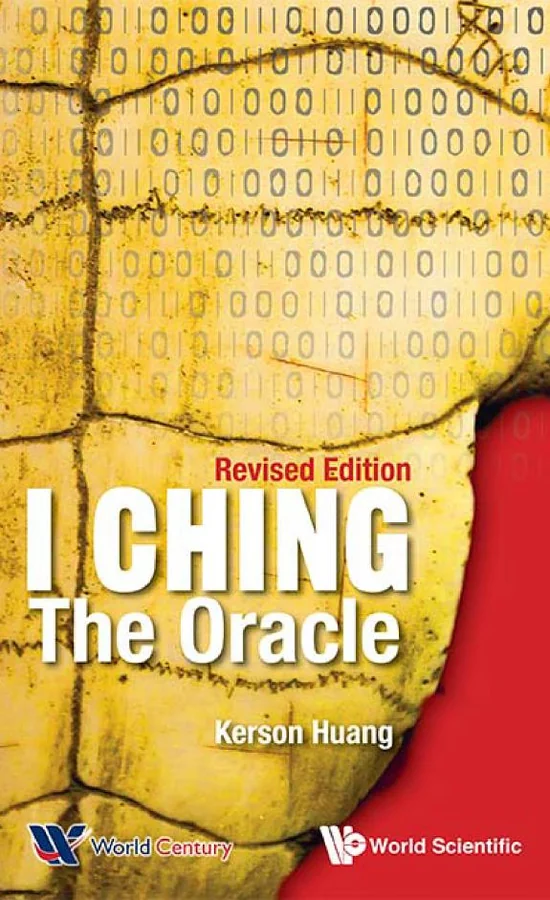
Kerson Huang's 2014 translation of the I Ching includes original Chinese characters and recent archaeological findings.
This 2014 edition of the I Ching, translated by Kerson Huang, presents the ancient Chinese divination text with its original Chinese characters alongside an English rendition. It distinguishes itself by incorporating recent archaeological discoveries to illuminate passages previously shrouded in obscurity. The translation aims to retain the poetic essence and original character of the text. An introductory section grounds the reader in the historical and philosophical milieu from which the I Ching emerged.
This work is intended for serious students of divination, ancient philosophy, and comparative religion. Scholars and practitioners seeking a more textually informed translation will find value in Huang's approach. Individuals interested in the historical development of Chinese thought and its enduring influence will also benefit from the contextual background provided. It is suited for those who appreciate meticulous scholarship applied to foundational esoteric texts.
The I Ching, or Book of Changes, is one of the oldest Chinese classic texts, with origins potentially stretching back to the Western Zhou dynasty. Its compilation and commentary evolved over centuries, involving figures like Confucius. During the Han Dynasty, it was officially established as one of the Five Classics of Confucianism. Throughout its history, it has been interpreted through various philosophical lenses, including Taoism and later Neo-Confucianism, influencing not only divination but also cosmology, ethics, and statecraft.
💡 Why Read This Book?
• Gain a deeper understanding of the I Ching's foundational principles by examining its connection to archaeological findings that illuminate passages obscured for millennia, as presented in Huang's 2014 translation. • Appreciate the poetic and philosophical nuances of the text through a rendition that strives to preserve the flavor of the original Chinese, allowing for a more resonant engagement with its wisdom. • Benefit from a comprehensive introduction to the historical and philosophical background of the I Ching, providing essential context for interpreting its 64 hexagrams and their associated judgments.
⭐ Reader Reviews
Honest opinions from readers who have explored this book.
❓ Frequently Asked Questions
What makes Kerson Huang's I Ching translation different from other versions?
Huang's 2014 translation distinguishes itself by incorporating recent archaeological findings to clarify obscure passages and by presenting the original Chinese text side-by-side with its English rendition, aiming for a poetic and contextually informed interpretation.
When was Kerson Huang's translation of the I Ching first published?
Kerson Huang's translation of the I Ching was first published in 2014.
Does this edition of the I Ching include the original Chinese text?
Yes, this edition features the original Chinese text set side-by-side with the English translation by Kerson Huang.
What kind of background information is provided in the book?
The book includes an introductory section that details the historical and philosophical background of the I Ching, offering context for understanding its origins and significance.
Who is the author of this specific translation of the I Ching?
The translator of this specific edition of the I Ching is Kerson Huang.
How does this translation approach the meaning of ancient passages?
This translation utilizes archaeological findings to uncover the meaning of passages that have been obscured for thousands of years, aiming for greater clarity and accuracy.
🔮 Key Themes & Symbolism
Divination and Guidance
The I Ching functions as a system for divination, offering counsel on present circumstances and future possibilities. Each of the 64 hexagrams, formed from combinations of yin and yang lines, represents a distinct situation or archetype. The text provides judgments and line statements that guide the interpreter in understanding the dynamics at play and making informed decisions. Huang's translation emphasizes clarity in these divinatory pronouncements, drawing on textual and archaeological evidence to support interpretations of passages that have historically posed challenges.
Cosmic Order and Change
Central to the I Ching is the concept of continuous change governed by the interplay of yin and yang forces. These fundamental principles are seen as the driving engine of the cosmos, manifesting in all phenomena. The hexagrams serve as symbolic representations of the myriad forms that change can take. Huang's work explores how this ancient text articulates a worldview where understanding the patterns of transformation is key to harmonizing with the natural order and navigating life's complexities.
Philosophical and Historical Roots
This translation studies the I Ching's deep roots within Chinese philosophical and historical traditions. The introductory material contextualizes the text within the broader field of ancient Chinese thought, potentially touching upon its relationship with Confucianism and Taoism. By referencing archaeological findings, the work seeks to connect the text to its earliest known historical periods, offering a more grounded understanding of its original intent and evolution over millennia.
Linguistic and Textual Scholarship
A significant aspect of Huang's translation is its focus on textual fidelity and scholarly rigor. The inclusion of the original Chinese characters alongside the English translation facilitates direct comparison and study. The approach highlights how linguistic interpretation, informed by archaeological discoveries, can shed new light on ancient texts. This meticulous attention to the source material aims to provide readers with a translation that is both accurate and poetically evocative of the original.
💬 Memorable Quotes
Direct passages from the work, attributed to the author.
“Archeological findings are used to uncover the meaning of passages obscured for thousands of years.”
— This highlights the translation's commitment to integrating scholarly advancements, particularly from archaeology, to resolve textual ambiguities and provide a clearer understanding of the I Ching's historical meaning.
“It preserves the flavor of the original in a poetic rendition.”
— This suggests the translation prioritizes aesthetic and stylistic elements, aiming to convey not just the literal meaning but also the tone and artistry of the ancient Chinese text.
“The Chinese original is set side-by-side with the translation.”
— This dual-language format is crucial for serious students, allowing for direct comparison, linguistic study, and a deeper appreciation of the translator's choices and the source text's structure.
“An introductory part of this book provides the historical and philosophical background to the I Ching.”
— This indicates the book is designed for readers seeking not just a translation but also a comprehensive understanding of the I Ching's context within ancient Chinese culture and thought.
“This book contains a dramatic and revealing translation of this ancient classic into English.”
— This statement sets a high expectation for the translation's impact, suggesting it offers new perspectives or clarifies previously misunderstood aspects of the I Ching.
🌙 Esoteric Significance
Tradition
The I Ching is foundational to numerous esoteric traditions, particularly within East Asian Taoism and Neo-Confucianism, but its influence extends globally. It is often considered a cosmological text that maps universal principles of change and balance. While not strictly Hermetic or Kabbalistic, its binary logic (yin/yang, broken/unbroken lines) and symbolic structure have found parallels and applications within Western esoteric systems seeking to understand cosmic order and transformation.
Symbolism
The core symbolism revolves around the trigrams (three-line figures representing fundamental elements like Heaven, Earth, Water, Fire) and the 64 hexagrams formed by their combinations. These symbols are not mere abstract representations but are believed to embody dynamic forces and archetypal situations. The interplay of yin (broken line) and yang (unbroken line) is paramount, symbolizing the dualistic yet complementary nature of reality and the constant flux that characterizes existence.
Modern Relevance
Contemporary practitioners of systems thinking, chaos theory, and even certain branches of psychology (influenced by Jung's engagement with the text) find relevance in the I Ching's model of dynamic change and pattern recognition. Its principles continue to inform modern divination practices, philosophical inquiry, and artistic creation, serving as a sophisticated framework for understanding complex systems and personal development.
👥 Who Should Read This Book
• Students of Chinese philosophy and ancient divination systems seeking a textually informed translation that incorporates modern scholarship. • Comparative religion scholars interested in the historical development and cross-cultural impact of foundational wisdom texts. • Individuals drawn to esoteric studies who wish to explore a primary source that bridges cosmology, divination, and philosophical inquiry through symbolic representation.
📜 Historical Context
The I Ching, or Book of Changes, boasts a lineage stretching back over three millennia, with its earliest roots likely in the Western Zhou dynasty (c. 1046–771 BCE). Its canonical status was solidified during the Han Dynasty (206 BCE – 220 CE) when it became one of the Five Classics of Confucianism, a core part of Chinese education and statecraft. Throughout subsequent dynasties, it was interpreted through various philosophical lenses, including Taoism and Neo-Confucianism, demonstrating its adaptability and enduring relevance. The text's transmission and reception in the West gained significant momentum in the 20th century, notably through Richard Wilhelm's German translation, which was later rendered into English by Cary Baynes. Wilhelm's work, in particular, sparked considerable interest among Western intellectuals and esotericists, including Carl Jung, who saw in its principles a reflection of his theories of synchronicity. Kerson Huang's 2014 translation enters this rich tradition, offering a modern scholarly perspective informed by recent archaeological discoveries, aiming to provide a more precise understanding of the text's ancient origins.
📔 Journal Prompts
The evolving nature of the hexagrams and their connection to personal circumstances.
Interpreting the balance of yin and yang in a specific life situation.
The role of archetypal imagery within the I Ching's judgments.
How archaeological insights refine the understanding of ancient passages.
The philosophical implications of constant change as depicted in the text.
🗂️ Glossary
Hexagram
A figure composed of six stacked horizontal lines, each line being either solid (yang) or broken (yin). There are 64 possible hexagrams in the I Ching, representing fundamental archetypes and situations.
Trigram
A figure composed of three stacked horizontal lines, each either solid (yang) or broken (yin). There are eight basic trigrams (e.g., Heaven, Earth, Fire, Water), which combine to form the 64 hexagrams.
Yin
In the I Ching and Chinese philosophy, yin represents the passive, dark, feminine, and receptive principle, often symbolized by a broken line (--).
Yang
In the I Ching and Chinese philosophy, yang represents the active, light, masculine, and creative principle, often symbolized by a solid line (—).
Judgment
A brief text associated with each hexagram, offering an overall interpretation or counsel regarding the situation represented by the hexagram.
Line Statement
Texts associated with each of the six lines within a hexagram, providing more specific guidance or commentary relevant to that particular line's position and meaning.
Divination
The practice of seeking knowledge about the future or the unknown through supernatural means. In the context of the I Ching, it involves casting methods (like coins or yarrow stalks) to generate hexagrams for interpretation.
This book appears in 1 collection
🔮 Readers Also Liked
Browse all →








From the “Confucianism” Collection
View all →


More Free Occult Philosophy Books
View all →