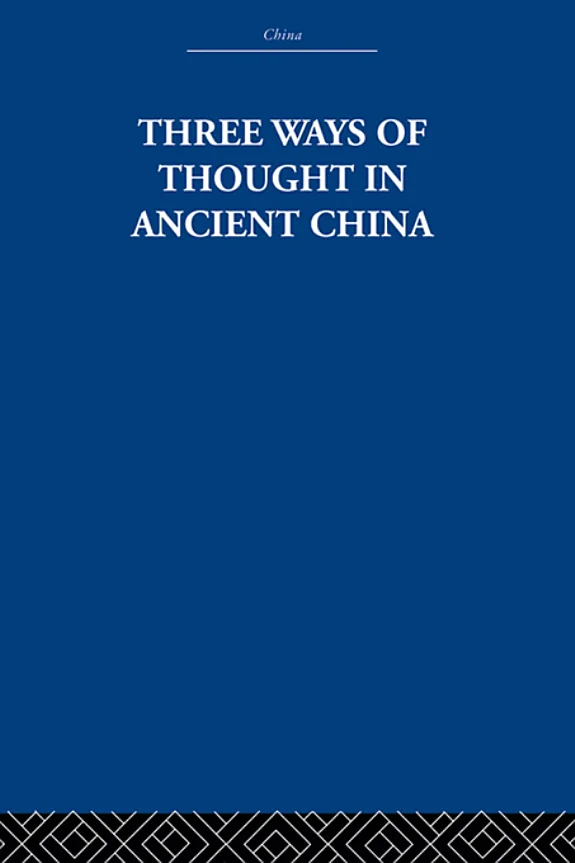
Three Ways of Thought in Ancient China
 72
72

Three Ways of Thought in Ancient China
Arthur Waley's "Three Ways of Thought in Ancient China" offers a compelling, if somewhat dated, introduction to three pivotal figures in early Chinese philosophy. The strength lies in Waley's judicious selection of passages, allowing Chuang Tzu's mystical musings, Mencius's moral arguments, and Han Fei Tzu's stark pragmatism to speak for themselves. The direct comparison between Han Fei Tzu's legalism and 20th-century totalitarianism, as noted in the original blurb, remains a potent observation. However, the book's primary limitation is its age; while influential, its interpretations and translations may not reflect contemporary sinological scholarship. The passage detailing Mencius's argument for innate human goodness, contrasting it with the utilitarianism of Mozi, exemplifies the book's core strength: showcasing contrasting philosophical approaches. Waley's work is a valuable historical artifact and a solid entry point, provided readers are aware of its temporal context.
📝 Description
72
Arthur Waley published "Three Ways of Thought in Ancient China" in 1939.
Arthur Waley's 1939 book examines three major currents in early Chinese thought. He uses selections from canonical texts to illustrate the differing approaches of Chuang Tzu, Mencius, and Han Fei Tzu. The work seeks to show how these thinkers understood the world, human ethics, and statecraft.
Waley's choices reflect the intellectual climate of the late 1930s. The inclusion of Han Fei Tzu's legalism, with its connections to contemporary political systems, offered readers a timely perspective on enduring political philosophy. The book aims to make complex ideas understandable while retaining their intellectual rigor, presenting a view of ancient Chinese intellectual history through these distinct philosophical frameworks.
While not strictly esoteric in the Western occult sense, this book engages with philosophical traditions that shaped a civilization's worldview for millennia. It presents systems of thought that offered alternative ways of understanding existence, morality, and social order, separate from the dominant narratives of their time. Waley’s focus on these foundational texts allows readers to access the core ideas that informed Chinese culture and spirituality, revealing a different logic for living.
💡 Why Read This Book?
• Gain insight into the foundational philosophical divergence between Taoist spontaneity (exemplified by Chuang Tzu) and Confucian ethical cultivation (represented by Mencius), understanding how these schools offered different paths to societal harmony. • Grasp the principles of Legalism through direct extracts from Han Fei Tzu, recognizing its emphasis on strict laws and state control, concepts that continue to echo in modern governance structures. • Appreciate Arthur Waley's 1939 scholarship in presenting these ancient Chinese thinkers, understanding the historical lens through which these enduring philosophies were introduced to a Western audience.
⭐ Reader Reviews
Honest opinions from readers who have explored this book.
❓ Frequently Asked Questions
What is the primary focus of Arthur Waley's "Three Ways of Thought in Ancient China"?
The book primarily focuses on three distinct schools of thought in ancient China: Taoism (via Chuang Tzu), Confucianism (via Mencius), and Legalism (via Han Fei Tzu), presenting their core ideas through selected texts.
When was "Three Ways of Thought in Ancient China" first published?
The book was first published in 1939, with later editions, including the one referenced here, making its insights accessible to new generations of readers.
How does Han Fei Tzu's philosophy relate to modern concepts?
Han Fei Tzu's Legalist philosophy, emphasizing strict laws and state authority, is presented as having a direct parallel to modern totalitarianism, a connection made explicit by Arthur Waley.
What are the key differences between Chuang Tzu and Mencius as presented in the book?
Chuang Tzu's thought appeals to imagination and a spontaneous approach to life, while Mencius's philosophy appeals to moral feelings and ethical development, representing contrasting orientations.
Is this book a complete collection of the works of Chuang Tzu, Mencius, and Han Fei Tzu?
No, the book consists chiefly of extracts and selections from these authors, curated by Arthur Waley to illustrate specific philosophical approaches rather than providing exhaustive texts.
What is the significance of Arthur Waley's contribution in this book?
Waley's significance lies in his influential translation and his conceptual framing that brought these distinct Chinese philosophical traditions to a Western audience in the 1930s.
🔮 Key Themes & Symbolism
The Taoist Imagination
The selections from Chuang Tzu highlight a philosophy that prioritizes spontaneity, naturalness, and a detachment from conventional societal structures. This 'way' of thought appeals directly to the imagination, presenting paradoxes and allegories that challenge rationalistic thinking. It suggests a path of effortless action (wu wei) and embracing the natural flow of the Tao, a concept central to Taoist esoteric traditions seeking harmony with the cosmic order.
Mencius's Moral Imperative
In contrast, the extracts from Mencius focus on the cultivation of innate human goodness and the ethical responsibilities of both individuals and rulers. His philosophy appeals to the moral feelings, arguing for benevolence and righteousness as the foundations of a just society. This ethical framework is a core part of Confucianism, emphasizing social harmony through virtuous conduct and proper governance.
Han Fei Tzu's Legalist Realism
Han Fei Tzu represents a starkly different approach – Legalism. His thought emphasizes the absolute necessity of strict laws, clear punishments, and rewards to maintain social order and state power. This pragmatic and often severe perspective, stripped of overt moral appeals, finds contemporary resonance in discussions of authoritarianism and state control, highlighting ancient China's engagement with realpolitik.
Comparative Philosophical Frameworks
The overarching theme is the presentation of these three divergent intellectual streams as distinct 'ways' of understanding existence, ethics, and governance. Waley's comparative method, by juxtaposing these texts, allows readers to see the breadth of ancient Chinese philosophical inquiry and the fundamental questions they sought to address, from individual liberation to societal structure.
💬 Memorable Quotes
Direct passages from the work, attributed to the author.
“Chuang Tzu appeals to the imagination.”
— This concise statement by Waley expresses the unique power of Chuang Tzu's writings. It suggests that his philosophy operates not through logical argument alone, but through evocative imagery, paradox, and allegory that bypasses conventional reason to touch something deeper within the reader.
“Mencius appeals to the moral feelings.”
— This contrasts directly with Chuang Tzu's method. It indicates that Mencius's philosophical project aims to stir the reader's sense of right and wrong, leveraging innate ethical sensibilities to persuade and guide towards virtuous action and governance.
“Han Fei Tzu's realism finds a close parallel in modern Totalitarianism.”
— This observation, made in the context of the book's 1939 publication, highlights the enduring relevance of ancient political thought. It points to the similarities between Han Fei Tzu's emphasis on state power, law, and control, and the political systems emerging in the 20th century.
“Extracts from Chuang Tzu, Mencius and Han Fei Tzu.”
— This fundamental description outlines the book's structure. It signifies that Waley has curated specific portions of these foundational texts to showcase the distinct philosophical contributions of each thinker, rather than presenting a comprehensive study of their entire works.
“These extracts... have a very contemporary connection.”
— This assertion underscores the timelessness of the philosophical problems addressed. It suggests that despite their ancient origins (third century B.C.), the ideas presented by Han Fei Tzu, and to some extent by Mencius and Chuang Tzu, remain relevant to contemporary human concerns and political realities.
🌙 Esoteric Significance
Tradition
While not explicitly part of a single Western esoteric lineage like Theosophy or Kabbalah, Waley's work engages with traditions that have profound esoteric dimensions. Taoism, particularly through Chuang Tzu, is deeply intertwined with mystical practices and the pursuit of inner transformation, aligning with Gnostic or Hermetic quests for gnosis and union with the divine principle (the Tao). Confucianism's focus on ethical cultivation can be seen as a form of social mysticism, aiming for perfected human conduct as a reflection of cosmic order.
Symbolism
Chuang Tzu's philosophy is rich with symbolic language, such as the 'great fish' (Kun) transforming into a bird (Peng), representing the vast potential for transformation and the boundless nature of the Tao. The recurring motif of the 'uncarved block' (P'u) symbolizes a state of natural simplicity and original potential, free from artificial distinctions and societal conditioning, a core ideal in many contemplative practices. The concept of 'wu wei' (non-action) itself functions symbolically, representing an ideal state of alignment with natural forces.
Modern Relevance
Contemporary thinkers and practitioners in fields like mindfulness, non-dualism, and certain branches of psychology draw heavily on Taoist principles presented through figures like Chuang Tzu. The emphasis on naturalness, spontaneity, and letting go speaks to modern desires to counteract the stresses of contemporary life. Furthermore, discussions on effective governance and the balance between individual liberty and state authority continue to engage with the pragmatic, sometimes stark, insights offered by Han Fei Tzu.
👥 Who Should Read This Book
• Students of comparative philosophy: Those seeking to understand the foundational divergences in ancient Chinese thought, specifically Taoism, Confucianism, and Legalism, will find direct textual evidence. • Political theorists and historians: Readers interested in the historical roots of governance models, particularly the enduring relevance of authoritarian and ethical statecraft concepts, will benefit from the Han Fei Tzu selections. • Seekers of wisdom traditions: Individuals exploring diverse paths to understanding existence, ethics, and the human condition will find the distinct philosophical appeals of Chuang Tzu and Mencius valuable.
📜 Historical Context
Published in 1939, "Three Ways of Thought in Ancient China" emerged during a period of significant global upheaval and intellectual ferment. Arthur Waley, a prominent translator and scholar of Chinese literature, aimed to introduce Western readers to foundational Eastern philosophies. The inclusion of Han Fei Tzu's Legalism, with its stark emphasis on state control and authoritarianism, was particularly resonant in the shadow of rising totalitarian regimes in Europe. Waley explicitly drew parallels between Han Fei Tzu's third-century B.C. doctrines and contemporary political systems, a connection that would have struck a chord with readers grappling with Nazism and Fascism. This contextualization offered a historical perspective on political structures that seemed alarmingly modern. The intellectual currents of the time favored comparative studies, and Waley's work contributed to a growing Western interest in Chinese thought, though it also reflected the scholarly perspectives and translation conventions of its era.
📔 Journal Prompts
The Taoist concept of 'wu wei' as presented through Chuang Tzu.
Mencius's arguments regarding the innate goodness of human nature.
The Legalist emphasis on strict laws and punishments by Han Fei Tzu.
Reflecting on the imaginative appeal of Chuang Tzu's parables.
Comparing the ethical appeals of Mencius with the pragmatic statecraft of Han Fei Tzu.
🗂️ Glossary
Tao (or Dao)
The fundamental principle and natural order of the universe in Taoism. It is often described as ineffable, the source from which all things arise and to which they return.
Wu Wei
A central Taoist concept, often translated as 'non-action' or 'effortless action.' It signifies acting in accordance with the natural flow of the Tao, without forcing or striving.
Legalism
A school of Chinese philosophy that advocated for a strong, centralized state governed by strict laws, clear punishments, and rewards, as expounded by thinkers like Han Fei Tzu.
Confucianism
A philosophical and ethical system based on the teachings of Confucius, emphasizing morality, social harmony, filial piety, and good governance through virtuous leadership.
Chuang Tzu (Zhuang Zhou)
A major figure in Taoism whose writings are characterized by wit, paradox, and allegorical stories that explore themes of freedom, nature, and the relativity of human values.
Mencius (Mengzi)
A Confucian philosopher who developed Confucius's teachings, notably arguing for the inherent goodness of human nature and the importance of benevolent governance.
Han Fei Tzu
A prominent Legalist philosopher whose work synthesized earlier Legalist ideas, advocating for a systematic approach to statecraft based on law, technique, and power.
This book appears in 1 collection
🔮 Readers Also Liked
Browse all →









From the “Confucianism” Collection
View all →




More Free Occult Philosophy Books
View all →