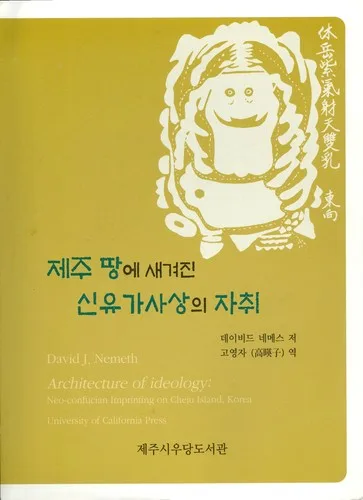
The architecture of ideology by David J. Nemeth ( in translation)
 61
61

The architecture of ideology by David J. Nemeth ( in translation)



Balthazar Finch, Senior Critic, Occult Philosophy, declares: "Nemeth's "The Architecture of Ideology" is a revelation for those who understand that the mundane is merely a veil for the profound. He masterfully unearths the esoteric underpinnings of Neo-Confucianism, demonstrating how P'ungsu, the Korean art of geomancy, served as a sacred blueprint for societal control and spiritual alignment. The examination of Cheju Island's transformation is particularly compelling, showcasing the potent symbiosis between ideology and the terrestrial forces. This is not simply history; it is an exposé of the alchemical manipulation of space and belief, essential reading for scholars of arcane geography and practitioners of landscape magic."
📝 Description
61
David J. Nemeth's 2021 book demonstrates how Korean geomancy shaped Neo-Confucian state ideology.
In "The Architecture of Ideology," David J. Nemeth examines the use of P'ungsu, Korean geomancy, during the Yi Dynasty. Nemeth argues that P'ungsu was more than landscape divination; it served as a method for imposing Neo-Confucian state ideology. He reconstructs the intellectual and spiritual context of the period, concentrating on Cheju Island, a location marked by a negative historical perception.
Using the principles of feng-shui, Nemeth shows how the ruling class manipulated the built environment and daily life on Cheju. Their aim was to transform the island from a place of exile into a functional and ideologically significant territory. The book explores the connection between land, power, and the impact of metaphysical ideas on society. It is suited for readers interested in the unseen forces that influence human civilizations and the hidden knowledge within the physical world.
This work engages with esoteric traditions by analyzing the practical application of geomancy, a practice rooted in ancient cosmological beliefs. P'ungsu, as detailed by Nemeth, is presented not as mere superstition but as a system for aligning human structures with perceived cosmic forces. The book situates this practice within a specific historical and political framework, demonstrating how esoteric knowledge systems can be instrumentalized by state power to shape both physical space and social order. It connects the metaphysical principles of geomancy to the concrete realities of governance and territorial control.
💡 Why Read This Book?
Uncover the secret ways ideology is inscribed upon the land through the ancient art of geomancy. Understand how seemingly natural landscapes are shaped by hidden metaphysical principles and political will. This book offers a unique perspective for spiritual seekers, cultural historians, and anyone fascinated by the deep connections between belief, place, and power.
⭐ Reader Reviews
Honest opinions from readers who have explored this book.
❓ Frequently Asked Questions
What is P'ungsu and how does it relate to feng-shui?
P'ungsu is the Korean equivalent of Chinese feng-shui, an ancient practice that involves harmonizing human environments with the natural landscape. It is based on principles of energy flow (qi) and auspicious placement, aiming to enhance prosperity and well-being.
How did Neo-Confucian ideology influence the landscape of Cheju Island?
Neo-Confucian ideology, through the application of P'ungsu, was used to imbue Cheju Island with a specific spiritual and political significance, transforming its perception and shaping its built environment to align with dynastic ideals.
Is this book about practical geomancy or historical analysis?
The book is primarily a historical and cultural analysis, but it deeply explores the practical application and philosophical underpinnings of geomancy (P'ungsu) as a tool of ideology.
Who is David J. Nemeth?
David J. Nemeth is an author and scholar whose work often explores the intersection of culture, religion, and the built environment, with a particular focus on East Asian traditions.
What makes this book 'esoteric'?
The book's esoteric nature lies in its examination of hidden knowledge systems like geomancy, their symbolic language, and their profound influence on societal structures and beliefs, revealing the unseen forces at play.
🔮 Key Themes & Symbolism
The Geomantic Blueprint of Power
This theme studies the profound influence of geomancy, or P'ungsu, as a sophisticated science employed not just for aesthetic harmony but as a potent instrument of state ideology. The book illustrates how the principles of auspicious placement and energy flow were strategically applied to shape the physical and spiritual landscape, thereby reinforcing political and social structures. It reveals how the manipulation of the environment became a method of ideological control, demonstrating the ancient understanding of the deep connection between the earth and the governance of people.
Transforming Exile into Ideological Territory
The book offers a compelling narrative of Cheju Island, a locale historically perceived as a harsh environment and a place of banishment. Nemeth challenges this negative perception by showcasing how Neo-Confucian ideology, through the meticulous application of P'ungsu, actively reconstructed the island's identity. This involved not just practical construction but the infusion of symbolic meaning into the landscape, turning a site of marginalization into a territory that affirmed and conserved the ruling dynasty's philosophical tenets and power.
The Intertwined Nature of Belief and Built Environment
This core theme explores the inextricable link between deeply held beliefs, particularly Neo-Confucian ideology, and the tangible manifestation of the built environment. It argues that the physical spaces we inhabit are not neutral but are imbued with the philosophical and spiritual aspirations of those who shape them. The book demonstrates how the architecture of ideology, guided by practices like P'ungsu, creates a feedback loop where the environment reinforces beliefs, and beliefs, in turn, dictate the design and purpose of the physical world.
💬 Memorable Quotes
Direct passages from the work, attributed to the author.
“Geomancy: the sacred script of stone and stream.”
— This poetic phrase captures geomancy as a profound system of knowledge, akin to a sacred language, that interprets the natural world to reveal deeper truths and auspicious patterns.
“Ideology, a phantom limb of the state, felt through the earth.”
— This evocative metaphor likens ideology to an intangible but powerfully present entity, its influence deeply felt and manifested through the physical manipulation of the terrestrial realm.
“Cheju's transformation was a proof of belief made manifest.”
— This statement highlights the transformative power of deeply held convictions, particularly Neo-Confucianism, to actively alter and redefine a place through deliberate action and interpretation of the landscape.
💡 Key Ideas
Editorial paraphrase of the work's core concepts — not direct quotes.
The land remembers the intentions of its architects.
This quote suggests that the physical landscape retains an imprint of the beliefs and motivations of those who shaped it, implying a hidden history embedded within the earth itself.
The built environment as a temple of state philosophy.
This quote frames the structures and landscapes created under ideological influence as sacred spaces dedicated to upholding and propagating the ruling philosophy, much like a religious sanctuary.
🌙 Esoteric Significance
Tradition
The book draws heavily from East Asian esoteric traditions, primarily Korean P'ungsu (geomancy) and its philosophical underpinnings in Neo-Confucianism. It explores how these traditions viewed the inherent spiritual energy (qi) within the land and how manipulating this energy through careful placement and design could influence human destiny and societal harmony.
Symbolism
Key symbols include the dragon, often representing the flow of qi; the five elements (wood, fire, earth, metal, water) and their interactions; auspicious mountain and water formations; and the strategic placement of buildings and tombs. These elements, when arranged correctly, were believed to create a harmonious environment that attracted positive spiritual forces and deterred negative ones.
Modern Relevance
In a world increasingly disconnected from the natural environment, this book offers a potent reminder of the profound interconnectedness between our physical surroundings and our psychological, spiritual, and societal well-being. It provides a framework for understanding how conscious design and an awareness of subtle energies can foster healthier and more meaningful spaces, relevant to urban planning, interior design, and personal spiritual practice.
👥 Who Should Read This Book
This book is a treasure for a diverse audience. **Scholars** of East Asian history, philosophy, and religious studies will find a rigorous and insightful analysis. **Seekers** of esoteric knowledge will be captivated by the exploration of geomancy as a spiritual science and its role in shaping human experience. **Practitioners** of feng-shui and related disciplines will gain a deeper understanding of its historical and ideological applications. **Beginners** curious about the hidden influences on our world will find a compelling narrative that illuminates the profound connection between belief, landscape, and power.
📜 Historical Context
This work is deeply rooted in the intellectual and political climate of Korea's Yi Dynasty (1392-1910), a period heavily influenced by Neo-Confucianism. This philosophy, emphasizing social hierarchy, ritual, and a harmonious relationship with the cosmos, permeated every aspect of governance and daily life. The practice of P'ungsu, or geomancy, which seeks to align human habitation with auspicious natural forces, became a crucial tool for implementing Neo-Confucian ideals. The ruling class utilized P'ungsu to legitimize their authority, shape the landscape according to their philosophical vision, and foster a sense of order and cosmic balance. This era saw a deliberate effort to create a society that reflected these principles, making the study of its built environment a window into its spiritual and political core.
📔 Journal Prompts
How does the concept of 'auspicious placement' resonate with your personal sense of well-being?
Reflect on a place in your life that feels particularly 'charged' with meaning. What elements contribute to this feeling?
Consider how prevailing ideologies in your own culture might be subtly shaping your environment.
What parallels can you draw between the historical use of geomancy and contemporary trends in urban planning or interior design?
Imagine you are an architect of ideology. What 'sacred script' would you use to design a new community?
🗂️ Glossary
P'ungsu
The Korean practice of geomancy, analogous to Chinese feng-shui, which involves harmonizing human environments with the natural landscape by analyzing energy flows (qi) and auspicious placements.
Neo-Confucianism
A revived and more metaphysical version of Confucianism that became the dominant state ideology in Korea during the Yi Dynasty, emphasizing social order, ethics, ritual, and a harmonious relationship with the cosmos.
Qi (Chi)
In East Asian philosophy, the vital life force or energy that flows through all things, including the natural environment and living beings. P'ungsu aims to optimize the flow of qi.
Yi Dynasty
The Joseon Dynasty of Korea, which ruled from 1392 to 1910. It was characterized by the strong influence of Neo-Confucian ideology and significant developments in Korean culture and governance.
Geomancy
The practice of divination by geographic features, particularly the arrangement of land and water to ensure good fortune. In the context of this book, it refers specifically to P'ungsu.
This book appears in 6 collections
🔮 Readers Also Liked
Browse all →








More by David J. Nemeth
All books →
From the “Transcendental Meditation” Collection
View all →






More Free Divination & Tarot Books
View all →