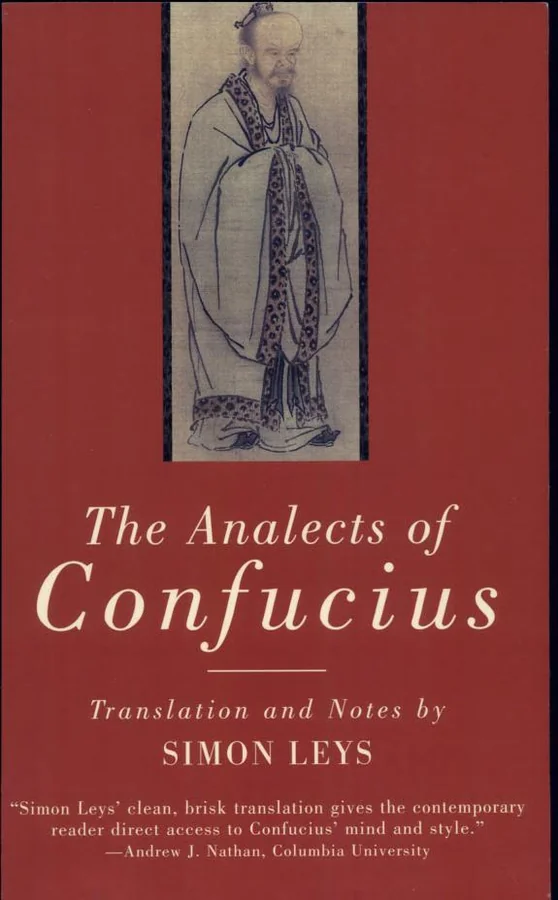
The Analects of Confucius
 82
82

The Analects of Confucius
The Analects offers a starkly practical, almost unadorned, guide to ethical living and governance. Unlike many Western philosophical texts that engage in abstract argumentation, Confucius and his disciples present wisdom through brief, memorable exchanges and pronouncements. This directness is its greatest strength, allowing principles to be readily absorbed and applied. The limitation, however, lies in its fragmented nature; readers accustomed to linear arguments might find the aphoristic style requires significant effort to synthesize into a coherent worldview. A passage like "The Master said, 'Do not do to others what you do not want yourself.'" (Analects 15.24) exemplifies this accessible yet profound ethical core. It is a text that demands contemplation rather than passive consumption. Its enduring relevance lies in its unwavering focus on personal responsibility for social well-being.
📝 Description
82
Confucius's sayings, collected by his disciples, formed the core of East Asian thought for centuries.
The Analects of Confucius is a compilation of dialogues and aphorisms attributed to the philosopher Kong Fuzi and his followers. It was assembled over a considerable period, not as a structured argument, but as a series of observations and brief stories. These passages provide counsel on personal conduct, the maintenance of social order, and principles for effective leadership. The book's lasting influence comes from its focus on cultivating personal ethics and establishing a well-functioning society.
This text is important for understanding the foundations of East Asian ethical and political frameworks. Students of philosophy, history, and comparative religion will find it a primary resource. Leaders, educators, and anyone interested in developing personal character and encouraging more peaceful social interactions will also find value here. Its principles offer practical guidance for everyday life.
The Analects likely took shape between 475 and 221 BCE, during China's Warring States period. This time of conflict and division led thinkers like Confucius to seek ways to restore order and improve governance. Confucius himself lived from 551 to 479 BCE, a time of intellectual change. He proposed an approach centered on morality, proper conduct, and just rule, contrasting with prevailing military and legalistic methods. Though challenged by other schools of thought, his ideas eventually became dominant.
While often seen as a guide to social and political order, The Analects also touches upon the cultivation of the self as a means to achieve harmony. The emphasis on personal virtue and the proper ordering of relationships can be interpreted through an esoteric lens, focusing on the inner transformation required for outer order. The pursuit of *ren* (humaneness) and *li* (ritual propriety) speaks to a disciplined way of being that aligns the individual with a moral cosmos, a common theme in esoteric traditions that seek to understand and enact universal principles through personal practice.
💡 Why Read This Book?
• Gain practical wisdom on cultivating personal virtue, as exemplified by the concept of *Ren* (benevolence), to improve your own character and interactions, directly from the foundational text of Confucian ethics. • Understand the historical and philosophical underpinnings of East Asian governance and social structures, learning how rulers in the Spring and Autumn period sought order through moral example. • Develop a framework for ethical decision-making by studying the emphasis on *Li* (ritual propriety) and its role in maintaining social harmony, as presented in this ancient collection of dialogues.
⭐ Reader Reviews
Honest opinions from readers who have explored this book.
❓ Frequently Asked Questions
When was Confucius actually alive, and when were The Analects compiled?
Confucius lived from 551 to 479 BCE during the Spring and Autumn period. The Analects, a collection of his sayings and those of his disciples, were compiled over centuries, primarily between the Warring States period (475-221 BCE).
What is the core virtue emphasized in The Analects?
The core virtue is *Ren* (仁), often translated as benevolence, humaneness, or goodness. It represents the ideal quality of compassion and empathy in interpersonal relationships and is central to Confucian ethics.
How does The Analects differ from Western philosophical texts?
Unlike Western texts that often feature systematic arguments and abstract reasoning, The Analects is a collection of aphorisms, dialogues, and anecdotes. It focuses on practical ethics, personal cultivation, and social harmony rather than theoretical speculation.
What is the meaning of 'Junzi' as discussed in The Analects?
*Junzi* (君子) refers to the ideal person, the 'superior man' or 'gentleman,' who embodies moral integrity, cultivates virtues like *Ren* and *Li*, and serves as a model for others in society and governance.
Can The Analects be considered an esoteric text?
While primarily a philosophical and ethical guide, its profound influence on societal structures, its emphasis on self-cultivation for harmonious existence, and its enduring wisdom grant it a place within esoteric studies for its insights into human potential and order.
What role does 'Li' play in Confucian thought as presented in The Analects?
'Li' (禮) encompasses ritual, propriety, etiquette, and social norms. It provides the structure for expressing virtues like *Ren* and is essential for maintaining social order and demonstrating respect in all interactions.
🔮 Key Themes & Symbolism
Cultivating Ren (Benevolence)
The Analects repeatedly emphasizes *Ren* (仁) as the paramount virtue, the essence of humaneness and ethical conduct. This theme explores how Confucius and his disciples understood *Ren* not as an abstract ideal but as a practical quality to be developed through daily actions, empathy, and sincere relationships. The text provides numerous examples of how *Ren* manifests in interactions, from familial duties to governing a state, positioning it as the a core part of a virtuous life and a well-ordered society.
The Role of Li (Ritual)
*Li* (禮), encompassing rites, etiquette, and social norms, is presented as the outward expression of inner virtue and the mechanism for social harmony. The Analects details the importance of observing proper conduct in various social contexts, from ancestor veneration to court ceremonies. This theme examines how *Li* provides structure and order, enabling individuals to act appropriately and reinforcing social bonds, thereby contributing to a stable and respectful community.
The Ideal of the Junzi
Central to the ethical framework is the concept of the *Junzi* (君子), the superior person or gentleman. This theme focuses on the qualities and aspirations of the *Junzi*, who is dedicated to moral self-improvement and exemplifies virtues such as righteousness (*yi* 義), benevolence (*ren* 仁), and propriety (*li* 禮). The Analects contrasts the *Junzi* with the petty person (*xiaoren* 小人), highlighting the path of continuous ethical cultivation as the means to achieve this ideal state of character.
Governance Through Moral Example
The Analects offers a distinct model of governance rooted in the moral character of the ruler. This theme explores Confucius's assertion that effective leadership stems not from coercion or strict laws, but from the ruler's personal virtue and virtuous example. By embodying *Ren* and *Li*, a leader can inspire loyalty, foster public trust, and cultivate a morally upright society, demonstrating the profound connection between personal ethics and political stability.
💬 Memorable Quotes
Direct passages from the work, attributed to the author.
“The Master said, "Do not worry about not being in office; worry about what makes you fit for office. Do not worry about not being known; seek something worth knowing."”
— This aphorism highlights Confucius's emphasis on inner cultivation and competence over external recognition or status. It suggests that true worth lies in developing one's character and abilities, rather than in seeking positions or fame.
“Zigong asked, saying, 'Is there one word which may serve as a rule of practice for all one's life?' The Master said, 'Is not reciprocity such a word? What you do not want done to yourself, do not do to others.'”
— This exchange presents the Golden Rule in its negative formulation, emphasizing reciprocity as a guiding principle for all actions. It captures the essence of *Ren* (benevolence) in a simple, universally applicable directive for ethical interaction.
“The Master said, "The superior man is anxious about his shortcomings, not about his lack of reputation."”
— This contrasts the mindset of the *Junzi* (superior man) with that of the common person. The focus is on internal moral development and self-awareness of one's flaws, rather than external validation or societal perception.
💡 Key Ideas
Editorial paraphrase of the work's core concepts — not direct quotes.
The Master said, "A young man should be filial at home and respectful to elders abroad, careful and trustworthy, and should have broad love for the people and draw near to those who are humane. If he has energy left over, he can study literature."
This quote outlines a foundational hierarchy of virtues, prioritizing familial duty, respect, trustworthiness, and compassion before intellectual pursuits. It underscores the practical, relationship-based ethics central to Confucian thought.
The Master said, "If the people be led by laws, and their uniformity be sought by punishments, they will try to avoid the punishment, but have no sense of shame. If they be led by virtue, and uniformity sought by rites, they will have the sense of shame, and moreover will become good."
This passage articulates Confucius's preference for governance through moral suasion and ritual (*li*) over legalistic control. It argues that virtue and proper conduct foster genuine goodness and a sense of shame, leading to a more ethical populace.
🌙 Esoteric Significance
Tradition
While primarily a socio-political and ethical philosophy, The Analects holds a place within esoteric traditions for its emphasis on self-cultivation as a path to enlightenment and societal harmony. Its principles of inner transformation and ethical perfection align with practices found in various wisdom traditions seeking to understand the human condition and its potential for virtuous existence. It offers a structured, humanistic approach to achieving a balanced and ordered inner and outer life, resonating with paths focused on personal development and ethical living.
Symbolism
Key symbolic concepts include the *Junzi* (君子), representing the ideal human potential and the cultivated sage striving for moral perfection. The concept of *Li* (禮) symbolizes the structured order and harmonious relationships that arise from proper conduct and ritual. Furthermore, the recurring motif of learning and self-improvement signifies the journey of spiritual or ethical growth, portraying the human mind as a field to be cultivated for the blossoming of virtue and wisdom.
Modern Relevance
Contemporary thinkers and practitioners in fields ranging from ethics and leadership studies to comparative philosophy draw heavily on The Analects. Its principles of relational ethics, the importance of character development, and governance through moral example continue to be explored in discussions on effective leadership, social responsibility, and intercultural understanding. Practices emphasizing mindfulness, ethical conduct, and community building often find echoes in the wisdom of Confucius, making his work relevant to modern pursuits of personal and collective well-being.
👥 Who Should Read This Book
• Individuals interested in the philosophical foundations of East Asian cultures, seeking to understand the ethical frameworks that have shaped societies for centuries. • Leaders, managers, and educators looking for time-tested principles on ethical conduct, personal responsibility, and fostering harmonious environments through moral example. • Students of comparative religion and philosophy exploring diverse approaches to human ethics, self-cultivation, and the art of living a virtuous life.
📜 Historical Context
The Analects emerged from a period of profound upheaval in China, specifically the Spring and Autumn (771–476 BCE) and Warring States (475–221 BCE) periods. Confucius himself lived through the decline of the Zhou Dynasty's authority, witnessing endemic warfare and political instability. His philosophy offered a powerful counter-narrative to the prevailing Legalist and militaristic ideologies, advocating for social harmony through ethical cultivation, ritual propriety (*Li*), and benevolent rule. His ideas were a significant intellectual current alongside Mohism, founded by Mozi, which emphasized universal love and utilitarianism, and Taoism, which stressed naturalness and non-action. Despite initial challenges, Confucianism, as codified in The Analects, eventually became the dominant state ideology during the Han Dynasty, profoundly shaping Chinese culture and governance for over two millennia.
📔 Journal Prompts
Reflect on the principle of *Ren* (benevolence) in your daily interactions.
Consider how *Li* (ritual propriety) can foster order in your personal or professional life.
Explore the qualities of the *Junzi* and how they apply to your aspirations.
Analyze the concept of governance through moral example in contemporary leadership.
How does the principle of reciprocity inform your decision-making process?
🗂️ Glossary
Ren (仁)
The paramount Confucian virtue, often translated as benevolence, humaneness, goodness, or compassion. It signifies the ideal ethical quality of empathy and concern for others, forming the basis of all virtuous conduct.
Li (禮)
Ritual propriety, etiquette, rites, and social norms. *Li* provides the framework for expressing virtues like *Ren* and is essential for maintaining social order, harmony, and respect in all interactions.
Junzi (君子)
The 'superior person' or 'gentleman.' The ideal ethical exemplar in Confucianism, characterized by moral integrity, self-cultivation, and the embodiment of virtues like *Ren* and *Li*.
Xiao (孝)
Filial piety; respect and obedience towards one's parents and elders. It is considered a fundamental virtue and the root of *Ren* (benevolence).
Yi (義)
Righteousness or justice. It refers to acting according to what is morally right and appropriate, often involving a sense of duty and obligation.
Spring and Autumn period
A historical period in China (771–476 BCE) marked by the decline of the Zhou Dynasty's authority and increasing conflict among feudal states. This era of instability greatly influenced thinkers like Confucius.
Warring States period
The period in Chinese history following the Spring and Autumn period (475–221 BCE), characterized by intense warfare and the consolidation of power among several major states. The compilation of many classical texts, including parts of The Analects, occurred during this time.
This book appears in 1 collection
🔮 Readers Also Liked
Browse all →








From the “Confucianism” Collection
View all →



More Free Occult Philosophy Books
View all →