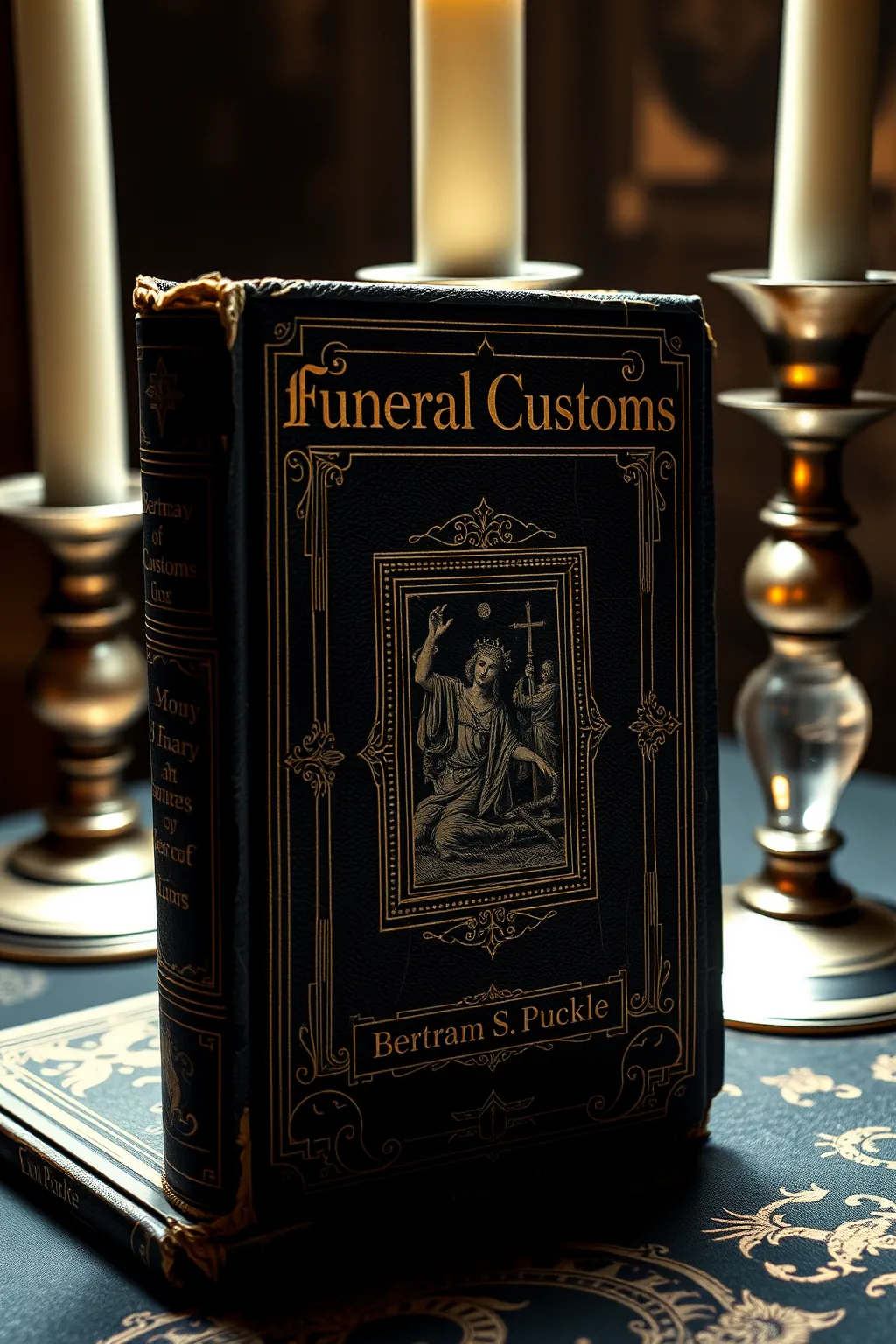
Funeral Customs
 79
79

Funeral Customs


Bertram S. Puckle’s 'Funeral Customs' stands as a monumental work, offering an unparalleled glimpse into the esoteric underpinnings of death rituals across millennia. Published in 1926, this volume transcends mere historical documentation, revealing the deep wells of spiritual and symbolic meaning embedded within human ceremonies. Puckle masterfully navigates the complex tapestry of beliefs, from ancient necromancy to the nascent rationalism of his era, highlighting the persistent human need to commune with the departed and understand the mysteries of the veil. This book is an indispensable resource for occult scholars and cultural historians alike, illuminating the hidden dialogues between the living and the dead that have shaped civilizations.
📝 Description
79
Bertram S. Puckle's 1926 book 'Funeral Customs' examines death rituals across history.
Bertram S. Puckle's 1926 book, 'Funeral Customs,' examines the rituals and beliefs surrounding death throughout human history. Puckle traces the evolution of these practices, from ancient rites rooted in animism and ancestor worship to the ceremonies of later periods. The book reveals how these customs reflect a society's cosmology and understanding of the afterlife.
Readers will find connections between different cultures' mourning practices and the enduring human need to confront mortality with reverence. Puckle details the symbolic languages and spiritual yearnings that have shaped how societies have processed death and grief. The work aims to illuminate the deep currents of spiritual thought related to death and the relationship between the physical and spiritual realms.
Published in 1926, 'Funeral Customs' by Bertram S. Puckle predates the widespread academic study of comparative religion and anthropology, yet it engages with themes that would become central to esoteric traditions. Puckle's work touches upon the symbolic languages of death and the connections between disparate cultures' rituals, hinting at underlying spiritual currents. It approaches these customs not merely as social history but as expressions of a collective human engagement with mortality and the unseen, aligning with an esoteric interest in hidden correspondences and the spiritual dimensions of human experience.
✍️ Author
Bertram S Puckle
This list of stage names lists names used by those in the entertainment industry, alphabetically by their stage name's surname followed by their birth name. Individuals who dropped their last name and substituted their middle name as their last name are lis…
💡 Why Read This Book?
Uncover the profound spiritual and symbolic tapestry woven through humanity's age-old rituals of death. 'Funeral Customs' offers a unique lens into the collective subconscious, revealing how diverse cultures have grappled with mortality, honored ancestors, and sought communion with the beyond. Ideal for seekers of esoteric knowledge, historians of ritual, and anyone drawn to the mysteries of life and death.
⭐ Reader Reviews
Honest opinions from readers who have explored this book.
❓ Frequently Asked Questions
What is the primary focus of 'Funeral Customs'?
The book meticulously explores the historical evolution of funeral practices, delving into the diverse rituals, beliefs, and ceremonies surrounding death across various cultures and historical periods, with an emphasis on their spiritual and symbolic dimensions.
Who is Bertram S. Puckle?
Bertram S. Puckle was an author and historian whose work in the early 20th century focused on anthropological and cultural studies, particularly concerning societal rituals and beliefs related to death and mourning.
Is this book suitable for beginners interested in death studies?
Yes, while scholarly, it provides a comprehensive overview. Beginners will find it an accessible yet deeply insightful introduction to the historical and cultural nuances of funeral customs.
Does the book discuss specific religious or magical practices?
Indeed, it touches upon a wide array of religious beliefs and ancient practices, often revealing their underlying magical or spiritual intent, and how these shaped funeral rites across different civilizations.
What kind of research would benefit from this book?
Researchers in anthropology, religious studies, cultural history, folklore, comparative mythology, and those interested in the esoteric dimensions of death and dying will find this book invaluable.
🔮 Key Themes & Symbolism
The Threshold of Transition
This theme explores funeral customs as sacred rites designed to facilitate the soul's passage from the physical realm to the ethereal. It examines the symbolic journeys, initiatory aspects, and the communal anxieties and hopes interwoven into these ceremonies. Puckle reveals how societies have sought to guide, protect, and honor the departed, viewing death not as an ending, but as a transformative event, a crucial step in the grand cosmic cycle, often imbued with rituals designed to appease unseen forces or facilitate reincarnation.
Traces of Ancestral Wisdom
Dive into the profound reverence for ancestors that permeates funeral customs across cultures. This theme investigates the enduring belief in the influence of the departed on the living, the practices of ancestor veneration, and the creation of sacred spaces for communion. Puckle highlights how these rituals served to maintain spiritual continuity, offer guidance, and ensure the well-being of the community through the intercession of those who have crossed the veil, revealing a deep-seated understanding of interconnectedness between realms.
The Language of Symbolism in Mourning
Unravel the rich symbolic lexicon embedded within funeral rites. This theme deciphers the meanings behind specific objects, gestures, colors, and incantations used in mourning ceremonies. Puckle illustrates how these symbols served as a universal language to express grief, articulate beliefs about the afterlife, and perform sacred acts. From the symbolic journey of the soul represented by burial orientation to the protective amulets placed with the deceased, these elements offer clear insights into humanity's spiritual and psychological relationship with death.
💬 Memorable Quotes
Direct passages from the work, attributed to the author.
“The veil between worlds is thin at the hour of departure.”
— Suggests a liminal state where the spiritual and physical realms are most permeable, highlighting the potent energies and opportunities for communion present during funeral rites.
“Ancestors whisper their guidance through the rituals of the living.”
— Emphasizes the active role of the deceased in the lives of the living, and how funeral customs serve as conduits for this ongoing spiritual dialogue and support.
“Each rite a key to unlock the mysteries of the beyond.”
— Positions funeral customs as sacred practices holding symbolic and spiritual knowledge, essential for understanding the unknown nature of the afterlife and the universe.
“Grief is the echo of a soul's deep connection.”
— Interprets human sorrow not as a mere biological response, but as a proof of the profound spiritual bonds that transcend physical existence, explored through mourning rituals.
💡 Key Ideas
Editorial paraphrase of the work's core concepts — not direct quotes.
Death is not an end, but a transformation.
This quote expresses the often mystical view of death as a spiritual metamorphosis, a passage rather than a cessation, central to many ancient belief systems explored in the book.
🌙 Esoteric Significance
Tradition
The book resonates deeply with traditions of comparative mythology, ancient mystery religions, and early anthropological studies of shamanism and animism. It touches upon the universal archetype of the hero's journey (or soul's journey), the concept of the psychopomp guiding souls, and the enduring human fascination with the afterlife, often viewed through a lens of spiritual continuity and hidden knowledge passed down through ritual.
Symbolism
Key symbols explored include the grave as a portal, the journey of the soul symbolized by pathways or rivers, the use of amulets for protection in the afterlife, the significance of burial orientation reflecting cosmic alignments, and the symbolic representation of death as sleep or transition. These symbols served as a shared language for expressing complex spiritual beliefs and facilitating the perceived transition between worlds.
Modern Relevance
In a contemporary world often detached from traditional rites, 'Funeral Customs' offers a vital re-connection to the profound spiritual and psychological needs fulfilled by these practices. It provides context for understanding contemporary grief, the resurgence of interest in ancestral heritage, and the ongoing human search for meaning in the face of mortality, encouraging a more mindful and symbolically rich approach to life's ultimate transition.
👥 Who Should Read This Book
This important work is indispensable for scholars of religious studies, anthropology, and cultural history, offering a rich source of comparative data. Esoteric practitioners and seekers will find clear insights into the spiritual underpinnings of death rituals and their symbolic language. For those grappling with personal loss or contemplating mortality, it offers a perspective that transcends mere grief, framing death within a broader, ancient context of transformation and spiritual continuity. Beginners to the study of death customs will find it an authoritative yet accessible gateway into a complex and fascinating field.
📜 Historical Context
Published in 1926, 'Funeral Customs' emerged during a period of significant intellectual ferment, bridging Victorian sensibilities with burgeoning anthropological and psychological insights. It was an era where the study of ancient civilizations and non-Western cultures was gaining academic traction, allowing for a broader, more comparative approach to human customs. Simultaneously, a growing interest in the esoteric, spiritualism, and the occult informed a desire to look beyond purely materialist explanations for human behavior. Puckle's work thus reflects a unique confluence of scholarly inquiry and a fascination with the deeper, often mystical, underpinnings of human experience, particularly concerning the universal confrontation with mortality. This context allowed for a rich exploration of how ancient beliefs and rituals informed the spiritual range of his time and continue to resonate.
📔 Journal Prompts
Reflect on a personal or cultural funeral custom that holds deep symbolic meaning for you. What does it communicate about life, death, and the universe?
Consider the concept of the 'threshold' in funeral rites. How do these ceremonies act as a transition point, and what are the symbolic markers of this passage?
Explore the idea of ancestral wisdom. In what ways do contemporary societies continue to honor or engage with their ancestors, even implicitly?
Analyze a specific symbol from a funeral custom described in the book. What might its deeper esoteric or spiritual meaning be?
How does the book's exploration of death rituals challenge or affirm your own beliefs about life, death, and what lies beyond?
🗂️ Glossary
Obsequies
The rites and ceremonies connected with a funeral; funeral observances or solemnities, often carrying a connotation of solemnity and ritualistic importance.
Animism
The belief that all natural objects, phenomena, and the universe itself possess a soul or spirit, and that these spirits can influence human affairs, often central to ancient funeral rites.
Necromancy
A form of divination or magical practice involving communication with the dead, often through rituals intended to elicit information or influence from spirits.
Cosmology
A belief system that describes the origin, structure, and evolution of the universe, including the relationships between celestial bodies and the spiritual realm, deeply influencing funeral customs.
Psychopomp
A guide of souls to the place of the dead; a figure in mythology or religion believed to escort the souls of the deceased, often playing a role in funeral ceremonies.
This book appears in 1 collection
🔮 Readers Also Liked
Browse all →









From the “Transcendental Meditation” Collection
View all →




More Free Esoteric History & Biography Books
View all →