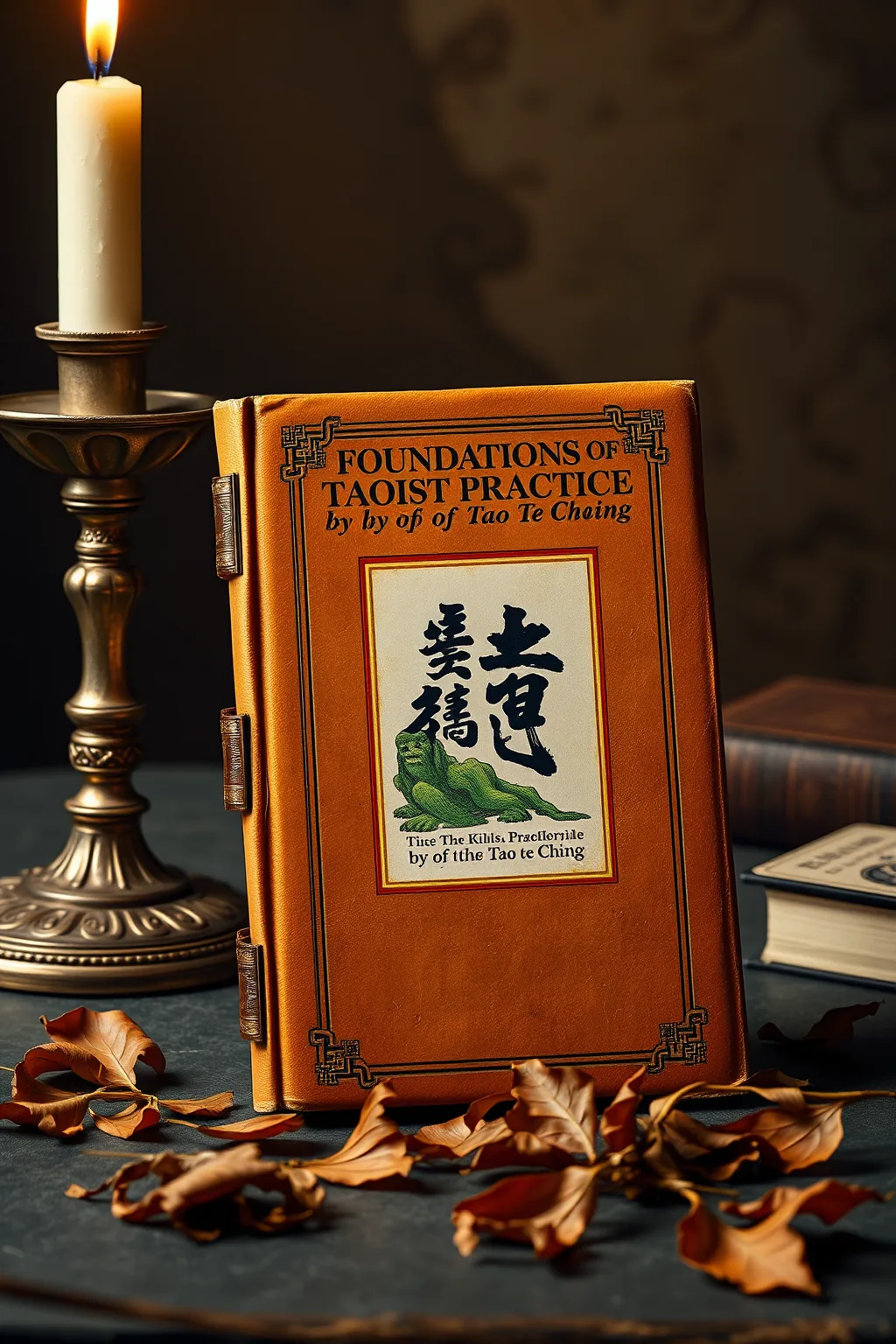
FOUNDATIONS OF TAOIST PRACTICE
 81
81

FOUNDATIONS OF TAOIST PRACTICE



Ophelia Vance, Mystical Literature Reviewer — "Foundations of Taoist Practice" is an indispensable guide for anyone seeking to penetrate the veil of illusion and connect with the primordial essence of the Tao. Attributed to the legendary Lao Tzu, this text eschews rigid dogma for a fluid, experiential understanding of the universe's underlying order. It masterfully unpacks core Taoist concepts, not as intellectual abstractions, but as living principles to be embodied. Its strength lies in its direct, unpretentious approach to profound mystical truths. Essential reading for serious practitioners and scholars of Eastern esotericism, offering a gateway to authentic Taoist contemplation.
📝 Description
81
This text, attributed to the author of the Tao Te Ching, explains the core principles of Taoist practice.
This book addresses the fundamental concepts of Taoism, focusing on the nature of the Tao itself. It examines the underlying principles that govern existence, presenting them not as abstract theories but as practical guides for living. The text details the concept of Wu Wei, or effortless action, and explains how to align oneself with the natural flow of the universe. It also discusses the interplay of Yin and Yang, illustrating their role in maintaining balance and harmony.
The work further explores the interconnectedness of all things, emphasizing a holistic view of reality. It uses symbolism and imagery to convey spiritual truths, aiming to offer clarity to those seeking deeper understanding. The aim is to reshape the reader's perception by awakening them to the underlying order and constant movement of existence.
As a text from the tradition that produced the Tao Te Ching, this work is situated within early Chinese philosophical and spiritual thought. It engages with concepts that inform Taoist alchemy, meditation, and cosmology. The focus on the ineffable Tao and the practical application of its principles places it among foundational texts for understanding the esoteric dimensions of Taoism, particularly those concerned with aligning human life with cosmic patterns.
✍️ Author

of the Tao Te Ching
The Tao Te Ching or Dào Dé Jīng, (traditional Chinese: 道德經; simplified Chinese: 道德经; lit. 'Classic of the Way and its Virtue') or Laozi in Chinese and scholarship, is an ancient Chinese classic text, becoming a foundational work of Taoism.
💡 Why Read This Book?
This book is a compass for navigating the elusive nature of the Tao. It offers a direct conduit to ancient wisdom, revealing principles of harmony, balance, and effortless action. Ideal for seekers of spiritual depth, scholars of Eastern philosophy, and practitioners looking to integrate the profound insights of Taoism into their lives.
⭐ Reader Reviews
Honest opinions from readers who have explored this book.
❓ Frequently Asked Questions
What is the 'Tao that can be described'?
The 'Tao that can be described' refers to any finite, conceptual understanding or name we attempt to assign to the ultimate reality. Lao Tzu warns that such descriptions are inherently limited and cannot capture the eternal, boundless nature of the true Tao.
How does this book approach the concept of Wu Wei?
The book elucidates Wu Wei not as inaction, but as 'effortless action' or 'non-doing.' It describes how to align oneself with the natural flow of the Tao, achieving results through spontaneity and minimal resistance, akin to water finding its path.
What is the significance of Yin and Yang in Taoist practice?
Yin and Yang represent the complementary, interdependent forces that govern all existence. The book explores how understanding and balancing these dualities—feminine/masculine, passive/active, dark/light—is crucial for achieving inner harmony and a balanced life.
Is this book suitable for beginners in Eastern philosophy?
Absolutely. While profound, the book's foundational nature makes it an accessible entry point for newcomers to Taoism. It gently introduces core concepts, providing a solid base for further exploration into the mystical aspects of this ancient tradition.
How can one 'practice' the Tao?
Practicing the Tao involves cultivating mindfulness, observing nature's rhythms, embracing simplicity, and acting in accordance with the natural flow of life. It's about inner cultivation, aligning one's actions with the principles of the Tao, and fostering harmony.
🔮 Key Themes & Symbolism
The Ineffable Nature of the Tao
This theme examines the core Taoist tenet that the ultimate reality, the Tao, is beyond human comprehension and linguistic definition. It emphasizes the inadequacy of words and concepts to grasp the eternal, formless, and boundless source of all existence. The book encourages an intuitive, experiential understanding, urging readers to perceive the Tao through quiet observation and inner stillness rather than through intellectual analysis. It presents the paradox of the undefinable as the very essence of its profound power and universality.
Wu Wei: The Art of Effortless Action
Wu Wei, often translated as 'non-action' or 'effortless action,' is explored not as passivity but as a state of being in perfect alignment with the natural flow of the universe. The book illustrates how through Wu Wei, one can achieve maximum effectiveness with minimal effort, like water yielding yet shaping stone. It teaches the wisdom of spontaneous action, adaptability, and yielding, revealing how to navigate life's challenges with grace and efficiency by surrendering to the natural currents of existence rather than resisting them.
The Harmony of Yin and Yang
This theme dissects the fundamental Taoist concept of Yin and Yang, the dualistic yet complementary forces that permeate all of reality. The book explains how these seemingly opposing energies—feminine and masculine, passive and active, darkness and light—are interdependent and essential for balance and creation. Readers are guided to recognize the dynamic interplay of Yin and Yang within themselves and the external world, understanding that true harmony arises not from the elimination of one force, but from their balanced interplay and cyclical transformation.
💬 Memorable Quotes
Direct passages from the work, attributed to the author.
“The Tao that can be described is not the eternal Tao.”
— This foundational warning highlights the limitations of language and intellect in grasping ultimate reality. It directs the reader towards intuitive understanding over conceptual definition.
“To know that you do not know is the highest wisdom.”
— Embracing humility and acknowledging the vastness of the unknown is presented as the true path to enlightenment. True knowledge begins with recognizing our own ignorance.
“The journey of a thousand miles begins with a single step.”
— This proverb underscores the importance of initiation and consistent, small actions in achieving any great endeavor. Patience and perseverance are key to accomplishing long-term goals.
“He who knows others is wise; he who knows himself is enlightened.”
— This emphasizes introspection as the ultimate path to true understanding and spiritual awakening. Self-knowledge is presented as superior to external knowledge.
💡 Key Ideas
Editorial paraphrase of the work's core concepts — not direct quotes.
Nature does not hurry, yet everything is accomplished.
This quote illustrates the principle of Wu Wei, advocating for a natural, unforced approach to life. It suggests that by aligning with nature's pace, tasks are completed with ease and perfection.
🌙 Esoteric Significance
Tradition
This book is a core part of the philosophical and mystical tradition of Taoism, one of the world's oldest indigenous spiritual systems. It explores esoteric concepts such as the nature of the Tao, the balance of Yin and Yang, the practice of Wu Wei, and the cultivation of internal energy (Qi). It serves as a direct conduit to the ancient, intuitive wisdom that underpins much of Eastern esotericism, guiding practitioners towards inner transformation and cosmic awareness.
Symbolism
Key symbols in Taoist practice, as explored in this work, include the uncarved block (Pu), representing original simplicity and potential; the empty vessel, signifying receptivity and humility; and the cyclical nature of Yin and Yang. The book uses these symbols not just as abstract ideas but as metaphors for understanding the universe and one's place within it, encouraging a deep, intuitive connection to the underlying patterns of existence.
Modern Relevance
In our hyper-connected and often chaotic modern world, the principles of "Foundations of Taoist Practice" offer a vital antidote. The emphasis on mindfulness, living in accordance with natural rhythms, and finding balance amidst complexity resonates deeply. The wisdom of Wu Wei provides strategies for navigating stress and achieving productivity without burnout, while the pursuit of inner harmony offers a path to resilience and contentment. This ancient philosophy provides timeless guidance for personal growth and a more sustainable way of being.
👥 Who Should Read This Book
This book is a treasure for the discerning reader. Absolute beginners curious about Eastern spirituality will find a clear, foundational introduction to Taoist thought. Scholars of comparative religion and philosophy will appreciate its direct engagement with core texts and concepts. Dedicated seekers of wisdom will discover clear insights for personal growth and spiritual development. Furthermore, practitioners of meditation, mindfulness, or other contemplative disciplines will find valuable guidance for deepening their practice and integrating ancient wisdom into their modern lives.
📜 Historical Context
Emerging from the turbulent Warring States period (c. 475–221 BCE) in ancient China, Taoism offered a profound counterpoint to the social and political unrest of the era. While Confucianism focused on social order and ethical governance, Taoism provided a path of spiritual refuge and natural harmony. The "Tao Te Ching," attributed to Lao Tzu, became a foundational text, advocating a return to simplicity, naturalness, and alignment with the cosmic order. This philosophy provided solace and a framework for understanding existence during a time of great upheaval, influencing not only religious and philosophical thought but also art, medicine, and martial arts for millennia.
📔 Journal Prompts
Reflect on a time you acted in alignment with the natural flow of a situation, embodying Wu Wei. What was the outcome?
How does the interplay of Yin and Yang manifest in your daily life? Identify moments of balance and imbalance.
Consider the concept of the 'undefinable.' What aspects of your own inner experience or the world around you resist easy description?
What does 'simplicity' mean to you in the context of your life and spiritual path?
How can you bring more 'effortless action' into a task or challenge you are currently facing?
🗂️ Glossary
Tao (Dao)
The ultimate, ineffable principle that underlies and permeates all existence. It is the fundamental reality, the source and guiding force of the universe, often described as the 'Way' or 'Path.'
Wu Wei
A core Taoist principle often translated as 'non-action' or 'effortless action.' It signifies acting in accordance with the natural flow of the universe, achieving results with minimal resistance and maximum effectiveness.
Yin and Yang
Two complementary, interdependent, and opposing forces that govern the universe. Yin represents passive, feminine, dark, and yielding qualities, while Yang represents active, masculine, light, and assertive qualities.
Qi (Chi)
The vital life force or energy that flows through all living things and the universe. Cultivating and balancing Qi is central to many Taoist practices, including internal alchemy and martial arts.
Lao Tzu
The semi-legendary ancient Chinese philosopher traditionally credited with authoring the 'Tao Te Ching,' the foundational text of Taoism. His teachings emphasize naturalness, simplicity, and harmony with the Tao.
This book appears in 1 collection
🔮 Readers Also Liked
Browse all →


From the “Christian Mysticism” Collection
View all →






More Free Mysticism & Contemplation Books
View all →