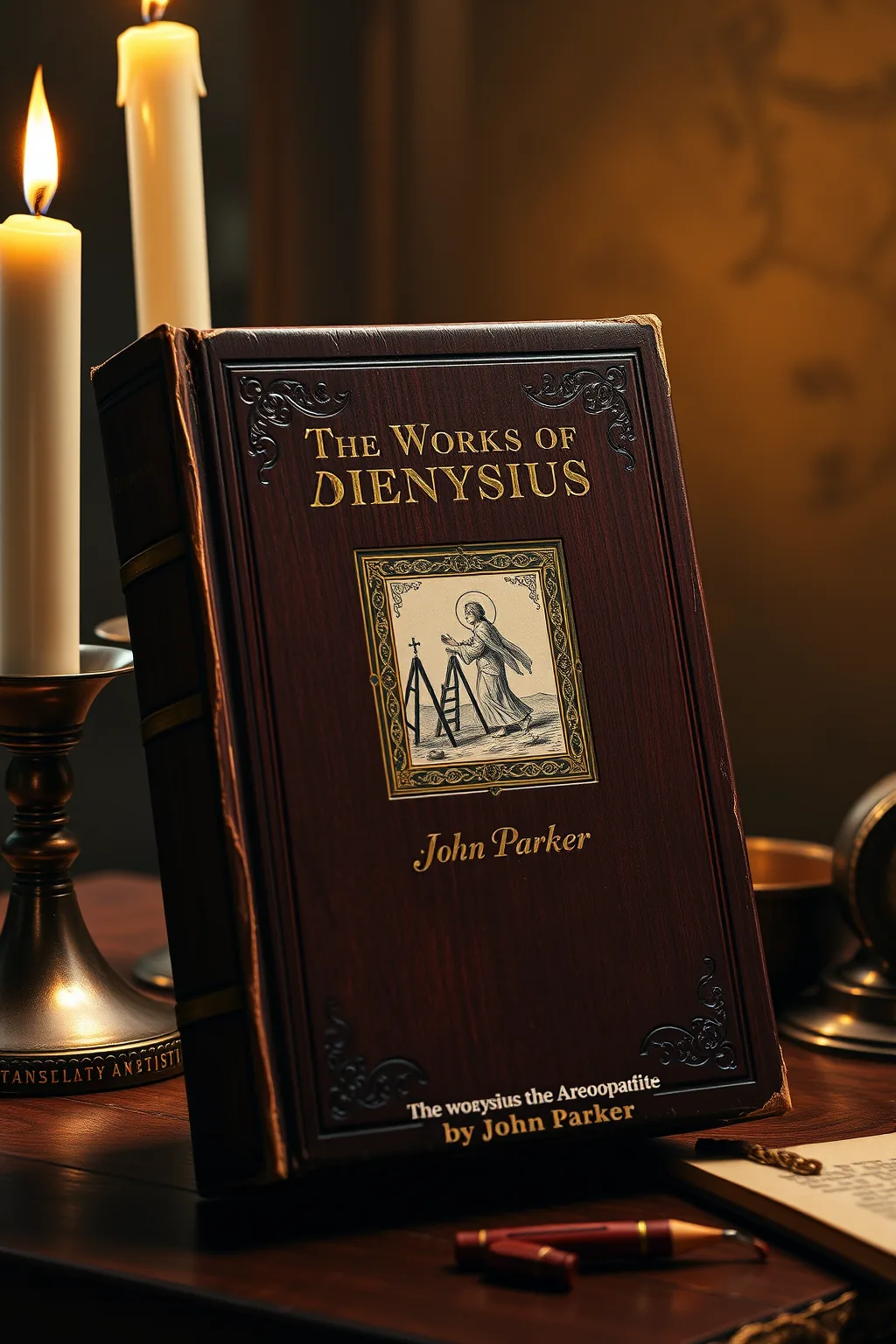
The Works of Dionysius the Areopagite
 80
80

The Works of Dionysius the Areopagite



Isolde Whitaker (Sacred Texts Editor) — John Parker's 1897 translation of Dionysius the Areopagite remains an indispensable cornerstone for any serious student of Christian mysticism and Western esotericism. Parker masterfully renders Pseudo-Dionysius's intricate Neoplatonic framework, revealing the profound synthesis of divine revelation and philosophical inquiry. The clarity of this edition facilitates access to concepts of the "Divine Names" and "Mystical Theology" that have shaped centuries of contemplative practice and theological discourse. It is a vital resource for scholars, theologians, and especially for modern spiritual seekers yearning for an authentic connection to transcendent realities through rigorous intellectual and devotional exploration.
📝 Description
80
John Parker's 1897 translation presents the complete writings of Dionysius the Areopagite.
This volume contains John Parker's 1897 English translation of the complete works attributed to Dionysius the Areopagite. Dionysius, a figure central to Christian Neoplatonism, synthesized early Christian thought with the philosophical traditions of late antiquity. His writings, particularly "The Divine Names" and "Mystical Theology," are key texts for understanding apophatic theology, the via negativa, and the use of symbols to approach the divine. Parker's translation aims to make these complex ideas accessible to a modern audience.
The collection offers a look at how Dionysius used philosophical concepts to articulate Christian doctrines. It discusses the divine attributes, the celestial hierarchy, and the nature of spiritual experience. The text encourages a contemplative approach, moving beyond intellectual understanding toward a more direct apprehension of the Godhead. This translation serves as a resource for those interested in the historical development of Christian mysticism and its philosophical underpinnings.
Dionysius the Areopagite stands as a cornerstone of Christian Neoplatonism, a tradition that merged Platonic philosophy with Christian doctrine. His writings, influential from the early medieval period onwards, provided a sophisticated theological framework. They detailed a hierarchical structure of reality, from God down to humanity, and outlined methods for spiritual purification and contemplation. This synthesis offered a way to understand the transcendent nature of God through negation and symbolic representation, deeply shaping Western mystical thought and esotericism.
✍️ Author
John Parker
John Parker (born 5 August 1938) is a British author and journalist. After leaving school, Parker found work at the Northampton Chronicle and Echo and worked in a number of local newspapers before getting a job in the Bahamas with the Nassau Daily Tribune.
💡 Why Read This Book?
This collection offers a direct encounter with the roots of Western Christian mysticism, bridging the gap between ancient philosophy and divine revelation. It is essential for anyone seeking to understand the contemplative tradition, explore the symbolic language of the sacred, or engage with the profound philosophical underpinnings of spiritual ascent. Ideal for scholars, mystics, and devout seekers.
⭐ Reader Reviews
Honest opinions from readers who have explored this book.
❓ Frequently Asked Questions
Who was Dionysius the Areopagite?
Dionysius the Areopagite was a 1st-century Athenian convert of the Apostle Paul, but the writings attributed to him were penned by an unknown author in the late 5th or early 6th century, now commonly referred to as Pseudo-Dionysius. He is a pivotal figure in Christian mysticism and Neoplatonism.
What is the primary focus of these works?
The works primarily focus on the nature of God, divine attributes, celestial hierarchies, and the contemplative ascent of the soul towards the Divine through negation and symbolic representation, drawing heavily from Neoplatonic thought.
Is this book suitable for beginners in mysticism?
While challenging, the clarity of Parker's translation makes it accessible. Beginners should approach with patience and perhaps guidance, but the rewards in understanding foundational mystical concepts are immense.
What is "apophatic theology"?
Apophatic theology, or the via negativa, is a theological approach that describes God by what God is not, emphasizing God's transcendence and ineffability beyond all human comprehension and positive attributes.
What is the significance of the "Celestial Hierarchies"?
The "Celestial Hierarchies" outlines a structured angelic order, seen as intermediaries between God and humanity, reflecting the divine order in the cosmos and serving as a blueprint for spiritual ascent and understanding divine governance.
🔮 Key Themes & Symbolism
The Ineffable Godhead and Apophatic Theology
This theme explores Dionysius's radical concept of God as utterly transcendent, beyond all conceptualization and positive description. Through the 'via negativa' (apophatic theology), the text guides the reader to approach the Divine not by what it is, but by what it is not, stripping away all finite attributes to reveal the luminous 'Divine Darkness'—a state of unknowing that paradoxically leads to direct spiritual union. This approach challenges conventional theological frameworks, pointing towards an experiential knowledge of God that transcends intellect.
Celestial Hierarchies and Spiritual Ascent
Dionysius meticulously maps out the angelic realms, presenting a cosmic order that reflects the divine emanations and serves as a ladder for the soul's ascent. The celestial hierarchies are not merely descriptive but prescriptive, offering a model for understanding the structure of spiritual reality and the intermediaries that facilitate divine grace. This theme explores the symbolic representation of spiritual beings and their role in guiding humanity towards contemplation of the Divine, emphasizing a structured path of spiritual progression.
The Symbolism of Divine Names and Creation
The treatise 'The Divine Names' explores how God, despite His ineffability, can be approached through the various names and attributes assigned to Him in scripture and creation. Dionysius argues that these names, while limited, are not arbitrary but symbolic pointers to different facets of the Divine essence. This theme examines the profound relationship between the created order and the Creator, suggesting that the entire cosmos is replete with divine symbolism, offering glimpses of God's glory and nature to the contemplative mind. It underscores the sacramental nature of existence.
💬 Memorable Quotes
Direct passages from the work, attributed to the author.
“For the cause of all is above all affirmation, and beyond all denial.”
— This highlights God's absolute transcendence, existing beyond the dualistic limitations of human language and understanding, both positive and negative.
“Let us then turn away from all that is seen, and all that is sensible, and all that is intellectual, and all that is perceptible, and all that is in any way conceivable.”
— A call to radical detachment from the empirical and intellectual realms to prepare the soul for a higher, more direct spiritual apprehension.
“For the Celestial Hierarchies are the most divine of all visible things, and the most visible of all unseen things.”
— This paradoxical statement underscores the role of the angelic realms as bridges between the material and spiritual, manifesting divine order in a way that can be apprehended by the devout seeker.
“The Divine Names are the very fountains of divine knowledge.”
— This emphasizes that while God is ineffable, the sacred names and attributes revealed in scripture and tradition serve as vital, albeit limited, channels for understanding and experiencing the Divine.
💡 Key Ideas
Editorial paraphrase of the work's core concepts — not direct quotes.
We must therefore praise Him by negation, as we withdraw from Him all that is, and by this very negation apprehend Him who is beyond all being.
This quote captures the core of apophatic theology, emphasizing that true knowledge of the ineffable God comes not from positive assertion, but from the stripping away of all limited concepts.
🌙 Esoteric Significance
Tradition
This work is a foundational text for Christian Neoplatonism, a highly influential esoteric tradition that synthesizes early Christian theology with the philosophical framework of Neoplatonism. It profoundly impacted medieval Christian mysticism, Sufism, and Kabbalah, and continues to inform contemporary esoteric and contemplative practices seeking direct experience of the Divine.
Symbolism
Dionysius employs a body of symbolism, from the celestial hierarchies of angels to the symbolic language of scripture and creation. These symbols are not mere allegories but are seen as direct manifestations of divine order and emanations. The apophatic approach itself is a symbolic method of transcending ordinary language to point towards the ineffable, with concepts like the 'Divine Darkness' serving as potent esoteric symbols for the ultimate union with God.
Modern Relevance
In an age often characterized by secularism and intellectualism, Dionysius's emphasis on direct spiritual experience, contemplative practice, and the limitations of purely rational understanding remains remarkably relevant. His work offers a profound framework for working through the spiritual path, challenging seekers to look beyond superficial appearances and engage with the deeper, symbolic, and ultimately transcendent dimensions of reality.
👥 Who Should Read This Book
This important work is essential for theologians and scholars of religious history seeking to understand the development of Christian mysticism and Neoplatonic thought. Advanced students of philosophy will find it a key text for exploring the intersection of metaphysics and spirituality. For practitioners of contemplative prayer, meditation, and esoteric disciplines, Dionysius offers useful insights and a structured approach to spiritual ascent. Beginners in mysticism may find it challenging but immensely rewarding, providing a foundational understanding of esoteric Christian concepts and the nature of the divine.
📜 Historical Context
Published in 1897, John Parker's translation of Dionysius the Areopagite emerged during a period of significant revival of interest in medieval mysticism and ancient esoteric traditions within Western intellectual and spiritual circles. The late 19th century saw a burgeoning of movements like Theosophy and the Hermetic Order of the Golden Dawn, alongside academic scholarship exploring early Christian thought and Neoplatonism. This translation served as a crucial bridge, making the useful insights of Pseudo-Dionysius accessible to a new generation of scholars, theologians, and mystics grappling with questions of faith, reason, and the nature of ultimate reality. It provided an authoritative source for understanding the historical roots of contemplative prayer, symbolic theology, and the Neoplatonic influence on Western esotericism.
📔 Journal Prompts
Reflect on a time you experienced something that felt beyond words. How does this relate to Dionysius's concept of the 'Divine Darkness'?
Consider a specific name of God from scripture or tradition. How might this name be a symbolic 'fountain of divine knowledge'?
If the celestial hierarchies represent divine order, what aspects of order do you observe or seek in your own life and the world around you?
How does the practice of negation, as described by Dionysius, challenge your typical ways of understanding or defining the Divine?
Explore the idea of 'turning away from all that is seen' in your daily life. What are the spiritual benefits and challenges of such detachment?
🗂️ Glossary
Neoplatonism
A philosophical system originating with Plotinus, drawing on Plato's ideas, emphasizing emanations from a single, transcendent 'One' and the ascent of the soul towards it.
Apophatic Theology (Via Negativa)
A theological method that describes God by stating what God is not, emphasizing God's transcendence and ineffability beyond all positive attributes.
Emanation
In Neoplatonic thought, the process by which reality flows or proceeds from a single source (the One) without diminishing it, creating a hierarchy of being.
Theurgy
A spiritual practice or ritual aimed at invoking divine assistance or achieving union with the divine, often through symbolic actions and purification.
Divine Darkness
A concept in Dionysian mysticism referring to the highest state of knowing God, achieved through the negation of all concepts, leading to an overwhelming, supra-intellectual union.
This book appears in 3 collections
🔮 Readers Also Liked
Browse all →







From the “Meditation” Collection
View all →






More Free Mysticism & Contemplation Books
View all →