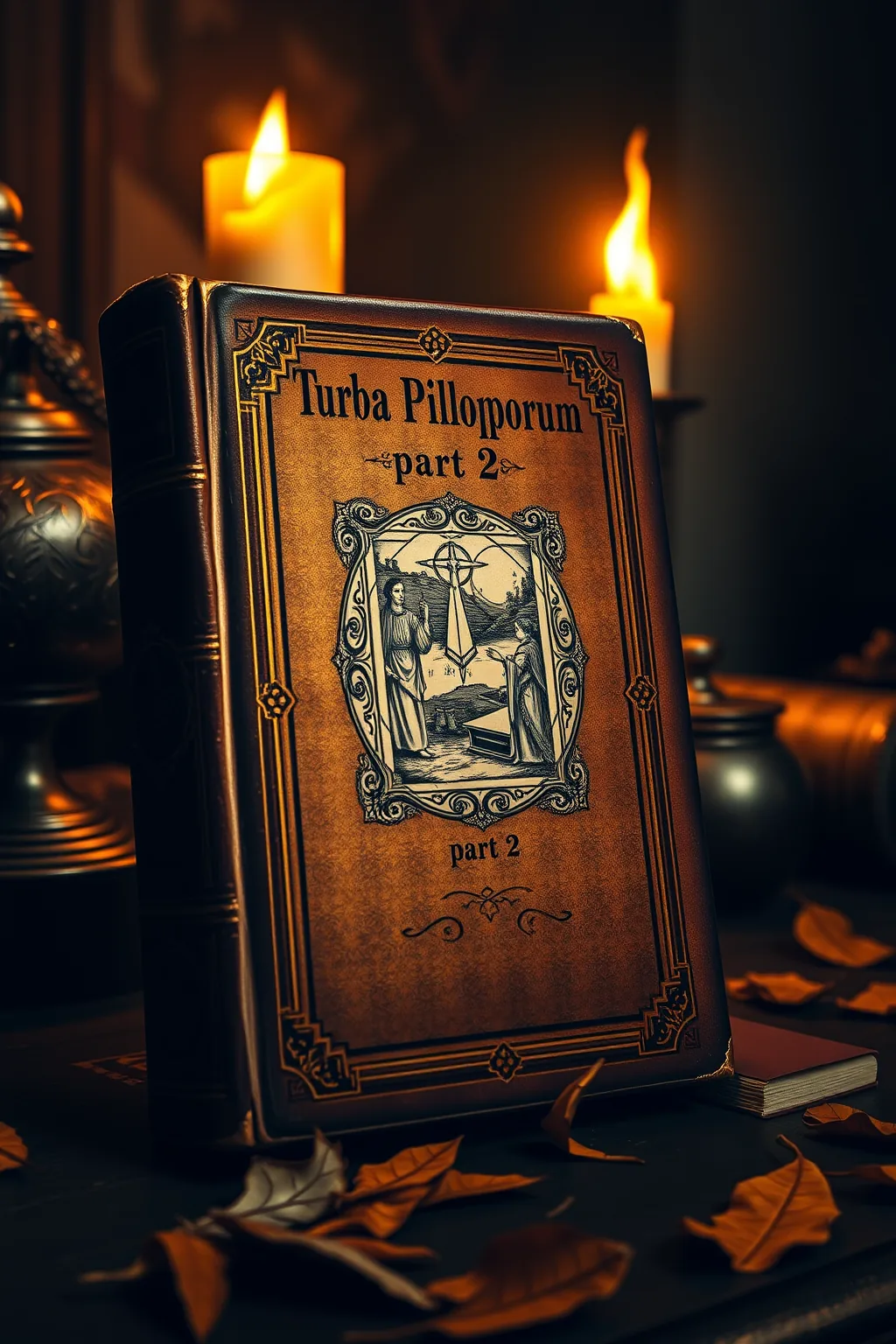
Turba Philosophorum (part 2)
 72
72

Turba Philosophorum (part 2)


Review by Silas Hawthorne (Hermetic Studies Editor) — The Turba Philosophorum, Part 2, continues its profound exploration of the Hermetic Arts with an unparalleled depth of symbolic language. This installment masterfully unpacks the intricate philosophical underpinnings of the alchemical quest, offering insights that resonate with ancient wisdom. The Unknown author's ability to convey complex spiritual truths through veiled allegory remains breathtaking. It is an essential text for serious students of alchemy and hermeticism, providing fertile ground for contemplation and practice. This volume is particularly potent for those who have already engaged with the foundational principles of the Great Work, offering a more nuanced and challenging perspective.
📝 Description
72
Part 2 of the Turba Philosophorum presents alchemical dialogues and allegories from an unknown master.
This second part of the Turba Philosophorum continues its exploration of the Great Work through allegorical language. Attributed to an anonymous master, the text details stages of transformation beyond simple material change. It uses cryptic conversations, veiled statements, and symbolic imagery to create a dense atmosphere of ancient knowledge and intellectual rigor.
The book appeals to those seeking hidden truths about the cosmos and the human spirit. Its philosophical basis is significant, outlining not only a method for alchemical success but also a plan for spiritual renewal and achieving inner peace. It is intended for individuals aiming to grasp the fundamental principles of existence and to realize their full potential.
The Turba Philosophorum, a significant alchemical text, is known for its allegorical style. Part 2 continues this tradition, presenting the Great Work not as a purely chemical process but as a path to profound spiritual and psychological change. The dialogues and symbols employed are characteristic of medieval European alchemy, which often used veiled language to protect its secrets and convey complex ideas about matter and spirit.
💡 Why Read This Book?
Unravel the veiled wisdom of the ancient alchemists and explore the transformative potential of the Great Work. Turba Philosophorum (Part 2) offers a profound journey into esoteric symbolism, philosophical inquiry, and the very nature of spiritual evolution. Ideal for seekers of hidden knowledge, scholars of mysticism, and practitioners dedicated to the path of inner transformation.
⭐ Reader Reviews
Honest opinions from readers who have explored this book.
❓ Frequently Asked Questions
What is the Turba Philosophorum?
The Turba Philosophorum, or 'Assembly of the Philosophers,' is a significant alchemical text from the medieval period, renowned for its collection of dialogues and pronouncements on the Great Work, presented in highly symbolic and allegorical language.
Who is the author of Turba Philosophorum (Part 2)?
The author of the Turba Philosophorum, including Part 2, is unknown. This anonymity is common in ancient esoteric texts, often intended to place emphasis on the universal truths conveyed rather than the individual author.
What are the main themes explored in Part 2?
Part 2 delves deeper into the practical and philosophical stages of the alchemical process, focusing on the separation, purification, and conjunction of primal elements, and the attainment of the Philosopher's Stone.
Is this text suitable for beginners?
While accessible, the Turba Philosophorum is best appreciated by those with some foundational understanding of alchemical or Hermetic principles. Its dense symbolism requires dedicated study and contemplation.
How does this text relate to modern spiritual practices?
The principles of transformation, purification, and integration found in this text have direct parallels to modern psychological and spiritual growth practices, offering a timeless framework for self-discovery and evolution.
🔮 Key Themes & Symbolism
The Alchemical Marriage
This section looks at the esoteric concept of the 'Alchemical Marriage,' a symbolic union of opposing forces – the masculine and feminine, the spiritual and material, the volatile and fixed – essential for the Great Work. It represents the integration of diverse elements within the alchemist and the cosmos to achieve a state of perfect harmony and completion, transcending dualistic thinking and paving the path towards ultimate transmutation and spiritual enlightenment.
Symbolism of the Elements
The text intricately combines a body of symbolic language, where the classical elements (earth, air, fire, water) and metals are not merely physical substances but represent profound psychological and spiritual states. Understanding these symbols is crucial to decoding the alchemist's journey, revealing the hidden meanings behind processes of dissolution, coagulation, and purification, which mirror the stages of inner transformation and the quest for the Philosopher's Stone.
The Great Work as Spiritual Evolution
Beyond material manipulation, the Turba Philosophorum presents the Great Work as a metaphor for profound spiritual evolution and self-realization. The alchemical stages of transformation are allegorical representations of the soul's journey through darkness, purification, and eventual illumination. It guides the practitioner towards an understanding of their own inner nature and the potential for achieving a state of divine consciousness and perfect integration.
💬 Memorable Quotes
Direct passages from the work, attributed to the author.
“I perceive that you, O crowd of the Wise, have conjoined two bodies, which your Master by no means ordered you to do!”
— This cryptic statement highlights a potential error in alchemical practice or understanding, suggesting that the union of elements or principles should be guided by divine or fundamental order, not by arbitrary or misguided actions.
“The Stone is not made of the seven metals alone, but of their quintessence.”
— This emphasizes that the Philosopher's Stone is not derived from common materials but from their most refined, spiritual essence, highlighting the transformative and elevated nature of the alchemical goal.
“He who does not separate, cannot unite.”
— This core alchemical principle underscores the necessity of deconstruction and purification before true integration and creation can occur, both in the laboratory and in the spiritual journey.
“The Mercury of the Sages is not the Mercury of the vulgar.”
— This distinguishes the spiritual, esoteric Mercury used in the Great Work from the common, physical element, pointing to a hidden, divine essence that is the true agent of transformation.
“The Art is one, though its operations are many.”
— This statement asserts the unified nature of the alchemical science, suggesting that despite diverse methods and stages, all alchemical processes serve a single, overarching purpose of transformation and perfection.
🌙 Esoteric Significance
Tradition
The Turba Philosophorum is a cornerstone text within the Hermetic and Alchemical traditions. It represents a crucial bridge between early Greek alchemy and the more formalized Hermeticism that developed in later centuries. Its dialogues and symbolic narratives are deeply rooted in the principle of 'As Above, So Below,' seeking to understand and manipulate the correspondences between the celestial and terrestrial realms, and more importantly, the microcosm of the human being.
Symbolism
The text is saturated with rich, multi-layered symbolism. The 'crowd of the Wise' (Turba Philosophorum) itself symbolizes the collective consciousness of alchemists or the dispersed elements that must be gathered. Concepts like the 'conjunction of two bodies' allude to the union of opposites, the 'philosophical mercury' and 'philosophical sulfur,' or the integration of the soul and spirit. The entire process is a symbolic journey of purification, dissolution, and reintegration, mirroring the path of spiritual evolution.
Modern Relevance
In contemporary times, the Turba Philosophorum continues to resonate deeply. Its exploration of transformation, integration of polarities, and the pursuit of inner perfection offers useful insights for modern psychology, spiritual development, and even contemporary art and literature. The text serves as a timeless guide for anyone seeking to understand the deeper currents of existence and to begin a path of profound personal growth and self-discovery.
👥 Who Should Read This Book
This volume is essential for serious students of Alchemy and Hermeticism, providing a foundational understanding of the Great Work's philosophical underpinnings. Scholars of esoteric traditions will find its historical context and symbolic depth invaluable. Seekers of spiritual knowledge will discover a rich allegory for personal transformation and the quest for enlightenment. Practitioners of contemplative or magical arts may find practical applications for its principles of integration and purification within their own disciplines.
📜 Historical Context
The Turba Philosophorum emerged during the vibrant intellectual milieu of medieval Europe, a period characterized by the rediscovery of classical texts and the flourishing of alchemical inquiry. Influenced by Arabic alchemical traditions and Hermetic philosophy, authors of this era sought to decipher ancient wisdom and apply it to both material and spiritual pursuits. The text reflects a society grappling with the intersection of science, religion, and mysticism, where the quest for the Philosopher's Stone was intertwined with aspirations for spiritual enlightenment and a deeper understanding of God's creation. Its allegorical nature was a common method for preserving esoteric knowledge, making it accessible to initiates while protecting it from the uninitiated or those with malicious intent.
📔 Journal Prompts
Reflect on the statement: 'I perceive that you, O crowd of the Wise, have conjoined two bodies, which your Master by no means ordered you to do!' What 'bodies' could this refer to in your own life or practice?
Identify a current imbalance or duality in your life or understanding. How might the principle of 'separation before union' apply to resolving this?
Consider the 'quintessence' mentioned in the text. What does this concept suggest about the ultimate goal of your personal or spiritual pursuits?
How can the symbolic language of alchemy be applied to understanding your own internal psychological or spiritual processes?
If the 'Master' represents a higher wisdom or guiding principle, what might be the 'orders' that are being neglected in the pursuit of esoteric knowledge?
🗂️ Glossary
Great Work
The main work of alchemy, referring to the process of creating the Philosopher's Stone and achieving spiritual perfection or transmutation. It is both a material and spiritual undertaking.
Philosopher's Stone
A legendary alchemical substance believed to be capable of turning base metals into gold and silver, and also possessing the power to grant immortality or eternal youth.
Quintessence
The fifth element or the highest, most refined essence of a substance, often considered the spiritual or celestial component that drives transformation.
Conjunction
In alchemy, the union of opposites, such as the masculine and feminine principles, or the volatile and fixed elements, a crucial step in creating the Philosopher's Stone.
Vulgar
Referring to common, ordinary, or mundane substances and practices, as opposed to the refined and esoteric principles used in the Great Work.
This book appears in 2 collections
🔮 Readers Also Liked
Browse all →








From the “Hermeticism” Collection
View all →







More Free Alchemy & Hermeticism Books
View all →