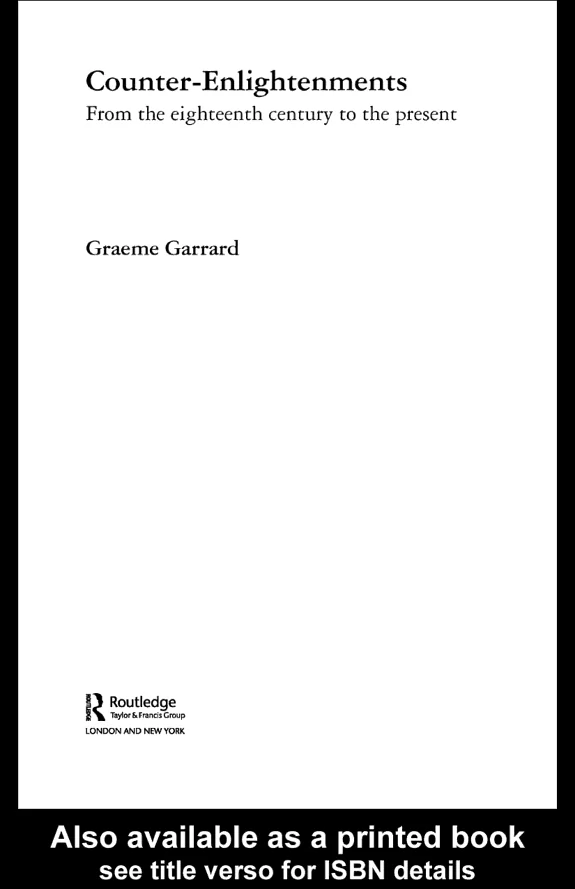
Counter-Enlightenments
 83
83

Counter-Enlightenments
Graeme Garrard’s "Counter-Enlightenments" offers a robust intellectual history that deftly maps a significant, often subterranean, current in Western thought. The book excels in its precise tracing of the Counter-Enlightenment's lineage, connecting figures from Rousseau to contemporary postmodernists with analytical rigor. Garrard is particularly effective in demonstrating how critiques of Enlightenment universalism and faith in reason have consistently re-emerged throughout history. A notable strength lies in its detailed engagement with the philosophical underpinnings of these critiques. However, the work occasionally feels overly focused on textual exegesis, sometimes at the expense of exploring the broader socio-political impacts of the ideas discussed. The section examining the link between the Counter-Enlightenment and postmodernism, while informative, could benefit from more explicit connections to lived political realities. "Counter-Enlightenments" provides a vital, if dense, account of intellectual opposition to modernity's core assumptions.
📝 Description
83
Graeme Garrard published "Counter-Enlightenments" in 2004, examining a tradition that questions Enlightenment ideals.
Graeme Garrard's "Counter-Enlightenments" examines a long-standing intellectual current that opposes core Enlightenment principles. The book traces this tradition from its 18th-century origins through to contemporary thought. Garrard argues that this is not merely a historical survey but an analysis of ideas challenging the supremacy of reason, the idea of inevitable human progress, and modernity's promise of liberation. He positions the Counter-Enlightenment as a significant force within Western intellectual history.
The work engages with thinkers who voiced doubts about progress, such as Jean-Jacques Rousseau in his 1750 "Discourse on the Arts and Sciences." Garrard shows how later figures, often responding to perceived flaws in Enlightenment thought, developed critiques that valued tradition, faith, and communal social structures. This intellectual stream grew stronger in the 19th century and continues to influence discussions on identity, culture, and the consequences of modernity. The book's 2004 publication date also situates it within a period of significant debate about postmodernism's influence.
While not strictly an esoteric text, "Counter-Enlightenments" engages with intellectual traditions that question the rationalist and secularizing impulses often associated with modernity. These traditions, at times, drew upon or referenced ideas that lie outside mainstream empiricism and scientific materialism. The book's focus on critiques of universalism and progress can resonate with esoteric concerns about hidden knowledge, alternative forms of authority, or the limitations of purely rational understanding. It provides a historical and philosophical framework for understanding intellectual currents that have sometimes run parallel to, or opposed, the dominant modes of modern thought, including those that informed esoteric movements.
💡 Why Read This Book?
• Gain a nuanced understanding of the intellectual currents opposing Enlightenment universalism, by examining Garrard's analysis of figures like Jean-Jacques Rousseau and his 1750 "Discourse on the Arts and Sciences". • Learn to identify the historical roots of postmodern skepticism towards reason and progress through the book's exploration of 19th-century critiques of modernity. • Appreciate the complex relationship between liberalism and its critics, understanding how debates initiated in the 18th century continue to shape contemporary political philosophy.
⭐ Reader Reviews
Honest opinions from readers who have explored this book.
❓ Frequently Asked Questions
What is the main argument of Graeme Garrard's "Counter-Enlightenments"?
The book argues that the Counter-Enlightenment is a distinct and persistent intellectual tradition that critiques core Enlightenment values like universal reason and progress, tracing its lineage from Rousseau to postmodernism.
Which historical figures are central to the Counter-Enlightenment as discussed by Garrard?
Key figures include Jean-Jacques Rousseau, whose "Discourse on the Arts and Sciences" (1750) is often cited as an early critique, and later thinkers who reacted against Enlightenment rationalism and universalism.
How does "Counter-Enlightenments" relate to postmodernism?
Garrard explores how ideas associated with the Counter-Enlightenment, such as skepticism towards grand narratives and universal reason, find significant expression and development within postmodern thought.
What is the relationship between the Enlightenment and the Counter-Enlightenment?
The Counter-Enlightenment is presented as a critical response to, and intellectual opposition against, the core tenets of the Enlightenment, questioning its emphasis on reason, progress, and universalism.
When was "Counter-Enlightenments" first published?
The book was first published on August 2, 2004.
Who is the author of "Counter-Enlightenments"?
The author is Graeme Garrard.
🔮 Key Themes & Symbolism
Critique of Universal Reason
Garrard examines how the Counter-Enlightenment tradition consistently questions the Enlightenment's faith in universal, abstract reason as the sole or primary guide for human affairs. This theme studies arguments that emphasize tradition, historical contingency, and cultural particularity over abstract rational principles. It explores how thinkers have challenged the notion that a single set of rational laws can or should govern all societies, highlighting the potential for such universalism to become a tool of oppression or cultural homogenization. The work traces this critique from its nascent stages to its sophisticated manifestations in late 20th-century thought.
Skepticism Towards Progress
A central tenet explored is the deep skepticism regarding the Enlightenment narrative of inevitable human progress. Garrard analyzes how various thinkers have challenged the idea that increased knowledge, scientific advancement, or social reform necessarily lead to a better state for humanity. This theme often involves examining the unintended consequences of modernity, the potential for reason to be used for destructive ends, and a Romantic or traditionalist valorization of past eras or simpler ways of life. The book contextualizes this skepticism within historical reactions to industrialization and social upheaval.
The Role of Tradition and Authority
This theme focuses on the Counter-Enlightenment's emphasis on the importance of tradition, inherited institutions, and established authorities. Garrard investigates how critics of the Enlightenment have argued that these elements provide essential social cohesion, moral guidance, and historical continuity that abstract rational systems often lack. The work explores the idea that societal order and meaning are often rooted in organic development and collective memory, rather than in the artificial constructs of rational planning. This perspective often leads to a defense of existing social structures against radical change.
Modernity's Discontents
Garrard frames the Counter-Enlightenment as a persistent intellectual response to the perceived discontents of modernity. This theme encompasses a broad range of critiques directed at the consequences of secularization, individualism, technological advancement, and the dissolution of traditional social bonds. The book examines how thinkers have sought to identify and articulate the spiritual, cultural, and social costs associated with the Enlightenment project. It positions the Counter-Enlightenment not merely as an academic debate, but as a continuous undercurrent of anxiety about the direction and nature of Western civilization.
💬 Memorable Quotes
Direct passages from the work, attributed to the author.
“Rousseau's "Discourse on the Arts and Sciences" questioned the very nature of progress.”
— This highlights an early, central moment where the optimistic trajectory of Enlightenment thought was challenged. It suggests that the critique of modernity's supposed advancements began early, questioning whether innovation inherently leads to human betterment or moral decay.
“Contemporary debates about postmodernism engage with Counter-Enlightenment themes.”
— This signifies the enduring relevance of these critiques. It points to how skepticism towards grand narratives, universal truths, and the authority of reason, central to the Counter-Enlightenment, are echoed in later philosophical movements like postmodernism.
“The relationship between liberalism and Enlightenment ideals is complex.”
— This indicates that the book explores internal tensions and critiques within the liberal tradition itself, suggesting that liberalism's foundations in Enlightenment thought are not monolithic and have faced significant internal and external challenges.
“The work traces the Counter-Enlightenment from its origins.”
— This emphasizes the historical depth and continuity of the intellectual tradition being examined. It suggests a focus on tracing the evolution of specific ideas and arguments across different historical periods and thinkers.
“The book analyzes critiques of reason's absolute sovereignty.”
— This points to a core philosophical contention: the challenge posed to the Enlightenment's belief that reason is the ultimate arbiter of truth and morality. The work likely explores alternative sources of knowledge or value.
🌙 Esoteric Significance
Tradition
While not explicitly aligned with a single esoteric lineage, "Counter-Enlightenments" speaks to traditions that question purely materialist or rationalist explanations of reality. Its critique of universalism and emphasis on historical or cultural particularity can echo Gnostic or Hermetic concerns about imposed, flawed demiurgic orders versus deeper, often hidden, truths. The skepticism towards linear progress might align with cyclical views of history found in some esoteric cosmologies. It provides intellectual fodder for those who see the dominant rationalist paradigm as a form of 'false light' obscuring more profound realities.
Symbolism
The book engages with concepts that function symbolically within esoteric thought. The 'Enlightenment' itself can be seen as a symbol of unveiled reason, often depicted as a blinding light or a rigid structure. The 'Counter-Enlightenment,' conversely, might symbolize a return to shadow, intuition, or tradition – the 'unseen' or the 'ancient wisdom' that rationalism seeks to dismiss. Rousseau's critique of 'artificial' society in favor of a more 'natural' state also carries symbolic weight, hinting at a lost paradise or a primal innocence that modernity has corrupted.
Modern Relevance
Contemporary esoteric thinkers and practitioners often grapple with the legacy of modernity and the Enlightenment's impact on spiritual and cultural life. Garrard's work provides a crucial intellectual framework for understanding the historical and philosophical roots of skepticism towards secular, rationalist modernity. This is relevant for movements that emphasize traditionalism, indigenous knowledge systems, or alternative spiritualities that consciously position themselves against dominant Western paradigms. Thinkers concerned with the perceived spiritual vacuum of secular society find intellectual allies in the critiques explored within 'Counter-Enlightenments'.
👥 Who Should Read This Book
• Students of political philosophy and intellectual history seeking to understand critiques of Enlightenment rationalism and liberalism. • Readers interested in the philosophical underpinnings of postmodernism and its historical antecedents. • Individuals exploring the tension between tradition, authority, and modernity in Western thought.
📜 Historical Context
Published in 2004, Graeme Garrard's "Counter-Enlightenments" arrived at a moment when postmodern critiques of universalism and reason were still highly influential, yet facing renewed scrutiny. The book situates its subject within the long arc of Western intellectual history, tracing its roots back to Jean-Jacques Rousseau's seminal "Discourse on the Arts and Sciences" (1750). This period saw a burgeoning questioning of the Enlightenment's optimistic faith in progress and reason. Garrard engages with thinkers who, reacting against the perceived abstractness and potential destructiveness of Enlightenment ideals, emphasized tradition, faith, and historical particularity. Contemporaries and intellectual precursors like Edmund Burke, Joseph de Maistre, and later figures associated with Romanticism and conservative thought represent crucial interlocutors. The book implicitly engages with competing schools of thought by defining the Counter-Enlightenment as a distinct intellectual current, often in opposition to prevailing liberal and rationalist orthodoxies that dominated much of 20th-century philosophy and political theory.
📔 Journal Prompts
Rousseau's critique of the arts and sciences as sources of corruption.
The concept of 'progress' as viewed by Enlightenment versus Counter-Enlightenment thinkers.
Tradition's role in providing social cohesion versus abstract reason.
The perceived discontents of modernity and their intellectual articulation.
Postmodern skepticism as a continuation of Counter-Enlightenment themes.
🗂️ Glossary
Enlightenment
An 18th-century intellectual and cultural movement emphasizing reason, individualism, skepticism, and scientific inquiry, often associated with ideas of progress and human perfectibility.
Counter-Enlightenment
An intellectual tradition and series of movements that critique, oppose, or question the core tenets and consequences of the Enlightenment, often emphasizing tradition, faith, and historical particularity.
Universalism
The belief that certain principles, values, or truths are universally applicable to all people, regardless of culture, time, or place. Often a target of Counter-Enlightenment critiques.
Postmodernism
A philosophical and cultural movement emerging in the mid-to-late 20th century, characterized by skepticism towards grand narratives, universal reason, and objective truth.
Liberalism
A political and moral philosophy based on liberty, consent of the governed, and equality before the law. Often seen as a direct outgrowth of Enlightenment ideals.
Tradition
The transmission of customs, beliefs, or knowledge from generation to generation, often valued by Counter-Enlightenment thinkers as a source of wisdom and social order.
Reason
The power of the mind to think, understand, and form judgments logically and coherently. Central to the Enlightenment, but questioned by its critics.
This book appears in 1 collection
🔮 Readers Also Liked
Browse all →






From the “Enlightenment” Collection
View all →





More Free Esoteric History & Biography Books
View all →