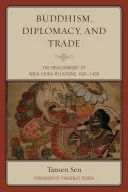
Buddhism, Diplomacy, and Trade
 82
82

Buddhism, Diplomacy, and Trade
Tansen Sen's "Buddhism, Diplomacy, and Trade" offers a compelling re-evaluation of Sino-Indian interactions during a millennium of profound cultural and economic shifts. The author skillfully dismantles the notion of a purely religious exchange, demonstrating instead how Buddhist institutions served as vital conduits for diplomacy and commerce. Sen's analysis of the Tang dynasty (618–907) is particularly illuminating, revealing how monks and sacred texts were instrumental in forging political and economic connections. A notable strength lies in the detailed examination of specific monastic complexes and trade routes, grounding the grand narrative in tangible historical evidence. However, the dense scholarly apparatus, while thorough, might present a challenge for the casual reader. The book's argument regarding the centrality of Buddhist networks in facilitating trade, particularly the discussion around the sea routes and their connection to monastic sites, is a significant contribution. This work fundamentally reshapes our understanding of Asian connectivity.
📝 Description
82
Tansen Sen's 2003 book details how Buddhist networks fueled trade and diplomacy between China and India from the 7th to 15th centuries.
Buddhism, Diplomacy, and Trade investigates the complex connections between Buddhist scholarship and commercial ties between China and India between the 7th and 15th centuries. Tansen Sen moves past a sole focus on religious transmission to analyze the wider geopolitical and economic forces shaping these interactions. The book shows how Buddhist institutions and monks acted as key points in diplomatic networks and supported expanding trade routes. The period examined, from the Tang dynasty (618–907 CE) onward, was a significant time for relations between China and India.
Buddhism, which had arrived in China centuries before, was by this era deeply woven into the culture. This integration created a foundation for ongoing contact, not just for religious figures like Xuanzang, but also for merchants and envoys. Sen places his analysis in this active setting, where religious devotion and practical economic interests often merged. He highlights the idea of 'Buddhist diplomacy,' where religious missions and the exchange of Buddhist materials functioned as a form of soft power, building goodwill and preparing the ground for formal political and commercial agreements. The work also details the 'monastic economy,' explaining how Buddhist monasteries, with their landholdings and established networks, became important economic entities. These monasteries influenced regional trade patterns and the development of cities.
While not strictly esoteric in the occult sense, this book examines how a major world religion, Buddhism, was not merely a spiritual pursuit but a practical force shaping secular affairs. It demonstrates how religious institutions and ideas acted as conduits for political alliances and economic growth, a perspective that challenges purely materialist interpretations of history. The concept of 'Buddhist diplomacy' reveals how spiritual transmission could serve pragmatic statecraft, a sophisticated interaction often overlooked in favor of simpler narratives of religious conversion.
💡 Why Read This Book?
• Gain insight into the specific role of Buddhist monks and monasteries in facilitating trade and diplomatic missions between China and India, particularly during the Tang dynasty (618–907). • Understand how religious exchange was inextricably linked with economic and political strategies, moving beyond a purely spiritual interpretation of historical interactions. • Discover the intricate details of early Asian trade networks, including the significance of maritime routes and their connection to monastic centers, as explored in Sen's research.
⭐ Reader Reviews
Honest opinions from readers who have explored this book.
❓ Frequently Asked Questions
What period does Tansen Sen's "Buddhism, Diplomacy, and Trade" primarily cover?
The book focuses on the period between the 7th and 15th centuries, with significant attention paid to the Tang dynasty (618–907) and its impact on Sino-Indian relations.
How did Buddhism influence trade between China and India according to the book?
Buddhism provided a shared cultural and religious framework that facilitated diplomatic missions and commercial exchanges, with monasteries often acting as key economic and logistical hubs.
What is the concept of 'Buddhist diplomacy' as discussed by Tansen Sen?
'Buddhist diplomacy' refers to the use of religious missions, the exchange of Buddhist texts, and the shared practice of Buddhism as a means to foster political goodwill and open channels for trade between states.
Does the book focus only on land trade routes?
No, the work also extensively examines the role of maritime trade routes and their connection to Buddhist centers and communities across Asia.
Who was Xuanzang and why is he relevant to this book?
Xuanzang was a famous Chinese Buddhist monk who traveled to India in the 7th century. His pilgrimage and subsequent translation of texts exemplify the deep religious engagement that Sen argues also paved the way for broader interactions.
What is the main argument regarding the transformation of Sino-Indian relations?
The book argues that relations transformed from being primarily Buddhist-dominated to increasingly commerce-centered, with Buddhism playing a critical role in mediating this transition.
🔮 Key Themes & Symbolism
Monastic Networks as Trade Hubs
Sen details how Buddhist monasteries, far from being isolated spiritual enclaves, were active participants in the economic life of ancient Asia. Their extensive landholdings, established organizational structures, and presence along major routes—both overland and maritime—made them natural centers for trade and exchange. These institutions provided safe havens, logistical support, and even financial services, directly contributing to the flow of goods and ideas between China, India, and Southeast Asia.
The Interplay of Religion and Statecraft
The work meticulously illustrates how religious devotion and diplomatic strategy were deeply intertwined. Buddhist pilgrims and scholars often served as unofficial envoys, their journeys facilitated by rulers seeking to establish or maintain alliances. The exchange of Buddhist scriptures and relics, beyond their spiritual value, acted as significant diplomatic currency, fostering mutual understanding and political goodwill between the Chinese and Indian spheres.
Evolution of Sino-Indian Interaction
Sen traces a significant transformation in the nature of contact between China and India over a millennium. Initially dominated by Buddhist missionary zeal and scholarly pursuits, the relationship gradually shifted towards a more commerce-driven exchange. This transition was not a sudden break but a complex evolution where Buddhist frameworks continued to provide the essential infrastructure and cultural bridge for burgeoning trade activities.
Maritime Silk Road and Buddhism
A crucial aspect of the book is its focus on the maritime dimension of Asian connectivity. Sen highlights how Buddhist communities and monasteries flourished in port cities and along coastal trade routes. These establishments played a vital role in supporting seafaring merchants, facilitating the transmission of Buddhist doctrines across the seas, and integrating regional economies into a larger trans-Asian commercial system.
💬 Memorable Quotes
Direct passages from the work, attributed to the author.
“The interactions between China and India were not solely driven by religious fervor but were equally shaped by commercial imperatives.”
— This highlights Sen's central thesis: that economic motivations were as powerful, if not more so, than spiritual ones in defining the relationship between these two major Asian civilizations.
“Buddhist monasteries served as crucial nodes in the diplomatic and trade networks of pre-modern Asia.”
— This statement underscores the functional role of religious institutions, positioning them as vital logistical and political centers rather than passive spiritual retreats.
“The Tang dynasty witnessed a significant integration of religious missions with state-sponsored diplomatic and commercial ventures.”
— This points to a specific historical period where the intertwining of Buddhist activities with political and economic goals became particularly pronounced and strategically important.
“The transformation from Buddhist-dominated exchange to commerce-centered interaction was a gradual process, mediated by existing religious frameworks.”
— This emphasizes the continuity and evolution of the relationship, suggesting that the shift in focus was not abrupt but a development built upon established cultural and institutional foundations.
“Maritime routes played a key role in disseminating both Buddhist ideas and commercial goods across vast distances.”
— This interpretation focuses on the importance of sea travel in connecting disparate regions, demonstrating how it served as a dual pathway for spiritual and material exchange.
🌙 Esoteric Significance
Tradition
While not strictly within a Western esoteric lineage like Hermeticism or Kabbalah, this work deeply engages with the practical and organizational manifestations of a major world religion. Buddhism, in its historical development, incorporated complex philosophical systems, meditative practices, and monastic governance that can be viewed through an esoteric lens of inner transformation and cosmic understanding. Sen's work reveals the 'exoteric' structures—diplomacy and trade—that were deeply influenced by these 'esoteric' underpinnings, showing how spiritual goals were pursued through worldly means.
Symbolism
The book implicitly touches upon the symbolism inherent in Buddhist relics and scriptures. Relics, often fragments of enlightened beings, served as potent symbols of spiritual authority and connection to the divine, used in diplomatic exchanges to legitimize rulers and foster bonds. Scriptures themselves symbolized wisdom and the path to liberation, their transmission across vast distances representing the spread of enlightenment and cultural influence.
Modern Relevance
Contemporary scholars of global history, religious studies, and international relations continue to draw on Sen's framework for understanding how cultural and religious elements facilitate economic and political ties. His work informs modern discussions on soft power, cultural diplomacy, and the historical roots of globalization, particularly in the Asian context. Thinkers exploring the intersection of religion and economics, or the role of transnational networks in historical development, find valuable case studies and analytical models in this book.
👥 Who Should Read This Book
• Comparative religion scholars: Those examining the institutional and socio-economic impact of Buddhism beyond purely theological doctrines will find detailed case studies. • Historians of East and Southeast Asia: Researchers focused on the Tang dynasty (618–907) and subsequent periods will gain a nuanced understanding of inter-regional dynamics. • Students of global trade history: Readers interested in the origins of globalization and the role of cultural exchange in facilitating commerce will find insights into the ancient world.
📜 Historical Context
Tansen Sen's "Buddhism, Diplomacy, and Trade" emerged in an era of renewed scholarly interest in transnational Asian history, challenging earlier, more nation-centric perspectives. The book engages with the intellectual currents that sought to understand the interconnectedness of East and Southeast Asia during the Tang (618–907) and Song dynasties, periods of immense economic and cultural florescence. Sen’s work directly addresses scholarship on the Maritime Silk Road and the spread of Buddhism, building upon foundational studies while offering a more integrated view. The period itself was marked by the robust exchange of goods, technologies, and ideas, with Buddhism acting as a significant cultural lubricant. Unlike earlier periods where Buddhist missions might be viewed primarily through a religious lens, Sen demonstrates their critical role in statecraft and commerce, a perspective that gained traction among historians like Whitmore, who studied Southeast Asian interactions. Sen’s meticulous research into primary sources offers a counterpoint to more generalized theories of cultural diffusion.
📔 Journal Prompts
The function of Buddhist monasteries as economic centers during the Tang dynasty.
Xuanzang's pilgrimage as a model for Sino-Indian exchange.
The transformation from Buddhist-dominated to commerce-centered interactions.
Analyzing the symbolism of Buddhist relics in diplomatic contexts.
The role of maritime trade routes in spreading both Buddhism and commerce.
🗂️ Glossary
Tang Dynasty
A major imperial dynasty of China that ruled from 618 to 907 CE. It is considered a high point in Chinese civilization, known for its cosmopolitanism, territorial expansion, and cultural achievements.
Sino-Indian Relations
Refers to the historical, cultural, political, and economic interactions between China (Sino-) and India.
Buddhist Diplomacy
The use of Buddhist monks, texts, institutions, and shared religious practices as instruments to foster political goodwill, establish alliances, and facilitate communication between states.
Monastic Economy
The economic activities undertaken by Buddhist monasteries, including land ownership, agricultural production, trade, and financial management, which contributed to their influence and wealth.
Maritime Silk Road
A sea-based trade network that connected East Asia with Southeast Asia, the Indian subcontinent, the Middle East, and Europe, flourishing from the 2nd century BCE to the 15th century CE.
Xuanzang
A renowned Chinese Buddhist monk, scholar, and traveler who visited India in the 7th century CE (during the Tang Dynasty) and brought back numerous Buddhist scriptures, significantly influencing Chinese Buddhism.
Relics
In Buddhism, relics are typically the physical remains of a holy person, such as the Buddha or an enlightened disciple, or objects associated with them, venerated for their spiritual power.