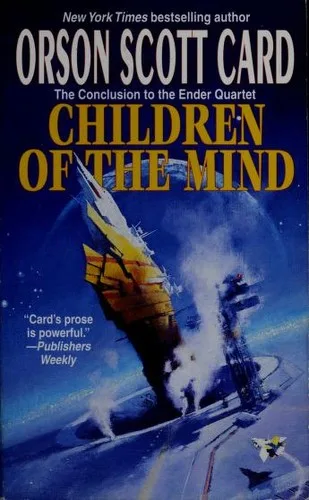
Children of the Mind
 72
72

Children of the Mind



Ophelia Vance, Mystical Literature Reviewer — Orson Scott Card masterfully weaves a tapestry of science fiction and esoteric philosophy in 'Children of the Mind.' Beyond its thrilling narrative of human-alien interaction, the novel offers profound insights into telepathic abilities as a form of spiritual awakening and the collective unconscious. Card's depiction of emergent consciousness and the transcendence of physical limitations resonates deeply with ancient mystical traditions. This work is a compelling read for those fascinated by the hidden potentials of the mind and the interconnectedness of all sentient beings, offering a unique blend of speculative fiction and spiritual exploration. It challenges readers to consider the universe not just as matter, but as a symphony of consciousness.
📝 Description
72
Orson Scott Card published 'Children of the Mind' in 1996, continuing the story of Ender Wiggin.
'Children of the Mind' follows Ender Wiggin's efforts to understand and guide a new generation of telepathic children. These children, gifted with extraordinary mental abilities, are feared and persecuted by the xenophobic human fleet. Ender, along with his sister Valentine and his brother Peter, works to protect them and foster their development. The narrative focuses on the children's burgeoning sentience and their capacity for both great love and terrible destruction. Card examines the implications of these advanced mental powers, particularly telepathic communion and its role in shaping identity and society. The book questions the nature of consciousness itself and the potential for evolution beyond physical limitations. It asks what it means to be human when minds can connect across vast distances and influence one another directly.
The story is set against a backdrop of interstellar politics and the ongoing struggle for survival of humanity. The children's abilities are presented not as simple magic, but as a complex form of communication and perception that challenges existing paradigms. Ender's role becomes one of a shepherd, trying to steer these powerful young minds toward a future where their gifts can be used constructively. The novel questions the ethics of control and the responsibility that comes with immense power, both individual and collective.
This novel engages with themes often found in esoteric traditions, particularly those concerning mental abilities and consciousness expansion. The telepathic communion depicted echoes concepts of shared consciousness or 'mind melds' found in various spiritual philosophies, suggesting a reality where minds are not entirely separate entities. The children's development can be seen as a metaphor for spiritual awakening or the emergence of higher faculties, a common motif in esoteric thought. The book hints at a deeper, unseen order governing existence, accessible through internal awareness rather than external observation, aligning with mystical paths that emphasize inner knowing.
💡 Why Read This Book?
Embark on a voyage into the uncharted territories of the mind, where telepathic connections forge interstellar bonds and consciousness itself becomes a cosmic force. 'Children of the Mind' offers a unique fusion of gripping science fiction and profound philosophical inquiry into the nature of sentience. Ideal for seekers of hidden knowledge, scholars of consciousness studies, and practitioners exploring the esoteric dimensions of human potential.
⭐ Reader Reviews
Honest opinions from readers who have explored this book.
❓ Frequently Asked Questions
What is the core esoteric concept explored in 'Children of the Mind'?
The book centrally explores telepathy not just as a communication tool, but as a manifestation of advanced consciousness and a pathway to spiritual interconnectedness, echoing concepts of shared mind and universal awareness found in various mystical traditions.
How does this book relate to divination?
While not a traditional divination text, the exploration of telepathy and precognition within the narrative touches upon the intuitive reception of information, mirroring aspects of clairvoyance and the understanding of subtle energies often associated with divination practices.
Is this book suitable for beginners in esoteric literature?
Yes, 'Children of the Mind' serves as an accessible entry point, blending engaging science fiction with foundational esoteric themes of consciousness and interconnectedness, making complex ideas understandable through compelling storytelling.
What is the significance of the human-alien encounters in the book?
These encounters serve as a catalyst for exploring the evolution of consciousness, challenging anthropocentric views and highlighting the universal potential for empathy and understanding across vastly different forms of life, a common theme in esoteric thought regarding cosmic brotherhood.
Does the book offer practical esoteric exercises?
While not a practical guide, the narrative's focus on the power of thought, empathy, and collective consciousness can inspire readers to cultivate their own inner awareness and explore their intuitive faculties, indirectly encouraging personal growth and esoteric contemplation.
🔮 Key Themes & Symbolism
The Evolution of Consciousness
This theme examines the idea that consciousness is not a static entity but a dynamic force capable of profound evolution. The novel posits that through shared experience and telepathic communion, sentient beings can transcend their individual limitations and achieve higher states of awareness. This mirrors esoteric philosophies that speak of spiritual ascension and the unfolding of latent psychic abilities, suggesting that humanity is on a path toward a greater collective understanding and interconnectedness.
Telepathic Communion and Empathy
At its heart, 'Children of the Mind' explores telepathy as the ultimate form of empathy, a means by which individuals can truly understand and connect with one another on a fundamental level. This transcends mere communication, venturing into the shared experience of emotions, thoughts, and even consciousness itself. This appeals to mystical concepts of unity and the dissolution of the ego, where the boundaries between self and other become blurred, fostering a sense of universal brotherhood and shared existence.
Human Potential and Inner Worlds
The narrative champions the idea that humanity possesses untapped psychic and spiritual potential, waiting to be awakened. It suggests that the greatest frontiers are not in outer space, but within the vast, unexplored landscapes of the human mind. This aligns with esoteric traditions that emphasize introspection, meditation, and the development of inner faculties as the keys to unlocking profound truths and mastering one's own reality. The book encourages readers to look inward for answers and power.
💬 Memorable Quotes
Direct passages from the work, attributed to the author.
“The mind is a universe.”
— This statement emphasizes the boundless potential and complexity of consciousness, suggesting that the inner world is as vast and mysterious as the cosmos itself, full of undiscovered realms.
“We are not alone, even in our thoughts.”
— This highlights the interconnectedness of all minds, suggesting that even our most private thoughts can resonate and connect with others, hinting at a universal consciousness.
“True strength lies in shared understanding.”
— This suggests that collective wisdom and mutual comprehension are more potent than individual power, advocating for unity and collaboration as the foundation of true resilience.
“The future is not written, it is felt.”
— This implies that our collective emotional state and intuitive perceptions shape destiny, suggesting that consciousness and feeling have a direct influence on the unfolding of events.
💡 Key Ideas
Editorial paraphrase of the work's core concepts — not direct quotes.
Empathy is the bridge between worlds.
This quote posits that the ability to truly understand and share the feelings of another is the fundamental key to overcoming differences and fostering connection across all forms of existence.
🌙 Esoteric Significance
Tradition
The book deeply appeals to traditions focused on consciousness expansion, telepathy, and the interconnectedness of all beings, such as certain schools of Theosophy, New Age thought, and philosophies emphasizing the power of the mind. It touches upon concepts akin to the Akashaic records or a universal mind, where information and experience are shared across time and space.
Symbolism
Key symbolism includes the 'mind' itself as a sacred space, telepathic links as spiritual conduits, and the human-alien encounters as metaphors for encountering the 'other' within and without. The progression of consciousness can be seen as a symbolic journey of spiritual evolution, moving from isolation to unity, mirroring the alchemical process of transformation.
Modern Relevance
In an era increasingly dominated by digital communication, 'Children of the Mind' offers a powerful counterpoint, emphasizing the depth and authenticity of direct consciousness-to-consciousness connection. It speaks to a modern yearning for deeper human connection and understanding, suggesting that true progress lies not just in technological advancement, but in the cultivation of our inner spiritual and psychic potential.
👥 Who Should Read This Book
This novel is a profound exploration for the discerning reader. **Seekers** of spiritual and philosophical depth will find a compelling narrative that probes the nature of consciousness and interconnectedness. **Scholars** of speculative fiction and consciousness studies will appreciate Card's intricate world-building and his thoughtful examination of telepathic abilities. **Practitioners** interested in the esoteric dimensions of human potential may find inspiration in the book's portrayal of latent psychic powers and the transformative capacity of shared thought. Even those new to metaphysical concepts will be drawn in by the engaging story and its underlying wisdom.
📜 Historical Context
Published in the latter half of the 20th century, a period marked by rapid advancements in science, burgeoning interest in parapsychology, and a growing cultural fascination with the potential of the human mind. The Cold War's shadow also cast a long influence, fostering anxieties about human conflict but also inspiring explorations of cooperation and understanding. This era saw a surge in science fiction that grappled with profound philosophical questions, moving beyond simple adventure to explore consciousness, alien contact, and the future of humanity. Orson Scott Card's work fits within this tradition, pushing the boundaries of speculative fiction by integrating complex psychological and philosophical themes, resonating with a readership eager to ponder humanity's place in a vast and mysterious universe.
📔 Journal Prompts
Reflect on a time you felt a strong intuitive connection with another person. What might have been the nature of that connection?
If telepathy were commonplace, how would society and personal relationships fundamentally change?
Consider the concept of a 'collective consciousness.' How might your individual consciousness contribute to or be influenced by such a force?
Explore the idea of 'inner worlds.' What are the landscapes and inhabitants of your own mind?
How can the concept of empathy, as explored in the book, be actively cultivated in your daily life to foster deeper understanding?
🗂️ Glossary
Telepathy
The supposed communication of thoughts or ideas by means other than the known senses, particularly by direct mental contact, as depicted in the novel as a profound form of consciousness sharing.
Consciousness
The state of being aware of and responsive to one's surroundings; in the context of the book, it is explored as a vast, interconnected entity with evolving potential.
Sentience
The capacity to feel, perceive, or be conscious. The book explores the many-sided nature of sentience across different species and evolutionary stages.
Psionic
Relating to or denoting the supposed psychic or mental powers such as telepathy, telekinesis, etc. The novel presents these abilities as natural extensions of consciousness.
Interconnectedness
The state of being connected with each other; a fundamental theme suggesting that all beings and phenomena are linked, particularly through consciousness.
This book appears in 3 collections
🔮 Readers Also Liked
Browse all →







More by Orson Scott Card
All books →




From the “Tarot” Collection
View all →









More Free Divination & Tarot Books
View all →