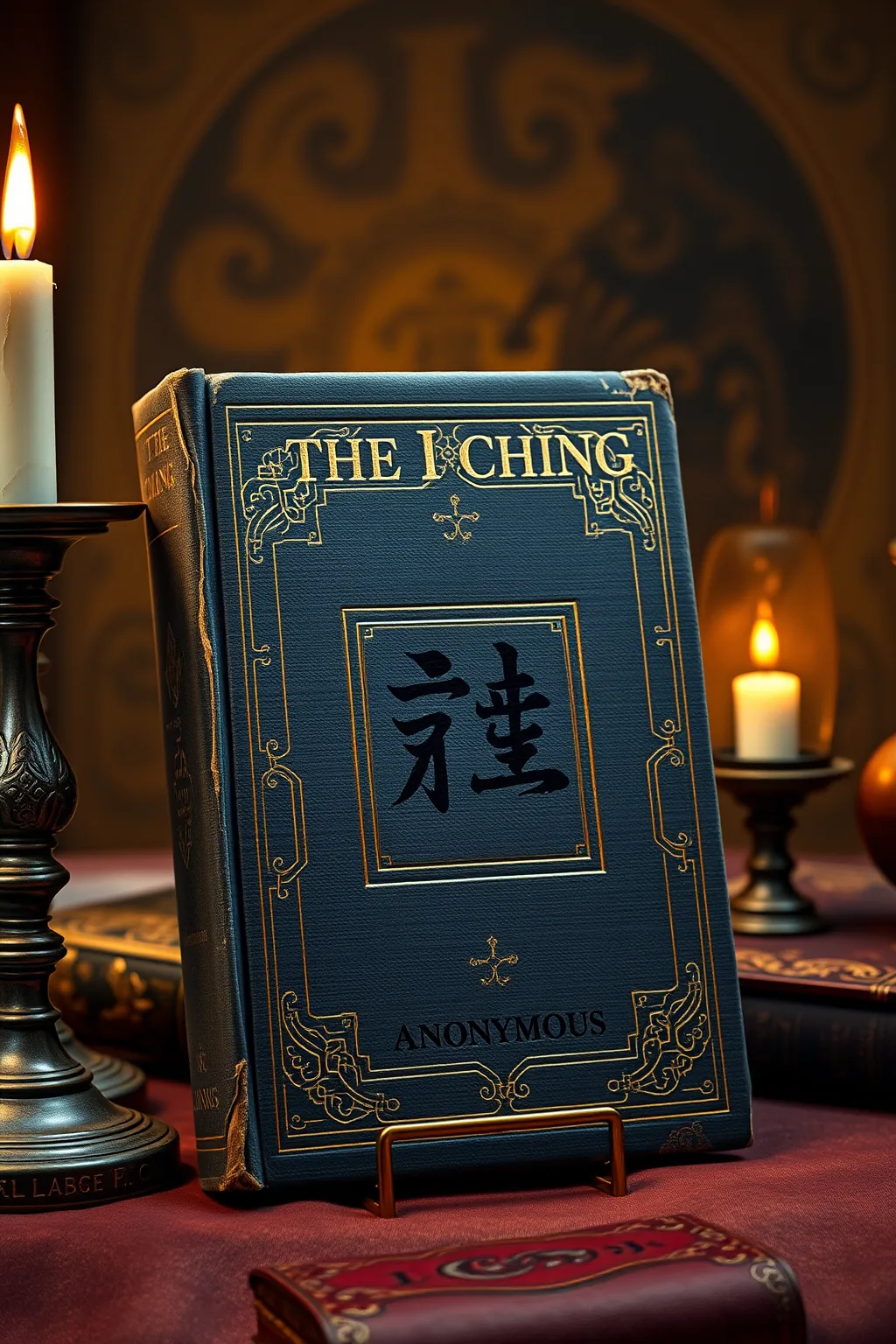
The I Ching
 61
61

The I Ching



Sophia Crane (Associate Editor) — 'The I Ching' stands as an unparalleled cornerstone of esoteric wisdom. Its abstract yet deeply resonant language invites contemplation, revealing profound insights into the cyclical nature of existence and the subtle forces that shape our lives. The anonymous authorship only amplifies its mystique, suggesting a universal truth rather than individual dogma. This work is not for the casual dabbler; it demands patience, introspection, and a willingness to engage with its profound symbolic language. For serious students of divination, ancient philosophy, and the art of self-discovery, 'The I Ching' offers an inexhaustible wellspring of guidance and enlightenment, a true testament to enduring spiritual inquiry.
📝 Description
61
The I Ching, compiled over centuries, offers a framework for understanding change through its 64 hexagrams.
This ancient Chinese text uses a system of hexagrams, formed from broken (Yin) and solid (Yang) lines, to comment on situations and predict future developments. It is not simply a divinatory tool but a philosophical work that explores the dynamics of change, balance, and transformation. The text contains judgments for each hexagram, as well as commentaries that elaborate on their meanings and applications. These commentaries, developed over time by various thinkers, add layers of interpretation to the core hexagrams. The I Ching suggests that by understanding the patterns of change, individuals can align themselves with the natural order of the cosmos and make better decisions.
Its advice often relates to adapting to circumstances, recognizing opportune moments, and acting with integrity. The philosophical underpinnings of the I Ching touch upon concepts of balance between opposing forces, the cyclical nature of events, and the importance of human agency within a larger cosmic flow. It invites contemplation on the relationship between the individual, society, and the universe, encouraging a mindful approach to life's challenges and opportunities.
The I Ching is a foundational text within East Asian esoteric traditions, particularly Taoism and Confucianism. It functions as a system of divination and a philosophical guide, rooted in ancient Chinese cosmology and the observation of natural phenomena. Its hexagrams represent archetypal situations and transformations, believed to mirror the workings of the universe. The text's emphasis on change and harmony aligns it with concepts of cosmic order and the interconnectedness of all things, making it a central work for those studying Chinese philosophy, divination practices, and broader esoteric thought.
💡 Why Read This Book?
Discover the ancient art of self-reflection and cosmic alignment. 'The I Ching' offers profound insights into the patterns of change and the forces that shape your destiny. Ideal for seekers of wisdom, scholars of ancient philosophy, and practitioners of divination who wish to deepen their understanding of universal principles and navigate life's challenges with greater awareness and harmony.
⭐ Reader Reviews
Honest opinions from readers who have explored this book.
❓ Frequently Asked Questions
What is the I Ching?
The I Ching, or 'Book of Changes,' is an ancient Chinese divination text and one of the oldest Chinese classics. It's a complex system of hexagrams and their interpretations used to gain insight into the past, present, and future.
Who is the author of the I Ching?
The authorship of the I Ching is traditionally attributed to legendary Chinese figures like Fu Xi, King Wen, and Confucius, but it is largely considered anonymous, with its wisdom evolving over centuries.
How does the I Ching work?
The I Ching is consulted by casting coins or yarrow stalks to generate a hexagram. Each hexagram, composed of six lines (solid for Yang, broken for Yin), has associated interpretations that offer guidance.
Is the I Ching a form of fortune-telling?
While it can be used for divination, the I Ching is more profoundly a philosophical text and a guide to understanding the principles of change and harmony in the universe. It offers wisdom for decision-making rather than deterministic predictions.
What are hexagrams in the I Ching?
Hexagrams are the fundamental building blocks of the I Ching, consisting of six stacked lines. Each of the 64 hexagrams represents a different situation or stage of development, imbued with symbolic meaning and advice.
🔮 Key Themes & Symbolism
The Philosophy of Change
Fundamentally, , 'The I Ching' is a profound meditation on the ceaseless nature of change. It posits that change is the only constant and that understanding its ebb and flow is paramount to navigating life successfully. The text illustrates how situations evolve, transform, and cycle through predictable patterns, urging readers to adapt rather than resist. It teaches that by recognizing the underlying principles of change, one can align their actions with cosmic currents, fostering harmony and wisdom.
Yin and Yang Dynamics
The fundamental duality of Yin (passive, feminine, dark) and Yang (active, masculine, light) is intricately woven into the fabric of 'The I Ching.' These complementary forces are not oppositional but interdependent, constantly interacting and transforming into one another. The text demonstrates how the balance and interplay of Yin and Yang manifest in all aspects of existence, from natural phenomena to human relationships, offering a framework for understanding cosmic order and personal equilibrium.
The Art of Harmonious Action
Beyond mere prediction, 'The I Ching' serves as an ethical and practical guide for living in accordance with universal principles. It emphasizes the importance of timely and appropriate action, urging individuals to act with sincerity, integrity, and awareness of the prevailing circumstances. By consulting the oracle, one can gain insight into the most auspicious course of action, fostering personal growth and contributing to a more harmonious existence within the greater cosmic order.
💬 Memorable Quotes
Direct passages from the work, attributed to the author.
“When you meet a wise man, do not forget him. When you meet a fool, do not forget him.”
— This highlights the importance of learning from all encounters. Both positive and negative experiences offer valuable lessons for personal growth and wisdom.
“The beginning of things are difficult to see, but easy to mend.”
— This aphorism underscores the value of early intervention and foresight. Addressing issues when they are nascent prevents them from escalating into insurmountable problems.
“Do not be afraid of being late.”
— This encourages patience and trust in the natural unfolding of events. It suggests that rushing can be counterproductive and that timing, when aligned with destiny, will eventually arrive.
💡 Key Ideas
Editorial paraphrase of the work's core concepts — not direct quotes.
The superior man, when he has made his choice, does not regret it.
This quote emphasizes decisiveness and conviction. Once a path is chosen with due consideration, one should commit to it without wavering, accepting the consequences and learning from the experience.
He who knows others is wise. He who knows himself is enlightened.
This quote points to the ultimate goal of self-awareness as the highest form of enlightenment, surpassing mere knowledge of the external world.
🌙 Esoteric Significance
Tradition
Rooted in the ancient Chinese Taoist and Confucian traditions, 'The I Ching' is a core part of East Asian esoteric thought. It is considered a 'Book of Changes' that reveals the fundamental principles governing the cosmos and human existence. Within esoteric circles, it's revered as a profound tool for spiritual development, offering insights into the Tao, the cosmic order, and the path to harmony and enlightenment through understanding the dynamics of change.
Symbolism
The primary symbolism of 'The I Ching' lies in its 64 hexagrams, each composed of six lines (Yin and Yang). These binary symbols represent archetypal situations, energies, and transformations. The trigrams (three-line combinations) are foundational, symbolizing natural elements and forces like Heaven, Earth, Thunder, and Water. The interplay of these symbols provides a rich, multi-layered symbolic language to interpret the nuances of any given situation and its potential future.
Modern Relevance
'The I Ching' remains remarkably relevant in the modern era, offering a timeless framework for navigating complexity and uncertainty. Its emphasis on adaptability, understanding cyclical patterns, and making conscious, harmonious choices resonates deeply with contemporary challenges. For individuals seeking self-awareness, ethical guidance, or a deeper connection to universal principles in a fast-paced world, the ancient wisdom of the I Ching provides a profound and insightful compass.
👥 Who Should Read This Book
This important work is essential for a diverse audience. Beginners to divination and Eastern philosophy will find it a challenging yet rewarding introduction to ancient wisdom, offering a unique perspective on life's questions. Scholars of comparative religion, philosophy, and cultural studies will discover a rich source of historical and intellectual depth. Seekers of spiritual guidance and self-discovery will appreciate its introspective nature and its ability to illuminate personal paths. Experienced practitioners of divination and esoteric arts will find 'The I Ching' an indispensable tool for deepening their practice and enhancing their understanding of universal energies.
📜 Historical Context
Emerging from the crucible of ancient China, 'The I Ching' boasts a lineage stretching back over three millennia, making it one of the world's oldest continuously studied texts. Its origins are shrouded in the mists of proto-Chinese civilization, with initial elements likely predating written records. The text evolved through various stages, incorporating philosophical interpretations from the Zhou Dynasty, notably attributed to King Wen and his son, the Duke of Zhou, who developed the commentary. Later, Confucius and his disciples are believed to have added further layers of interpretation, solidifying its status as a classic of Confucianism. Its enduring influence spans across East Asia, shaping not only divination practices but also Chinese philosophy, politics, art, and medicine, profoundly impacting the intellectual and spiritual landscape for centuries.
📔 Journal Prompts
Reflect on a recent significant change in your life. How did the principles of Yin and Yang manifest in this transition?
Consider a current dilemma. If the I Ching were to offer advice, what archetypal hexagram might best represent your situation?
How can the concept of 'harmonious action' be applied to a specific relationship or decision you are facing?
Visualize the interplay of opposing forces in your life. How can you find balance and integration between them?
What does 'the beginning of things are difficult to see, but easy to mend' mean in the context of your personal growth?
🗂️ Glossary
Hexagram
A six-line symbol in the I Ching, formed by combining two trigrams. Each of the 64 hexagrams represents a specific situation or stage of development with its own interpretation.
Trigram
A three-line symbol, one of the eight basic combinations of Yin and Yang lines. Trigrams represent fundamental elements and forces like Heaven, Earth, and Water.
Yin
The passive, feminine, dark, and receptive principle in Taoist philosophy, often represented by broken lines in the I Ching.
Yang
The active, masculine, light, and creative principle in Taoist philosophy, often represented by solid lines in the I Ching.
Tao
The fundamental principle of the universe in Taoist philosophy; the 'Way' or the natural order of things. The I Ching is seen as a guide to understanding and aligning with the Tao.
This book appears in 3 collections
🔮 Readers Also Liked
Browse all →







More by Anonymous
All books →
![The secrets of black arts!: A key note to witchcraft, devination [sic], omens, forwarnings, apparitions, sorcery, dæmonology, dreams, predictions, visions, and the Devil's legacy to earth mortals, compacts with the Devil! With the most authentic history of Salem witchcraft](/img/thumb/the-secrets-of-black-arts-b-a-key-note-to-witchcraft-devination-sic-omens-forwarnings-apparitions-sorcery-d-monology-dreams-predictions-visions-and-the-devil-s-legacy-to-earth-mortals-compacts-with-th.webp)
From the “Tarot” Collection
View all →






More Free Divination & Tarot Books
View all →