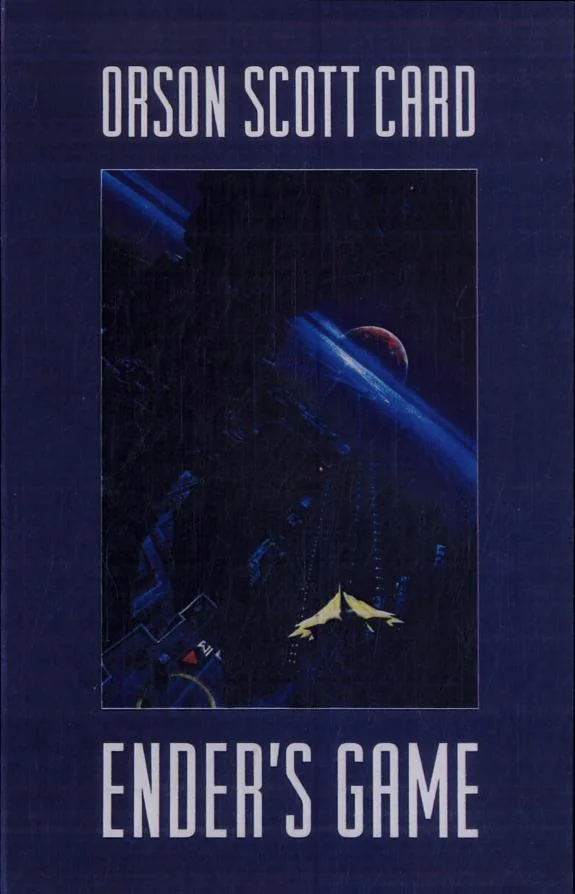
Ender's Game
 72
72

Ender's Game
Orson Scott Card’s 1991 novel, Ender's Game, presents a chillingly effective portrayal of childhood weaponization. The central conceit—that the most brilliant minds, still children, are the only hope against an alien invasion—is executed with stark precision. Ender Wiggin’s journey through Battle School, a starkly utilitarian orbital facility, is a masterclass in escalating psychological pressure. Card’s depiction of Ender’s isolation, particularly after the climactic ‘game’ that turns out to be devastatingly real, remains potent. The limitation, however, lies in the occasional didacticism regarding the ‘buggers’ and their motivations, which can feel slightly underdeveloped compared to the intricate portrayal of Ender’s internal conflict. A passage describing Ender’s manipulation by Colonel Graff early in his training vividly illustrates the book’s thematic core. The work ultimately functions as a disquieting examination of the cost of victory.
📝 Description
72
Orson Scott Card's 1991 novel, Ender's Game, imagines a child prodigy trained for interstellar war.
Andrew "Ender" Wiggin is a gifted child recruited into Battle School, an orbital facility. There, under intense psychological pressure and through complex zero-gravity war games, he is groomed to become humanity's supreme commander. The International Fleet manipulates Ender and his peers, pushing them to their limits to prepare for a potential renewed conflict with the alien Formics, or 'buggers.' The story examines the moral weight of command and the personal cost of genius when placed in situations demanding extreme strategic thinking and empathy. It questions the nature of warfare and the ethics of using children as instruments of survival.
Ender's Game was published in 1991, a time of global political change. Though not directly referencing these events, its narrative of a united Earth facing an external threat and the pressures on young leaders may have resonated with the era's anxieties. The novel's themes of control, manipulation, and the burden of exceptional talent continue to spark discussion. It raises questions about the separation of an artist's work from their personal beliefs, a dialogue that has evolved since its release.
Within an esoteric framework, Ender's Game can be seen as an allegory for the development of higher consciousness under extreme duress. The Battle School functions as a crucible, forcing individuals to transcend egoic limitations and confront archetypal conflicts. Ender's genius and his ability to empathize with his enemy, even the Formics, represent a path towards integration and the overcoming of dualistic thinking. The narrative's focus on children, often viewed as vessels of future potential, suggests a spiritual or psychological evolution necessary for species continuation, mirroring concepts of initiatory trials found in various mystical traditions.
💡 Why Read This Book?
• Understand the strategic paradoxes of warfare through Ender's zero-gravity combat scenarios, illustrating how perceived 'games' can mask immense stakes, as seen in the Battle School simulations. • Explore the ethical quandaries of child soldiers and the psychological burdens of command by examining Ender Wiggin's isolation and the manipulative tactics used by figures like Colonel Graff. • Contemplate xenocide and interspecies communication by analyzing the Formics' (buggers') role as an alien threat and Ender's eventual empathy towards them.
⭐ Reader Reviews
Honest opinions from readers who have explored this book.
❓ Frequently Asked Questions
When was Ender's Game first published?
Ender's Game was first published in 1991, marking its entry into the science fiction landscape during a period of significant global change.
Who is the author of Ender's Game?
The author of Ender's Game is Orson Scott Card, an American writer known for his contributions to speculative fiction.
What is the primary setting for Ender's training?
Ender's training primarily takes place at Battle School, an orbital military academy designed to prepare gifted children for interstellar combat.
What alien race does humanity face in Ender's Game?
Humanity faces an insectoid alien race known as the Formics, often referred to as 'buggers,' who previously attacked Earth.
What is the significance of the 'mind game' in Ender's training?
The 'mind game' is a sophisticated psychological tool used to test and develop Ender's strategic thinking and emotional resilience under simulated pressure.
What is the core conflict Ender must resolve?
The core conflict involves Ender being groomed to lead humanity's final defense against the Formics, a task that forces him to confront the morality of his actions.
🔮 Key Themes & Symbolism
The Burden of Genius
Ender's exceptional intellect is presented not as a gift but as a profound burden. From his early childhood, he is singled out, manipulated, and isolated by adults who see him as a tool for survival. The novel meticulously details the psychological toll this takes, demonstrating how extraordinary cognitive abilities can lead to profound loneliness and moral compromise. Ender's struggle to retain his humanity while making decisions that impact billions highlights the inherent conflict between personal well-being and perceived destiny.
Moral Ambiguity of Warfare
Ender's Game challenges simplistic notions of good versus evil. The 'buggers' are portrayed as a formidable alien threat, yet Ender's eventual interaction with them reveals a more complex reality. The narrative questions the necessity and morality of xenocide, particularly when conducted under false pretenses. The International Fleet's deception of Ender, using him to commit genocide without his full understanding, forces readers to confront the ethical compromises often made in the name of survival.
Childhood Under Pressure
The novel is a stark examination of childhood corrupted by war. Children are not depicted as innocent bystanders but as instruments of state policy, subjected to brutal training regimes and psychological warfare. Battle School's zero-gravity environment and competitive structure are designed to break them down and rebuild them as soldiers. This theme interrogates the exploitation of youth and the lasting impact of such experiences on developing minds, raising questions about where the line between training and abuse lies.
Xenocide and Empathy
The concept of the Formics, or 'buggers,' as an existential threat is central. However, the work transcends a simple alien invasion narrative by exploring the possibility of understanding and empathy across species. Ender's unique ability to understand his enemies, a trait that makes him invaluable, leads him to question the annihilation of the Formics. This arc suggests that true victory might lie not in destruction but in communication and reconciliation, even after immense loss.
💬 Memorable Quotes
Direct passages from the work, attributed to the author.
“In the moment when I truly understand my enemies, understand them in that deep and sickening way of knowing, and when I know, also in that way, that I can defeat them, then I will destroy them.”
— This statement expresses Ender's strategic philosophy, highlighting the terrifying clarity that precedes decisive action. It suggests that profound understanding is the prerequisite for ultimate victory, a concept that becomes tragically literal for him.
“I have to think of my own future, my own life, my own survival. And I have to do it all alone.”
— This reflects Ender's pervasive sense of isolation. Despite being surrounded by peers and superiors at Battle School, he recognizes that the ultimate responsibility for his fate and actions rests solely on his shoulders.
“I have to be the best. I have to be the best. I have to be the best.”
— This internal repetition emphasizes the immense pressure placed upon Ender to excel. It illustrates the psychological conditioning he undergoes, where constant high performance is not just encouraged but demanded for survival.
“The enemy is not the enemy. The enemy is us.”
— This profound interpretation suggests that the true obstacles are internal – our own fears, prejudices, and limitations – rather than external threats. It implies that self-awareness and internal transformation are key to overcoming any conflict.
💡 Key Ideas
Editorial paraphrase of the work's core concepts — not direct quotes.
The perfect is the enemy of the good. Sometimes everything has to be screwed up a little bit so that you can do something good.
This paraphrased concept speaks to the pragmatic compromises often required in leadership and conflict. It suggests that absolute perfection is unattainable and that strategic imperfection can sometimes pave the way for necessary, albeit flawed, progress.
🌙 Esoteric Significance
Tradition
While not explicitly tied to a single esoteric tradition, Ender's Game engages with Gnostic themes of a flawed creator and a hidden, manipulative demiurge (represented by the International Fleet's leadership). The 'buggers' can be seen as an alien manifestation of the 'other' or the shadow, challenging human preconceptions. Ender's journey toward understanding and empathy with them reflects the Gnostic pursuit of gnosis, or true knowledge, to overcome perceived limitations and achieve a higher state of awareness.
Symbolism
The zero-gravity Battle School serves as a microcosm of a chaotic, disconnected universe, a common motif in mystical traditions symbolizing the material plane or the 'sea of creation' that must be navigated. Ender's isolation and his ability to perceive the 'patterns' in combat and alien behavior can be interpreted as a form of intuitive or higher perception, akin to psychic development or spiritual insight, allowing him to transcend conventional limitations.
Modern Relevance
Contemporary discussions on AI ethics, the psychology of leadership in high-stakes environments, and the philosophy of interspecies communication frequently draw parallels to Ender's Game. Thinkers exploring the potential dangers of advanced military technology and the moral costs of 'preemptive' conflict find resonance in the novel's depiction of the International Fleet's actions. Its continued popularity among young adult and adult readers suggests a persistent interest in narratives that grapple with the complexities of power, responsibility, and ethical decision-making in extreme circumstances.
👥 Who Should Read This Book
• Students of military strategy and psychological warfare: Gain insights into simulated combat, leadership under extreme duress, and the ethical implications of weaponizing youth, as depicted in Battle School. • Explorers of Gnostic and existential themes: Engage with a narrative that questions a manipulative 'creator' (the Fleet command) and explores the path to knowledge (gnosis) through understanding an alien 'other.' • Aspiring writers and narrative theorists: Analyze a detailed look in pacing, character development under pressure, and the construction of compelling moral dilemmas within a science fiction framework.
📜 Historical Context
Published in 1991, Orson Scott Card's Ender's Game arrived in a post-Cold War world, a time marked by shifting global alliances and lingering anxieties about large-scale conflict. While the novel’s narrative is set in a distant future and focuses on an alien threat, its themes of unified defense against an existential enemy and the psychological pressures on young leaders resonated with contemporary concerns. The science fiction range of the early 1990s was diverse, with authors like Ursula K. Le Guin and Iain M. Banks exploring complex societal and ethical issues within their works. Ender's Game quickly garnered critical acclaim, winning the Hugo Award and Nebula Award, solidifying its place as a significant work in the genre. Its later controversies, stemming from Card's personal views, also sparked broader discussions about the separation of art and artist, a debate that continues to shape literary reception.
📔 Journal Prompts
Ender Wiggin's strategic understanding of the Formics, prior to full awareness of their destruction, prompts reflection on empathic xenocide.
The isolation of Battle School and Ender's subsequent solitude offer fertile ground for contemplating the burdens of exceptionalism.
Colonel Graff's manipulative leadership style invites analysis of utilitarian ethics versus individual well-being.
The concept of the 'mind game' as a tool for psychological conditioning warrants examination of artificial versus authentic learning.
Ender's final act of seeking out the Hive Queen egg invites contemplation on atonement and interspecies responsibility.
🗂️ Glossary
Formics
The insectoid alien species that previously attacked Earth, also referred to as 'buggers.' They are portrayed as a collective intelligence posing an existential threat to humanity.
Battle School
An orbital training facility designed to identify and groom gifted children into military commanders capable of defeating the Formics. It features zero-gravity training rooms and rigorous psychological conditioning.
Zero-Gravity Combat
The unique form of combat practiced at Battle School, taking place in a large, zero-gravity arena where students use 'imaginary' weapons and tactics to defeat opposing teams.
The Mind Game
A sophisticated computer program used at Battle School to simulate strategic scenarios and probe a student's psychological state, often reflecting their deepest fears and desires.
International Fleet
The global military organization responsible for defending Earth against the Formics. It employs controversial methods, including the recruitment and manipulation of child prodigies.
Buggers
A derogatory and common nickname used by humans for the Formics, reflecting their fear and dehumanization of the alien species.
Xenocide
The systematic destruction of an alien race. This concept is central to the novel's climax and Ender's subsequent moral crisis.
This book appears in 1 collection
🔮 Readers Also Liked
Browse all →









From the “Telepathy” Collection
View all →









More Free Occult Philosophy Books
View all →