Atlantis in America
 80
80

Atlantis in America
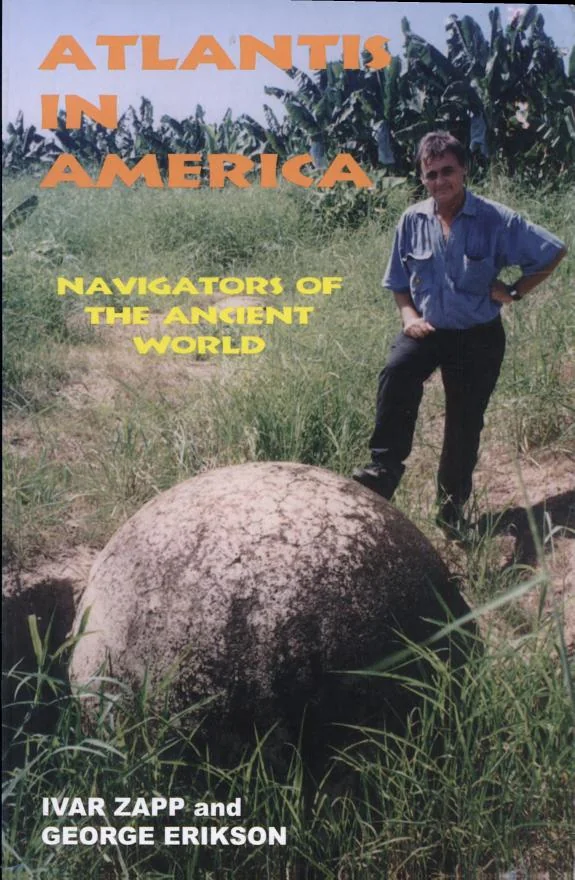
Zapp and Erikson’s *Atlantis in America* is a bold proposition, presenting the stone spheres of Costa Rica and other enigmatic artifacts not as art or ritual objects, but as sophisticated navigational instruments. The authors meticulously detail the geometry and astronomical alignments inherent in these finds, suggesting they were used to teach sea routes and constellations. Their argument for a link between Mesoamerica and the ancient Middle East is particularly compelling, drawing parallels that conventional history often overlooks. A notable strength is the detailed photographic evidence and schematics provided for the sighting stones. However, the work occasionally leans heavily on speculative interpretation, particularly when inferring the exact nature of the knowledge encoded. One particularly striking passage details the potential use of the spheres as gyroscopic compasses, a concept that, while intriguing, requires significant leaps of faith. Ultimately, *Atlantis in America* offers a challenging, evidence-based, though sometimes conjectural, re-evaluation of ancient seafaring capabilities and global interconnectedness.
📝 Description
80
Atlantis in America (1998) proposes giant stone spheres were ancient navigational tools.
Ivar Zapp and George Erikson's Atlantis in America argues that certain enigmatic artifacts from Mesoamerica, such as the giant stone spheres of Costa Rica and various sighting stones found throughout the Pacific, served as sophisticated navigational instruments. These objects, they contend, were not merely decorative but were used by ancient mariners to chart sea routes and celestial paths. The authors present this as tangible evidence for advanced knowledge transfer and transoceanic contact during prehistoric eras.
The book is directed towards serious students of ancient mysteries, comparative mythology, and alternative history. It will particularly interest those who question conventional understandings of human civilization's timeline and look for evidence supporting pre-Columbian transoceanic voyages. Readers concerned with archaeoastronomy, lost civilizations, and the potential for ancient technological capabilities will find substantial material for consideration and further research.
Published in 1998, Atlantis in America entered a period of renewed interest in theories challenging established historical timelines and suggesting advanced ancient capabilities. The work aligns with esoteric traditions that propose lost civilizations possessed sophisticated knowledge, particularly in astronomy and navigation, which has been forgotten or suppressed. By focusing on specific artifacts and their proposed practical functions, the authors sought to provide concrete examples supporting these unconventional historical narratives, situating their research within a broader discussion of ancient mysteries and alternative archaeology.
💡 Why Read This Book?
• Gain a new perspective on ancient technology by examining the proposed function of Costa Rican stone spheres as navigational tools, moving beyond purely artistic or ritualistic interpretations. • Understand the potential for pre-Columbian transoceanic contact by analyzing the links Zapp and Erikson draw between Mesoamerica and ancient Egypt and the Middle East. • Explore the concept of archaeoastronomy through the detailed discussion of sighting stones and their proposed use in teaching celestial paths to ancient mariners.
⭐ Reader Reviews
Honest opinions from readers who have explored this book.
❓ Frequently Asked Questions
What is the central argument of 'Atlantis in America' regarding the stone spheres of Costa Rica?
The book argues that the large stone spheres of Costa Rica, dating back to around 600 CE, were not merely decorative but served as sophisticated navigational tools. Zapp and Erikson propose they were used to teach sea routes and constellation paths to ancient mariners.
What evidence does the book present for links between Mesoamerica and the Middle East?
The authors highlight similarities in architectural styles, mythological motifs, and particularly the functional use of artifacts like sighting stones, suggesting a shared knowledge base or direct contact between these distant ancient cultures.
Who were the primary authors of 'Atlantis in America'?
The book was authored by Ivar Zapp and George Erikson. It was first published in 1998, contributing to discussions about ancient civilizations and their capabilities.
What specific types of artifacts are examined in the book?
The primary focus is on the giant stone spheres found in Costa Rica, alongside various 'sighting stones' discovered across the Pacific islands and other enigmatic megalithic structures.
Does the book claim direct evidence of the lost continent of Atlantis?
While the title references Atlantis, the book's focus is on presenting evidence for advanced ancient navigation and transoceanic contact, suggesting a civilization with knowledge comparable to or exceeding our understanding of ancient capabilities, rather than a direct mapping of Plato's Atlantis.
What is the proposed purpose of the 'sighting stones' mentioned in the book?
The sighting stones are presented as instruments used by ancient navigators. Their design and placement are theorized to have allowed for the observation of specific stars or constellations, aiding in determining direction and location at sea.
🔮 Key Themes & Symbolism
Ancient Navigational Technology
The core of Zapp and Erikson's argument centers on the interpretation of large stone spheres and sighting stones as advanced navigational instruments. The work posits that these artifacts were not ceremonial but functional, designed to encode celestial and geographical information. By analyzing the precise geometry and astronomical alignments of these objects, particularly those from Costa Rica around 600 CE, the authors suggest ancient mariners possessed a sophisticated understanding of star paths and sea routes, enabling transoceanic voyages long before conventionally accepted timelines.
Transoceanic Contact
Atlantis in America strongly advocates for significant contact between ancient civilizations across vast oceans. The book presents substantial links between Mesoamerica and regions such as Egypt and the Middle East. This connection is explored through shared artifactual evidence, symbolic parallels, and the proposed dissemination of advanced navigational knowledge, challenging the notion of isolated cultural development in the ancient world and suggesting a more interconnected global history.
Archaeoastronomy and Lost Knowledge
The work examines the field of archaeoastronomy, examining how ancient peoples utilized celestial bodies for practical purposes. The 'sighting stones' are presented as key examples of instruments used to teach navigators about constellation paths. This focus highlights a lost body of knowledge concerning astronomy and its application to seafaring, suggesting that ancient societies possessed scientific understanding that has been largely overlooked or forgotten by modern scholarship.
Reinterpreting Megalithic Artifacts
Zapp and Erikson challenge conventional interpretations of megalithic structures and artifacts. They move beyond viewing objects like the Costa Rican spheres solely as art or status symbols. Instead, the book offers a functional perspective, proposing that these massive stones were integral components of an ancient technological system designed for exploration and global communication, requiring a re-evaluation of their purpose and the capabilities of their creators.
💬 Memorable Quotes
Direct passages from the work, attributed to the author.
“The great stone spheres of Costa Rica and sighting stones throughout the Pacific were used to teach sea routes and constellation paths to navigators.”
— This core statement expresses the book's central thesis: that enigmatic ancient artifacts held practical, navigational functions, suggesting a sophisticated understanding of astronomy and seafaring.
“These artifacts represent a sophisticated system of knowledge transfer for ancient mariners.”
— This interpretation emphasizes the authors' view of the artifacts not as isolated objects, but as components of a larger, intelligent design aimed at educating and guiding ancient seafarers across vast distances.
“Conventional history overlooks the evidence for widespread ancient transoceanic voyaging.”
— This statement reflects the authors' critical stance towards mainstream historical narratives, suggesting that existing evidence for global connections and advanced capabilities in antiquity has been largely ignored.
💡 Key Ideas
Editorial paraphrase of the work's core concepts — not direct quotes.
Substantial links exist between Meso-America and Egypt and the Middle East.
This paraphrase highlights the authors' assertion of significant cultural and knowledge exchange between the New World and Old World in antiquity, challenging traditional views of historical isolation.
The precision in the construction of these stones points to advanced scientific understanding.
This paraphrased concept underscores the authors' argument that the craftsmanship and alignment of the artifacts suggest a level of scientific and mathematical knowledge in ancient cultures that is often underestimated.
🌙 Esoteric Significance
Tradition
This work, while not strictly adhering to a single named esoteric tradition like Hermeticism or Theosophy, draws heavily on the broader Hermetic principle of 'As Above, So Below.' It aligns with esoteric pursuits that seek hidden knowledge and lost wisdom in ancient artifacts and myths. The exploration of celestial alignments and their terrestrial applications echoes Gnostic concerns with cosmic order and the potential for humanity to understand and utilize these principles.
Symbolism
The primary symbols are the colossal stone spheres and the 'sighting stones.' The spheres, with their perfect geometric form, symbolize cosmic order, advanced knowledge, and potentially the unified whole of a lost civilization. Sighting stones, as depicted in the book, represent focused intent, the directed application of astronomical knowledge, and the pathways of cosmic energy or information guiding human endeavors, particularly navigation.
Modern Relevance
Contemporary researchers in archaeoastronomy, ancient technology, and alternative history continue to reference Zapp and Erikson's findings. Their work provides a foundational dataset for those exploring pre-Columbian transoceanic contact theories and the possibility of advanced ancient scientific understanding. Thinkers interested in rediscovering lost knowledge and challenging established paradigms find value in the book's detailed examination of artifactual evidence.
👥 Who Should Read This Book
• Researchers of archaeoastronomy and ancient navigational techniques will find detailed case studies of artifacts like the Costa Rican spheres. • Enthusiasts of alternative history and lost civilizations will appreciate the arguments for pre-Columbian global contact and advanced ancient societies. • Students of comparative mythology and ancient symbolism will gain insights into how artifacts may have encoded and transmitted knowledge across cultures.
📜 Historical Context
Published in 1998, *Atlantis in America* emerged during a period marked by growing public interest in alternative historical theories and the re-examination of ancient civilizations. Mainstream archaeology at the time largely maintained a consensus on the timeline of human migration and technological development, often dismissing theories of early transoceanic contact. Zapp and Erikson's work engaged with this discourse, offering detailed artifactual analysis to support claims of advanced ancient navigation and global interconnectedness. Their approach, focusing on the functional interpretation of objects like the Costa Rican spheres, distinguished it from purely mythological explorations of lost continents. While not directly engaging with figures like Ignatius Donnelly, whose 1882 work *Atlantis: The Antediluvian World* popularized the Atlantis myth, Zapp and Erikson provided a more artifact-centric argument for a sophisticated ancient global network.
📔 Journal Prompts
The proposed function of the Costa Rican stone spheres as navigational tools.
The parallels drawn between Mesoamerican and Middle Eastern ancient cultures.
The concept of 'sighting stones' and their role in ancient seafaring.
Evidence for transoceanic contact presented in the book.
Reinterpreting the purpose of megalithic artifacts based on Zapp and Erikson's theories.
🗂️ Glossary
Stone Spheres of Costa Rica
Massive, precisely carved granite spheres, primarily found in the Diquís Delta region of Costa Rica, dating from approximately 600 to 1000 CE. Their original purpose is debated, but Zapp and Erikson propose they were navigational aids.
Sighting Stones
Artifacts, often portable stones with specific markings or apertures, discussed in the book as tools used by ancient mariners to align with celestial bodies for navigation.
Archaeoastronomy
The interdisciplinary study of how past cultures understood astronomical phenomena and how they used celestial bodies in their structures, calendars, and mythologies.
Transoceanic Voyages
Journeys made by sea across vast oceans. The book argues for significant pre-Columbian transoceanic voyages, challenging conventional historical timelines.
Mesoamerica
A historical region and cultural area in the Americas, extending from central Mexico through Belize, Guatemala, El Salvador, Honduras, Nicaragua, and northern Costa Rica.
Gyroscopic Compass
A compass that uses a gyroscope to maintain orientation. Zapp and Erikson explore the speculative possibility that ancient spheres could have functioned similarly.
Pre-Columbian
Referring to the period of history in the Americas before the arrival of Christopher Columbus in 1492 and the subsequent European colonization.
This book appears in 1 collection
🔮 Readers Also Liked
Browse all →








From the “Atlantis” Collection
View all →







More Free Esoteric History & Biography Books
View all →