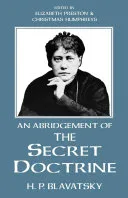
An Abridgement of the Secret Doctrine
 80
80

An Abridgement of the Secret Doctrine
An Abridgement of the Secret Doctrine succeeds in its primary goal: to make H. P. Blavatsky's dense cosmology digestible. By excising much of the exhaustive comparative analysis and esoteric jargon from the original 1888 text, this version offers a clearer, albeit less comprehensive, window into her vision of universal creation and human evolution. The section on "Root Races," for example, remains a challenging but fascinating concept, outlining a multi-epochal developmental process for humanity that stands apart from conventional scientific or religious narratives. However, the necessary simplification inevitably sacrifices some of the original's nuance and the sheer weight of its scholarly (or pseudo-scholarly) apparatus. The abridgement loses the extensive footnotes and cross-references that formed a significant part of the original's argumentative structure. While the core ideas are present, the reader misses the detailed scaffolding that supported Blavatsky's grand hypotheses. It's a valuable gateway, but one should be aware of the path not taken to reach this distilled form.
📝 Description
80
First published in 1888, H. P. Blavatsky's 'The Secret Doctrine' is now available in a condensed version.
This abridged edition makes Helena Petrovna Blavatsky's extensive cosmological and anthropological teachings more accessible. It distills the core ideas from the original 1500-page work, which Blavatsky presented as a compilation of ancient wisdom uncovered through her research. The book addresses universal cosmology, the evolution of humanity, and the underlying principles she identified.
It is suitable for readers new to Theosophy and esoteric philosophy who wish to grasp its fundamental concepts without the entirety of the original text. Students of comparative religion, metaphysics, and ancient history will find its alternative interpretations of creation myths and human origins of interest. Those curious about occult thought's development in the late 19th century and Blavatsky's influence will also find this version valuable.
Published in 1888, 'The Secret Doctrine' emerged during a period of Western fascination with spiritualism and Eastern philosophies. Blavatsky, a co-founder of the Theosophical Society, sought to synthesize ancient esoteric teachings with contemporary scientific ideas. The work became a significant text in esoteric movements, shaping discussions on occultism and spiritual evolution for decades.
💡 Why Read This Book?
• Gain an introduction to the Theosophical understanding of cosmic and human origins, as presented in Blavatsky's seminal work, without the daunting length of the original. • Understand the concept of "Root Races" and their proposed evolutionary stages, a key element of Blavatsky's unique anthropological framework first detailed in "The Secret Doctrine." • Explore the "Stanzas of Dzyan," the esoteric source texts Blavatsky cited, offering a glimpse into ancient cosmogonies outside mainstream historical records.
⭐ Reader Reviews
Honest opinions from readers who have explored this book.
❓ Frequently Asked Questions
What is the primary purpose of "An Abridgement of the Secret Doctrine"?
The abridgement aims to make H. P. Blavatsky's complex "Secret Doctrine" more accessible by distilling its core teachings on universal creation and human evolution, reducing the overwhelming scale of the original 1500-page text.
Who was Helena Petrovna Blavatsky and what was her role?
Blavatsky (1831-1891) was a Russian-born mystic and co-founder of the Theosophical Society in 1875. She is credited with synthesizing esoteric traditions and presenting them as the "Ancient Wisdom."
When was the original "The Secret Doctrine" first published?
The original, unabridged "The Secret Doctrine" was first published in two volumes in 1888.
What are some of the key esoteric concepts discussed in the book?
The abridgement covers concepts such as the "Root Races," the "Stanzas of Dzyan," the "Seven Planes of Existence," and the "Monad."
Is this abridgement a complete representation of Blavatsky's original work?
No, it is a condensation. While it retains the essential cosmological and anthropological ideas, it omits much of the detailed argumentation, extensive references, and comparative analysis found in the original 1888 publication.
What historical period influenced Blavatsky's writing of "The Secret Doctrine"?
Blavatsky wrote "The Secret Doctrine" during the late 19th century, a time of significant Western interest in spiritualism, Eastern religions, and occult philosophies.
🔮 Key Themes & Symbolism
Cosmic Evolution
This abridgement explores the Theosophical view of the universe's genesis, presenting a cyclical model of creation and dissolution rather than a linear one. It posits that the cosmos evolves through a series of "Manvantaras" (periods of activity) and "Pralayas" (periods of rest). The work details the emergence of fundamental principles and forces that shape the manifested universe, drawing parallels between macrocosmic events and the unfolding of individual consciousness across vast timescales, as outlined in Blavatsky's interpretation of ancient texts.
Human Origins and Evolution
Central to the text is the doctrine of "Root Races," a framework positing seven distinct stages of human evolution unfolding across millions of years. This abridgement outlines the progression from ethereal beings to the physical humanity of the present "Fifth Root Race." It discusses the spiritual and physical development of each race, their eventual decline, and the cyclical nature of their appearance and disappearance, offering an esoteric alternative to conventional evolutionary theories.
The Ancient Wisdom
The work presents itself as an exposition of the "Ancient Wisdom," a perennial philosophy believed to underlie all world religions and esoteric traditions. Blavatsky claimed to have access to this hidden knowledge, purportedly preserved in secret teachings and texts like the "Stanzas of Dzyan." The abridgement conveys the idea that this wisdom provides a unified understanding of reality, connecting the physical, psychic, and spiritual planes of existence for both the cosmos and humanity.
Seven Planes of Existence
The text elucidates a hierarchical structure of reality comprising seven distinct planes, ranging from the purely spiritual to the physical. This abridgement describes how consciousness, or the "Monad," descends through these planes to gain experience and then ascends again through spiritual evolution. Understanding these planes is crucial for grasping Blavatsky's model of manifestation and the cyclical journey of souls.
💬 Memorable Quotes
Direct passages from the work, attributed to the author.
“Man is the microcosm, reflecting the macrocosm.”
— This expresses the Hermetic principle of "as above, so below," suggesting that the human being mirrors the structure and processes of the entire universe, a key tenet for understanding individual spiritual development within Blavatsky's system.
“The Root Races represent stages in the evolution of human consciousness and form.”
— This interpretation emphasizes that Blavatsky's "Root Races" are not merely biological classifications but represent distinct phases in the development of both the physical body and the spiritual awareness of humankind over vast epochs.
“The Monad is the divine spark within, destined to incarnate and evolve.”
— This statement defines the 'Monad' as the eternal, spiritual essence of an individual, whose purpose is to experience successive lifetimes and spiritual growth across different planes of existence.
💡 Key Ideas
Editorial paraphrase of the work's core concepts — not direct quotes.
The universe is worked and guided by Seven Logoi, the Seven Creative Forces.
This quote highlights Blavatsky's concept of a structured, ordered cosmos guided by divine intelligences or creative principles, a fundamental aspect of her cosmological framework presented in the work.
Evolution is the unfurling of a pre-existing plan.
This paraphrased concept points to the idea that evolution, as presented in the book, is not a random process but a divinely guided unfolding of potentials inherent in the cosmos and in humanity.
🌙 Esoteric Significance
Tradition
This work is a central to modern Theosophy, a tradition Blavatsky largely synthesized and popularized. It draws heavily from Eastern esoteric philosophies, particularly Hinduism (Vedanta and Samkhya) and Buddhism (Mahayana), alongside Hermeticism and Kabbalah. Theosophy positions itself as a universal, ancient wisdom tradition, and "An Abridgement of the Secret Doctrine" serves as a key text for understanding its unique cosmological and anthropological doctrines, departing from purely Western occult lineages by its extensive use of Eastern concepts.
Symbolism
Key symbols include the "Ouroboros," representing cyclical time, eternity, and the unity of existence, often depicted as a serpent eating its own tail. The "Triangle" and "Interlocking Triangles" symbolize the interplay of divine and human principles, or the manifest and unmanifest realms. The "Lotus" flower is frequently used to represent the unfolding of consciousness and the universe from a single divine source, emerging from the mud (materiality) into the light (spirituality).
Modern Relevance
Contemporary esoteric practitioners, New Age thinkers, and comparative religion scholars continue to engage with Blavatsky's ideas. Concepts from "The Secret Doctrine," such as the "Root Races" and the "Seven Planes," have been influential in various spiritual subcultures. Modern interpretations often seek to reconcile Blavatsky's theories with contemporary science or psychology, and her work remains a reference point for discussions on consciousness, evolution, and ancient cosmology within alternative spiritual communities.
👥 Who Should Read This Book
• Aspiring Theosophists and students of esoteric philosophy seeking a foundational text that outlines Blavatsky's core cosmological and evolutionary theories. • Researchers in comparative religion and history of occultism interested in the development of spiritual thought in the late 19th century and the influence of Eastern philosophies on Western esotericism. • Individuals curious about alternative cosmogonies and anthropological models who wish to explore concepts like "Root Races" and cyclical evolution presented in a structured, albeit abridged, format.
📜 Historical Context
Published in 1888, "The Secret Doctrine" emerged during a period of intense spiritual and intellectual ferment in the West. Helena Petrovna Blavatsky, already a prominent figure through the Theosophical Society she co-founded in 1875, sought to present a synthesis of ancient religious, philosophical, and scientific ideas. The late 19th century saw a surge of interest in Eastern religions (Hinduism, Buddhism), spiritualism, and occultism, partly as a reaction against perceived materialism and the rigid doctrines of established churches. Blavatsky's work engaged with contemporary scientific theories, such as Darwinism, offering esoteric counter-narratives. The book was met with both widespread admiration from esoteric circles and severe criticism from mainstream academics and religious figures, who questioned its sources and claims. Its reception significantly shaped the trajectory of Theosophy and influenced subsequent New Age and esoteric movements, even as figures like the Sanskrit scholar Max Müller critiqued its use of Indian texts.
📔 Journal Prompts
The "Stanzas of Dzyan" as a source of Ancient Wisdom, what are its implications?
Reflection on the cyclical nature of "Manvantaras" and "Pralayas" in cosmic processes.
The concept of the "Monad's" journey across the "Seven Planes of Existence."
Consider the "Root Races" as stages of human development; how might this framework apply metaphorically today?
The interconnectedness of the microcosm (human) and macrocosm (universe) as presented in the text.
🗂️ Glossary
Ancient Wisdom
The perennial philosophy or universal truth believed by Theosophists to underlie all world religions and esoteric traditions, claimed by Blavatsky to be the source of her teachings.
Manvantara
A Sanskrit term referring to a period of cosmic activity or a "day of Brahma," representing a cycle of manifestation in the universe's existence.
Pralaya
A Sanskrit term for a period of cosmic dissolution or "night of Brahma," a state of rest and non-manifestation between cycles of creation.
Root Races
A Theosophical concept describing seven sequential stages of human evolution, each characterized by distinct physical and spiritual attributes, unfolding over vast geological epochs.
Seven Planes of Existence
A hierarchical structure of reality in Theosophy, comprising seven levels from the spiritual to the material, through which consciousness descends and ascends.
Stanzas of Dzyan
Ancient esoteric texts Blavatsky claimed as the source material for "The Secret Doctrine," said to contain secret teachings on cosmology and anthropology.
Theosophy
A spiritual movement founded by Helena Blavatsky and others, aiming to promote the study of comparative religion, philosophy, and science to uncover the underlying unity of all existence.