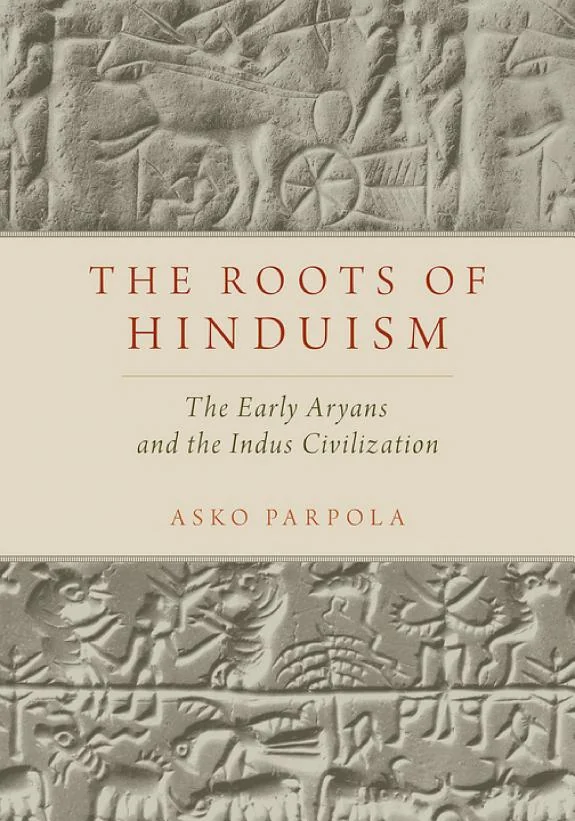
The Roots of Hinduism
 71
71

The Roots of Hinduism
Parpola’s "The Roots of Hinduism" presents a formidable argument for a specific Indo-Iranian homeland and migration route, grounded in linguistic reconstruction and archaeological findings. The author's detailed tracing of Proto-Indo-European and Proto-Indo-Iranian language families provides a solid foundation for his thesis. A notable strength is the detailed exploration of the connections between early Vedic hymns and the later epic narratives, offering a coherent developmental arc. However, the sheer density of linguistic data can be overwhelming for readers less familiar with Indo-European philology, making certain sections demanding. The work's examination of the Rigvedic period and its potential links to Central Asian archaeological cultures, particularly the Sintashta culture around 2000 BCE, is particularly illuminating. Ultimately, this is a rigorous scholarly work that demands attention from serious students of ancient South Asian history and linguistics.
📝 Description
71
Asko Parpola's 2015 book traces Indo-Iranian migrations and the origins of Hindu traditions.
Asko Parpola's "The Roots of Hinduism" reconstructs the historical movements of Indo-Iranian speakers, beginning from a presumed homeland north of the Black Sea and extending across the Eurasian steppes into Central, West, and South Asia. The work connects linguistic evidence with archaeological findings to propose new ideas about the beginnings of Vedic literature, rituals, and the great Hindu epics. Parpola synthesizes philological analysis and archaeological data, moving past solely textual studies to consider wider Eurasian influences on South Asian religious traditions. He examines the early Vedic period and how epics like the Mahabharata and Ramayana developed. The research looks at the linguistic layers and cultural exchanges that formed these narratives and their associated rites, giving a way to understand the development of Brahmanical traditions. The book emphasizes the Eurasian steppes as a key area for cultural and linguistic spread, showing how movements through this region shaped India's religious and literary history. This view challenges simpler models of cultural spread and highlights interconnectedness.
While "The Roots of Hinduism" is primarily an academic work grounded in linguistics and archaeology, it touches upon the development of esoteric traditions within Hinduism. By tracing the origins of Vedic rituals and the foundational epics, Parpola provides context for later mystical and philosophical developments. The book's focus on the interplay of language, migration, and religious practice offers a historical framework for understanding how the intellectual and spiritual currents that would give rise to Gnosticism and other esoteric paths within South Asia took shape.
💡 Why Read This Book?
• Gain a nuanced understanding of the Indo-Iranian migration from the Eurasian steppes, learning about the linguistic evidence Parpola uses to connect disparate regions. • Explore the formation of Vedic literature and rites, understanding how early hymns and rituals evolved from a proposed Proto-Indo-Iranian cultural base. • Grasp the origins of the great Hindu epics, recognizing their deep roots in the cultural and linguistic history discussed by Parpola.
⭐ Reader Reviews
Honest opinions from readers who have explored this book.
❓ Frequently Asked Questions
What is the proposed origin of the Indo-Iranian speakers according to Asko Parpola?
Asko Parpola proposes that the Indo-Iranian speakers originated in the Pontic-Caspian steppe region, north of the Black Sea, before migrating eastward and southward.
What historical periods does "The Roots of Hinduism" cover?
The book covers the period from the presumed Indo-Iranian homeland to the formation of Vedic literature and the great Hindu epics in South Asia.
How does Parpola connect language and archaeology in his research?
Parpola uses comparative linguistics to reconstruct proto-languages and identify migration patterns, correlating these findings with archaeological evidence of material culture and settlements.
What is the significance of the Eurasian steppes in Parpola's thesis?
The Eurasian steppes are presented as a crucial corridor for the migration and cultural diffusion of Indo-Iranian peoples, influencing religious and literary traditions.
Does the book discuss the origins of specific Hindu deities?
While focusing on broader linguistic and cultural formations, the work explores the development of Vedic religion, which includes early forms and concepts of deities later central to Hinduism.
When was "The Roots of Hinduism" first published?
The book was first published in 2015, presenting contemporary scholarship on the subject.
🔮 Key Themes & Symbolism
Linguistic Paleontology
Parpola employs linguistic paleontology, reconstructing proto-languages to infer ancient lifeways, migrations, and cultural contacts. The work traces Proto-Indo-Iranian linguistic features back to hypothesized homelands north of the Black Sea, using systematic sound changes and reconstructed vocabulary to map movements across the Eurasian steppes. This method provides a framework for understanding the cultural substrate that influenced early Vedic society and its subsequent development in South Asia.
Vedic and Epic Formation
The book offers a detailed analysis of the formation of Vedic literature and the great Hindu epics. Parpola argues for a continuity and evolution from early Vedic rites and hymns to the narratives of the Mahabharata and Ramayana. This perspective emphasizes the deep historical layering within these texts, suggesting their roots extend beyond the Indian subcontinent to earlier Eurasian cultural spheres.
Eurasian Steppe Migrations
A central theme is the migration of Indo-Iranian speakers from the Pontic-Caspian steppe region. Parpola details their passage through Central Asia and into South Asia, linking linguistic evidence with archaeological cultures. This focus highlights the steppes not just as a point of origin but as a dynamic zone of cultural exchange and diffusion that profoundly shaped the Indian subcontinent.
Proto-Indo-Iranian Culture
The work reconstructs aspects of Proto-Indo-Iranian culture, inferring social structures, religious practices, and technological advancements from linguistic data. This hypothetical early culture serves as a crucial reference point for understanding the subsequent development of both Iranian and Indic traditions, providing a common ancestral framework for their divergence and evolution.
💬 Memorable Quotes
Direct passages from the work, attributed to the author.
“the Indo-Iranian speakers originated in the Pontic-Caspian steppe”
— This is a core assertion by Parpola, positing a specific geographical origin for the ancestral group before their eastward and southward expansion, influencing the linguistic and cultural trajectories of India and Iran.
“the formation of Vedic literature and rites”
— Parpola's analysis focuses on the developmental stages of early Hindu scriptures and ritual practices, suggesting they are products of specific historical migrations and cultural syntheses rather than static revelations.
“the great Hindu epics”
— The book examines the origins and development of foundational epic narratives, linking their historical roots to the broader Indo-Iranian migrations and cultural exchanges explored in the text.
“migration through the Eurasian steppes”
— This highlights the critical role of the vast steppe regions as conduits for ancient peoples, facilitating the spread of languages and cultures from their hypothesized homelands into new territories.
“new ideas on the origin and formation”
— This phrase emphasizes the book's contribution of novel theories and interpretations regarding the historical genesis of key elements within Hinduism, particularly its earliest literary and ritual expressions.
🌙 Esoteric Significance
Tradition
While "The Roots of Hinduism" is primarily a work of historical linguistics and archaeology, its focus on the deep origins of Vedic culture and Hindu epics touches upon foundational elements often explored in esoteric traditions. It provides a historical and philological grounding that can inform esoteric interpretations of ancient Indian cosmology and mythology, offering a framework beyond purely devotional or mystical approaches. It aligns with esoteric interests in uncovering primal sources and ancient wisdom traditions.
Symbolism
The book implicitly engages with the symbolism embedded in Vedic hymns and epic narratives. For instance, the concept of *ṛta* (cosmic order) in the Vedas, though discussed historically, carries profound symbolic weight in many esoteric systems as a universal principle of truth and balance. The migration routes themselves can be seen as symbolic journeys of consciousness and cultural evolution, reflecting archetypal patterns of expansion and development.
Modern Relevance
Contemporary scholars and practitioners interested in comparative mythology, ancient spiritual roots, and the historical development of Indic traditions draw upon Parpola's extensive research. His work provides a critical historical lens for understanding the origins of concepts and narratives that continue to resonate in modern yoga, Vedanta, and various forms of Hindu practice and philosophy, offering a more informed perspective on their deep historical lineage.
👥 Who Should Read This Book
• Students of comparative religion and mythology seeking to understand the historical formation of South Asian traditions beyond textual analysis. • Linguists and archaeologists interested in the application of philological methods to reconstruct ancient Eurasian migrations and cultural interactions. • Scholars of early Indian history and Vedic studies looking for a comprehensive, research-driven perspective on the origins of Indic civilization and its foundational texts.
📜 Historical Context
Published in 2015, Asko Parpola’s "The Roots of Hinduism" entered a scholarly landscape deeply engaged with debates surrounding the Indo-Aryan migrations. For decades, the dominant paradigm, influenced by scholars like Sir Mortimer Wheeler, often focused on a southward expansion from Central Asia. Parpola’s work, however, builds upon earlier linguistic hypotheses, notably those of his father, Reino Parpola, and others who championed a Pontic-Caspian steppe origin. This approach countered prevailing theories that emphasized a more direct diffusion of Vedic culture into India without extensive prior Indo-Iranian presence in Central Asia. The book emerged in an era of sophisticated interdisciplinary research, integrating genetics and advanced archaeological dating techniques, though Parpola primarily relies on philology and archaeology. Its reception within the academic community was significant, offering a robust, linguistically-driven counterpoint to certain archaeological interpretations of the Indus Valley Civilization and its successors.
📔 Journal Prompts
The Proto-Indo-Iranian homeland and its proposed location north of the Black Sea.
Parpola's reconstruction of early Vedic rites and their potential connections to steppe cultures.
The linguistic evidence linking the Eurasian steppes to the formation of Hindu epics.
Reflect on the concept of *ṛta* as presented within the historical context of Vedic hymns.
The significance of the Indo-Iranian migration path as described by Parpola.
🗂️ Glossary
Proto-Indo-Iranian
The reconstructed common ancestral language spoken by the hypothetical Proto-Indo-Iranian people before their divergence into Iranian and Indo-Aryan branches.
Vedic literature
The corpus of religious texts composed in Vedic Sanskrit, including the Rigveda, Samaveda, Yajurveda, and Atharvaveda, forming the earliest scriptures of Hinduism.
Eurasian Steppes
The vast expanse of grassland stretching across Northern Eurasia, considered a major route for ancient migrations and cultural diffusion.
Philology
The study of language in oral and written historical sources; it is an approach to understanding human history through the appraisal of recorded material.
Sintashta culture
An archaeological culture of the Middle Bronze Age (c. 2100–1800 BCE) found on the northern Eurasian steppe, often associated with early Indo-Iranians.
Rigveda
The oldest and most important of the four Vedas, a collection of hymns composed in Vedic Sanskrit, central to early Brahmanical religion.
Indo-Iranian homeland
The hypothesized geographical region from which the speakers of Proto-Indo-Iranian language and culture originated before their migrations.
This book appears in 1 collection
🔮 Readers Also Liked
Browse all →








From the “Hinduism” Collection
View all →








More Free Esoteric History & Biography Books
View all →