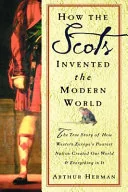
How the Scots Invented the Modern World
 74
74

How the Scots Invented the Modern World
Arthur Herman's "How the Scots Invented the Modern World" presents a compelling, if somewhat sweeping, thesis: that a small nation's intellectual output in the 18th century laid the groundwork for modern Western society. The book excels in detailing the contributions of figures like Adam Smith and David Hume, effectively illustrating their impact on economic and philosophical thought. Herman's assertion that Scottish thinkers championed ideas like freedom of speech and equal opportunity with particular fervor is well-supported by his examination of their writings. A notable strength lies in connecting the dots between distinct Scottish thinkers and their collective influence. However, the book occasionally feels overly enthusiastic, at times bordering on nationalist pride rather than purely critical analysis. The broad scope means that some nuanced counter-arguments or alternative influences might be less explored. One passage that stands out is the detailed exploration of Adam Smith's *The Theory of Moral Sentiments* (1759) before his more famous economic work, highlighting the ethical underpinnings of his thought. Ultimately, Herman provides a robust, albeit occasionally one-sided, argument for Scotland's pivotal role in shaping the modern world.
📝 Description
74
Arthur Herman's 2001 book contends that Scottish thinkers created modern Western civilization.
Arthur Herman's "How the Scots Invented the Modern World" argues that Scotland, especially in the 18th century, was a crucible for ideas that define Western society. The book contends that concepts like democratic governance, free markets, and universal education found their initial, crucial articulation in the work of Scottish philosophers and thinkers. Herman details how this period, known as the Scottish Enlightenment, produced an extraordinary number of influential minds despite Scotland's relative poverty.
The author identifies key Scottish contributions, including empiricist philosophy, the groundwork for modern economics and sociology, and a strong belief in education's power for social advancement. These intellectual currents, he asserts, spread from Scotland throughout Europe and influenced the early United States. The book is aimed at readers interested in intellectual history and the origins of societal structures.
While not strictly esoteric in the sense of occult studies, this book engages with the idea of intellectual lineages and the hidden springs of societal development. It examines how a specific, localized intellectual movement fundamentally altered the course of global thought, suggesting that profound shifts can emerge from unexpected sources. The focus on tracing the roots of modern concepts to a particular culture and era aligns with a tradition of seeking underlying patterns and influences in history, albeit through a lens of intellectual and social history rather than mystical or spiritual traditions.
💡 Why Read This Book?
• Learn how the Scottish Enlightenment, particularly figures like Adam Smith and David Hume in the 18th century, formulated foundational principles of modern economics and philosophy, offering a deep dive into the origins of free-market capitalism and empiricism. • Understand the specific historical context of Scotland's intellectual boom, realizing how societal conditions in the late 1700s fostered groundbreaking ideas about education and democracy that were then exported globally. • Gain a new perspective on the development of civic virtues, such as freedom of speech and equal opportunity, recognizing how Scottish thinkers articulated and promoted these ideals as cornerstones of societal progress.
⭐ Reader Reviews
Honest opinions from readers who have explored this book.
❓ Frequently Asked Questions
What specific Scottish Enlightenment figures does Arthur Herman highlight as most influential?
Arthur Herman prominently features figures such as Adam Smith, the father of modern economics, and David Hume, a key philosopher of empiricism and skepticism. He also discusses the impact of thinkers like Francis Hutcheson and Adam Ferguson.
When did the Scottish Enlightenment period primarily occur?
The Scottish Enlightenment is generally considered to have flourished during the 18th century, with its peak activity occurring from roughly the 1730s to the end of the century.
How did Scottish contributions influence the American Revolution or its founding principles?
Herman explores how Scottish ideals of liberty, representative government, and the importance of education influenced American Founding Fathers. Concepts like the separation of powers and natural rights found echoes in Scottish philosophical discourse.
What is the book's argument regarding the origins of democracy and freedom of speech?
The book argues that Scottish thinkers of the Enlightenment were instrumental in developing and advocating for democratic principles and robust freedom of speech, viewing them as essential for intellectual and social progress.
Does Arthur Herman connect Scottish innovations to modern concepts of equal opportunity?
Yes, Herman links the Scottish commitment to education and meritocracy to the modern ideal of equal opportunity, suggesting that the emphasis on schooling as a means of social advancement originated in Scotland.
What was the primary intellectual tradition that influenced the Scottish Enlightenment?
The primary intellectual tradition influencing the Scottish Enlightenment was empiricism, heavily shaped by John Locke and further developed by Scottish philosophers like David Hume, emphasizing experience and observation.
🔮 Key Themes & Symbolism
The Empiricist Revolution
The work details how Scottish philosophers, notably David Hume and Francis Hutcheson, advanced empiricism. This philosophical school, which posits that knowledge originates in sensory experience, challenged prevailing rationalist doctrines. Herman illustrates how this focus on observable reality and empirical evidence became a central to modern scientific inquiry and critical thinking, moving away from purely abstract metaphysical speculation and influencing the very way we understand truth and knowledge.
Foundations of Political Economy
Arthur Herman foregrounds Adam Smith's contributions, particularly *The Wealth of Nations* (1776), as foundational to modern capitalism. The book explains Smith's concepts of the 'invisible hand,' division of labor, and free markets. Beyond economics, it touches on how Scottish thinkers like Adam Ferguson analyzed the development of civil society and the state, providing early sociological insights into social structures and their evolution.
Education as Social Engineering
A central theme is the Scottish Enlightenment's fervent belief in the power of education. Herman explores the establishment of parish schools and the emphasis on universal literacy. This commitment is presented not merely as intellectual enlightenment but as a deliberate strategy for social uplift and national progress, arguing that this focus on accessible education as a driver of opportunity was a uniquely Scottish innovation that spread globally.
The Scottish Mindset: Pragmatism and Progress
Herman suggests a distinct 'Scottish mindset' characterized by pragmatism, a drive for improvement, and a focus on practical application of knowledge. This mindset, fostered by historical circumstances, led to innovations across science, philosophy, and governance. The book explores how this intellectual energy, unburdened by established aristocratic traditions of continental Europe, allowed for radical rethinking of societal structures and human potential.
💬 Memorable Quotes
Direct passages from the work, attributed to the author.
“The Scots were the first to truly believe in the possibility of progress.”
— This statement expresses Herman's core argument that Scottish thinkers actively promoted the idea of societal improvement and forward movement, a concept he sees as central to the modern Western worldview.
“Universal education was a tool for national advancement.”
— This interpretation reflects the book's focus on the practical, societal impact of the Scottish Enlightenment's educational reforms, positioning them as a deliberate strategy for improving the nation's standing.
“The Scottish Enlightenment was born from necessity and opportunity.”
— This interpretation suggests that the historical circumstances of Scotland in the 18th century – perhaps its relative poverty or political situation – spurred a unique intellectual flowering that Herman explores.
💡 Key Ideas
Editorial paraphrase of the work's core concepts — not direct quotes.
Adam Smith saw the moral sentiments as the foundation for economic activity.
This paraphrased concept highlights Herman's emphasis on Smith's *The Theory of Moral Sentiments* (1759), suggesting that the book connects economic principles to ethical frameworks, rather than presenting them in isolation.
Hume questioned the certainty of knowledge derived solely from reason.
This paraphrased concept points to David Hume's skeptical empiricism, emphasizing his challenge to rationalist philosophy and his insistence on experience as the primary source of understanding human affairs.
🌙 Esoteric Significance
Tradition
While not strictly within a defined esoteric lineage like Hermeticism or Gnosticism, Herman's work touches upon themes that resonate with certain esoteric philosophies concerning human potential and societal evolution. The Enlightenment's emphasis on reason, progress, and the perfectibility of man aligns with certain optimistic strands of occult thought that believe in humanity's capacity to transcend limitations through knowledge and self-awareness. It departs from traditional esotericism by focusing on empirical, secular means rather than mystical or supernatural ones.
Symbolism
The 'Scottish Mind' itself can be seen as a symbolic construct, representing a particular mode of thought—rational, empirical, and focused on societal improvement. The concept of the 'invisible hand' from Adam Smith, while economic, can be interpreted esoterically as a hidden order or guiding principle in collective human action. The widespread establishment of schools symbolizes the 'illumination' of the populace through knowledge, a common motif in various esoteric traditions seeking to dispel ignorance.
Modern Relevance
Contemporary thinkers in fields like libertarianism and classical liberalism draw heavily on the economic and political ideas popularized by Scottish Enlightenment figures discussed in the book. Furthermore, educational theorists and proponents of meritocracy can find historical roots for their ideas within Herman's analysis. The work's focus on the power of ideas to shape civilization also finds echoes in modern discussions about cultural influence and intellectual history within both academic and popular discourse.
👥 Who Should Read This Book
• Students of Western intellectual history seeking to understand the origins of modern democratic and economic systems, gaining specific insights into the Scottish Enlightenment's role. • Readers interested in the philosophy of progress and societal development, learning how concepts like universal education were championed as drivers of national advancement. • Individuals curious about the unacknowledged influences on Western civilization, particularly how ideas originating from Scotland impacted global thought and governance.
📜 Historical Context
Published in 2001, Arthur Herman's "How the Scots Invented the Modern World" emerged during a period of renewed interest in the Enlightenment and its lasting legacy. The book situates itself within the intellectual currents of the 18th century, specifically the Scottish Enlightenment, a vibrant era from roughly the 1730s to 1800. Key contemporaries and influences included figures from the broader European Enlightenment like Voltaire and Rousseau, though Herman emphasizes Scotland's distinct contributions. The book implicitly engages with the historiographical debate about the origins of modern thought, often dominated by French and German philosophers. While not facing overt censorship, its broad claims likely sparked debate among historians and cultural critics, some of whom might have found its nationalist undertones debatable compared to more cosmopolitan interpretations of the Enlightenment.
📔 Journal Prompts
The Scottish Enlightenment's emphasis on empiricism and its challenge to rationalism.
Adam Smith's concept of the 'invisible hand' and its societal implications.
The role of universal education as a catalyst for social and national progress.
David Hume's philosophical skepticism and its impact on certainty.
The practical application of freedom of speech ideals by Scottish thinkers.
🗂️ Glossary
Scottish Enlightenment
A period of intense intellectual and scientific activity in Scotland during the 18th century, characterized by a focus on reason, empiricism, and societal progress.
Empiricism
A philosophical theory that states all knowledge is derived from sense-experience, emphasizing observation and experimentation over innate ideas or pure reason.
Invisible Hand
A concept introduced by Adam Smith, describing the unintended social benefits of individual self-interested actions in a free market economy.
Freedom of Speech
The principle that supports the liberty of an individual or community to articulate their opinions and ideas without fear of retaliation or censorship.
Parish Schools
Schools established in local parishes across Scotland, particularly during the Enlightenment, aimed at providing basic education to the general population.
Sociology
The study of the development, structure, and functioning of human society, with early foundational ideas explored by Scottish thinkers like Adam Ferguson.
Rationalism
A philosophical approach that emphasizes reason as the primary source of knowledge, often contrasting with empiricism's reliance on sensory experience.
This book appears in 1 collection
🔮 Readers Also Liked
Browse all →







From the “Enlightenment” Collection
View all →









More Free Esoteric History & Biography Books
View all →