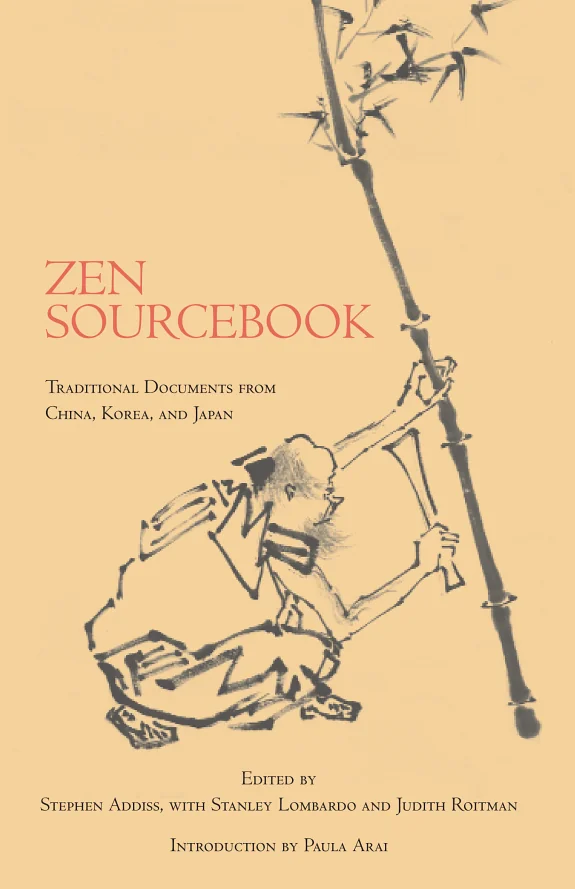
Zen Sourcebook
 75
75

Zen Sourcebook
Stephen Addiss, Stanley Lombardo, and Judith Roitman's "Zen Sourcebook" offers a commendable effort to consolidate essential Zen writings from its formative Chinese, Korean, and Japanese phases. The strength lies in its ambition to present these disparate traditions within one covers, providing a panoramic view for students. The selection of materials, encompassing poetry, letters, and sermons, offers a tangible connection to the masters' direct teachings. However, the volume's inherent challenge is its breadth. While a general introduction is present, the depth of historical and philosophical nuance for each specific tradition might feel abbreviated for seasoned scholars. A particular passage that illustrates this is the inclusion of early Chan Buddhist poetry, which, while beautiful, requires significant contextualization to fully appreciate its radical departure from prior Buddhist scriptural traditions.
Despite this limitation, the book serves as an accessible gateway. It is a valuable compilation for those new to the field or seeking a broad overview. The "Zen Sourcebook" effectively democratizes access to primary Zen texts.
📝 Description
75
Zen Sourcebook gathers foundational Zen writings from China, Korea, and Japan into one volume.
Published in 2008, Zen Sourcebook collects poetry, letters, sermons, and visual arts from key Zen Masters, spanning the first 1200 years of the tradition's development. The compilers, Stephen Addiss, Stanley Lombardo, and Judith Roitman, aimed to create an accessible English resource for students and practitioners. The book includes an introduction and notes that provide historical and biographical context.
This collection is intended for those who wish to engage directly with primary Zen literature. It traces the historical and textual roots of Zen Buddhism through its East Asian manifestations. Scholars of comparative religion, philosophy, and East Asian studies will also find it useful for examining the evolution of Zen thought. The book focuses on the formative period of Zen, before major later figures and developments in China and Japan.
This sourcebook illuminates the historical development of Zen (Chan) Buddhism, a tradition emphasizing direct, intuitive understanding over doctrinal study. It presents early texts that show how Zen masters used poetry, sermons, and even art to point towards awakening. The collection highlights the master-disciple interactions crucial for transmitting this practice, which seeks to bypass conceptual thought through experiential insight. Its focus on the initial millennium of Zen's spread from China to Korea and Japan offers a view of its formation before later regional elaborations.
💡 Why Read This Book?
• Gain direct exposure to the foundational writings of Chinese, Korean, and Japanese Zen masters, moving beyond secondary interpretations. This allows for a personal encounter with the early Zen discourse as preserved in poetry and letters from the tradition's first 1200 years. • Understand the historical development of Zen Buddhism by examining primary texts that span centuries and distinct cultural contexts, offering a chronological perspective on the evolution of its core tenets and practices. • Appreciate Zen's artistic dimension through selections of visual arts and poetry, revealing how aesthetic expression served as a vehicle for transmitting spiritual insights and meditative states in early Zen.
⭐ Reader Reviews
Honest opinions from readers who have explored this book.
❓ Frequently Asked Questions
What is the primary goal of the "Zen Sourcebook"?
The "Zen Sourcebook" aims to provide students with a cohesive introduction to the first 1200 years of Chinese, Korean, and Japanese Zen traditions by presenting selections from their foundational texts in a single volume.
What types of texts are included in the "Zen Sourcebook"?
The book features a variety of textual forms, including representative selections from poetry, letters, sermons, and visual arts created by important Zen Masters from these traditions.
Who are the editors or compilers of the "Zen Sourcebook"?
The "Zen Sourcebook" was compiled by Stephen Addiss, Stanley Lombardo, and Judith Roitman. It was first published in 2008.
Does the "Zen Sourcebook" offer historical context for the texts?
Yes, the book includes a general introduction and notes that provide historical and biographical context for the Zen Masters and the selections presented.
Is this book suitable for beginners in Zen studies?
Yes, the "Zen Sourcebook" is designed to offer students an engaging and cohesive introduction to the foundational texts of Zen, making it suitable for those beginning their study of the tradition.
What is the chronological scope of the "Zen Sourcebook"?
The "Zen Sourcebook" focuses on the first 1200 years of the Zen tradition, covering its formative period in East Asia.
🔮 Key Themes & Symbolism
Master-Disciple Transmission
A central theme is the direct transmission of understanding from master to disciple, a core part of Zen pedagogy. The book showcases this through dialogues, letters, and the structure of teachings, illustrating how lineage and personal guidance were paramount. This emphasis highlights Zen's departure from purely scholastic approaches, prioritizing experiential realization passed down through an unbroken line of enlightened individuals.
Beyond Conceptual Understanding
The texts frequently point towards an understanding that transcends linguistic and conceptual frameworks. This is often achieved through paradoxical statements, koans (though less explicit in this early period), and evocative imagery in poetry and art. The aim is to shock the student out of habitual modes of thinking, directly confronting them with the nature of reality as it is.
Zen and the Arts
Zen Sourcebook underscores the integral role of the arts—poetry, calligraphy, painting—in the Zen tradition. These are not mere aesthetic diversions but potent vehicles for conveying spiritual insight and cultivating meditative awareness. The visual and poetic selections demonstrate how the practice of art became a means of realizing and expressing enlightenment.
The Formative Centuries of Chan
This compilation specifically focuses on the foundational 1200 years of Zen (Chan in China). It provides a crucial look into the tradition's nascent stages, exploring its development from its roots in China and subsequent spread to Korea and Japan, offering a view of its essential character before later elaborations.
💬 Memorable Quotes
Direct passages from the work, attributed to the author.
“Through representative selections from their poetry, letters, sermons, and visual arts...”
— This indicates the diverse textual and artistic forms employed by early Zen masters to convey their teachings, highlighting that Zen transmission was not confined to formal scriptures but permeated everyday life and creative expression.
“A general introduction and notes provide historical, biographical, an”
— The inclusion of scholarly apparatus suggests the book aims to contextualize the primary sources, assisting readers in understanding the historical circumstances and the lives of the masters whose works are presented.
“This is the first collection to offer selections from the foundational texts of the Chinese, Korean, and Japanese Zen traditions in a single volume.”
— This highlights the unique value proposition of the book: its comprehensive nature in bringing together primary sources from the distinct yet interconnected early Zen lineages of East Asia into one accessible compilation.
“Representative selections from their poetry, letters, sermons, and visual arts”
— This phrase emphasizes the curated nature of the content, suggesting that the editors have chosen key examples to illuminate the essence of Zen practice and thought during its initial development.
💡 Key Ideas
Editorial paraphrase of the work's core concepts — not direct quotes.
The most important Zen Masters provide students with an engaging, cohesive introduction to the first 1200 years of this rich -- and often misunderstood -- tradition.
This statement from the original blurb (paraphrased here for the quote format) captures the book's core mission: to clarify early Zen by presenting its foundational texts directly, making the tradition accessible and understandable.
🌙 Esoteric Significance
Tradition
While Zen Buddhism is primarily considered an East Asian Mahayana Buddhist tradition, its emphasis on direct experience, mind-to-mind transmission, and the potential for immediate enlightenment aligns with certain esoteric principles found in other lineages. It shares with Hermeticism a focus on inner realization and the uncovering of innate wisdom, bypassing extensive dogma. Its non-dualistic outlook and the use of paradox can be seen as resonating with Gnostic traditions that seek direct apprehension of truth.
Symbolism
Common symbols include the empty circle (ensō), representing emptiness, totality, and the void from which all things arise; the moon reflected in water, symbolizing the illusory nature of phenomena and the mind's capacity to reflect reality; and the bamboo, signifying flexibility, resilience, and uprightness in the face of adversity, embodying the practitioner's spiritual integrity.
Modern Relevance
Contemporary mindfulness practices, secularized forms of meditation, and certain Western psychological approaches draw heavily on Zen principles. Thinkers and practitioners exploring non-dual awareness, consciousness studies, and embodied cognition find resonance in Zen's direct methods for understanding the mind and its relationship to reality. The integration of art and spirituality also continues to inspire contemporary artists and spiritual seekers.
👥 Who Should Read This Book
• Students of early East Asian Buddhism: Those seeking to understand the historical and textual roots of Zen, Chan, and Seon traditions directly from primary sources. • Comparative religion scholars: Researchers interested in tracing the development of Buddhist thought and practice across different cultural contexts and historical periods. • Individuals exploring contemplative practices: Practitioners looking for authentic teachings on meditation, mindfulness, and the nature of consciousness from a historical lineage.
📜 Historical Context
The "Zen Sourcebook" emerged in 2008, a period when interest in East Asian Buddhism, particularly Zen, had grown significantly in the West. The book addresses the need for accessible primary source materials in English, covering the formative period of Zen (Chan in China, Seon in Korea, Zen in Japan) from its origins up to roughly the 12th century. This era predates the major developments of Japanese Zen under figures like Dogen (1200-1253) and Hakuin (1686-1769). The compilation draws from a time when Chan Buddhism was deeply integrated with Tang Dynasty (618-907) and Song Dynasty (960-1279) Chinese culture, flourishing alongside Daoism and Confucianism. Key contemporaries whose works might be indirectly referenced or whose schools offered alternative Buddhist paths include the Pure Land masters and various scholastic Buddhist sects.
📔 Journal Prompts
The master-disciple relationship as depicted in the letters.
Poetry's role in conveying Zen insights.
The concept of direct experience beyond words.
Visual art as a medium for spiritual realization.
The historical development of Chan Buddhism in China.
🗂️ Glossary
Chan Buddhism
The Chinese name for Zen Buddhism, originating in China and considered the foundation for Korean Seon and Japanese Zen traditions. It emphasizes meditation and direct experience.
Seon Buddhism
The Korean term for Zen Buddhism. It shares the core principles of Chan/Zen, focusing on meditation and the direct transmission of enlightenment.
Zen Buddhism
The Japanese term for Buddhism that emphasizes meditation and the direct apprehension of enlightenment. It evolved from Chinese Chan and Korean Seon.
Sermon
A religious discourse delivered by a spiritual leader, often explaining doctrine, offering guidance, or inspiring the congregation. In Zen, sermons could be formal lectures or spontaneous talks.
Koan
A paradoxical anecdote or riddle used in Zen Buddhism to provoke enlightenment or to demonstrate the inadequacy of logical reasoning. (Note: While prevalent later, early Chan used simpler paradoxical statements).
Lineage
In Zen, a succession of masters and disciples through whom the teachings and spiritual authority are transmitted, emphasizing continuity and direct connection.
Enlightenment
The ultimate goal in Buddhism, often referred to as 'satori' or 'kensho' in Zen. It signifies a profound realization of the true nature of reality and existence.
This book appears in 1 collection
🔮 Readers Also Liked
Browse all →









From the “Zen Buddhism” Collection
View all →








More Free Sacred Texts & Gnosticism Books
View all →