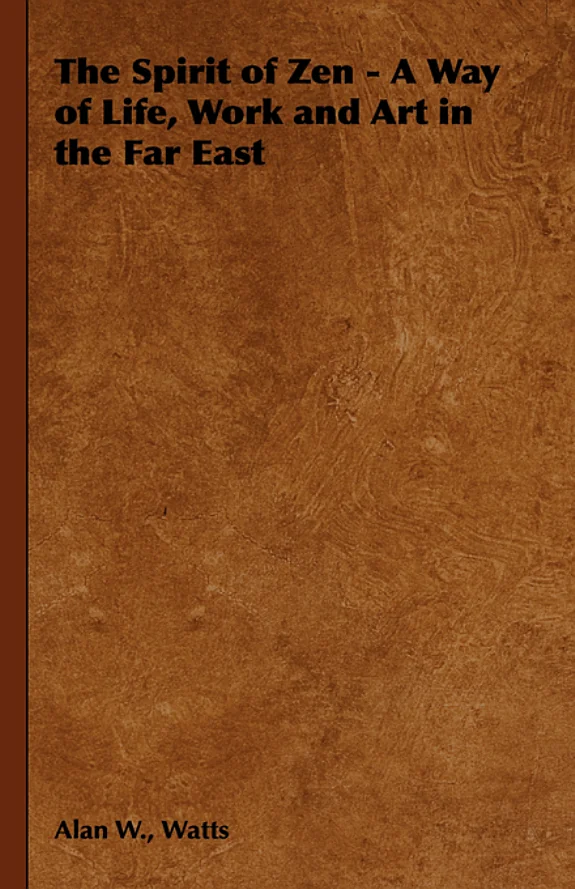
The Spirit of Zen
 84
84

The Spirit of Zen
Alan Watts, in "The Spirit of Zen," manages to distill a notoriously elusive tradition into something tangible for Western readers, a feat few manage without succumbing to oversimplification. His strength lies in framing Zen not as a dogma, but as an experiential method for confronting reality directly. He adeptly uses the analogy of Chinese art to illustrate Zen principles, showing how an appreciation for form implies an understanding of its underlying emptiness. However, the book’s 2008 publication date, while making it accessible, means it lacks engagement with later scholarship or contemporary Zen practice that has evolved significantly since Watts's primary period of engagement. A passage discussing the koan, which Watts presents as a tool to shock the mind out of its ruts, exemplifies his skill in making abstract concepts relatable. Ultimately, Watts provides a valuable, albeit dated, introduction to Zen's spirit.
📝 Description
84
Alan Watts's "The Spirit of Zen" first appeared in 2008.
Alan Watts wrote "The Spirit of Zen" to introduce Western readers to Zen Buddhism. He saw Zen not just as a philosophy or religion, but as a way of life. Watts argued that Zen is best understood through personal experience, not just study. He believed Zen was a high point of Chinese art and spirituality, capable of influencing modern Western thought.
The book is for people looking for deeper meaning outside of typical Western beliefs. It speaks to those who find standard life approaches lacking and offers a path to understanding reality through direct engagement. Readers interested in how Eastern ideas connect with Western psychology will find Watts's writing helpful. It also serves those interested in the roots of East Asian art and how Zen shaped its major works.
Watts's "The Spirit of Zen" situates the practice within the broader context of Mahayana Buddhism, specifically the Chan school that developed in China. It reflects mid-20th century Western interest in Eastern contemplative traditions, influenced by scholars like D.T. Suzuki. Watts sought to present Zen as an experiential discipline that could offer an alternative to Western rationalism and materialism, highlighting its roots in Chinese culture and its potential to inform Western perspectives on art and spirituality.
💡 Why Read This Book?
• You will learn to appreciate the concept of "no-mind" (mushin) as a state of effortless action, as Watts describes its role in Zen practice and its contrast with conscious deliberation. • You will gain an understanding of "emptiness" (sunyata) not as nihilism, but as the ground of all existence, a concept central to Buddhist philosophy and explored through Zen. • You will discover how Zen principles are intrinsically linked to Chinese artistic achievements, offering a new perspective on appreciating art as a reflection of a spiritual way of life.
⭐ Reader Reviews
Honest opinions from readers who have explored this book.
❓ Frequently Asked Questions
When was Alan Watts's 'The Spirit of Zen' first published?
Alan Watts's 'The Spirit of Zen' was first published in November 2008, making it a relatively modern introduction to a centuries-old tradition.
Is 'The Spirit of Zen' a religious text or a philosophical one?
It functions as both, exploring Zen Buddhism as a spiritual path and a philosophical framework for understanding reality, emphasizing direct experience over dogma.
What is the 'original blurb' for 'The Spirit of Zen'?
The original blurb highlights Zen as something unfamiliar to the West, appealing to those seeking deeper reality. It notes Zen's historical Buddhist roots but emphasizes its elusive, vital nature that requires living rather than just definition.
How does Watts connect Zen to Chinese culture?
Watts presents Zen as the highest achievement of the Chinese spirit and the inspiration for its greatest art, suggesting Chinese culture reinforms our own through Zen.
What is the core message Watts conveys about understanding Zen?
Watts argues that Zen is so vital and elusive that it escapes definition and must be lived to be truly understood, rather than merely studied intellectually.
What makes Watts's approach to Zen unique for Western readers?
Watts makes Zen accessible by framing it as a way to find deeper reality than conventional philosophy or religion can express, appealing to a Western desire for experiential truth.
🔮 Key Themes & Symbolism
Direct Experience Over Doctrine
Watts consistently emphasizes that Zen is not a set of beliefs to be acquired but a way of living and perceiving reality directly. He critiques intellectualization as a barrier to understanding, arguing that concepts like "emptiness" (sunyata) or "no-mind" (mushin) can only be grasped through practice and intuitive insight, not through philosophical debate. This theme underscores the experiential core of Zen, setting it apart from more scholastic traditions.
The Unity of Opposites
A recurring motif is the dissolution of dualistic thinking – the separation between self and other, mind and body, sacred and profane. Watts illustrates this through Zen's appreciation for the present moment and the inherent nature of things. The book suggests that true understanding arises when these perceived dichotomies are seen as interconnected facets of a single, unified reality, often reflected in the spontaneous flow of Zen art.
Zen as a Way of Life
Rather than focusing solely on meditation or monasticism, Watts portrays Zen as an integration of spiritual awareness into everyday activities. The book highlights how Zen principles inform the highest achievements of Chinese art and culture, demonstrating that enlightenment is not separate from the mundane world but found within it. This perspective positions Zen as a practical approach to living fully and authentically.
The Elusive Nature of Reality
Watts grapples with the ineffable quality of ultimate reality, which Zen seeks to reveal. He uses paradox and analogy to point towards truths that resist conventional language. The book suggests that the "spirit" of Zen is precisely this elusive, vital quality that cannot be pinned down by rigid definitions, inviting the reader to approach understanding with openness and humility.
💬 Memorable Quotes
Direct passages from the work, attributed to the author.
“Zen is so vital and elusive that it escapes definition.”
— This statement captures the essence of Watts's approach, highlighting that Zen is not a system to be learned from books but a direct experience that defies intellectual containment.
“To be understood it must be lived.”
— This reinforces the idea that Zen requires active participation and personal engagement, rather than passive observation or theoretical study, to be truly grasped.
“As a way of life it is the highest achievement of the Chinese spirit.”
— Watts posits Zen not merely as a religious practice but as the pinnacle of cultural and spiritual expression within Chinese civilization.
“Zen reinforms our own [culture].”
— This suggests that embracing Zen principles can offer a transformative perspective, revitalizing and enriching Western thought and experience.
“Something which will appeal strongly to all who are trying to find deeper reality in life than philosophy and conventional religion can express.”
— Watts identifies a core audience: those dissatisfied with existing frameworks and seeking a more authentic, profound understanding of existence.
🌙 Esoteric Significance
Tradition
While Zen Buddhism is a distinct tradition with roots in Mahayana Buddhism, Watts's interpretation often touches upon themes resonant with Western esoteric thought, such as the direct apprehension of ultimate reality and the dissolution of the ego. His emphasis on "no-mind" and spontaneous action aligns with concepts of naturalness and intuitive wisdom found in Taoism and certain mystical traditions, suggesting a convergence of Eastern and Western paths toward self-realization.
Symbolism
Key symbols in Zen, as explored by Watts, include the empty circle (ensō), representing enlightenment, the void, and the universe in its totality, and the bamboo, symbolizing flexibility, resilience, and strength through yielding. These symbols are not mere decoration but embody the core principles of Zen: emptiness, spontaneity, and the interconnectedness of form and void, reflecting a deeper cosmic order.
Modern Relevance
Watts's work continues to influence contemporary thinkers and practitioners interested in mindfulness, non-dual awareness, and the integration of spiritual practice into daily life. His accessible explanations of Zen concepts resonate with modern schools of psychology, particularly those exploring consciousness and therapeutic approaches that emphasize acceptance and present-moment awareness, such as Acceptance and Commitment Therapy (ACT).
👥 Who Should Read This Book
• Individuals seeking a practical, experiential approach to spirituality beyond dogma, who are curious about finding deeper meaning in everyday life. • Students of comparative religion and philosophy interested in understanding the unique characteristics of Zen Buddhism and its cultural impact. • Artists and creatives looking for inspiration on how Eastern philosophies, particularly Zen's emphasis on spontaneity and form, can inform their creative process.
📜 Historical Context
Alan Watts's "The Spirit of Zen," published in 2008, emerged decades after his primary engagement with Eastern thought in the mid-20th century. This period, particularly the 1950s and 60s, saw a significant influx of Eastern philosophies, including Zen Buddhism, into Western intellectual and counter-cultural circles. Figures like D.T. Suzuki were instrumental in introducing Zen to the West, influencing artists, writers, and psychologists. Watts's work entered a landscape where Zen was often romanticized or misunderstood, aiming to provide a more grounded, experiential interpretation. While not directly engaging with contemporaries in this specific text, Watts's broader philosophical project placed him in dialogue with thinkers exploring existentialism and humanistic psychology, such as Erich Fromm, who also wrote about Zen. The book's reception occurred in an era where interest in mindfulness and contemplative practices was growing, albeit with roots in earlier introductions by scholars and practitioners.
📔 Journal Prompts
The concept of "no-mind" (mushin) and its application to daily actions.
Reflecting on experiences where direct perception superseded intellectual analysis.
How the "spirit of Zen" might inform one's relationship with art and culture.
The challenge of defining elusive spiritual concepts versus living them.
Exploring the idea of "emptiness" (sunyata) as potentiality in one's life.
🗂️ Glossary
Zen
A school of Mahayana Buddhism that emphasizes meditation, intuition, and direct experience of enlightenment, often transcending scriptures and doctrine. Its name derives from the Sanskrit word for meditation, 'dhyana'.
No-mind (Mushin)
A state of mind free from ego-consciousness, where actions are spontaneous, natural, and uninhibited. It signifies a mind that is not fixed or occupied, allowing for direct response to circumstances.
Emptiness (Sunyata)
A core concept in Mahayana Buddhism, referring not to a void but to the lack of inherent, independent existence in all phenomena. It signifies interdependence and the potentiality from which all things arise.
Koan
A paradoxical anecdote or riddle used in Zen practice to provoke doubt, challenge logical reasoning, and ultimately lead to a deeper, intuitive understanding beyond conceptual thought.
Enlightenment
In Zen, the attainment of clear insights into the true nature of reality, often described as a sudden awakening or realization of one's own Buddha-nature.
Dhyana
The Sanskrit term for meditation, from which the word 'Zen' is derived. It refers to a state of profound concentration and contemplative absorption.
Chinese spirit
Refers to the distinctive cultural, philosophical, and artistic essence of Chinese civilization, which Watts suggests is profoundly expressed and embodied through Zen practice and aesthetics.
This book appears in 1 collection
🔮 Readers Also Liked
Browse all →









From the “Zen Buddhism” Collection
View all →







More Free Occult Philosophy Books
View all →