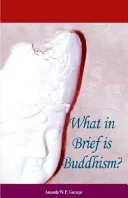
What in Brief Is Buddhism?
 75
75

What in Brief Is Buddhism?
Guruge's "What in Brief Is Buddhism?" succeeds admirably in its stated aim: to provide a clear, concise introduction to a vast tradition. The book's strength lies in its methodical organization, breaking down complex doctrines into digestible chapters. For instance, the explanation of dependent origination (pratītyasamutpāda) is particularly effective in its clarity. However, the brevity, while a virtue for accessibility, sometimes leaves one wishing for more depth, particularly when discussing the diverse monastic traditions or the philosophical nuances between different schools like Theravada and Mahayana. The book could benefit from more explicit engagement with its own historical context, perhaps a deeper dive into the intellectual climate of India during the Buddha's time beyond a brief mention. Overall, it serves as a solid, dependable primer for those beginning their exploration of Buddhist thought and practice.
📝 Description
75
Ananda W. P. Guruge's 2004 book explains Buddhism's core principles.
Ananda W. P. Guruge's "What in Brief Is Buddhism?" provides a clear and thorough introduction to Buddhist thought. The book is organized into sections that make complex ideas easier to grasp. It begins by situating Buddhist philosophy within the context of ancient Indian thought and then details its central teachings. This guide is suitable for anyone new to Buddhism or those wanting to solidify their understanding. It favors direct explanations of spiritual and philosophical systems. The book roots its discussion in the historical context of India, recognizing Buddhism's origins in existing intellectual currents. It systematically covers key doctrines that have influenced Buddhist practice over many centuries and across different regions. Guruge discusses specific concepts like the Four Noble Truths, the Eightfold Path, and the nature of impermanence. The text also looks at how these teachings appear in Buddhist communities in Asia today, showing Buddhism as a continuing tradition.
This work addresses Buddhist teachings, a tradition often associated with contemplative practices and philosophical inquiry aimed at understanding the nature of reality and the self. While presented here in a concise, introductory manner, the book touches upon concepts central to Buddhist mysticism, such as the path to liberation and the nature of consciousness. It places these within a historical and doctrinal framework, allowing readers to see the structure of these contemplative systems.
💡 Why Read This Book?
• Understand the Four Noble Truths, a foundational framework for Buddhist practice, as explained in the book's dedicated chapter. • Grasp the concept of *pratītyasamutpāda* (dependent origination), a core doctrine Guruge elucidates with remarkable clarity. • Appreciate the historical roots of Buddhism within Indian thought, recognizing its origins and early development as discussed in the text.
⭐ Reader Reviews
Honest opinions from readers who have explored this book.
❓ Frequently Asked Questions
What is the primary goal of "What in Brief Is Buddhism?"
The book aims to provide an erudite yet accessible guide to Buddhism's fundamental teachings and major practices, structured for easy comprehension.
When was "What in Brief Is Buddhism?" first published?
The initial publication of "What in Brief Is Buddhism?" by Ananda W. P. Guruge was in 2004.
Does the book cover Buddhist practices in different regions?
Yes, the work explores how Buddhism is practiced today in various parts of Asia, demonstrating its diverse manifestations.
What are some key Buddhist doctrines discussed in the book?
The book covers essential doctrines such as the Four Noble Truths and the concept of dependent origination.
Who is the author of "What in Brief Is Buddhism?"
The author is Ananda W. P. Guruge, an academic and scholar known for his work on Buddhism.
Is the book suitable for beginners?
Yes, its clear structure and accessible language make it an excellent starting point for those new to Buddhist philosophy and practice.
🔮 Key Themes & Symbolism
Foundations of Buddhist Doctrine
The book meticulously lays out the bedrock principles of Buddhism, originating from ancient Indian philosophical soil. It emphasizes the Four Noble Truths as the central diagnostic and therapeutic framework for understanding suffering and its cessation. Guruge traces the logical progression of these truths, presenting them not as dogma but as practical observations about the human condition. The exploration extends to concepts like *dukkha* (suffering/dissatisfaction) and *anicca* (impermanence), illustrating how these ideas form the intellectual scaffolding upon which Buddhist practice is built.
The Practice of the Path
Beyond theoretical understanding, "What in Brief Is Buddhism?" addresses the active cultivation of Buddhist principles. It highlights the Eightfold Path as the practical methodology for achieving liberation. The work differentiates between intellectual assent and embodied practice, showing how ethical conduct, mental discipline, and wisdom are interwoven. Guruge offers glimpses into how these practices are integrated into daily life and ritual across different Asian cultures, underscoring Buddhism's dynamic nature.
Historical Emergence
Guruge situates Buddhism within its historical milieu, acknowledging its roots in the rich intellectual field of 6th century BCE India. The text clarifies that Buddhism arose not in a vacuum but as a distinct development from existing Brahmanical and ascetic traditions. This historical perspective helps readers appreciate the specific societal and philosophical conditions that gave rise to the Buddha's teachings, differentiating it from earlier Vedic thought and highlighting its innovative aspects.
Contemporary Buddhist Life
A significant aspect of the book involves observing Buddhism as a living, evolving tradition. Guruge provides insight into how Buddhist principles are actualized in contemporary societies across Asia. This section moves beyond historical or doctrinal analysis to show the lived experience of Buddhism, including its diverse forms of worship, community structures, and adaptation to local customs. It presents a picture of Buddhism as a relevant and practiced spiritual path today.
💬 Memorable Quotes
Direct passages from the work, attributed to the author.
“The Four Noble Truths serve as the core of the Buddha's teaching.”
— This highlights the centrality of understanding suffering, its cause, its cessation, and the path to cessation as the fundamental framework of Buddhist philosophy and practice.
“Buddhism emerged from the intellectual currents of ancient Indian thought.”
— This frames Buddhism not as a sudden revelation but as a significant development within a pre-existing philosophical and religious milieu, acknowledging its historical context.
“The Eightfold Path provides the practical methodology for liberation.”
— This emphasizes that Buddhist liberation is achieved through diligent practice and ethical cultivation, not merely through intellectual belief or ritual.
“Buddhist practice varies significantly across different Asian regions.”
— This points to the adaptability and diverse expressions of Buddhism, acknowledging that its implementation differs culturally while adhering to core principles.
“Understanding *dukkha* is essential to the Buddhist path.”
— This underscores the importance of recognizing dissatisfaction, suffering, or unease as the starting point for spiritual inquiry and the motivation for seeking enlightenment.
🌙 Esoteric Significance
Tradition
While "What in Brief Is Buddhism?" primarily functions as an introduction to mainstream Buddhist doctrine and practice, its focus on the Four Noble Truths and the Eightfold Path can be seen as aligning with the core principles of many contemplative and wisdom-oriented esoteric traditions. These traditions often seek direct experiential understanding of reality's nature, a goal mirrored in Buddhist aims of liberation from suffering through insight and disciplined practice. The work departs from explicitly mystical or magical interpretations often found in Western esotericism, focusing instead on the philosophical and psychological dimensions.
Symbolism
The book implicitly engages with potent Buddhist symbols. The Dharma Wheel (Dharmachakra), though not always explicitly detailed, represents the Buddha's teachings and the path to enlightenment, symbolizing the cyclical nature of existence and the turning towards liberation. The concept of the Lotus flower, often associated with purity and spiritual awakening emerging from muddy waters, serves as a metaphor for the potential for enlightenment inherent within all beings, regardless of their current circumstances.
Modern Relevance
Guruge's work remains relevant for contemporary mindfulness practitioners and secular Buddhists who seek to understand the philosophical underpinnings of these popular movements. Thinkers and practitioners influenced by Jon Kabat-Zinn's Mindfulness-Based Stress Reduction (MBSR) often find resonance in the Buddhist emphasis on impermanence and the cessation of suffering. Furthermore, comparative religion scholars and those interested in the global spread of Eastern philosophies continue to find value in its clear exposition of core Buddhist ideas.
👥 Who Should Read This Book
• Individuals new to Buddhist philosophy seeking a clear, structured introduction to its core concepts like the Four Noble Truths and the Eightfold Path. • Comparative religion students needing a concise overview of Buddhist doctrine and its historical roots in Indian thought. • Practitioners interested in understanding the foundational principles behind contemporary mindfulness movements and their origins.
📜 Historical Context
Ananda W. P. Guruge's "What in Brief Is Buddhism?", first published in 2004, emerged during a period of increased global interest in Eastern religions and philosophies. The book addresses a scholarly and lay audience seeking clarity on Buddhism's origins and tenets, which flourished within the diverse intellectual field of ancient India. This era saw the development of various philosophical schools, including Vedic Brahmanism and Jainism, with which early Buddhism engaged and differentiated itself. While Guruge's work focuses on presenting the core teachings, contemporary scholars like Richard Gombrich were also actively publishing significant works on Buddhist history and doctrine, often engaging with textual criticism and archaeological findings to reconstruct the early Buddhist period. Guruge's approach prioritizes accessibility, presenting a condensed overview that contrasts with more detailed academic analyses, making it a valuable resource for those new to the subject.
📔 Journal Prompts
Reflection on the Four Noble Truths as applied to personal experiences of *dukkha*.
Considering the Eightfold Path: which aspect requires the most immediate personal cultivation?
Exploring the concept of impermanence (*anicca*) in daily life.
How does the historical context of 6th century BCE India shape the understanding of early Buddhist teachings?
Analyzing the practical manifestation of Buddhist principles in contemporary Asian societies described in the text.
🗂️ Glossary
Dukkha
Often translated as 'suffering,' but more accurately encompassing dissatisfaction, unease, or stress inherent in conditioned existence.
Anicca
The Buddhist doctrine of impermanence, asserting that all conditioned phenomena are in a constant state of flux.
Pratītyasamutpāda
Dependent origination; the principle that all phenomena arise in dependence upon other phenomena; the causal chain of existence.
Four Noble Truths
The foundational framework of Buddhism: 1. The truth of suffering (dukkha), 2. The truth of the origin of suffering (samudaya), 3. The truth of the cessation of suffering (nirodha), 4. The truth of the path to the cessation of suffering (magga).
Eightfold Path
The path to the cessation of suffering, comprising Right Understanding, Right Thought, Right Speech, Right Action, Right Livelihood, Right Effort, Right Mindfulness, and Right Concentration.
Brahmanism
The religious tradition and practice of Vedic ritual and philosophy that predated and influenced early Indian thought, including Buddhism.
Theravada
The 'School of the Elders,' one of the major branches of Buddhism, considered the oldest surviving branch, prevalent in Sri Lanka and Southeast Asia.