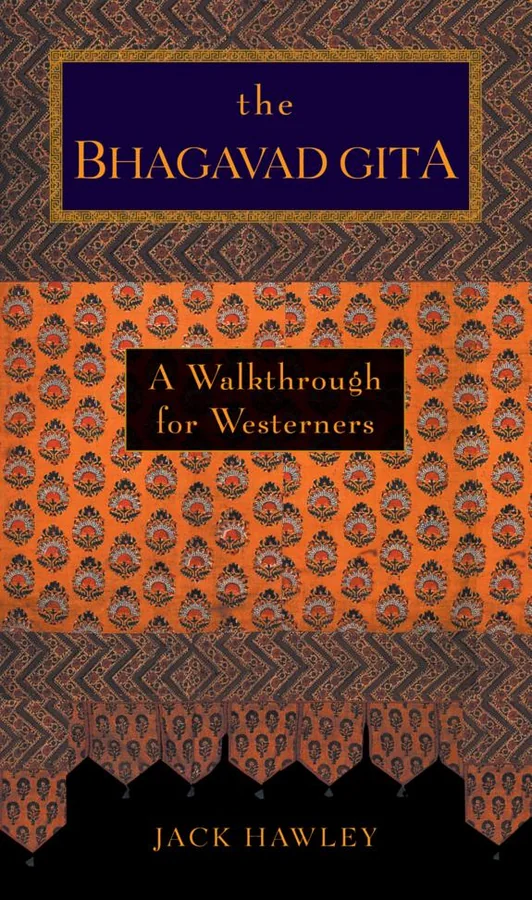
The Bhagavad Gita
 82
82

The Bhagavad Gita
Jack Hawley's 2001 translation of The Bhagavad Gita offers a remarkably clear prose rendition of this ancient Indian dialogue. The work excels in making Krishna's teachings to Arjuna accessible, particularly his explanations of different yogic paths. A notable strength is the text's ability to distill complex philosophical concepts into understandable language, avoiding overly academic or archaic phrasing. However, while aiming for universality, some of the inherent poetic and layered Sanskrit nuances are inevitably simplified in translation, which might be a point of contention for scholars of classical Indian literature. The translation's emphasis on "healing inner pain" and "celebrating life" positions it as a practical guide rather than purely a theological treatise. Ultimately, Hawley's version serves as a potent and approachable gateway to the Gita's spiritual wisdom.
📝 Description
82
Jack Hawley's 2001 translation presents the Bhagavad Gita, a dialogue set on a battlefield.
The Bhagavad Gita records a conversation between Prince Arjuna and Lord Krishna during a pivotal battle. Facing a moral crisis, Arjuna questions his duty and the meaning of his actions. Krishna's responses form the core of the text, addressing the nature of the self, the divine, and the path to spiritual understanding.
This prose translation by Jack Hawley aims for clarity for modern readers. It addresses fundamental questions about living a meaningful life, particularly when faced with difficult choices. The teachings are intended to offer guidance for anyone seeking a spiritual path, regardless of their background.
The Bhagavad Gita, composed between the 5th and 2nd centuries BCE, is a significant Hindu scripture. It emerged during a period of intense philosophical development in ancient India, alongside the rise of Vedanta. Its teachings on the soul, duty, and the divine are central to Hindu thought, and its concepts have influenced various spiritual traditions seeking liberation from suffering through different yogic paths.
💡 Why Read This Book?
• Understand the concept of *dharma* as presented to Arjuna on the battlefield of Kurukshetra, learning how to discern and act according to one's prescribed duties in a chaotic world. • Explore the path of *karma yoga*, as detailed in the Gita's teachings, to understand how selfless action, performed without attachment to results, can lead to spiritual purification. • Grasp the nature of the *atman* (the soul) through Krishna's discourse, realizing its eternal essence distinct from the temporary physical body, offering a framework for confronting mortality.
⭐ Reader Reviews
Honest opinions from readers who have explored this book.
❓ Frequently Asked Questions
What is the primary philosophical debate presented in The Bhagavad Gita?
The central debate unfolds between Prince Arjuna, who is overwhelmed by the prospect of fighting his kin, and Lord Krishna, his charioteer and divine guide. Krishna instructs Arjuna on duty (*dharma*), the nature of the soul (*atman*), and the paths to liberation.
When was The Bhagavad Gita first written?
Scholarly consensus places the composition of The Bhagavad Gita between the 5th and 2nd centuries BCE, although it was later incorporated into the epic Mahabharata.
Who is Jack Hawley and what is his contribution to The Bhagavad Gita?
Jack Hawley is the translator of this specific 2001 prose edition. His contribution lies in rendering the ancient Sanskrit text into accessible modern English, aiming to capture its spiritual essence for a contemporary audience.
What does 'Bhagavad Gita' mean?
The title 'Bhagavad Gita' translates from Sanskrit to 'The Song of the Lord' or 'The Lord's Song,' referring to the divine teachings imparted by Lord Krishna.
Is The Bhagavad Gita a religious text or a philosophical one?
It functions as both. Religiously, it is a sacred scripture within Hinduism. Philosophically, it explores profound concepts of metaphysics, ethics, and epistemology that have influenced thinkers globally.
Where does the dialogue in The Bhagavad Gita take place?
The pivotal conversation between Arjuna and Krishna occurs on the battlefield of Kurukshetra, just before a major war is set to commence, adding immense gravity to Krishna's instructions.
🔮 Key Themes & Symbolism
The Nature of Dharma
The text centers on Arjuna's crisis of conscience regarding his *dharma* (duty) to fight a war against his own relatives. Krishna's discourse emphasizes performing one's prescribed duties with detachment, illustrating that adherence to righteous action, even when difficult, is paramount for spiritual progress and maintaining cosmic order. This concept transcends simple obligation, exploring the ethical framework for existence.
Paths to Union (Yoga)
Krishna outlines three primary paths for achieving union with the divine: *Karma Yoga* (the path of selfless action), *Jnana Yoga* (the path of knowledge and wisdom), and *Bhakti Yoga* (the path of devotion). The Gita suggests these paths are not mutually exclusive and can be integrated, offering a comprehensive approach to spiritual realization adaptable to different temperaments and life circumstances.
The Eternal Soul (Atman)
A core tenet is the distinction between the impermanent physical body and the eternal, unchanging soul (*atman*). Krishna assures Arjuna that the soul cannot be killed or destroyed, providing a philosophical basis for overcoming fear of death and suffering. Understanding the *atman*'s true nature is presented as crucial for liberation from the cycle of birth and rebirth.
Divine Manifestation and Presence
The Gita explores the concept of the divine as both transcendent and immanent, present in all existence. Krishna reveals his universal form to Arjuna, showcasing the totality of creation within himself. This underscores the idea that the divine is not distant but intimately connected to the world and all beings, accessible through various forms of worship and contemplation.
💬 Memorable Quotes
Direct passages from the work, attributed to the author.
“You have a right to perform your prescribed duty, but you are not entitled to the fruits of your actions.”
— This principle of *karma yoga* is central, advocating for performing actions with dedication and integrity, yet relinquishing attachment to the outcome. It encourages a focus on the process and ethical execution rather than external rewards or punishments.
“The soul is never born and never dies. It is not that the soul will come into being at some time in the future. The soul is unborn, eternal, ever-existing, and ancient.”
— This highlights the eternal nature of the *atman*, distinct from the perishable body. It serves as a profound reassurance against the fear of death, emphasizing the soul's enduring essence beyond physical existence.
“Whatever action a great man performs, common men follow. Whatever standards he sets, the world adopts.”
— This observation points to the influence of exemplary individuals and leaders. It suggests that their conduct sets the moral and behavioral tone for society, making their adherence to *dharma* critically important.
“By controlling the senses, the wise one should sit in meditation, focused on Me, with his mind completely subdued.”
— This emphasizes the discipline required for spiritual practice, particularly in the path of devotion (*bhakti yoga*). It calls for mastering sensory distractions to achieve a state of focused contemplation on the divine.
“Even if you are the greatest sinner, you can cross over all the sins by the raft of self-knowledge.”
— This speaks to the redemptive power of wisdom (*jnana yoga*). It suggests that profound understanding of the self and reality can overcome past negative actions or perceived failings, offering a path to purification.
🌙 Esoteric Significance
Tradition
The Bhagavad Gita is a core part of Hindu Vedanta philosophy, a tradition deeply rooted in esoteric interpretations of the Vedas. While not strictly Hermetic or Gnostic, its emphasis on inner knowledge, the divine within, and the nature of reality shares common ground with other mystical traditions. It provides a framework for understanding the soul's journey and its potential for union with the Absolute, aligning with perennial philosophical concepts found across esoteric lineages.
Symbolism
Key symbols include the battlefield of Kurukshetra, representing the inner struggle between higher and lower impulses; the chariot, symbolizing the body driven by the mind, senses, and soul; and Krishna himself, embodying the Divine Guide and Supreme Being. The three paths of yoga (action, knowledge, devotion) function as symbolic frameworks for spiritual discipline, guiding the seeker towards liberation from material entanglement.
Modern Relevance
Contemporary spiritual teachers and movements, particularly within yoga and mindfulness, frequently draw upon the Gita's concepts of *karma yoga* and detachment. Its philosophical depth continues to inform discussions on ethics, consciousness, and the nature of existence in both spiritual and academic circles. Thinkers exploring conscious living and the integration of spiritual principles into daily life often reference its teachings.
👥 Who Should Read This Book
• Seekers of ancient wisdom interested in comparative religious studies, looking for a primary text that bridges philosophy and practical spirituality. • Individuals grappling with ethical dilemmas and life's challenges, who can benefit from Krishna's guidance on duty (*dharma*) and righteous action. • Students of yoga and meditation seeking to deepen their understanding of the philosophical underpinnings of these practices, particularly the concepts of *karma yoga* and the nature of the self.
📜 Historical Context
The Bhagavad Gita, estimated to have been composed between the 5th and 2nd centuries BCE, emerged during a dynamic period of Indian intellectual history. It became integrated into the vast epic, the Mahabharata, likely centuries after the epic's core narrative was established. This scripture arose amidst a flourishing of philosophical inquiry, alongside emerging schools of thought like early Vedanta and various heterodox traditions questioning Vedic orthodoxy. Its teachings offered a synthesis of existing spiritual ideas, presenting accessible paths to liberation that appealed broadly. The Gita's enduring influence is evident in its continuous study and commentary by figures across Hindu traditions and beyond, notably influencing thinkers like Mahatma Gandhi, who saw it as a guide for ethical action in the 20th century.
📔 Journal Prompts
Arjuna's dilemma on the battlefield: How does your understanding of *dharma* inform your response to difficult choices?
Krishna's counsel on the fruits of action: Reflect on a recent task where detachment from the outcome shifted your experience.
The nature of the *atman*: Contemplate the difference between your physical form and your enduring sense of self.
The three paths of yoga: Which aspect of *karma yoga*, *jnana yoga*, or *bhakti yoga* most closely aligns with your current life and inclinations?
The battlefield as an inner struggle: Identify a personal conflict where opposing desires or duties are present.
🗂️ Glossary
Dharma
One's duty, righteousness, moral law, or inherent nature. In the Gita, it refers to the specific responsibilities and actions appropriate to one's social role and spiritual path.
Karma Yoga
The spiritual path of selfless action. It involves performing one's duties with dedication and skill, without attachment to the results, as a means of spiritual purification and union with the divine.
Atman
The eternal, unchanging self or soul. The Gita posits that the *atman* is distinct from the physical body and mind, and is immortal and indestructible.
Bhakti Yoga
The spiritual path of devotion. It emphasizes loving surrender and worship of the Divine (often personified as Krishna) as the primary means to achieve spiritual realization.
Jnana Yoga
The spiritual path of knowledge and wisdom. It involves intellectual inquiry, philosophical discernment, and the pursuit of self-realization through understanding the true nature of reality.
Moksha
Liberation or release from the cycle of birth, death, and rebirth (*samsara*). It is the ultimate goal of spiritual practice in many Indian traditions.
Samsara
The continuous cycle of birth, death, and reincarnation, driven by karma. Liberation (*moksha*) from *samsara* is a central aim in Hindu and Buddhist philosophies.
This book appears in 1 collection
🔮 Readers Also Liked
Browse all →








From the “Hinduism” Collection
View all →








More Free Sacred Texts & Gnosticism Books
View all →