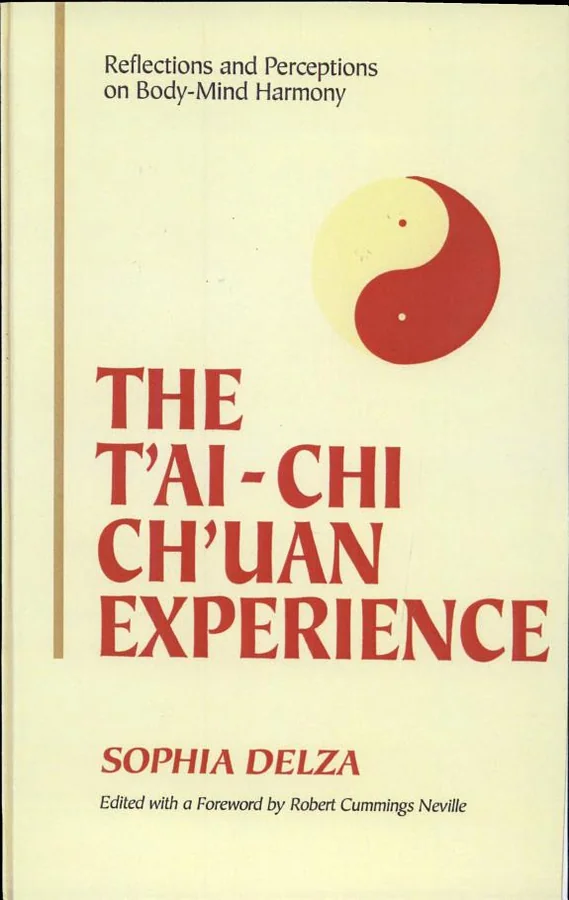
The T'ai-Chi Ch'uan Experience
 83
83

The T'ai-Chi Ch'uan Experience
Sophia Delza's 'The T'ai-Chi Ch'uan Experience' offers a welcome counterpoint to the often superficial Western engagement with martial arts. Her meticulous dissection of the Wu style's spiritual and aesthetic dimensions, particularly her interpretation of 'emptiness' (Xu) as active potential, provides significant depth. The work excels in linking intricate physical forms to their philosophical underpinnings, a feat few texts achieve with such clarity. However, the sheer density of philosophical concepts, while a strength, can occasionally make the text feel less accessible to the absolute beginner unfamiliar with Taoist thought. Delza's explanation of 'rooting' as a connection to earth's energy is particularly illuminating. This book is an essential, if challenging, read for serious students seeking the soul of T'ai Chi.
📝 Description
83
Sophia Delza's 1996 book explains T'ai-Chi Ch'uan as a philosophical and aesthetic practice.
First published in 1996, Sophia Delza's work details T'ai-Chi Ch'uan beyond its physical form. Delza, an American proponent of the Wu style, focuses on the spiritual dimensions of the art. The book guides readers to understand the deeper meanings in each movement and posture, showing how the practice builds internal harmony and outward grace. It is written for dedicated students of T'ai-Chi Ch'uan, especially those interested in the Wu style. Practitioners seeking to deepen their understanding beyond physical technique will find value, as will those interested in the cultural and spiritual roots of the art. It offers a connection to the philosophical underpinnings of martial arts and comparative studies of mind-body practices. The text addresses subtle nuances and aesthetic principles that define authentic T'ai Chi.
'The T'ai-Chi Ch'uan Experience' arrived in 1996, a time when T'ai Chi was growing in popularity but often misunderstood in the West. Delza's book acted as a bridge, linking the physical practice to its philosophical heritage. It examined concepts like 'Qi' and the principles of 'Yin and Yang' as they appear in movement. The book grounds esoteric ideas in clear explanations, contributing to a more authentic representation of T'ai Chi for a global audience.
This book connects the physical practice of T'ai-Chi Ch'uan to its philosophical roots. It examines concepts such as Qi and Yin/Yang, not just as physical mechanics, but as expressions of deeper principles. Delza's work positions T'ai Chi as a method for cultivating internal harmony and a connection to ancient Chinese thought. It is part of a tradition that views martial arts as a path for self-development and spiritual cultivation, moving beyond mere combat techniques.
💡 Why Read This Book?
• Learn the spiritual and aesthetic meanings of T'ai-Chi Ch'uan, as explored through Delza's detailed analysis of Wu style principles, offering a perspective beyond mere physical technique. • Understand the concept of 'emptiness' (Xu) not as void, but as a state of receptivity and potential, a crucial element for redirecting energy as discussed in the text. • Gain insight into 'rooting' as a fundamental practice for stability and connection to earth's energy, a concept elaborated upon within the book's physical and philosophical framework.
⭐ Reader Reviews
Honest opinions from readers who have explored this book.
❓ Frequently Asked Questions
What is the significance of the Wu style in T'ai-Chi Ch'uan according to Sophia Delza?
Sophia Delza highlights the Wu style's emphasis on the spiritual and aesthetic dimensions of T'ai Chi. She presents it as a method for cultivating internal harmony and grace, moving beyond a purely physical interpretation, as detailed in her 1996 publication.
How does Sophia Delza explain the concept of 'emptiness' (Xu) in T'ai Chi?
Delza interprets 'emptiness' (Xu) not as a void, but as a state of active potential and receptivity. This concept is crucial for understanding how practitioners can yield to force and redirect energy, a core philosophical tenet she explores.
What is the original publication year of 'The T'ai-Chi Ch'uan Experience'?
The book 'The T'ai-Chi Ch'uan Experience' by Sophia Delza was first published on January 1, 1996.
Who is Sophia Delza and what is her connection to T'ai Chi?
Sophia Delza was a leading proponent of the Wu style of T'ai-Chi Ch'uan in America. Her work focuses on the spiritual and aesthetic meanings inherent in the practice, offering a philosophical depth to the art.
What esoteric concepts are explored in Sophia Delza's book?
The book explores esoteric concepts such as Qi (internal energy), the principles of Yin and Yang as applied to movement, and the philosophical interpretation of 'emptiness' (Xu) and 'rooting', linking them to the practice of T'ai Chi.
Is this book suitable for beginners in T'ai Chi?
While offering profound insights, the book delves deeply into philosophical concepts. It is best suited for practitioners who have some familiarity with T'ai Chi and are seeking to deepen their understanding beyond the physical form.
🔮 Key Themes & Symbolism
Spiritual Dimensions of Movement
Delza posits that T'ai-Chi Ch'uan is more than a physical exercise; it is a profound spiritual practice. The book articulates how the deliberate, flowing movements cultivate internal harmony and alignment with cosmic principles. It examines the concept of Qi, or vital energy, not just as a physical force but as a spiritual current that can be directed through intention and refined awareness, connecting the practitioner to a deeper energetic reality.
Aesthetic Principles in Practice
The text emphasizes the inherent aesthetic qualities of T'ai-Chi Ch'uan, viewing each posture and transition as a form of moving art. Delza explores concepts like fluidity, balance, and the expression of internal states through external form. The aesthetic dimension is presented as intrinsically linked to the spiritual efficacy of the practice, suggesting that beauty in movement arises from inner coherence and balanced energy flow.
Philosophical Underpinnings of Wu Style
Delza looks at the philosophical bedrock of the Wu style, particularly its Taoist roots. Concepts like 'emptiness' (Xu) as potential and 'rooting' as groundedness are explained not as abstract ideas but as integral components of effective practice. The book elucidates how these principles inform the art’s defensive strategies and its capacity for fostering inner peace and mental clarity.
Bridging East and West
Published in 1996, the book served as a vital bridge for Western audiences seeking a more authentic understanding of T'ai Chi. Delza offers clear explanations of complex Chinese philosophical and energetic concepts, making them accessible without sacrificing their depth. This effort to translate esoteric wisdom into understandable terms was crucial for the art's reception and practice outside of its native cultural context.
💬 Memorable Quotes
Direct passages from the work, attributed to the author.
“The Wu style discusses the spiritual and aesthetic meanings of t'ai chi ch'uan.”
— This foundational statement frames Delza's approach, positioning T'ai Chi as a discipline with profound inner dimensions, going beyond mere physical technique to encompass the cultivation of spirit and appreciation of form.
“Understanding 'emptiness' (Xu) is key to yielding.”
— This highlights a central Taoist principle, reinterpreted by Delza for T'ai Chi. 'Emptiness' here signifies receptivity and potential, enabling a practitioner to absorb and redirect an opponent's force rather than meeting it directly.
“The art expresses internal harmony through graceful external movement.”
— This interpretation captures Delza's view of T'ai Chi as a holistic practice. The visible, aesthetically pleasing movements are seen as outward manifestations of a balanced and cultivated inner state.
“Delza, a leading proponent in America of the Wu style, explored its deeper meanings.”
— This positions Delza as an authoritative voice within the Western T'ai Chi community. It underscores her specific focus on the Wu style and her dedication to revealing its spiritual and aesthetic complexities.
💡 Key Ideas
Editorial paraphrase of the work's core concepts — not direct quotes.
Rooting connects the practitioner to the earth's energy.
This paraphrased concept emphasizes the importance of grounding in T'ai Chi. It suggests a physical and energetic connection to the planet, providing stability and a source of power for movement and defense.
🌙 Esoteric Significance
Tradition
This work fits within the broad spectrum of Taoist esoteric practices, specifically focusing on its application within the Wu style of T'ai-Chi Ch'uan. It extends the lineage of internal martial arts, which traditionally seek to cultivate and harmonize Qi for both physical efficacy and spiritual development. Delza’s text bridges classical Taoist philosophy with practical somatic experience, aligning with esoteric traditions that view physical discipline as a pathway to higher consciousness and energetic mastery.
Symbolism
Key symbols explored include 'emptiness' (Xu), representing not a void but a state of receptive potential crucial for yielding and redirection. 'Qi' (vital energy) is symbolized as the flowing current animating the practice, connecting the individual to universal life force. 'Rooting' serves as a symbol of groundedness, stability, and connection to the earth's foundational energy, essential for balance and power.
Modern Relevance
Delza's work continues to influence contemporary practitioners and scholars of mind-body disciplines. Thinkers exploring embodied cognition and somatic psychology find value in her detailed exploration of how physical practice shapes consciousness. Modern schools of T'ai Chi seeking to emphasize depth over superficiality often reference her insights into the Wu style's philosophical underpinnings and its aesthetic principles.
👥 Who Should Read This Book
["• Dedicated T'ai-Chi Ch'uan practitioners: Those who have moved beyond beginner stages and seek to understand the spiritual, aesthetic, and philosophical dimensions of the Wu style, as elucidated by Delza.", '• Students of comparative philosophy and religion: Individuals interested in Taoism, Chinese martial arts history, and the intersection of physical practice with spiritual development will find rich material.', "• Researchers of somatic practices: Scholars and practitioners exploring the connection between physical movement, energy cultivation (Qi), and psychological states will benefit from Delza's detailed analysis."]
📜 Historical Context
Sophia Delza's 'The T'ai-Chi Ch'uan Experience,' released in 1996, emerged during a period of burgeoning interest in Eastern philosophies and practices within the West. While T'ai Chi was gaining popularity, it was often presented through simplified, health-focused lenses, divorced from its martial roots and philosophical depth. Delza’s work, deeply rooted in the Wu style, provided a rigorous counter-narrative. It offered a scholarly yet accessible exploration of Taoist principles like 'emptiness' (Xu) and the flow of 'Qi,' directly engaging with concepts that were less understood in Western martial arts circles at the time. Unlike purely functional martial arts manuals, Delza’s approach situated T'ai Chi within a rich cultural and spiritual tradition, challenging prevailing superficial interpretations and contributing significantly to the authentic transmission of the art.
📔 Journal Prompts
The concept of 'emptiness' (Xu) as potential: How does this idea inform your current understanding of stillness and movement?
Reflect on the aesthetic qualities of your T'ai Chi practice. Where do you perceive the expression of internal harmony?
Consider the principle of 'rooting.' What does this connection to the earth's energy feel like in your body during practice?
Analyze a specific posture from the Wu style: How does its form embody both spiritual meaning and aesthetic grace?
Sophia Delza's interpretation of Qi: How does the concept of vital energy influence your intention and focus during practice?
🗂️ Glossary
Wu Style
A specific lineage of T'ai-Chi Ch'uan known for its emphasis on spiritual and aesthetic principles, often characterized by slower, more deliberate movements compared to other styles.
Qi (Chi)
The vital life force or energy believed to flow through all living things. In T'ai Chi, its cultivation and circulation are central to the practice's health and martial benefits.
Xu (Emptiness)
A Taoist concept interpreted in T'ai Chi not as void, but as a state of receptivity, potentiality, and openness, essential for yielding and strategic redirection.
Rooting
A fundamental T'ai Chi principle referring to the feeling of being firmly connected to the ground, providing stability, balance, and a conduit for earth's energy.
Yin and Yang
The Taoist concept of complementary, interconnected opposites (e.g., passive/active, dark/light). In T'ai Chi, these principles govern the interplay of force, movement, and stillness.
Wu Wei
Literally 'non-action' or 'effortless action.' In Taoism and T'ai Chi, it refers to acting in accordance with the natural flow of things, without forcing or resistance.
Aesthetic Meaning
The appreciation of beauty and form within the practice of T'ai Chi, linking graceful movement to internal harmony and spiritual expression.
This book appears in 1 collection
🔮 Readers Also Liked
Browse all →









From the “Tai Chi” Collection
View all →






More Free Occult Philosophy Books
View all →