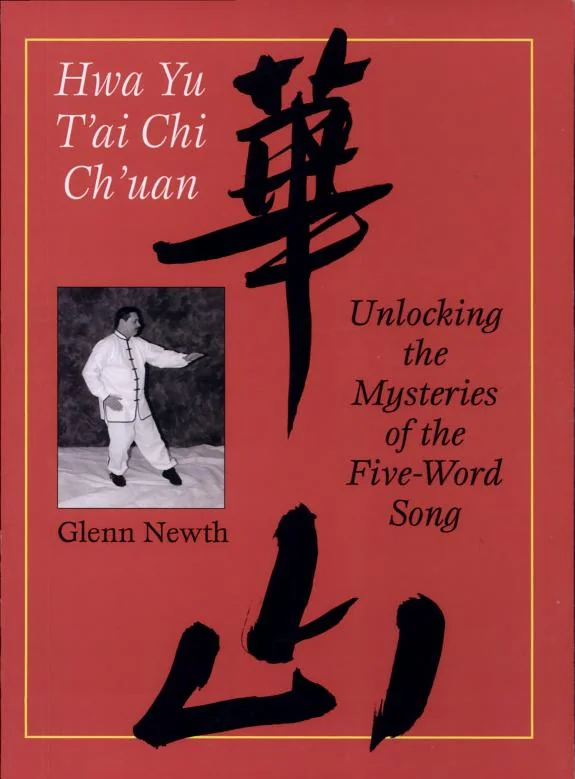
Hwa Yu Tai Chi Ch'uan
 76
76

Hwa Yu Tai Chi Ch'uan
Glenn D. Newth’s "Hwa Yu Tai Chi Ch'uan" offers a welcome, if somewhat dry, exposition of a practice rarely detailed in English. The book’s strength lies in its meticulous breakdown of movements and applications, providing photographic sequences that, while functional, sometimes lack the dynamism needed to convey the art’s flow. Newth’s treatment of the philosophical underpinnings is thorough, grounding the physical techniques in ancient principles. However, the prose occasionally feels overly academic, making the "fighting applications" section less immediately accessible than it could be. A particularly illustrative sequence details the "Pushing Hands" drill, demonstrating the subtle yielding and redirecting inherent in the style. This work serves as a valuable reference for dedicated students but may require significant prior knowledge for full appreciation.
"Hwa Yu Tai Chi Ch'uan" provides an essential, albeit dense, manual for understanding a foundational martial art lineage.
📝 Description
76
Glenn D. Newth's 2009 book details Hwa Yu Tai Chi Ch'uan, a martial art lineage over a thousand years old.
This book examines Hwa Yu Tai Chi Ch'uan, a martial art style with roots stretching back over a millennium. Newth makes accessible a tradition previously kept within a private lineage, moving beyond just the physical movements. The work covers the underlying philosophy and health practices that characterize this sophisticated method of movement. It is written for dedicated practitioners of internal martial arts, students of Chinese culture, and anyone seeking a deeper grasp of mind-body connection.
Readers interested in less common Tai Chi styles or those wanting a thorough guide to forms, combat applications, and partner drills will find this volume valuable. Hwa Yu Tai Chi Ch'uan, documented for more than 1,000 years, represents an important part of Tai Chi's historical development. It offers insight into the art's early stages and its influence on later family styles. The text explains the theoretical foundations of Hwa Yu Tai Chi Ch'uan, its philosophical basis, and its energetic principles. It describes the practical execution of its forms, combat applications, and the push hands training method, all part of a complete approach to the art.
Hwa Yu Tai Chi Ch'uan belongs to the internal martial arts tradition, which emphasizes the cultivation and circulation of internal energy (qi) for health and combat effectiveness. Unlike external styles that focus primarily on muscular strength and speed, internal arts like Hwa Yu train the practitioner to unify mind, body, and breath. This tradition often incorporates philosophical concepts from Daoism and traditional Chinese medicine, viewing the body as a microcosm of the universe and seeking harmony between internal states and external actions. The guarded nature of its lineage prior to this book reflects a common practice in esoteric traditions where knowledge was passed directly from master to disciple.
💡 Why Read This Book?
• Learn the specific philosophical and theoretical basis of Hwa Yu Tai Chi Ch'uan, a style with over 1,000 years of history, offering insights unavailable in more generalized Tai Chi texts. • Master the step-by-step instructions and photo sequences for forms practice and fighting applications, providing a practical, visual guide to executing this unique kinesthetic form. • Understand the health benefits and energetic principles specific to Hwa Yu Tai Chi Ch'uan, differentiating it from other internal martial arts through its distinct theoretical framework.
⭐ Reader Reviews
Honest opinions from readers who have explored this book.
❓ Frequently Asked Questions
What makes Hwa Yu Tai Chi Ch'uan different from other Tai Chi styles?
Hwa Yu Tai Chi Ch'uan is distinguished by its age, being over 1,000 years old and serving as a basis for many later family styles. Its unique structure and detailed philosophical underpinnings, as presented in Glenn D. Newth's work, offer a distinct approach to internal martial arts practice.
Is this book suitable for absolute beginners in Tai Chi?
While the book provides step-by-step instructions, its comprehensive nature and historical depth are best suited for those with some existing familiarity with Tai Chi or martial arts principles. Beginners might find the technical detail and philosophical context more accessible after foundational training.
Does the book cover the health benefits of practicing Hwa Yu Tai Chi Ch'uan?
Yes, the book includes an overview of the many health benefits associated with practicing Hwa Yu Tai Chi Ch'uan. It connects the physical practice to improved well-being through its unique kinesthetic form and theoretical basis.
How does the book explain fighting applications?
The book offers detailed explanations and photo sequences illustrating the fighting applications of Hwa Yu Tai Chi Ch'uan. This practical aspect is presented alongside the forms practice and push hands drills, providing a complete martial perspective.
What is 'push hands' in the context of Hwa Yu Tai Chi Ch'uan?
Push hands is a cooperative training exercise detailed in the book that develops sensitivity, balance, and the ability to yield and redirect an opponent's force. It is a crucial element for understanding the practical application of Hwa Yu Tai Chi Ch'uan's principles in partner work.
When was Hwa Yu Tai Chi Ch'uan first published by Glenn D. Newth?
The first publication of Glenn D. Newth's "Hwa Yu Tai Chi Ch'uan" was in 2006. This edition aimed to make the previously closed style more accessible to a broader audience.
🔮 Key Themes & Symbolism
Ancient Lineage Preservation
This work serves as a crucial archive for Hwa Yu Tai Chi Ch'uan, a martial art lineage exceeding one thousand years. It meticulously documents a system historically kept within closed circles, offering practitioners and scholars access to its foundational forms, fighting applications, and theoretical framework. By detailing the practice, Newth ensures the continuation and study of a sophisticated kinesthetic art that predates many contemporary styles, highlighting its role as a basis for later developments in Tai Chi Ch'uan family styles.
Kinesthetic Sophistication
The book emphasizes the intricate physical execution central to Hwa Yu Tai Chi Ch'uan. Through detailed step-by-step instructions and photographic sequences, it illustrates a complex system of movement designed for both martial efficacy and health. This focus on the 'kinesthetic form' reveals how specific postures and transitions, like those in push hands, embody deeper principles of balance, force redirection, and energetic cultivation, making it a distinct practice.
Philosophical and Theoretical Basis
Beyond physical technique, Hwa Yu Tai Chi Ch'uan is deeply rooted in a specific philosophical and theoretical understanding. This book elaborates on those underpinnings, connecting the martial art's movements to broader concepts of internal energy (Qi), balance, and the harmony of opposing forces. Understanding this theoretical layer is presented as essential for truly grasping the art's depth and its many-sided benefits, extending beyond mere combat to encompass well-being.
Health and Energetic Cultivation
The practice of Hwa Yu Tai Chi Ch'uan is presented not solely as a martial discipline but also as a path to enhanced health. The book outlines the numerous physiological and energetic benefits derived from its unique forms and training methods, such as push hands. This holistic perspective integrates the physical, mental, and energetic aspects of the practice, aligning with esoteric traditions that view martial arts as a means of cultivating vital force and promoting longevity.
💬 Memorable Quotes
Direct passages from the work, attributed to the author.
“The basis for many of the family styles, Hwa Yu T'ai Chi Ch'uan is more than 1,000 years old, but remained a closed style until quite recently.”
— This statement highlights the historical significance and relative obscurity of Hwa Yu Tai Chi Ch'uan, positioning it as a foundational, yet historically guarded, component of Tai Chi's evolution.
“This comprehensive, practical guide explains this unique and sophisticated kinesthetic form in detail.”
— This emphasizes the book's function as an in-depth manual, aiming to explain and instruct readers on the specific physical methods and intricacies of the Hwa Yu style.
“The book contains step-by-step instructions and photo sequences that illustrate forms practice, fighting applications, and push hands.”
— This points to the pedagogical approach of the text, relying on visual aids and sequential breakdowns to teach the core components of the art.
“A thorough explanation of the form's philosophical and theoretical basis.”
— This indicates the work's commitment to exploring the underlying principles and conceptual framework that inform the physical practice of Hwa Yu Tai Chi Ch'uan.
“And an overview of the many health benefits.”
— This suggests that the practice is not solely focused on martial prowess but also offers significant advantages for physical and energetic well-being.
🌙 Esoteric Significance
Tradition
While not overtly aligned with a single Western esoteric system like Hermeticism or Kabbalah, Hwa Yu Tai Chi Ch'uan fits within the broader esoteric tradition of internal alchemy and energy cultivation found in Taoism. Its emphasis on the flow of Qi, the integration of mind and body, and the pursuit of health through specific movement and breathing practices carries the alchemical processes of refining vital essence. The work can be seen as a practical application of Taoist principles for physical and energetic transformation, aligning with traditions that seek to harmonize the individual with universal forces.
Symbolism
Key motifs in Hwa Yu Tai Chi Ch'uan, as presented in the text, likely include the cyclical nature of movement, representing the Taoist concept of perpetual change and the generation/control cycles of Yin and Yang. The 'Push Hands' practice itself symbolizes the dynamic interplay of opposing forces, a core concept in understanding balance and effective application. Furthermore, the very act of preserving and disseminating a 'closed style' can be seen symbolically as bringing hidden knowledge (esoteric) into a more accessible form, mirroring the initiatory process found in many spiritual lineages.
Modern Relevance
Contemporary practitioners of internal martial arts, particularly those seeking historical depth beyond mainstream styles, draw significantly on works like Newth's. Thinkers and schools focused on somatic education, embodied cognition, and the integration of traditional Chinese medicine principles with physical practice find value in the detailed exploration of Hwa Yu Tai Chi Ch'uan's unique kinesthetic and theoretical basis. It provides a concrete example of how ancient systems of energy cultivation and martial application continue to offer relevant insights for modern health, wellness, and self-defense paradigms.
👥 Who Should Read This Book
• Dedicated Tai Chi Ch'uan practitioners seeking to expand their knowledge beyond common family styles and explore a lineage over 1,000 years old. • Martial arts historians and researchers interested in the evolution and diversification of internal Chinese martial arts, specifically those looking for details on historically guarded systems. • Individuals interested in the intersection of philosophy, physiology, and movement, who wish to understand the health benefits and theoretical underpinnings of sophisticated kinesthetic forms.
📜 Historical Context
Published in 2006, Glenn D. Newth's "Hwa Yu Tai Chi Ch'uan" arrived at a time when interest in the deeper, historical lineages of Chinese martial arts was growing, often alongside a resurgence of interest in traditional philosophies. While many texts focused on the more widely practiced Yang or Chen styles, Newth's work addressed a specific, older branch, Hwa Yu, which had remained largely inaccessible. This style’s purported 1,000-year history positions it as a significant, albeit less documented, contributor to the broader Tai Chi Ch'uan family tree, potentially influencing or paralleling developments seen in other schools like the Shaolin martial arts. Unlike contemporary popularizers who might simplify techniques, Newth's approach appears more scholarly, aiming for fidelity to a preserved tradition, likely responding to a niche but dedicated audience seeking authentic lineage knowledge. The book's release did not coincide with any major public controversies or awards but filled a gap for serious researchers and practitioners seeking to understand the martial art's formative stages.
📔 Journal Prompts
The historical isolation of Hwa Yu Tai Chi Ch'uan as a closed style.
The connection between its philosophical basis and its fighting applications.
The specific health benefits outlined for practitioners.
The detailed explanation of the 'push hands' training method.
The unique kinesthetic form described in the text.
🗂️ Glossary
Hwa Yu Tai Chi Ch'uan
A specific, ancient style of Tai Chi Ch'uan with a history exceeding 1,000 years, traditionally kept as a closed or family style, now detailed in this guide.
Kinesthetic Form
Refers to the specific, characteristic way a body moves within a particular discipline, emphasizing the physical execution, patterns of motion, and bodily intelligence involved in practices like Tai Chi.
Forms Practice
The solo training of Tai Chi Ch'uan sequences, where practitioners execute a series of pre-arranged movements to cultivate internal energy, develop technique, and improve body mechanics.
Fighting Applications
The practical, combative uses and self-defense principles derived from the movements and postures of a martial art style, as distinct from their solo practice or health benefits.
Push Hands
A cooperative training exercise in Tai Chi Ch'uan where two partners practice sensing, yielding, and redirecting each other's force, developing sensitivity, balance, and rootedness.
Philosophical Basis
The underlying belief system, ethical principles, or conceptual framework that informs and justifies the practice and techniques of a discipline, such as the Taoist principles influencing Tai Chi.
Theoretical Basis
The fundamental principles, concepts, and scientific or metaphysical explanations that underpin the methods and efficacy of a practice, including energetic flow (Qi) and biomechanics in Tai Chi.
This book appears in 1 collection
🔮 Readers Also Liked
Browse all →









From the “Tai Chi” Collection
View all →







More Free Occult Philosophy Books
View all →