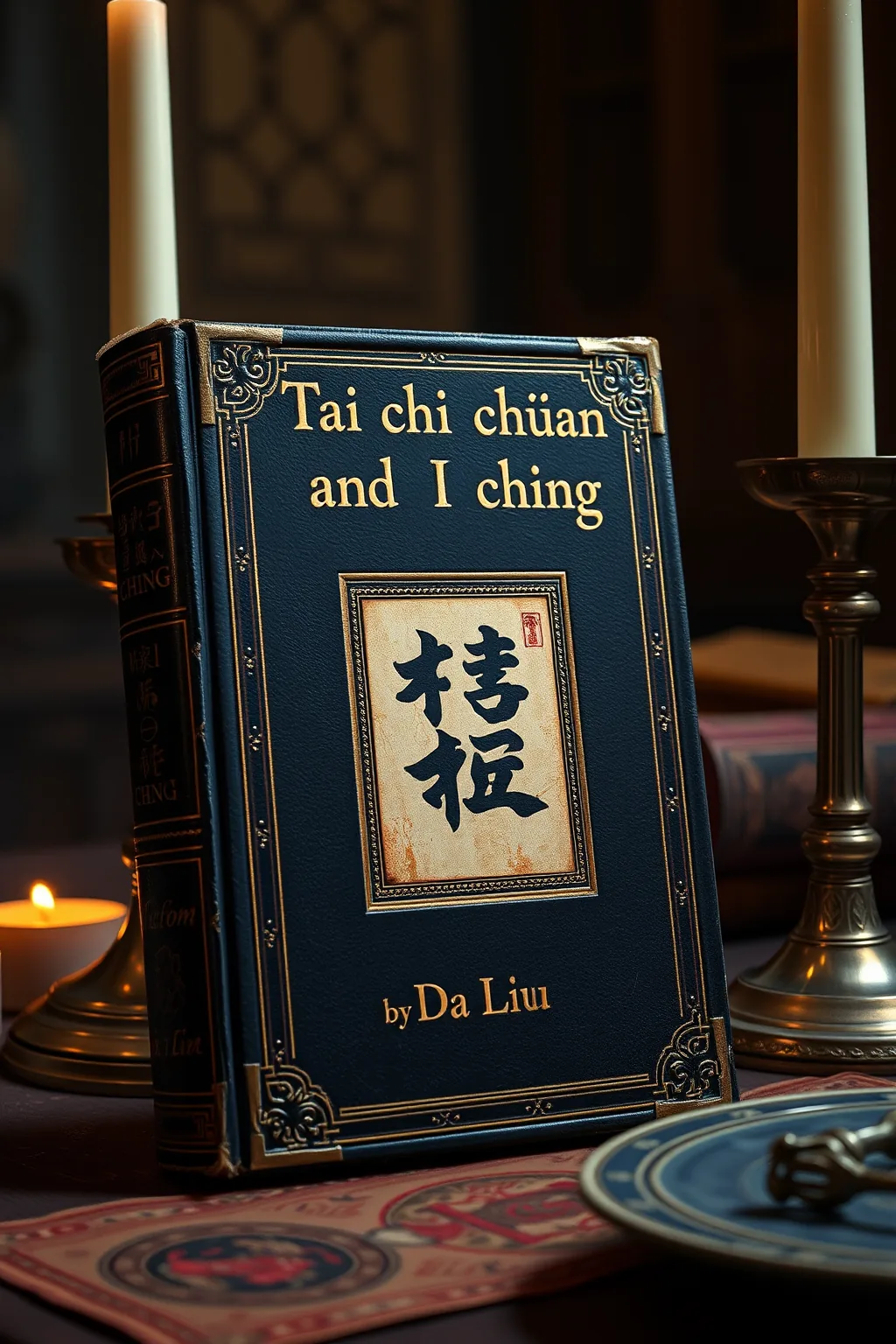
Tʻai chi chʻuan and I ching
 61
61

Tʻai chi chʻuan and I ching



Sophia Crane, Associate Editor — Da Liu's "Tʻai Chi Chʻuan and I Ching" is a masterful exploration of two pillars of Chinese esoteric philosophy. Crane expertly navigates the complex symbology of the I Ching, demonstrating its profound connection to the energetic principles of Tʻai Chi. The book offers invaluable insights for practitioners seeking to imbue their movements with deeper philosophical understanding and for diviners wishing to grasp the dynamic, ever-changing nature of fate. Its strength lies in its ability to synthesize seemingly disparate disciplines into a cohesive, enlightening whole, making it essential reading for serious students of Eastern mysticism and self-mastery.
📝 Description
61
Da Liu first connected the I Ching's hexagrams to T'ai Chi Ch'uan's movements in 1972.
Da Liu's 1972 book examines the philosophical connections between the I Ching and T'ai Chi Ch'uan. He argues that the principles governing the sixty-four hexagrams of the I Ching find expression in the movements and theories of T'ai Chi. The text does not present itself as a practical guide to either discipline but rather as an interpretation of their shared underlying philosophy. Da Liu draws parallels between the dynamic shifts of Yin and Yang in the I Ching and the cultivation of internal energy (qi) through T'ai Chi practice. The book uses the symbolic language of the hexagrams to illuminate concepts of self development, fate, and the universe's cyclical patterns.
This work is for those interested in understanding the esoteric thought behind these two traditions. It aims to bridge the gap between physical practice and metaphysical understanding, showing how cosmic forces can be seen to mirror the energies developed in T'ai Chi. The author's intent is to reveal a deeper meaning in both the ancient oracle and the martial art, suggesting a unified system of thought rooted in Chinese cosmology.
This book sits within the tradition of Chinese internal arts and divination, seeking correspondences between the cosmic order as described by the I Ching and the human body's energetic processes as understood in T'ai Chi. It engages with concepts of qi, the five elements, and the cyclical nature of change, applying them to both philosophical inquiry and physical practice. The work reflects a Daoist perspective that emphasizes balance, flow, and the interconnectedness of all things, viewing both the hexagrams and martial forms as manifestations of universal laws.
💡 Why Read This Book?
Uncover the harmonious fusion of martial arts and ancient divination. This book offers a unique perspective on cosmic forces, personal destiny, and the cultivation of inner harmony through the practice of Tʻai Chi. Ideal for those seeking deeper self-understanding, philosophical enlightenment, and a profound connection to the wisdom of the East. Explore the esoteric links between movement, mind, and the universe’s subtle energies.
⭐ Reader Reviews
Honest opinions from readers who have explored this book.
❓ Frequently Asked Questions
What is the primary connection between Tʻai Chi Chʻuan and the I Ching?
The book posits that the principles of Yin and Yang, central to both Tʻai Chi and the I Ching, represent a fundamental dynamic of the universe. Tʻai Chi's movements embody these principles, while the I Ching offers a framework for understanding their manifestation and influence in life.
Is this book suitable for beginners in Tʻai Chi or the I Ching?
While it assumes some familiarity, the book's clear explanations and rich symbolic interpretations make it accessible to dedicated beginners eager to explore the deeper philosophical dimensions of these practices.
What kind of esoteric knowledge can one expect to find?
Readers can expect to uncover the symbolic language of the hexagrams, their correspondence to energetic flows and bodily meridians, and how these ancient insights can inform the practice and philosophy of Tʻai Chi for personal growth and spiritual development.
How does the book approach the concept of fate or destiny?
It presents destiny not as a fixed end, but as a dynamic interplay of forces, much like the ever-changing nature of the I Ching's hexagrams. Tʻai Chi practice is shown as a means to consciously navigate and harmonize with these forces.
What is the philosophical significance of this book?
The book highlights the interconnectedness of all things, suggesting that the microcosm (the human body and its movements) reflects the macrocosm (the universe). It offers a path to wisdom through embodied understanding and attunement with natural laws.
🔮 Key Themes & Symbolism
The Unification of Movement and Divination
This theme explores the core thesis of Da Liu's work: the profound and symbiotic relationship between the physical discipline of Tʻai Chi Chʻuan and the ancient divinatory system of the I Ching. It looks at how the flowing, dynamic movements of Tʻai Chi can be seen as a living embodiment of the principles of change and transformation described by the I Ching's hexagrams. The text illuminates how understanding the symbolic language of the oracle can imbue martial practice with deeper philosophical meaning and vice versa, revealing a unified path toward self-awareness and cosmic attunement. This integration offers practitioners a holistic approach to understanding their place in the universe.
The Philosophy of Yin and Yang
At the heart of this book lies an in-depth exploration of Yin and Yang, the fundamental dualistic forces that govern all existence according to ancient Chinese philosophy. Da Liu masterfully illustrates how these complementary energies are not only the bedrock of the I Ching's sixty-four hexagrams but are also dynamically expressed through the postures, transitions, and internal cultivation techniques of Tʻai Chi Chʻuan. The book deciphers the subtle interplay between these forces, showing how their balance and transformation are key to understanding both the external world and the internal field of the human being, offering a profound lens for personal growth and energetic harmony.
Embodied Wisdom and Self-Cultivation
This key theme focuses on the transformative potential of integrating the philosophical insights of the I Ching with the embodied practice of Tʻai Chi. The book argues that true wisdom is not merely intellectual but is deeply rooted in physical and energetic understanding. Through the deliberate cultivation of internal energy (Qi) and the mindful execution of Tʻai Chi movements, practitioners are guided to tap into a profound, intuitive knowledge. This process of self-cultivation, informed by the cyclical wisdom of the I Ching, leads to enhanced self-awareness, emotional balance, and a deeper connection to the natural order of the universe, fostering a holistic approach to personal development and spiritual evolution.
💬 Memorable Quotes
Direct passages from the work, attributed to the author.
“Within stillness, there is movement; within movement, there is stillness.”
— A fundamental principle of Tʻai Chi and Daoism, this highlights the paradoxical unity of opposites and the interconnectedness of apparent dualities in the cosmos.
“The hexagrams are maps of the cosmic dance.”
— This evocative metaphor suggests that the I Ching's symbols are not static predictions but rather guides to understanding the ever-evolving patterns of universal forces and their influence.
“To know the self is to know the Tao.”
— This profound statement links the journey of self-discovery, often facilitated by Tʻai Chi and I Ching study, to the understanding of the fundamental universal principle or 'Way'.
“Harmony arises from the balanced interplay of forces.”
— This emphasizes the importance of equilibrium, particularly the balance of Yin and Yang, as the source of well-being and order in both the individual and the universe.
💡 Key Ideas
Editorial paraphrase of the work's core concepts — not direct quotes.
The universe is a ceaseless flow of change.
This quote captures the core philosophy of the I Ching and its connection to Tʻai Chi, emphasizing the dynamic and impermanent nature of reality and the importance of adapting to these shifts.
🌙 Esoteric Significance
Tradition
This work is deeply rooted in the Daoist tradition, drawing heavily from its cosmological principles, particularly the concepts of Yin and Yang and the concept of the Tao (the Way). It also intersects with the lineage of Chinese internal martial arts and their philosophical interpretations, viewing Tʻai Chi as a practice that cultivates internal harmony and aligns the practitioner with natural forces, mirroring the cyclical wisdom of the I Ching.
Symbolism
The book unravels the strong symbolism of the I Ching's hexagrams, interpreting them not just as divinatory signs but as archetypal representations of universal patterns and states of being. It connects these symbols to the energetic flows and physical movements of Tʻai Chi, illustrating how the body’s posture and motion can reflect and interact with these cosmic blueprints. Key symbols explored include the interplay of Yin and Yang, the trigrams, and the dynamic transitions between different hexagram states.
Modern Relevance
In a world often characterized by fragmentation and disconnection, the synthesis of Tʻai Chi and the I Ching offers a powerful path toward holistic integration. The book's emphasis on embodied wisdom and understanding life's cyclical nature provides timeless guidance for navigating personal challenges and fostering inner peace. Its teachings remain highly relevant for individuals seeking practical methods for self-cultivation, mental clarity, and a deeper, more harmonious relationship with the universe.
👥 Who Should Read This Book
This seminal text is essential for dedicated practitioners of Tʻai Chi Chʻuan seeking to deepen their understanding beyond mere physical form, offering philosophical insights that can enrich their practice. Scholars of Eastern philosophy, comparative religion, and cultural studies will find its interdisciplinary approach invaluable. For spiritual seekers and those interested in divination, the I Ching's mystical interpretations, seamlessly woven with Tʻai Chi principles, provide a profound path to self-discovery and cosmic attunement. It is also recommended for anyone interested in the profound connections between mind, body, and the universe.
📜 Historical Context
Written during a period of burgeoning global interest in Eastern philosophies and practices, Da Liu's "Tʻai Chi Chʻuan and I Ching" emerged as a significant bridge between Western and Eastern esoteric traditions. The mid-to-late 20th century saw a rise in the popularization of martial arts and meditative practices, often divorced from their deep philosophical roots. Da Liu’s work, published in 1972, sought to rectify this by providing a scholarly yet accessible exploration of the profound metaphysical underpinnings of two of China's most revered systems. It contributed to a more nuanced understanding of these disciplines, moving beyond mere physical technique or fortune-telling to reveal their potential as pathways to spiritual enlightenment and a deeper connection with universal principles. The book resonated with a generation seeking alternative perspectives and a more holistic approach to life and self-understanding.
📔 Journal Prompts
Reflect on a recent life event and identify the dominant Yin and Yang energies at play. How did Tʻai Chi principles help you navigate it?
Consider a specific hexagram from the I Ching. How might its symbolism be expressed through a Tʻai Chi posture or movement?
What does 'harmony arising from the balanced interplay of forces' mean in your daily life?
Explore the concept of 'stillness within movement' in your own experience. Where do you find this paradox?
How can the continuous flow of change, as described in the I Ching, inform your approach to personal growth and challenges?
🗂️ Glossary
Tʻai Chi Chʻuan
An ancient Chinese internal martial art and meditative practice, emphasizing slow, flowing movements, breath control, and the cultivation of internal energy (Qi) for health, self-defense, and spiritual development.
I Ching (Yijing)
An ancient Chinese divination text and one of the oldest Chinese classics, known as the 'Book of Changes,' which uses a system of hexagrams to interpret the forces of the universe and provide guidance.
Yin and Yang
Fundamental concepts in Chinese philosophy representing complementary, interconnected opposites (e.g., dark/light, passive/active, feminine/masculine) whose dynamic balance governs all phenomena.
Qi (Chi)
The vital life force or energy believed to flow through all living things, cultivated and balanced in practices like Tʻai Chi for health and well-being.
Hexagram
A symbol composed of six stacked horizontal lines, each either solid (Yang) or broken (Yin), used in the I Ching for divination and philosophical interpretation.
This book appears in 3 collections
🔮 Readers Also Liked
Browse all →








More by Da Liu
All books →





From the “Tarot” Collection
View all →








More Free Divination & Tarot Books
View all →