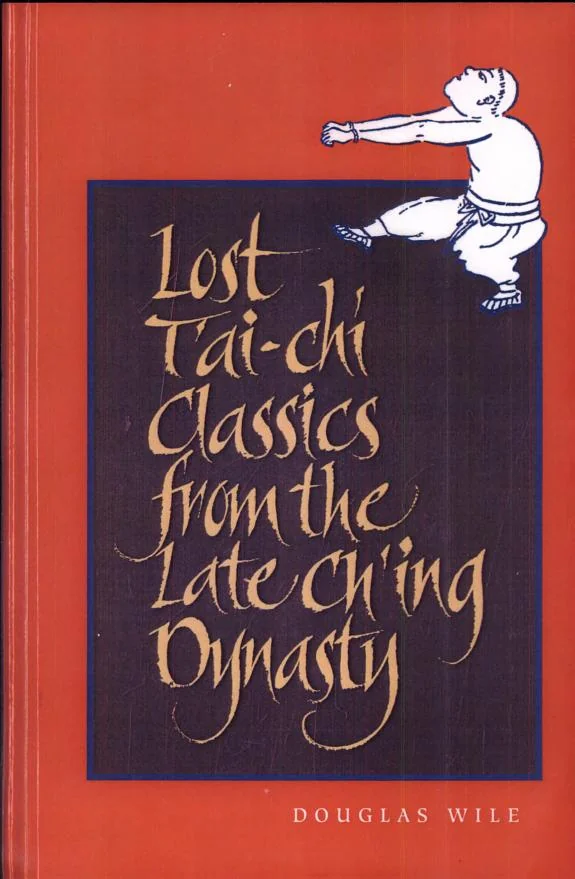
Lost T'ai-chi Classics from the Late Ch'ing Dynasty
 71
71

Lost T'ai-chi Classics from the Late Ch'ing Dynasty
Douglas Wile's rigorous scholarship in Lost T'ai-chi Classics is a formidable challenge to the romanticized histories often surrounding internal martial arts. His meticulous dissection of late Ch'ing Dynasty documents, particularly concerning the lineage and authorship of key T'ai-chi texts, is nothing short of revelatory for dedicated practitioners. The work's strength lies in its unwavering commitment to primary sources, effectively unearthing figures like Ch'ang Nai-chou and re-contextualizing the contributions of Wang Tsung-yueh. However, the dense academic prose, while precise, can be a formidable barrier for those not already steeped in the subject matter. The section detailing the differences between Wu, Yang, and Li styles, while informative, requires careful attention to follow Wile's nuanced arguments. This is not a book for casual readers, but for those committed to a scholarly understanding of T'ai-chi's historical roots, it offers invaluable, albeit demanding, revelations.
📝 Description
71
Douglas Wile's 1996 book revises T'ai-chi history with late Ch'ing dynasty texts.
Lost T'ai-chi Classics from the Late Ch'ing Dynasty offers a detailed study of martial arts texts that became available in the late 19th and early 20th centuries. Douglas Wile examines these materials carefully, proposing a new understanding of how T'ai-chi developed. This work is for serious students and researchers of T'ai-chi Ch'uan, martial arts history, and Chinese esoteric traditions. It requires a commitment to close textual analysis and historical evidence, going beyond common interpretations.
The book emerged at a time of growing academic attention to Chinese martial arts. It questioned common ideas about T'ai-chi's origins, particularly links to early Daoist figures. The late Ch'ing period was important for the formalization and spread of internal martial arts, and Wile's research sheds light on this era. He looks at who wrote key T'ai-chi texts and separates different stylistic lines like Wu, Yang, and Li. The author also reassesses the importance of figures such as Wang Tsung-yueh and Chiang Fa, and examines the less known Ch'ang Nai-chou.
This book examines T'ai-chi within the context of Chinese esoteric traditions, particularly those prominent in the late Ch'ing Dynasty. It moves beyond the martial aspects to consider the philosophical and internal cultivation elements often associated with these practices. By analyzing newly accessible historical documents, Wile places T'ai-chi's development within a lineage that valued introspection and specific methods of energy cultivation, distinct from more superficial or purely combative interpretations that often dominate popular understanding.
💡 Why Read This Book?
• Gain a fact-based understanding of T'ai-chi's origins, moving beyond legend to explore evidence from the late Ch'ing Dynasty. • Critically assess the distinct contributions of figures like Wang Tsung-yueh and Ch'ang Nai-chou to T'ai-chi's early development. • Differentiate between major T'ai-chi stylistic lineages such as Wu, Yang, and Li, based on textual analysis.
⭐ Reader Reviews
Honest opinions from readers who have explored this book.
❓ Frequently Asked Questions
When was Lost T'ai-chi Classics from the Late Ch'ing Dynasty first published?
The book was first published on January 1, 1996, offering a fresh academic perspective on T'ai-chi history based on late Ch'ing Dynasty materials.
Who is Douglas Wile, the author?
Douglas Wile is a noted scholar specializing in Chinese martial arts history and internal alchemy, known for his detailed textual research and re-evaluation of traditional narratives.
What specific T'ai-chi styles does the book compare?
The book analyzes and compares the stylistic differences and historical development of Wu, Yang, and Li styles of T'ai-chi, based on late Ch'ing Dynasty sources.
Does the book discuss Chang San-feng?
Yes, the work explores the traditional association of Chang San-feng with T'ai-chi's origins and critically examines the evidence for this connection, contrasting it with documented figures from the late Ch'ing period.
What new material does the book present?
Wile's analysis centers on rich new material from the late Ch'ing Dynasty, including previously overlooked texts and biographical information that sheds light on the evolution of T'ai-chi and its key proponents.
Is this book suitable for beginners in T'ai-chi?
While informative, the book's dense scholarly approach and focus on textual criticism make it more suitable for advanced students, researchers, or practitioners with a strong interest in historical and theoretical aspects of T'ai-chi.
🔮 Key Themes & Symbolism
Revisiting T'ai-chi Origins
The book critically examines long-held beliefs about the genesis of T'ai-chi, particularly challenging the mythic attribution to figures like Chang San-feng. Wile focuses on verifiable historical records from the late Ch'ing Dynasty, presenting evidence that suggests a more recent and documented evolution of the art, emphasizing the roles of specific martial artists and their textual contributions during this period.
Authorship of Canonical Texts
A central theme is the meticulous investigation into the authorship and authenticity of foundational T'ai-chi classics. Wile dissects the often-attributed works, distinguishing between genuine contributions and later additions or misattributions. This scholarly approach aims to clarify the lineage of T'ai-chi knowledge, identifying the actual individuals responsible for codifying its principles and techniques during the late 19th and early 20th centuries.
Stylistic Lineage Analysis
The work provides a comparative analysis of distinct T'ai-chi styles, including Wu, Yang, and Li. By scrutinizing the late Ch'ing Dynasty sources, Wile elucidates the historical divergence and unique characteristics of these lineages. This exploration moves beyond superficial descriptions to reveal the subtle yet significant differences in their theoretical underpinnings and practical applications as recorded in early texts.
The Role of Ch'ang Nai-chou
Wile highlights the significance of Ch'ang Nai-chou, a figure previously considered a 'missing link' in T'ai-chi history. Through his research into late Ch'ing materials, Wile reconstructs Ch'ang's contributions, placing him as a central figure whose work influenced subsequent developments and practitioners. This reassessment corrects the historical record and underscores the importance of lesser-known historical figures.
💬 Memorable Quotes
Direct passages from the work, attributed to the author.
“The established narrative of T'ai-chi's origins, particularly its linkage to figures like Chang San-feng, requires critical re-evaluation.”
— This statement captures Wile's core argument: that popular myths surrounding T'ai-chi's ancient roots are not supported by the available textual evidence from the late Ch'ing period, necessitating a scholarly revision.
“Ch'ang Nai-chou's writings represent a crucial, yet historically overlooked, bridge in the transmission of T'ai-chi principles.”
— Wile emphasizes the importance of Ch'ang Nai-chou, presenting him not just as a practitioner but as a key textual contributor whose work connected earlier forms of internal arts to the developing T'ai-chi styles of the late 19th century.
“Distinguishing the specific contributions of Wang Tsung-yueh from later interpolations is vital for understanding T'ai-chi's early codified form.”
— This highlights Wile's method of textual criticism, focusing on separating authentic early material attributed to figures like Wang Tsung-yueh from subsequent modifications or additions that obscure the original teachings.
“The differences between Wu, Yang, and Li styles are rooted in distinct interpretations and transmissions originating in the late Ch'ing era.”
— This interpretation points to the book's exploration of T'ai-chi's stylistic diversification, attributing the divergence of major schools to specific historical developments and interpretations during the late imperial period.
“Newly available documents from the late 19th and early 20th centuries provide a more accurate basis for T'ai-chi's historical reconstruction.”
— Wile underscores the significance of his research material, indicating that the late Ch'ing Dynasty texts he analyzes offer a more reliable and detailed account of T'ai-chi's evolution than previously accessible sources.
🌙 Esoteric Significance
Tradition
This work engages with the esoteric dimensions of T'ai-chi Ch'uan, particularly its roots within Daoist internal cultivation practices. While not strictly a guide to alchemy or meditation, it situates the martial art's development within a broader context of late imperial Chinese esoteric thought. Wile's research illuminates how principles of Qi cultivation, internal awareness, and philosophical Daoism were integrated into the martial framework during the late Ch'ing Dynasty.
Symbolism
Key symbolic motifs explored implicitly relate to the concept of Yin and Yang dynamics, central to Daoist philosophy and T'ai-chi practice. The book's focus on the transmission of knowledge through lineages also symbolizes the esoteric principle of direct, authorized transmission. The very act of recovering 'lost' texts can be seen as an esoteric endeavor, akin to rediscovering hidden wisdom or alchemical secrets.
Modern Relevance
Contemporary scholars and practitioners of internal martial arts, particularly those interested in historical authenticity and the philosophical underpinnings of T'ai-chi, draw heavily on Wile's research. Thinkers exploring the intersection of martial arts, Daoism, and Chinese philosophy find his textual analysis indispensable for grounding their understanding of T'ai-chi's lineage and its connection to classical Chinese thought.
👥 Who Should Read This Book
• Dedicated T'ai-chi practitioners seeking to understand the historical roots and textual foundations of their art beyond popular narratives. • Researchers of Chinese martial arts history and comparative esoteric traditions interested in scholarly analysis of late Ch'ing Dynasty martial developments. • Students of Daoism and Chinese philosophy looking to explore the practical application of classical concepts within a martial context.
📜 Historical Context
Lost T'ai-chi Classics emerged in 1996, a period when academic study of Chinese martial arts was gaining traction, moving beyond martial lore into serious historical inquiry. Douglas Wile’s work directly engaged with and challenged the prevailing, often mythologized, accounts of T'ai-chi’s origins, particularly the popular linkage to Daoist immortals like Chang San-feng. This book was published in the same era that scholars like Stanley Henning were also publishing critical analyses of martial arts history. Wile's focus on the late Ch'ing Dynasty (1644-1912) provided a crucial temporal anchor, situating T'ai-chi's formalization within a specific, documented historical period rather than attributing it to ancient, unverifiable sources. The book's reception among martial arts historians and practitioners was significant, prompting a re-examination of foundational texts and lineage charts.
📔 Journal Prompts
The historical debate surrounding Chang San-feng's connection to T'ai-chi.
Reconstructing the lineage of T'ai-chi based on the textual evidence presented for Wang Tsung-yueh.
Comparing the identified characteristics of Wu, Yang, and Li T'ai-chi styles.
The significance of Ch'ang Nai-chou's recovered contributions to T'ai-chi.
Evaluating the impact of late Ch'ing Dynasty societal changes on martial arts development.
🗂️ Glossary
T'ai-chi Ch'uan
A Chinese internal martial art practiced for both its health benefits and self-defense applications, characterized by slow, flowing movements and emphasis on internal energy (Qi).
Ch'ing Dynasty
The last imperial dynasty of China, ruling from 1644 to 1912. The late period of this dynasty was crucial for the codification and dissemination of many internal martial arts.
Qi (Chi)
In traditional Chinese culture, the vital life force or energy believed to flow through all living things. Central to internal martial arts and esoteric practices.
Wang Tsung-yueh
A significant historical figure associated with the early development and textual transmission of T'ai-chi Ch'uan, whose writings are analyzed in the book.
Chang San-feng
A legendary Daoist figure traditionally credited as the founder of T'ai-chi Ch'uan, whose historical connection is critically examined in the book.
Wu Style T'ai-chi
One of the major recognized styles of T'ai-chi Ch'uan, characterized by specific postures and internal principles distinct from other lineages.
Yang Style T'ai-chi
The most widely practiced style of T'ai-chi Ch'uan, known for its larger, more expansive movements and emphasis on relaxation.
This book appears in 1 collection
🔮 Readers Also Liked
Browse all →







From the “Tai Chi” Collection
View all →








More Free Occult Philosophy Books
View all →




![The Teti Cemetery at Saqqara / N. Kanawati and M. Abder-Raziq ; with contributions by A. McFarlane ... [et al.].](/img/thumb/the-teti-cemetery-at-saqqara-n-kanawati-and-m-abder-raziq-with-contributions-by-a-mcfarlane-et-al-n--688041.webp)