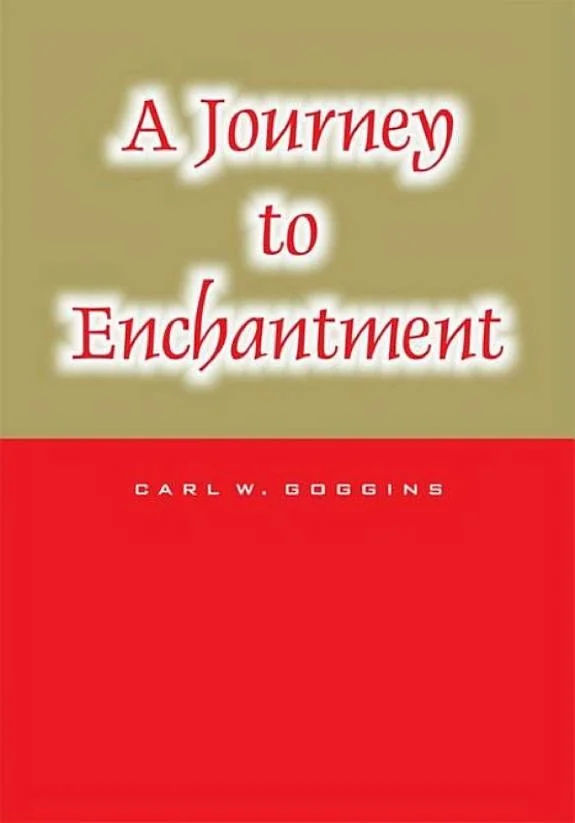
A Journey to Enchantment
 73
73

A Journey to Enchantment
Carl W. Goggins’ A Journey to Enchantment posits a compelling, if familiar, premise: the divine is not elsewhere, but here. The novel’s strength lies in its determined pursuit of this idea through David Noble’s unfolding awareness. Goggins introduces a striking figure in the Mother of the Universe, whose claims shake the foundations of conventional theology. However, the narrative’s momentum occasionally falters under the weight of its philosophical expositions. A particular challenge arises in the characterization of David’s friend, Michael Van Hagen, whose role as a catalyst feels somewhat underdeveloped. Despite these moments, the work’s exploration of immanent spirituality offers a refreshing perspective for those seeking meaning beyond traditional doctrines. The book ultimately offers a contemplative, if uneven, exploration of self-realization.
📝 Description
73
Carl W. Goggins' 2000 novel, A Journey to Enchantment, suggests fulfillment is an earthly state, not a future reward.
A Journey to Enchantment follows David Noble's spiritual quest, where he learns that true fulfillment, which Goggins calls 'Enchantment,' is not a distant afterlife but a present reality. His path involves an encounter with a figure claiming to be the Mother of the Universe, a meeting that challenges conventional religious ideas about divinity. The book uses this narrative to question established spiritual doctrines and explore an immanent view of the divine.
This novel is suited for readers who question traditional religious frameworks and are interested in philosophical fiction that addresses existential concerns. It will appeal to those who seek alternative spiritual perspectives and enjoy narratives that combine metaphysical ideas with character development. Goggins' work integrates these elements into a plot that encourages introspection on consciousness and personal transformation.
Published in 2000, A Journey to Enchantment emerged during a resurgence of interest in New Age spirituality and comparative religions. This period saw a growing cultural acceptance of Eastern philosophies and esoteric thought, often presented as alternatives to Western monotheism. Goggins' novel fits within this context by questioning established divine authority and proposing an immanent, rather than transcendent, spiritual reality. It engages with ideas that were circulating in spiritual circles seeking personal transformation outside of traditional religious institutions.
💡 Why Read This Book?
• Gain a fresh perspective on spiritual fulfillment by engaging with the concept of 'Enchantment' as an immanent state, as explored through David Noble’s journey in the novel. • Understand the philosophical underpinnings of challenging established religious paradigms, particularly through the introduction of the 'Mother of the Universe' figure. • Contemplate the nature of reality and personal transformation by examining how the novel presents a shift from external salvation to internal discovery, a core theme originating in its 2000 publication.
⭐ Reader Reviews
Honest opinions from readers who have explored this book.
❓ Frequently Asked Questions
What is the central theme of Carl W. Goggins' 'A Journey to Enchantment'?
The central theme is that spiritual fulfillment, referred to as 'Enchantment,' is attainable in the present moment on Earth, rather than in a distant afterlife. It challenges conventional notions of divinity and self-discovery.
Who is the protagonist of 'A Journey to Enchantment'?
The protagonist is David Noble. His journey involves a profound personal transformation as he learns to perceive 'Enchantment' as an ever-present reality.
What is the significance of the 'Mother of the Universe' in the book?
She represents a powerful, potentially divine feminine force challenging patriarchal religious structures. Her arrival signals a critical juncture in humanity's spiritual evolution as presented in the novel.
When was 'A Journey to Enchantment' originally published?
The book was first published in the year 2000, placing it within a period of increasing interest in alternative spiritualities.
Does the book offer practical advice for spiritual growth?
While not a direct self-help manual, the narrative implicitly guides readers toward recognizing the sacred in the mundane and embracing inner transformation as the path to 'Enchantment'.
What philosophical ideas does the novel engage with?
It engages with existentialism, mysticism, and Gnostic concepts, particularly regarding the nature of reality, the divine, and the potential for immediate spiritual realization.
🔮 Key Themes & Symbolism
Immanent Divinity
The work posits that 'Enchantment'—a state akin to Nirvana or Heaven—is not a future reward but a present reality. David Noble's narrative arc centers on this realization, challenging the common spiritual dichotomy of the sacred and the profane. This concept shifts the focus from seeking external salvation to recognizing the divine within everyday existence and the earthly plane.
The Divine Feminine
The introduction of the 'Mother of the Universe' serves as a key element, embodying a powerful feminine divine presence. This figure challenges patriarchal religious frameworks prevalent in Western thought and offers an alternative perspective on cosmic creation and governance. Her purported mission to 'end God's experiment with Man' suggests a reevaluation of divine order and humanity's role within it.
Inner Transformation
Central to the protagonist's journey is the theme of inner transformation. David Noble’s path is one of awakening to a deeper understanding of life, death, and love, facilitated by his encounters and reflections. The novel suggests that true enchantment arises from internal shifts in perception and consciousness, rather than external circumstances or doctrines.
Critique of Religious Dogma
Goggins uses the narrative to question established religious tenets and the concept of an external, distant deity. The 'Mother of the Universe' character, in particular, functions as a catalyst for this critique, proposing a radical reinterpretation of divine purpose and human existence. The novel invites readers to reconsider their own beliefs about spirituality and ultimate truth.
💬 Memorable Quotes
Direct passages from the work, attributed to the author.
“The Mother of the Universe claimed she was here to end God's experiment with Man.”
— This statement introduces a radical, potentially Gnostic, challenge to traditional Abrahamic cosmology. It suggests a reevaluation of divine intention and humanity's place in the cosmic narrative, positioning the feminine divine as a force of profound change.
“David Noble's journey was one of recognizing the sacred in the mundane.”
— This interpretation describes the protagonist's essential transformation. It underscores the novel's theme that enlightenment is not about escaping earthly life but about perceiving its inherent spiritual depth.
“Michael Van Hagen introduced David to a radical new perspective.”
— This highlights the catalytic role of friendship in spiritual seeking. Michael serves as the conduit through which David encounters challenging ideas, prompting his own profound self-discovery.
💡 Key Ideas
Editorial paraphrase of the work's core concepts — not direct quotes.
Enchantment is not found in the heavens, but here on Earth.
This paraphrased concept highlights the core message that spiritual fulfillment is an immanent experience, accessible in the present moment and on the material plane, rather than a future or otherworldly reward.
Love, life, and death are all part of the path to inner transformation.
This paraphrased concept expresses the existential and spiritual dimensions explored. It suggests that confronting fundamental aspects of human experience is integral to achieving a higher state of consciousness.
🌙 Esoteric Significance
Tradition
The work aligns broadly with Gnostic and Neoplatonic traditions, emphasizing the immanence of the divine and the potential for immediate spiritual awakening (gnosis). It departs from conventional Abrahamic theology by introducing a powerful feminine divine principle and questioning the established divine order, echoing Gnostic dualisms and critiques of a flawed creator deity.
Symbolism
The concept of 'Enchantment' itself functions as a symbol for ultimate realization or enlightenment, representing a state of being rather than a place. The 'Mother of the Universe' symbolizes the divine feminine, a potent force challenging patriarchal religious structures and representing a more holistic cosmic principle. The protagonist, David Noble, embodies the seeker archetype, representing humanity's potential for awakening.
Modern Relevance
Contemporary spiritual seekers exploring non-dual philosophies, eco-spirituality, and goddess-centric movements may find resonance with Goggins' ideas. The novel's emphasis on finding the sacred within the mundane aligns with mindfulness practices and emergent spiritual paradigms that reject institutional dogma in favor of personal experience and immanent divinity.
👥 Who Should Read This Book
• Seekers of alternative spiritual narratives: Readers who question traditional religious doctrines and are interested in philosophical fiction exploring immanent divinity and personal awakening. • Students of comparative religion and mythology: Individuals interested in how narratives challenge established theological concepts, particularly regarding the divine feminine and the nature of ultimate reality. • Readers exploring existential and metaphysical themes: Those drawn to literature that probes the meaning of life, death, and consciousness through a blend of narrative and philosophical inquiry.
📜 Historical Context
Published in 2000, Carl W. Goggins' *A Journey to Enchantment* emerged during a period marked by a significant resurgence of interest in esoteric thought, New Age spirituality, and comparative religious studies. The late 20th century witnessed a cultural diffusion of Eastern philosophies, Gnosticism, and Neoplatonism into Western discourse, often through popular literature and self-help movements. This era saw figures like Joseph Campbell gain widespread recognition for exploring mythological archetypes across cultures. Goggins’ novel participates in this intellectual milieu by questioning traditional Western monotheistic frameworks, particularly the patriarchal emphasis, and proposing an immanent, accessible form of spiritual realization. While not directly engaging with academic debates, the book reflects a broader cultural shift away from rigid dogma towards more personalized and experiential spiritual paths, a trend that contrasted with the more established theological doctrines of the time.
📔 Journal Prompts
The concept of 'Enchantment' as an immanent state.
The role of Michael Van Hagen in David's spiritual awakening.
Reconciling the 'Mother of the Universe' with traditional divine concepts.
The significance of David Noble's realization about life, death, and love.
Exploring personal perceptions of the divine in the here and now.
🗂️ Glossary
Enchantment
A term used in the novel to denote a state of ultimate spiritual fulfillment, enlightenment, or divine presence, understood as being accessible in the present moment on Earth.
Mother of the Universe
A character presented as a divine feminine entity who claims to be the ultimate cosmic power, challenging the established order and potentially bringing an end to humanity's current spiritual trajectory.
David Noble
The protagonist of the novel, whose personal journey involves the discovery and realization of 'Enchantment' within his earthly existence.
Michael Van Hagen
David Noble's closest friend, who acts as a catalyst in the narrative by introducing David to the 'Mother of the Universe' and her radical claims.
God's experiment with Man
A concept referenced by the 'Mother of the Universe,' implying that human existence and history are part of a divine trial or project that is nearing its conclusion.
Inner Transformation
The process of profound personal change in consciousness, perception, and understanding, central to achieving the state of 'Enchantment' as depicted in the novel.
Immanent Divinity
The philosophical and spiritual concept that the divine is present within the material world and human experience, rather than being transcendent or external to it.
This book appears in 1 collection
🔮 Readers Also Liked
Browse all →








From the “Nirvana” Collection
View all →







More Free Occult Philosophy Books
View all →