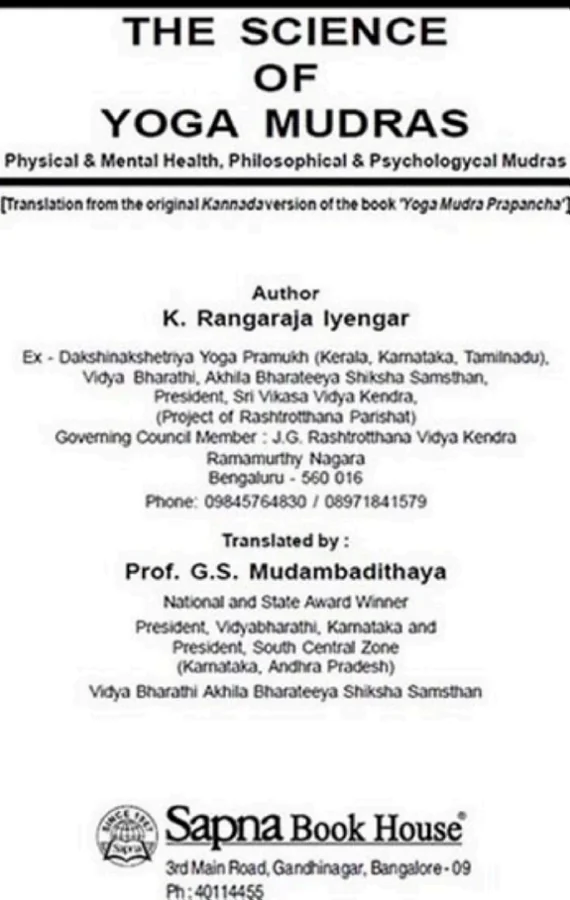
THE SCIENCE OF YOGA MUDRAS
 81
81

THE SCIENCE OF YOGA MUDRAS
Iyengar and Mudambadithaya's "The Science of Yoga Mudras" attempts to bring a rigorous, almost scientific, approach to the often-esoteric practice of yogic hand gestures. The book is commendable for its effort to connect these ancient techniques to tangible effects on the practitioner's physical and mental state, moving away from purely spiritual interpretations. A notable strength lies in its detailed explanations of how specific mudras might influence energy flow, referencing the concept of prana and its circulation. However, the work occasionally falters in its presentation, sometimes feeling more like a dense academic treatise than an accessible guide for practitioners. The language, while precise, can be dense, and the original blurb's lament about yoga being reduced to disease management or pleasure-seeking feels somewhat disconnected from the technical exposition that follows. The book is a serious study, but its practical utility for the average practitioner might be limited by its academic tone. It offers a valuable, albeit challenging, perspective on a core yogic element.
📝 Description
81
Published in 2013, 'The Science of Yoga Mudras' details yogic hand gestures and their energetic effects.
This volume examines yogic hand gestures, or mudras, within the framework of yogic philosophy. It moves past physical form to discuss the energetic and psychological impacts of these symbolic positions. The authors aim to clarify mudras, showing them as essential parts of yogic science. They are designed to alter internal states and achieve specific results for practitioners.
The book is for those who want to understand yoga more deeply than just the physical postures. It will interest dedicated yoga practitioners, students of esoteric traditions, and anyone curious about the body's subtle energies. Readers seeking to use yogic techniques for better concentration, emotional stability, or spiritual growth will find useful instruction. It also serves scholars of comparative religion and ancient Indian sciences who are interested in yogic philosophy's practical uses.
Originating from ancient India, the science of mudras is a tradition discussed in classical Sanskrit texts. While yoga gained global attention later, mudras represent an older, established practice. This book aims to present these ancient techniques to a modern audience, connecting traditional knowledge with current views on mind-body interaction. It acknowledges the sages, known as Rshis, who developed these practices.
💡 Why Read This Book?
• Gain a scientific framework for understanding yogic hand gestures, learning how specific mudras are believed to direct prana within the body, as detailed in the text's exploration of energetic locks. • Discover the philosophical underpinnings of yogic practices beyond asanas, understanding the concept of "pure living" and the original purpose of human creation as envisioned by the Rshis. • Explore the practical application of mudras for enhancing concentration and emotional balance, with actionable techniques presented in the book's detailed exposition.
⭐ Reader Reviews
Honest opinions from readers who have explored this book.
❓ Frequently Asked Questions
What is the primary focus of "The Science of Yoga Mudras"?
The book focuses on yogic hand gestures, known as mudras, presenting them as integral components of yogic science. It explores their energetic and psychological effects, aiming to demystify them as tools for influencing internal states and achieving specific yogic goals.
Who are the authors of "The Science of Yoga Mudras"?
The book is authored by K. Rangaraja Iyengar and Prof. G.S. Mudambadithaya. It was first published on May 17, 2013.
What does the book say about the purpose of Yoga?
The book suggests that the original intent of Yoga, as conceived by the Rshis, was not solely for physical healing or material enjoyment, but for achieving "pure living" and awareness of one's purpose.
How does the book explain the function of Mudras?
It explains mudras as energetic locks and seals that direct prana (life force energy) within the body, influencing chakras and nadis to cultivate mental clarity, emotional stability, and higher consciousness.
What is the historical origin of Yoga and Mudras mentioned?
The book places Yoga and its associated practices, like mudras, within the ancient Indian tradition originating from the Rshis. It highlights the deep historical roots of mudras, predating modern yoga's global spread.
What is the overall tone of "The Science of Yoga Mudras"?
The book adopts a detailed and somewhat academic tone, aiming for a scientific exposition of mudras. It seeks to provide a rigorous understanding of these practices rather than a purely devotional or superficial approach.
🔮 Key Themes & Symbolism
Mudras as Energetic Locks
The core concept is that yoga mudras are not merely symbolic gestures but function as precise energetic locks or seals within the body. The text elaborates on how these specific hand positions are designed to direct the flow of prana, the vital life force energy. By manipulating prana through mudras, practitioners can influence the subtle energetic pathways (nadis) and energy centers (chakras), leading to profound internal shifts. This scientific approach aims to provide a tangible understanding of how these ancient practices achieve their purported effects.
The Original Purpose of Yoga
This theme addresses the critique that modern yoga has drifted from its original intent. The book posits that the ancient Rshis developed Yoga not just as a system for curing diseases or enhancing material pleasures, but as a path to "pure living." This involves understanding and aligning oneself with the fundamental purpose for which human beings were created. Mudras, in this context, are presented as tools to help achieve this higher awareness and purposeful existence.
Mind-Body Connection and Consciousness
"The Science of Yoga Mudras" emphasizes the deep interconnectedness of the mind and body, with mudras serving as a bridge. By altering physical gestures, practitioners can directly influence their mental states, fostering enhanced concentration, emotional regulation, and even facilitating access to higher states of consciousness. The book argues that mastering these techniques allows for a more integrated and aware existence, where the physical form supports spiritual and mental development.
Prana and Subtle Anatomy
A foundational concept is the understanding of prana and the subtle body. The book details how mudras interact with the body's energetic system, specifically the nadis and chakras. It explains that by consciously applying these gestures, one can regulate the distribution and quality of prana. This manipulation is presented as essential for maintaining health, achieving mental stillness, and progressing on the yogic path as envisioned by classical yogic science.
💬 Memorable Quotes
Direct passages from the work, attributed to the author.
“Yoga is another name for pure living.”
— This statement captures the book's view of yoga's ultimate aim: not just physical health or spiritual enlightenment in isolation, but a holistic way of existence characterized by purity, purpose, and awareness.
“If man lives, being aware of the purpose for which he was created, what else can it be excepted in Yoga?”
— This question highlights the book's perspective that true yoga involves a profound self-awareness and alignment with one's inherent purpose, suggesting that living consciously is the essence of the yogic path.
“Human body is”
— This incomplete phrase suggests the book aims to elaborate on the human body's potential and its role within the yogic framework, likely positioning it as a vehicle for spiritual realization and energetic manipulation.
“The entire humanity needs yoga today.”
— This assertion underscores the book's belief in the universal relevance and necessity of yoga in contemporary times, framing it as a solution to modern human challenges.
“If going after Yoga to get rid of diseases is one dimension, using Yoga to make our body healthy so that we can enjoy material pleasures is the other dimension.”
— This points to the book's critique of superficial understandings of yoga, distinguishing between its therapeutic applications and its use for hedonistic ends, from its deeper philosophical purpose.
🌙 Esoteric Significance
Tradition
This work is firmly rooted in the classical yogic tradition of India, a lineage that predates many modern esoteric systems. While distinct from Hermeticism, Kabbalah, or Gnosticism, it shares with them an emphasis on subtle energies, internal transformation, and the understanding of cosmic principles through microcosmic practice. Mudras, as described here, function as practical tools within this yogic framework, aiming to align the individual practitioner with universal laws and consciousness, a common goal across esoteric disciplines.
Symbolism
The primary symbolism lies in the mudras themselves, which are seen as symbolic gestures that unlock energetic pathways. Specific hand formations are understood to represent or activate particular energetic states or correspondences within the subtle anatomy (nadis and chakras). The concept of 'prana' itself is a central symbol, representing the vital life force that animates all existence. The book likely explores how these symbolic gestures can become direct conduits for this energy, facilitating states of consciousness.
Modern Relevance
Contemporary practitioners of tantra, advanced yogis, and those exploring subtle energy work often draw upon classical texts that detail mudras. Thinkers and practitioners interested in somatic psychology, bioenergetics, and the intersection of neuroscience and ancient contemplative practices may find this work's scientific approach to mudras particularly relevant. It informs modern explorations into how physical postures and gestures can influence neurological states and subjective experience.
👥 Who Should Read This Book
• Dedicated yoga practitioners seeking to deepen their understanding beyond asana, particularly those interested in pranic control and subtle energy work. • Students of esoteric Indian traditions and comparative religion scholars looking for detailed explanations of yogic techniques and their philosophical underpinnings. • Individuals interested in the mind-body connection and self-cultivation, who wish to explore ancient methods for enhancing concentration, emotional balance, and spiritual awareness.
📜 Historical Context
Published in 2013, "The Science of Yoga Mudras" emerges in an era saturated with global yoga trends, often focused on fitness and stress relief. This work, however, anchors itself in the classical yogic tradition originating from the ancient Rshis of India. It seeks to reclaim the deeper, more esoteric aspects of yoga often overlooked in contemporary practice. While the 20th century saw figures like Swami Vivekananda introducing Indian philosophy to the West, and later movements emphasizing asana, this book looks at the specific science of mudras, a subject less commonly detailed in mainstream yoga literature. Its publication reflects a growing interest in returning to the foundational texts and practices of yoga, moving beyond purely physical or therapeutic applications. The work implicitly contrasts its approach with the popularization of yoga as mere physical exercise, reminding readers of its original purpose for "pure living."
📔 Journal Prompts
The concept of "pure living" as the ultimate aim of Yoga.
Directing prana through specific mudras for internal shifts.
The Rshis' original vision for human existence and yogic purpose.
How specific mudras might influence one's energetic state.
The balance between physical health and the pursuit of material pleasures in relation to Yoga.
🗂️ Glossary
Mudras
Specific yogic hand gestures or symbolic postures used to influence the flow of vital energy (prana) within the body and mind, often employed to achieve particular states of consciousness or physical effects.
Yoga
An ancient Indian discipline encompassing physical, mental, and spiritual practices aimed at achieving union of mind, body, and spirit, often leading to self-realization and enlightenment.
Prana
The vital life force energy believed to permeate all living beings and the universe, which can be consciously manipulated through yogic techniques like breathing exercises and mudras.
Rshis
Ancient Indian sages or seers who are credited with the origination and transmission of Vedic knowledge and yogic wisdom.
Nadis
Subtle energy channels within the body through which prana flows, analogous to meridians in Traditional Chinese Medicine.
Chakras
Energy centers located along the spine in the subtle body, believed to govern various psychological and physiological functions.
Asana
Physical postures or poses in yoga, typically practiced for their physical health benefits, mental discipline, and as a preparation for meditation.
This book appears in 1 collection
🔮 Readers Also Liked
Browse all →









From the “Yoga” Collection
View all →







More Free Occult Philosophy Books
View all →