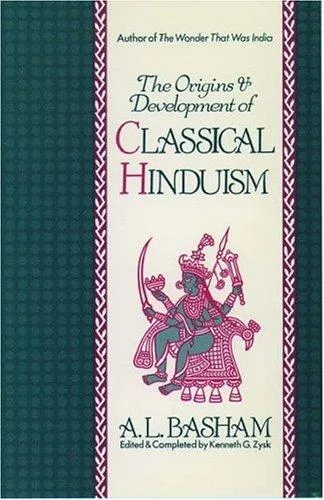
The origins and development of classical Hinduism
 77
77

The origins and development of classical Hinduism
Basham's examination of classical Hinduism is a sober, scholarly affair, eschewing the mystical pronouncements so often found in esoteric libraries. He anchors his narrative in textual evidence and archaeological findings, charting the transition from the hymns of the Rigveda to the philosophical dialogues of the Upanishads. The strength lies in its comprehensive survey and clear exposition of complex ideas like karma and dharma. However, the work's focus is decidedly historical and anthropological, which may leave readers seeking direct spiritual instruction wanting. A passage detailing the development of the concept of Brahman, for instance, is intellectually rigorous but lacks the evocative language some might expect from an esoteric text. Ultimately, it offers a robust historical framework for understanding a major world religion.
📝 Description
77
A. L. Basham's 1989 book traces Hinduism from Vedic roots to its classical forms.
First published in 1989, A. L. Basham's work examines the evolution of Hindu religious and philosophical thought. It begins with the earliest Vedic traditions and moves through the classical period, detailing the formation of major deities, the practices of ritual, and the rise of distinct philosophical schools. Basham's approach synthesizes decades of Indological scholarship, engaging with contemporary analyses of ancient Indian society and religion. This contrasts with earlier, more mythologically focused studies.
The book covers the period from Indo-Aryan migrations and the Rigveda around 1500 BCE, through the development of Vedic ritual (yajña) and its early pantheon. It then moves to the Gupta Empire (c. 320–550 CE), a time when Hinduism became more systematized with the consolidation of the Puranic tradition and philosophical ideas in the Upanishads and Bhagavad Gita.
This book situates classical Hinduism within a long historical development, tracing the transition from early Vedic practices to the philosophical and ritual systems that defined the tradition for centuries. It acknowledges the foundational role of texts like the Upanishads and the Bhagavad Gita, which contain deep philosophical insights and meditative practices central to later Hindu thought. By examining the historical formation of these elements, Basham's work provides context for understanding the esoteric dimensions that emerged and evolved within Hinduism.
💡 Why Read This Book?
• Gain a concrete understanding of the historical development of the concept of Brahman, tracing its origins from Vedic thought through the Upanishadic period, providing a foundation for later philosophical interpretations. • Learn about the specific Vedic rituals like *yajña* and their evolution, understanding their significance beyond mere ceremony and their role in shaping early Hindu cosmology. • Grasp the historical context of the Bhagavad Gita's composition, allowing for a more informed appreciation of its philosophical dialogues on dharma, karma, and devotion.
⭐ Reader Reviews
Honest opinions from readers who have explored this book.
❓ Frequently Asked Questions
When was the Rigveda composed, and what is its significance in classical Hinduism?
The Rigveda is estimated to have been composed around 1500 BCE. It is the oldest scripture of Hinduism and contains hymns dedicated to various deities, forming the bedrock of Vedic religion and early Hindu cosmology.
What is the role of the Upanishads in the development of Hindu thought?
The Upanishads, composed later than the Rigveda, represent a philosophical shift. They explore concepts like Brahman (ultimate reality) and Atman (the self), moving towards more abstract and metaphysical discussions that profoundly influenced later Hindu philosophy.
How does Basham explain the concept of karma?
Basham details karma as a principle of cause and effect, intrinsically linked to the cycle of rebirth (samsara). He explains how actions, driven by intention, determine future consequences across lifetimes, a central tenet of Hindu ethics and soteriology.
What historical period does 'classical Hinduism' primarily refer to in this book?
Classical Hinduism, as presented by Basham, generally encompasses the period from the later Vedic age through the Gupta Empire (roughly 500 BCE to 500 CE), a time marked by the codification of laws, the flourishing of philosophical schools, and the development of Puranic literature.
Does the book discuss the caste system's origins?
Yes, Basham's work addresses the origins and development of the varna system, linking it to Vedic society and later social stratification, explaining its theoretical underpinnings and practical implications within the evolving Hindu social order.
What is the significance of the Bhagavad Gita according to Basham?
Basham highlights the Bhagavad Gita as a pivotal text synthesizing earlier Vedic traditions with emerging philosophical and devotional elements. He emphasizes its discourse on dharma, selfless action (karma yoga), and the nature of the divine as Krishna.
🔮 Key Themes & Symbolism
Vedic Foundations
The work meticulously reconstructs the religious field of the Vedic period, focusing on the hymns of the Rigveda. It details the pantheon of early deities like Indra and Agni and the central role of ritual sacrifice (*yajña*) in maintaining cosmic order and appeasing the gods. Basham highlights how these early practices and beliefs laid the groundwork for subsequent developments, emphasizing the continuity and transformation of religious expression across centuries.
The Upanishadic Synthesis
A significant portion of the book is dedicated to the philosophical insights of the Upanishads. Basham explains the emergence of abstract concepts such as Brahman (the ultimate reality) and Atman (the soul or self), and their profound relationship. This section explores the shift from ritualistic focus to metaphysical inquiry, detailing the development of key doctrines like reincarnation (samsara) and liberation (moksha), which became central to Hindu soteriology.
Deities and Puranic Traditions
The development and systematization of Hindu deities are examined, particularly the Trimurti (Brahma, Vishnu, Shiva) and the rise of Puranic literature. Basham traces how these figures and their associated myths and narratives became central to popular worship and religious practice. The book illustrates the integration of diverse local cults and traditions into a more unified, pan-Indian religious framework.
Dharma and Law
Basham analyzes the concept of *dharma* not merely as religious duty but as a comprehensive system of law, social order, and ethical conduct. He discusses the influence of texts like the *Manusmriti* in codifying social norms, the varna system, and the principles governing personal and societal responsibilities, demonstrating how *dharma* provided a framework for life within classical Hindu society.
💬 Memorable Quotes
Direct passages from the work, attributed to the author.
“The earliest Indian literature which has survived is the Rigveda”
— This statement anchors the historical study of Hinduism to its earliest textual evidence, emphasizing the Rigveda's foundational status for understanding subsequent religious and philosophical evolution in ancient India.
“Brahman is the ultimate reality, and Atman is the individual soul”
— This succinctly captures the core metaphysical insight of the Upanishads, highlighting the profound philosophical exploration of the relationship between the universal essence and the individual consciousness in Hindu thought.
“Karma is the law of cause and effect”
— This defines the fundamental principle of karma, explaining its role in shaping an individual's destiny across lifetimes and its ethical implications within the framework of Hindu cosmology and rebirth.
“The Bhagavad Gita is a synthesis of various religious and philosophical traditions”
— This interpretation underscores the Bhagavad Gita's importance as a text that harmonized earlier Vedic ideas with devotionalism and Sankhya and Vedanta philosophies, presenting a comprehensive spiritual path.
💡 Key Ideas
Editorial paraphrase of the work's core concepts — not direct quotes.
Dharma is the ethical and social order
This paraphrased concept emphasizes *dharma* as more than just religious duty; it encompasses the moral, legal, and social fabric that structured ancient Indian society and guided individual conduct.
🌙 Esoteric Significance
Tradition
While primarily a work of historical scholarship, Basham's exploration of classical Hinduism provides essential context for various esoteric traditions that draw upon its cosmology and philosophy. Its detailed examination of Vedic rituals, Upanishadic metaphysics, and the Bhagavad Gita's yogic teachings informs Western esoteric lineages like Theosophy and certain branches of modern occultism that seek to understand the roots of Eastern spiritual practices and philosophies.
Symbolism
The book implicitly engages with potent symbols that resonate esoterically. The concept of *Om*, the primordial sound, represents the ultimate reality (Brahman) and serves as a potent meditative focus. The cyclical nature of *samsara* (rebirth) and the goal of *moksha* (liberation) provide a framework for understanding spiritual evolution and transcendence, concepts central to many esoteric paths seeking release from material limitations.
Modern Relevance
Contemporary practitioners of yoga and Vedanta, as well as scholars of comparative religion, continue to rely on Basham's work for its clarity and historical rigor. His analysis of karma, dharma, and the philosophical underpinnings of Hindu practice provides a crucial reference point for understanding how these ancient concepts are interpreted and applied in modern spiritual movements and New Age philosophies seeking ancient wisdom.
👥 Who Should Read This Book
• Students of comparative religion and ancient history seeking a scholarly yet accessible overview of Hinduism's formative centuries. • Individuals interested in the philosophical underpinnings of concepts like karma, dharma, and Brahman, wanting to understand their historical development. • Practitioners of yoga or meditation looking to contextualize their practice within the broader historical and philosophical landscape from which these disciplines emerged.
📜 Historical Context
A. L. Basham’s key work emerged in 1989, synthesizing decades of Indological research. It engaged with the intellectual currents of the mid-20th century, which sought to move beyond purely colonial or Orientalist interpretations of Indian culture and religion. The book built upon the foundational scholarship of figures like Sir William Jones and later Indologists while offering a more nuanced social and historical perspective. Basham's approach provided a vital counterpoint to purely devotional or mythological accounts, grounding the development of Hinduism in archaeological evidence and textual analysis. The period saw considerable academic debate regarding the Aryan invasion theory and the dating of key texts, areas where Basham offered carefully considered conclusions, positioning his work within the ongoing scholarly conversation.
📔 Journal Prompts
The evolution of Brahman and Atman: trace your own understanding.
Vedic *yajña*: Reflect on the purpose of ancient rituals.
The concept of *dharma*: How does it manifest in your life?
The Bhagavad Gita's synthesis: What insights did you gain?
The cycle of *samsara*: Consider its implications beyond rebirth.
🗂️ Glossary
Rigveda
One of the oldest sacred texts of Hinduism, a collection of hymns dedicated to various deities, forming the foundation of Vedic religion.
Upanishads
Philosophical texts that form the culmination of Vedic scripture, exploring concepts like Brahman, Atman, karma, and moksha.
Brahman
The ultimate, unchanging reality or cosmic spirit in Hindu philosophy, the source and sustainer of all existence.
Atman
The individual soul or self, often considered to be identical with Brahman in Advaita Vedanta philosophy.
Karma
The principle of cause and effect; actions and their consequences that determine an individual's fate in this life and future lives.
Samsara
The continuous cycle of birth, death, and rebirth, driven by karma and desire, from which liberation (moksha) is sought.
Dharma
One's duty, righteousness, moral law, and the underlying order of the universe; a fundamental concept in Hinduism.
🔮 Readers Also Liked
Browse all →







More Free Occult Philosophy Books
View all →