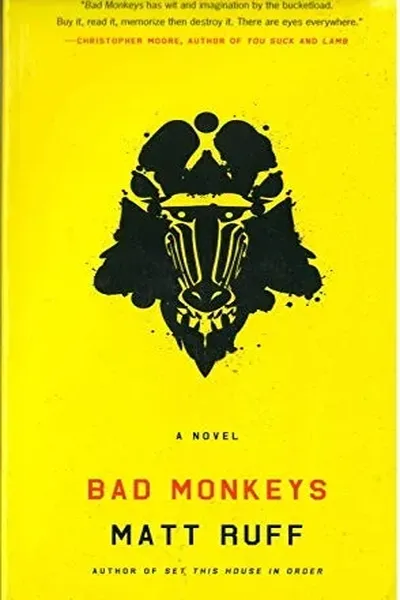
Bad Monkeys

 77
77

Bad Monkeys
Matt Ruff's "Bad Monkeys" is a novel that thrives on its audacious premise and unsettling atmosphere. The central conceit of a secret organization that eliminates threats before they materialize, often through extreme measures, is a potent one. Ruff excels at depicting the psychological toll such work takes on its operatives, particularly protagonist Jane. The narrative’s strength lies in its relentless pacing and its ability to constantly reframe the reader's understanding of who the real villains are. However, the novel occasionally falters under the weight of its own complexity. The intricate plot, while engaging, can sometimes feel convoluted, and certain character motivations, particularly in the latter half, could benefit from clearer articulation. A passage detailing the organization's "pre-crime" evaluations, where potential future harms are weighed against immediate ethical costs, vividly encapsulates the book's moral tightrope walk. Ultimately, "Bad Monkeys" is a compelling, if occasionally dense, exploration of radical utilitarianism and the human cost of maintaining order.
📝 Description
77
Matt Ruff's 2008 novel, "Bad Monkeys," follows an operative targeted by her own clandestine organization.
The novel centers on Jane, a member of a secret group that intervenes to prevent disasters. Her work, however, draws the attention of internal affairs, forcing her to confront the organization's methods and her own role within it. Ruff constructs a narrative that questions the definition of good and evil, especially when the stakes are existential.
The story unfolds with a focus on Jane's perspective as she navigates the investigation. The organization's actions often involve morally compromised choices, blurring the lines between what is right and what is necessary. Readers will find themselves questioning the cost of security and the nature of heroism when faced with extreme circumstances. The plot is built around moral ambiguity and the consequences of wielding hidden power.
Published in 2008, "Bad Monkeys" touches on themes of hidden powers and societal manipulation that resonated during a period of increasing public concern over information control and covert operations. The novel's exploration of pre-crime intervention and the justification of morally questionable acts for a perceived greater good aligns with discussions found in certain occult traditions concerning cosmic balance and the difficult choices made by those who perceive a larger reality.
💡 Why Read This Book?
• Understand the philosophical implications of pre-emptive action, as explored through the "necessary evil" paradox that drives the clandestine organization's operations. • Experience a narrative that dissects the nature of heroism and villainy, prompting reflection on how societal structures define good and evil. • Grasp the psychological impact of morally ambiguous work, exemplified by Jane's personal struggles within the clandestine agency.
⭐ Reader Reviews
Honest opinions from readers who have explored this book.
❓ Frequently Asked Questions
What is the primary organization in 'Bad Monkeys' and what is its purpose?
The primary organization is a clandestine group tasked with preventing catastrophic events by eliminating potential threats. Their methods often involve morally ambiguous actions, focusing on a utilitarian approach to global security.
Who is the main protagonist of 'Bad Monkeys' and what is her central conflict?
The main protagonist is Jane, an operative within the clandestine organization. Her central conflict arises when she becomes the subject of an internal investigation, forcing her to confront the agency's secrets and her own role within it.
What philosophical concepts does 'Bad Monkeys' explore?
The novel explores concepts like utilitarianism, the nature of good versus evil, free will versus determinism, and the psychological toll of performing morally questionable acts for a perceived greater good.
When was 'Bad Monkeys' by Matt Ruff originally published?
Matt Ruff's novel 'Bad Monkeys' was first published in 2008, placing it within a period of growing interest in speculative fiction that engaged with darker themes and complex societal issues.
Does 'Bad Monkeys' involve elements of science fiction or supernatural occurrences?
While grounded in a speculative premise, 'Bad Monkeys' primarily focuses on the psychological and ethical dimensions of its clandestine organization rather than overt science fiction or supernatural elements, though the organization's capabilities blur these lines.
What is the tone of 'Bad Monkeys'?
The tone of 'Bad Monkeys' is generally dark, suspenseful, and psychologically intense. It delves into morally ambiguous territory and explores the unsettling aspects of covert operations and the nature of justice.
🔮 Key Themes & Symbolism
The Utility of Evil
The novel confronts the unsettling idea that horrific acts can be justified if they prevent even greater suffering. The clandestine organization operates on a radical utilitarian calculus, where the elimination of individuals is deemed acceptable to avert mass casualties. This theme forces readers to question the absolute nature of morality and whether a utilitarian framework, however extreme, can ever truly align with humanistic values. The narrative scrutinizes the psychological impact on those who enact such policies, highlighting the corrosive effect of justifying 'necessary evils'.
Subjectivity of Morality
Ruff challenges conventional notions of heroes and villains by presenting characters who operate in a profound moral gray zone. The operatives of the organization believe they are doing good, yet their methods are undeniably cruel. The narrative consistently shifts perspectives, revealing how each character's understanding of right and wrong is shaped by their experiences and their perceived role in a larger, often inscrutable, agenda. This exploration suggests that moral judgments are not absolute but are contingent upon context and individual interpretation.
Determinism vs. Free Will
The organization's mission to prevent future catastrophes inherently questions the extent of human agency. By intervening in events before they occur, they operate under the assumption that outcomes can be controlled and predetermined. However, the narrative also probes the idea that even within a seemingly controlled system, individual choices and unpredictable factors can alter destiny. The protagonist's journey, in particular, becomes a struggle against perceived predestination and an assertion of personal autonomy.
The Price of Order
Maintaining global order, as depicted in 'Bad Monkeys,' comes at a steep price, not just in terms of lives lost but also in the psychological and ethical compromise of those responsible. The book illustrates that the pursuit of absolute safety can lead to authoritarian control and the erosion of fundamental human rights. It questions whether a society that sacrifices its ethical principles for security is truly worth saving, and what constitutes an acceptable cost for peace.
💬 Memorable Quotes
Direct passages from the work, attributed to the author.
“We’re not the bad guys. We’re the ones who stop the bad guys.”
— This statement reflects the self-justification employed by the organization's members. It highlights the blurred lines between protector and perpetrator, where the definition of 'bad guy' becomes fluid and subjective based on one's role and perceived mission.
“Everyone’s a threat to someone.”
— This cynical observation underscores the pervasive paranoia and distrust that fuels the organization's operations. It suggests that in a world of potential dangers, everyone carries the risk of becoming a threat, justifying constant vigilance and preemptive action.
“The only way to win is to play the game.”
— This aphorism speaks to the feeling of being trapped within a system. For the characters, it implies that escaping the organization's influence or the cycle of violence is impossible, and survival depends on adhering to its rules, however abhorrent.
💡 Key Ideas
Editorial paraphrase of the work's core concepts — not direct quotes.
The universe is not a benevolent place. It doesn't care about us. We have to take care of ourselves.
This quote expresses the bleak, survivalist worldview that underpins the clandestine organization's actions. It suggests a cosmic indifference, necessitating human intervention to impose order and prevent chaos, even through harsh means.
Sometimes you have to do terrible things to prevent worse things from happening.
This paraphrased concept captures the core ethical dilemma of the novel: the justification of 'necessary evil.' It frames the organization's extreme actions as a pragmatic, albeit morally compromising, response to perceived existential threats.
🌙 Esoteric Significance
Tradition
While not explicitly tied to a single esoteric lineage, "Bad Monkeys" engages with Gnostic and Hermetic themes of hidden knowledge, duality, and the manipulation of the material world by unseen forces. The clandestine organization's pursuit of a 'higher' good through morally compromised means echoes Gnostic ideas of a flawed demiurge or a hidden divine plan operating outside conventional morality. The idea of operatives acting as agents of fate or cosmic balance aligns with Hermetic principles of correspondence and the hidden order of the universe.
Symbolism
The concept of the "monkey" itself serves as a motif, perhaps symbolizing primal instincts, chaos, or the unpredictable elements that the organization seeks to control. The organization's internal structure and classification systems can be seen as attempts to impose order and categorization onto a fundamentally chaotic reality, reflecting a Hermetic desire to understand and master the universe through knowledge and classification. The blurred lines between operative and target, or good and evil, symbolize the Gnostic concept of the interconnectedness of all things, even opposing forces.
Modern Relevance
Contemporary discussions surrounding intelligence agencies, preemptive warfare, and the ethics of surveillance echo the core conflicts in "Bad Monkeys." Thinkers and practitioners interested in applied ethics within security contexts, or those exploring fictional representations of cosmic or societal control mechanisms, find relevance in Ruff's work. It serves as a cautionary tale and a thought experiment for modern discussions on the balance between security and liberty, and the potential for even well-intentioned power to corrupt.
👥 Who Should Read This Book
• Fans of philosophical thrillers who enjoy narratives that dissect complex ethical dilemmas and question the nature of good and evil. • Readers interested in secret societies and conspiracy narratives that explore the hidden mechanisms of power and control in the world. • Those who appreciate dark, psychological fiction that looks at the mental and emotional toll of morally ambiguous actions taken for a perceived greater good.
📜 Historical Context
Published in 2008, Matt Ruff's "Bad Monkeys" arrived in a cultural landscape increasingly preoccupied with security, surveillance, and the ethics of covert operations, themes amplified by the post-9/11 world. The novel taps into a broader literary trend of exploring morally ambiguous protagonists and clandestine organizations, a lineage that includes works like John le Carré's espionage thrillers or even earlier dystopian narratives. While not directly engaging with specific esoteric movements, its exploration of hidden powers and societal manipulation appeals to anxieties about control and hidden agendas that became more pronounced with the rise of the internet. The reception of such works often reflected a public fascination with the idea of secret forces shaping world events, a fascination that has persisted through various political and social upheavals.
📔 Journal Prompts
The organization's justification for 'necessary evils': analyze the ethical framework presented.
Jane's internal conflict: explore the tension between duty and personal morality.
Reflect on the portrayal of 'control' versus 'chaos' by the clandestine group.
The subjective nature of heroism and villainy in the narrative.
Consider the concept of pre-crime and its implications for free will.
🗂️ Glossary
Clandestine Organization
A secret group operating outside official channels, often with covert objectives and methods. In "Bad Monkeys," this organization intervenes to prevent catastrophic events.
Necessary Evil
The concept that morally reprehensible actions may be justified if they prevent a greater harm or achieve a significant good. This is a central ethical theme in the novel.
Utilitarianism
A philosophical approach where the morality of an action is judged by its outcome, aiming for the greatest good for the greatest number. The organization's logic often leans towards this principle.
Pre-Crime
An action or intervention taken to prevent a crime or disaster before it occurs. The novel explores the ethical implications of such preemptive measures.
Operative
An individual who works for a secret organization, often performing clandestine tasks. Jane is an operative within the novel's central group.
Moral Ambiguity
Situations or characters where the lines between right and wrong are unclear or contested. The novel is characterized by its pervasive moral ambiguity.
Existential Threat
A danger that poses a risk to the survival or fundamental existence of a group, society, or humanity. The organization's purpose is to counter these threats.
🔮 Readers Also Liked
Browse all →








More by Matt Ruff
All books →
More Free Occult Philosophy Books
View all →