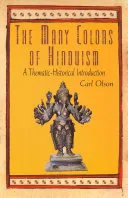
The Many Colors of Hinduism
 75
75

The Many Colors of Hinduism
Carl Olson’s "The Many Colors of Hinduism" endeavors to present a balanced perspective on a religion often misunderstood or oversimplified in Western discourse. Its primary strength lies in its thematic-historical approach, which successfully illustrates the multiplicity of beliefs and practices within Hinduism, a point made effectively when discussing the varied interpretations of divine figures. The work draws on an impressive range of sources, from ancient texts to contemporary anthropological studies, providing a solid foundation for its arguments. However, the sheer scope occasionally leads to a somewhat encyclopedic feel, where depth might be sacrificed for breadth. For instance, the section on the Upanishads, while informative, could benefit from more extended textual exegesis. Olson demonstrates a clear command of the subject matter, synthesizing complex ideas for a general audience. It is a valuable resource for those seeking an introductory overview that respects the internal diversity of Hinduism.
📝 Description
75
Carl Olson's 2007 book examines Hinduism's diversity, moving past simple descriptions.
Carl Olson's "The Many Colors of Hinduism" surveys this ancient religious tradition, embracing its inherent diversity and contradictions. The book uses a thematic-historical approach, combining textual analysis with anthropological fieldwork and scholarly discussion. It is written for students and general readers who want a deeper understanding of Hinduism, as well as those interested in comparative religion, cultural studies, and the philosophical basis of spiritual paths. Scholars of religious studies will find Olson's integration of various sources useful for understanding the wide scope of Hindu thought and practice.
Olson places Hinduism within its extensive historical development over millennia. The text covers classical Hinduism, the Bhakti movement's effect, and how colonial encounters shaped its modern forms. It also references the scholarly conversations about Hindu studies, mentioning important figures and disagreements in the field. The book systematically looks at fundamental Hindu ideas like dharma, karma, moksha, and the different gods and goddesses. It discusses philosophical systems such as Vedanta and Yoga, alongside devotional practices and social organization. Olson emphasizes the connection between religious texts and actual religious life, showing how Hindu traditions change over time.
While not strictly an esoteric text itself, "The Many Colors of Hinduism" addresses themes that resonate with esoteric traditions. It acknowledges the diverse philosophical schools within Hinduism, some of which have influenced or run parallel to esoteric thought globally. The book's focus on concepts like moksha (liberation) and the varied paths to spiritual realization can be of interest to those studying comparative mysticism or the philosophical underpinnings of traditions that explore inner spiritual journeys.
💡 Why Read This Book?
• Gain a foundational understanding of key Hindu concepts like dharma and karma, informed by Olson's synthesis of ancient texts and modern scholarship, allowing for a more accurate apprehension of ethical frameworks. • Appreciate the historical evolution of Hindu traditions, from early Vedic periods to the influence of figures like Adi Shankara, providing context for contemporary practices. • Understand the diverse devotional practices and theological interpretations, moving beyond monolithic views to recognize the spectrum of belief exemplified by the contrasting approaches to deities.
⭐ Reader Reviews
Honest opinions from readers who have explored this book.
❓ Frequently Asked Questions
When was Carl Olson's "The Many Colors of Hinduism" first published?
The book "The Many Colors of Hinduism" by Carl Olson was first published in 2007, offering a comprehensive overview of the religion.
What approach does Olson use to discuss Hinduism?
Olson utilizes a thematic-historical approach, integrating textual evidence, anthropological fieldwork, and scholarly voices to present a balanced view of Hinduism's diverse aspects.
Does the book cover the main deities of Hinduism?
Yes, the book explores the diverse pantheon of Hindu deities, examining various interpretations and devotional practices associated with them.
Who are some scholars mentioned in "The Many Colors of Hinduism"?
The work references scholars such as Indologist Alf Hiltebeitel and Cambridge scholar Julius Lipner, among others, to support its analysis.
What are some core philosophical concepts discussed?
Key philosophical concepts like dharma, karma, and moksha are systematically explored, alongside different schools of thought such as Vedanta and Yoga.
Is the book suitable for beginners in religious studies?
Absolutely. It serves as an excellent introductory text for students and general readers new to Hinduism, providing a nuanced and accessible overview.
🔮 Key Themes & Symbolism
The Divine Spectrum
Olson examines the vast array of deities within Hinduism, from the prominent Trimurti of Brahma, Vishnu, and Shiva to goddesses like Durga and Lakshmi. The work highlights how these figures are understood through different philosophical lenses and devotional practices, illustrating the spectrum of divine manifestation and worship. It moves beyond a monolithic view, showcasing the personal and regional variations in the veneration of specific deities, a key aspect of Hinduism's colorful expression.
Dharma and Karma Frameworks
Central to Olson's analysis are the concepts of dharma (righteous duty, cosmic order) and karma (action and consequence). The book explores how these principles shape individual lives and the broader social fabric across different Hindu traditions. It discusses the complexities of interpreting dharma in various contexts, from personal ethics to societal roles, and the intricate workings of karma as a mechanism for spiritual evolution and rebirth, providing an ethical bedrock.
Paths to Liberation
The text investigates the various paths (margas) leading to moksha, or liberation from the cycle of birth and death (samsara). Olson details the philosophical underpinnings and practical methodologies of major traditions like Jnana Yoga (the path of knowledge), Bhakti Yoga (the path of devotion), and Karma Yoga (the path of selfless action). This exploration reveals the diverse spiritual aspirations and the goal of transcending worldly existence.
Textual and Experiential Synthesis
Olson emphasizes the interplay between authoritative scriptures (like the Vedas and Upanishads) and lived religious experience. The book demonstrates how anthropological fieldwork and insider accounts enrich the understanding of textual doctrines. This synthesis highlights that Hinduism is not solely defined by ancient texts but is a dynamic, evolving tradition shaped by the practices and interpretations of its followers over centuries.
💬 Memorable Quotes
Direct passages from the work, attributed to the author.
“The work acknowledges competing and even contradictory aspects of Hinduism.”
— This statement underscores Olson's commitment to presenting a many-sided and realistic portrayal of Hinduism, avoiding oversimplification and embracing its inherent internal diversity and tensions.
“Utilizing a thematic-historical approach.”
— This signifies the book's methodological foundation, combining an examination of recurring themes with an understanding of how these themes have evolved across different historical periods within Hinduism.
“Drawing on textual evidence, anthropological fieldwork, and scholarly voices.”
— This highlights the comprehensive research strategy employed, integrating classical sources, empirical studies of contemporary practices, and academic interpretations to build a robust picture of the religion.
“A balanced view of this rich religious tradition.”
— This points to the book's objective: to provide an introductory overview that respects the complexity and depth of Hinduism without bias or undue focus on any single aspect.
“The result is a narrative approach.”
— This suggests that Olson presents the information in a flowing, story-like manner, making the complex subject of Hinduism more accessible and engaging for the reader.
🌙 Esoteric Significance
Tradition
While not strictly adhering to a single Western esoteric lineage like Theosophy or Hermeticism, Olson's work provides foundational knowledge essential for those studying Eastern esoteric traditions. It serves as a crucial bridge, offering the necessary context for understanding the philosophical and spiritual concepts that inform many Western esoteric practices. The book's emphasis on diverse paths to liberation and the nature of consciousness aligns with perennialist philosophies often explored within esoteric circles.
Symbolism
The multiplicity of deities in Hinduism, such as Shiva as the destroyer and transformer or Vishnu as the preserver, serves as potent symbolic representations of cosmic forces and psychological archetypes. The concept of Samsara, the cycle of birth, death, and rebirth, acts as a symbolic framework for understanding spiritual evolution and the human condition. The Om (Aum) symbol, representing the primordial sound and the essence of the universe, is a core motif discussed in relation to meditation and spiritual realization.
Modern Relevance
Contemporary Western practitioners of yoga and meditation often draw implicitly or explicitly on the concepts detailed in Olson's book. Thinkers exploring consciousness studies, comparative mysticism, and integral spirituality frequently reference the philosophical depth found in Hindu traditions. The book's nuanced approach is relevant to modern interfaith dialogue and the ongoing effort to understand diverse spiritual perspectives in an interconnected world.
👥 Who Should Read This Book
• Students of comparative religion seeking a comprehensive and balanced introduction to one of the world's major religious traditions, benefiting from Olson's thematic-historical methodology. • Individuals interested in Eastern philosophies and spiritual practices who require a clear exposition of concepts like dharma, karma, and moksha, grounded in both text and practice. • Scholars and researchers in religious studies looking for a synthesized overview that incorporates diverse scholarly voices and anthropological insights into Hinduism.
📜 Historical Context
Published in 2007, "The Many Colors of Hinduism" emerged during a period of heightened global interest in Eastern religions, yet also when scholarly discourse on Hinduism was increasingly specialized. Olson's work aimed to bridge this gap, offering an accessible yet rigorous introduction. It arrived at a time when comparative religion studies were grappling with post-colonial critiques and the need to represent non-Western traditions authentically. The book consciously engaged with the legacy of Indology, referencing scholars like Alf Hiltebeitel, while also incorporating anthropological perspectives that provided a counterpoint to purely textual analysis. This approach countered more simplistic or orientalist interpretations prevalent in earlier Western scholarship. While no specific censorship events are noted, the reception likely involved academic peers evaluating its synthesis against established works and contemporary debates within religious studies.
📔 Journal Prompts
The concept of dharma as presented by Olson, and its application across different contexts.
Reflecting on the symbolic meanings of the Trimurti (Brahma, Vishnu, Shiva) within Hindu cosmology.
Exploring the various paths to moksha discussed in the text, such as Jnana Yoga and Bhakti Yoga.
The role of anthropological fieldwork in understanding Hindu lived religion, as highlighted by Olson.
Comparing the textual interpretations of deities with their devotional significance in practice.
🗂️ Glossary
Dharma
In Hinduism, a many-sided concept encompassing duty, righteousness, cosmic law, social order, and the inherent nature of things. It guides ethical conduct and spiritual progression.
Karma
The principle of cause and effect, where actions (karma) in this life and past lives influence future experiences and determine the cycle of rebirth (samsara).
Moksha
Liberation from the cycle of birth, death, and rebirth (samsara). It is the ultimate spiritual goal in many Hindu traditions, often understood as union with the divine or realization of ultimate reality.
Samsara
The continuous cycle of birth, death, and reincarnation, driven by karma. Transcending samsara is the primary aim of spiritual liberation (moksha).
Vedanta
A major school of Hindu philosophy that focuses on the Upanishads as its primary source. It explores the nature of reality, the self (Atman), and the relationship between the individual soul and the ultimate reality (Brahman).
Bhakti Yoga
The path of devotion, characterized by intense love and surrender to a personal deity. It is one of the major spiritual disciplines for achieving liberation in Hinduism.
Upanishads
Ancient Sanskrit texts that form the core philosophical basis of Hinduism. They contain foundational concepts of Vedanta, such as Brahman and Atman.