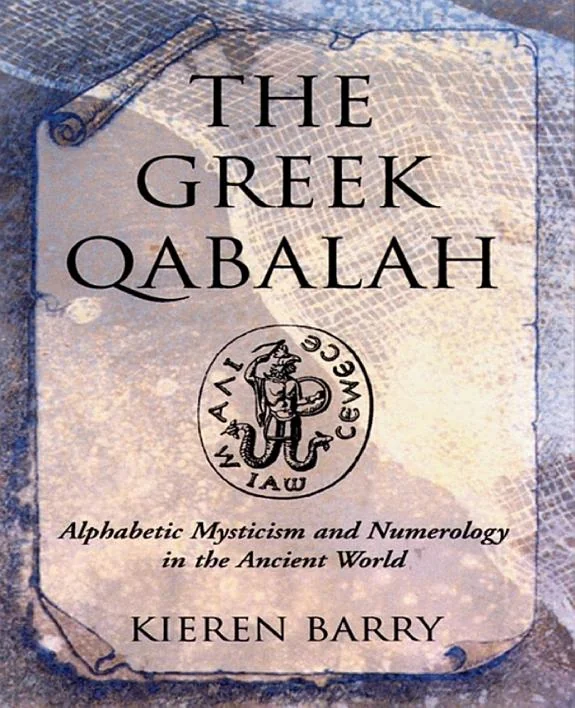
The Greek Qabalah
 75
75

The Greek Qabalah
Kieren Barry's The Greek Qabalah is a rigorously researched volume that meticulously lays the groundwork for understanding gematria within the Hellenistic linguistic context. Its strength lies in the sheer volume of data presented in the appendices, particularly the numeric dictionary of Greek words, which is an unparalleled resource. Barry avoids speculative leaps, grounding his analysis in textual evidence and historical context, making it an authoritative reference. However, the book's academic density, while a virtue for scholars, might present a barrier for the casual practitioner seeking immediate practical applications. The discussion on the philosophical implications of Greek gematria is thorough but sometimes feels constrained by the sheer weight of enumeration. For instance, the way Barry analyzes the numerical value of 'Logos' (λόγος) through its Greek letters demonstrates the potential for deep symbolic exegesis. The Greek Qabalah stands as an indispensable, albeit demanding, scholarly contribution to the study of esoteric numerical systems.
📝 Description
75
Kieren Barry's 1999 book, The Greek Qabalah, examines numerical systems in the Greek language.
Published in 1999, The Greek Qabalah by Kieren Barry investigates the numerological and symbolic potential within the Greek alphabet, drawing comparisons to the Hebrew Qabalah. The book meticulously details how assigning numerical values to Greek letters can reveal deeper meanings in ancient texts and philosophical ideas. Barry establishes a framework for understanding Greek gematria, a practice less frequently studied than its Hebrew counterpart. This work is structured to serve as both an academic reference and a practical manual for individuals interested in the numerical foundations of Western esotericism.
This text appeals to a broad audience. Students of classical philosophy, ancient history, and early Christian studies will discover relevant connections. Those involved with Qabalistic practices, ceremonial magic, and comparative religion will find its analysis of a less-explored esoteric system beneficial. Researchers looking for a detailed resource on Greek gematria and alphabetic symbolism will value its extensive notes and appendices. It is suited for readers who engage with esoteric studies from an analytical and historical viewpoint.
Barry's study appeared in 1999, a time when interest in Western esoteric traditions was growing. This period followed substantial 20th-century scholarship on Kabbalah and Hermeticism, with a rising fascination for the links between religion, philosophy, and mysticism. While Jewish Kabbalah had been thoroughly documented by scholars like Gershom Scholem, the systematic application of gematria to Greek texts was less developed. Barry's book aimed to address this gap, offering a rigorous academic study with practical applications.
💡 Why Read This Book?
• Gain a comprehensive understanding of Greek gematria, a system often overshadowed by its Hebrew counterpart, by exploring its numerical values and symbolic correspondences as detailed in the appendices. • Discover how ancient Greek philosophy and early Christian texts can be re-examined through a numerological lens, offering novel interpretations of concepts like 'Logos' (λόγος). • Access an unparalleled reference tool with the numeric dictionary of Greek words, providing a vast collection of gematric data for scholarly research or personal esoteric practice.
⭐ Reader Reviews
Honest opinions from readers who have explored this book.
❓ Frequently Asked Questions
What is Greek Qabalah and how does it differ from Hebrew Qabalah?
Greek Qabalah applies gematria, the practice of assigning numerical values to letters, to the Greek alphabet. Unlike Hebrew Qabalah, which uses the Hebrew alphabet, this system unlocks symbolic meanings and numerical connections within Greek texts and concepts.
Who was Kieren Barry and what is his background?
Kieren Barry is an author known for his work on esoteric subjects, particularly focusing on the intersection of ancient languages and mystical traditions. His academic approach grounds his explorations of subjects like the Greek Qabalah.
What kind of texts can be analyzed using Greek Qabalah?
Texts from ancient Greek philosophy, early Christian writings, Hellenistic mystical traditions, and any work written in Greek can potentially be analyzed. The book provides tools to explore their numerical and symbolic dimensions.
Are there practical applications for the Greek Qabalah system discussed in the book?
Yes, the book is of interest to modern magicians and practitioners of esoteric arts who can use the gematric dictionary and symbolic tables for ritual, divination, and deeper textual understanding.
What is included in the appendices of The Greek Qabalah?
The appendices feature tables of alphabetic symbolism, a list of relevant authors, and a substantial numeric dictionary of Greek words, forming the largest collection of Greek gematria in print at the time of its publication.
When was The Greek Qabalah first published?
The Greek Qabalah by Kieren Barry was first published on January 15, 1999, making it a significant contribution to esoteric studies in the late 20th century.
🔮 Key Themes & Symbolism
Greek Gematria System
The central theme is the systematic application of gematria to the Greek alphabet. This involves assigning numerical values to each Greek letter (Alpha=1, Beta=2, etc.) and exploring the resulting numerical correlations within words, phrases, and concepts. Barry demonstrates how this method can reveal hidden layers of meaning in philosophical texts, religious scriptures, and mystical writings, providing a parallel system to the more widely known Hebrew gematria.
Alphabetic Symbolism
Beyond mere numerical equivalence, the book examines the inherent symbolic qualities of the Greek letters themselves. Each letter, in its form and position within the alphabet, carries its own archetypal meaning. The Greek Qabalah explores how these symbolic meanings are amplified or interconnected when viewed through the lens of their numerical values, offering a dual approach to understanding linguistic mysticism.
Comparative Esotericism
A significant aspect is the comparison and connection drawn between Greek esoteric traditions and the Hebrew Qabalah. Barry positions Greek gematria not as an isolated phenomenon but as part of a broader Western esoteric heritage. The work seeks to integrate insights from Hellenistic philosophy, Pythagoreanism, and early Christian symbolism with established Qabalistic frameworks.
Textual Interpretation
The book serves as a practical guide for interpreting ancient texts. By providing tools like the numeric dictionary and tables of symbolism, Barry empowers readers to engage with sources like the works of Plato, the New Testament, or Gnostic scriptures in a new light, uncovering numerical patterns that traditional exegesis might overlook.
💬 Memorable Quotes
Direct passages from the work, attributed to the author.
“The Greek alphabet, like the Hebrew, possesses inherent symbolic qualities tied to its numerical assignments.”
— This highlights the book's core premise: that letters are not just arbitrary symbols but possess deeper, archetypal meanings amplified by their numerical values, forming a bridge between language and the mystical.
“The numeric dictionary represents the largest collection of gematria in print.”
— This statement underscores the book's unique contribution as a comprehensive reference tool, consolidating a vast amount of Greek gematric data for scholars and practitioners alike.
“Interest extends from students of Ancient History to modern magicians.”
— This indicates the broad applicability and appeal of Greek gematria, bridging academic disciplines like history and classical studies with practical esoteric traditions and magical practices.
“Extensive notes and citations from original sources.”
— This emphasizes the scholarly rigor of the work, assuring readers of its foundation in primary materials and its utility as an authoritative reference for academic research.
💡 Key Ideas
Editorial paraphrase of the work's core concepts — not direct quotes.
The Greek Qabalah offers a framework for understanding numerical relationships in Greek language.
This paraphrased concept explains the fundamental purpose of the book: to provide a structured methodology for exploring the hidden numerical dimensions within the Greek language and its associated texts.
🌙 Esoteric Significance
Tradition
This work fits within the broader Western Esoteric Tradition, specifically engaging with the principles of Kabbalah and Hermeticism. It extends the Qabalistic method of gematria, typically associated with Hebrew, to the Greek language. By doing so, it bridges Semitic mystical frameworks with Hellenistic philosophical and linguistic traditions, offering a syncretic approach relevant to Gnosticism, Neoplatonism, and early Christian mysticism.
Symbolism
The book explores the symbolic weight of individual Greek letters (e.g., Alpha as the beginning, Omega as the end) and their numerical values. For instance, the numerical value of 'Logos' (λόγος) becomes a focal point for understanding divine utterance and cosmic order through its gematric sum. It also examines how combinations of letters and numbers reveal deeper archetypal patterns within philosophical and religious discourse.
Modern Relevance
Contemporary practitioners of Western esotericism, comparative religion scholars, and students of ancient philosophy continue to draw on Barry's work. Thinkers exploring the intersection of language, mathematics, and consciousness find its detailed analysis of Greek gematria invaluable. It informs modern magical systems that seek to integrate diverse linguistic and numerical symbolic frameworks.
👥 Who Should Read This Book
• Academic researchers in Classics, Religious Studies, and History of Esotericism seeking a comprehensive reference on Greek gematria and its historical applications. • Students of Kabbalah and Western Mysticism looking to expand their understanding beyond Hebrew gematria and explore its Hellenistic correlations. • Practitioners of ceremonial magic and occult arts interested in developing new methods of symbolic interpretation and textual analysis using numerical systems.
📜 Historical Context
Published in 1999, Kieren Barry's *The Greek Qabalah* emerged during a resurgence of interest in Western esoteric traditions. The late 20th century saw a significant academic focus on mysticism, Kabbalah, and Hermeticism, building on the foundational work of scholars like Gershom Scholem. While Hebrew Kabbalah had been extensively studied, the application of gematria to the Greek language remained a less explored territory. Barry's book aimed to systematically bridge this gap, drawing connections to Pythagorean numerology and Hellenistic philosophies prevalent during the early centuries CE. It offered a scholarly counterpoint to more speculative occult literature, grounding esoteric concepts in linguistic analysis. The work provided a valuable resource for those investigating the syncretic nature of early Christian and Gnostic thought, which often blended Hellenistic and Semitic mystical elements. Its detailed appendices also catered to practitioners seeking concrete tools for symbolic interpretation, a demand present in contemporary magical orders.
📔 Journal Prompts
The numerical value of the word 'Logos' (λόγος) and its potential symbolic implications.
The connection between Pythagorean number theory and Greek alphabetic symbolism.
How the structure of the Greek alphabet itself conveys meaning beyond numerical values.
The comparative analysis of Hebrew and Greek gematria presented in the text.
The application of Greek gematria to specific philosophical or religious texts mentioned.
🗂️ Glossary
Gematria
A method of esoteric interpretation in which letters are assigned numerical values, and numerical equivalences between words or phrases are sought to reveal hidden meanings or connections.
Greek Alphabet
The writing system used by the Greek language, consisting of 24 letters, each with a distinct phonetic value, name, and, in this context, a numerical assignment.
Numeric Dictionary
A compilation of Greek words, listed according to their numerical value derived from gematria, serving as a reference for identifying words with shared numerical signatures.
Alphabetic Symbolism
The practice of attributing symbolic meanings to individual letters of an alphabet, often based on their shape, name, or position, which is then amplified by their numerical value in gematria.
Hellenistic Period
The historical era following the conquests of Alexander the Great (c. 323 BCE) and preceding the Roman Empire (c. 31 BCE), characterized by the spread of Greek culture and philosophy throughout the Mediterranean world.
Logos
A Greek term with profound philosophical and theological meanings, often translated as 'word,' 'reason,' or 'divine plan,' central to thinkers like Heraclitus and the Gospel of John.
Esotericism
Systems of thought and practice concerned with hidden or secret knowledge, often involving mystical, spiritual, or magical elements, typically accessible only to initiated individuals.
This book appears in 1 collection
🔮 Readers Also Liked
Browse all →





From the “Qabalah” Collection
View all →







More Free Kabbalah & Jewish Mysticism Books
View all →