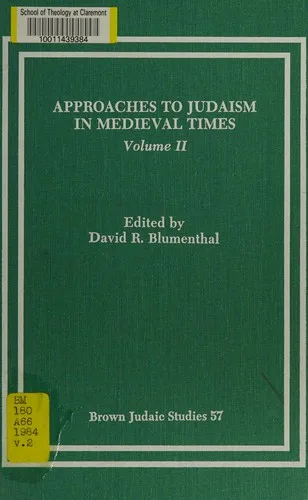
Approaches to Judaism in Medieval Times II
 62
62

Approaches to Judaism in Medieval Times II


Ophelia Vance, Mystical Literature Reviewer — "Approaches to Judaism in Medieval Times II" is an indispensable addition to the Esoteric Library. David R. Blumenthal offers an authoritative and deeply insightful exploration of medieval Jewish mysticism and philosophy. He illuminates the often-obscure pathways of Kabbalistic thought and the intellectual currents that challenged and transformed Jewish understanding. The book excels at revealing the esoteric dimensions of these traditions, making complex ideas accessible without sacrificing their depth. Its strength lies in its nuanced presentation of controversial theological dialogues and its clear demonstration of the enduring spiritual legacy. Highly recommended for serious students of mysticism and comparative religion.
📝 Description
62
David R. Blumenthal's 1988 volume collects essays on medieval Jewish thought.
This collection, edited by David R. Blumenthal, examines various intellectual currents within Judaism during the Middle Ages. It focuses on mystical traditions, philosophical arguments, and the development of esoteric thought. The book investigates how medieval Jewish thinkers grappled with understanding the divine and the universe through symbolic interpretation and theological reasoning. It includes discussions on the emergence of Kabbalistic ideas and their impact on Jewish intellectual life.
Scholars and those interested in the history of Jewish philosophy will find analyses of concepts that defined this period. The volume highlights the rigorous intellectual and spiritual efforts made by medieval Jews to connect with transcendent realities. It showcases the ways in which these thinkers sought answers to fundamental existential questions, blending philosophical inquiry with mystical yearning.
This work sits within the study of esoteric traditions in medieval Judaism, specifically tracing the development of mystical and philosophical ideas that went beyond mainstream theological discourse. It examines how thinkers engaged with hidden meanings, symbolic language, and speculative cosmology to understand the divine. The focus is on the intellectual and spiritual practices that sought a deeper, often hidden, connection to the sacred, particularly through early Kabbalistic thought.
💡 Why Read This Book?
This volume offers a gateway to the profound, often hidden, spiritual and intellectual landscapes of medieval Judaism. It is essential for anyone seeking to understand the origins and development of Kabbalah and its philosophical underpinnings. Scholars will find rigorous analysis, while practitioners and seekers will discover ancient wisdom and contemplative pathways that resonate even today. Uncover the rich symbolism and theological dialogues that continue to inform mystical traditions.
⭐ Reader Reviews
Honest opinions from readers who have explored this book.
❓ Frequently Asked Questions
What is the primary focus of this collection?
The collection focuses on the diverse philosophical and mystical approaches within Judaism during the medieval period, exploring theological debates, Kabbalistic ideas, and their historical context.
Is prior knowledge of Kabbalah required to read this book?
While prior knowledge can enhance understanding, the book is structured to be accessible to readers with a general interest in mysticism and religious history, with concepts explained within their historical framework.
What makes this book 'esoteric'?
The 'esoteric' nature stems from its exploration of mystical interpretations, hidden symbolism, and speculative theology within Judaism, offering insights not commonly found in mainstream religious discourse.
How does this book relate to Christianity and antisemitism?
The book addresses historical interactions and theological tensions between Judaism and Christianity, including instances of antisemitism, within the broader context of medieval intellectual exchange.
Who would benefit most from reading this volume?
Students of Jewish history, religious studies scholars, Kabbalah enthusiasts, and anyone interested in the development of mystical thought and medieval philosophy will find this book highly beneficial.
🔮 Key Themes & Symbolism
The Emergence of Kabbalistic Thought
This theme explores the nascent stages of Kabbalah, tracing its evolution from earlier mystical traditions and exploring the foundational concepts that would define Jewish esotericism. It examines the symbolic language, the mystical cosmology, and the quest for divine immanence that characterized these early movements, highlighting how these ideas offered a new lens through which to understand the Torah and the divine nature.
Philosophical Dialogue and Theological Controversy
This section investigates the dynamic intellectual range of medieval Judaism, characterized by robust philosophical inquiry and often contentious theological debates. It explores the engagement with external philosophical traditions, the development of internal Jewish philosophical systems, and the ways in which these discussions either reinforced or challenged established religious paradigms, often touching upon controversial interpretations of scripture and divine providence.
Judaism in Interreligious Contexts
This theme critically examines the complex relationships between Judaism and other religious traditions, particularly Christianity, during the medieval period. It sheds light on the historical interactions, the theological confrontations, and the impact of prevailing societal attitudes, including antisemitism, on Jewish intellectual and spiritual life. Understanding these external pressures is crucial for appreciating the internal resilience and unique development of Jewish thought.
💬 Memorable Quotes
Direct passages from the work, attributed to the author.
“Each letter of the Torah is a key to a hidden celestial realm.”
— This highlights the esoteric view of scripture where the physical text contains profound, multi-layered meanings accessible through mystical interpretation and symbolic decoding.
“Wisdom is a garden cultivated through rigorous contemplation.”
— This emphasizes the active, disciplined nature of acquiring spiritual knowledge, likening it to the careful tending of a garden, requiring patience and dedicated effort.
“The soul's journey is an ascent through veils of understanding.”
— This speaks to the concept of spiritual progression, where the soul moves towards higher states of consciousness by progressively shedding ignorance and gaining deeper insight.
“To know the name is to approach the essence.”
— This points to the power attributed to divine names in mystical traditions, suggesting that understanding or invoking them offers a pathway to connecting with the divine being itself.
💡 Key Ideas
Editorial paraphrase of the work's core concepts — not direct quotes.
The divine is not a distant monarch, but a presence woven into the fabric of existence.
This quote suggests a mystical understanding of God as immanent, present within the world, rather than solely transcendent and removed from human experience.
🌙 Esoteric Significance
Tradition
This work is deeply rooted in the esoteric traditions of medieval Judaism, particularly the nascent Kabbalistic movement. It explores the Gnostic-like emphasis on hidden knowledge, the complex symbolic systems used to represent divine emanations, and the contemplative practices aimed at achieving direct experience of the divine. The significance lies in understanding how these traditions offered an alternative, mystical pathway to spiritual enlightenment and a deeper comprehension of God's relationship with creation, distinct from purely philosophical or Halakhic approaches.
Symbolism
The symbolism explored within this volume is complex, drawing heavily from Hebrew letters, divine names, biblical narratives, and cosmological imagery. Key symbols include the Sefirot (divine emanations), the Tree of Life, and various permutations of divine names, each representing specific aspects of God's presence and creative power. These symbols served as a coded language, allowing mystics to access profound theological concepts and to map the divine realms, facilitating a richer, more intuitive understanding of the sacred.
Modern Relevance
The esoteric and mystical approaches discussed in this book hold significant modern relevance for spiritual seekers and scholars alike. They offer insights into perennial questions about existence, consciousness, and the nature of the divine that transcend historical periods. Furthermore, the contemplative practices and symbolic interpretations provide frameworks for personal spiritual growth and a deeper appreciation of the collection of human religious experience. Understanding these medieval dialogues can illuminate contemporary discussions on spirituality, interfaith relations, and the enduring human quest for meaning.
👥 Who Should Read This Book
This volume is a treasure for the dedicated seeker of ancient wisdom and the meticulous scholar alike. Beginners interested in the origins of Jewish mysticism and the philosophical underpinnings of esoteric thought will find it an useful introduction. Scholars of religious studies, Jewish history, and comparative mysticism will appreciate its depth and scholarly rigor. Practitioners of contemplative traditions, seeking to broaden their understanding of historical mystical frameworks, will discover rich material for reflection and practice. Anyone yearning to explore the hidden currents of spiritual thought and the profound questions that have occupied humanity for centuries will find this book profoundly rewarding.
📜 Historical Context
The medieval period (roughly 5th to 15th centuries) was a time of immense intellectual ferment and religious transformation across the Mediterranean and European worlds. For Jewish communities, this era was marked by both vibrant cultural development and significant challenges. They navigated complex interactions with dominant Christian and Islamic societies, often facing persecution and theological scrutiny. This context fueled a rich internal intellectual life, leading to the refinement of philosophical reasoning and the flourishing of mystical traditions like Kabbalah. The desire to understand God, the cosmos, and humanity's place within them intensified, prompting scholars and mystics to study esoteric interpretations of scripture and to develop sophisticated theological frameworks that sought both to defend Judaism and to explore its deepest spiritual dimensions.
📔 Journal Prompts
Reflect on the concept of divine immanence presented in the text. How does this differ from your current understanding of God?
Choose one key symbol discussed and explore its potential meanings in your own spiritual practice or daily life.
Consider the challenges faced by medieval Jewish thinkers. How might these external pressures have shaped their internal spiritual explorations?
If you were a medieval mystic, which aspect of the divine (as described in the book) would you most seek to understand and why?
How can the search for 'hidden knowledge' in these traditions inform your own pursuit of wisdom and self-understanding?
🗂️ Glossary
Kabbalah
A system of Jewish mysticism and esoteric theology that seeks to understand the nature of God and the universe through symbolic interpretation of scripture and mystical contemplation.
Sefirot
In Kabbalah, the ten divine emanations or attributes through which God reveals Himself and by which the universe is created and sustained. They form a complex symbolic structure often depicted as the Tree of Life.
Gnosis
A Greek term referring to esoteric knowledge, particularly spiritual knowledge, that is believed to lead to salvation or enlightenment. Often associated with early mystical and Gnostic traditions.
Halakha
Jewish law, derived from the Torah and rabbinic interpretation, governing religious and civil aspects of Jewish life. Often contrasted with mystical or philosophical approaches.
Theology
The study of the nature of God and religious belief. In this context, it refers to the systematic exploration of Jewish doctrines and divine concepts during the medieval period.
This book appears in 1 collection
🔮 Readers Also Liked
Browse all →









More by David R. Blumenthal
All books →




From the “Kabbalah” Collection
View all →







More Free Kabbalah & Jewish Mysticism Books
View all →