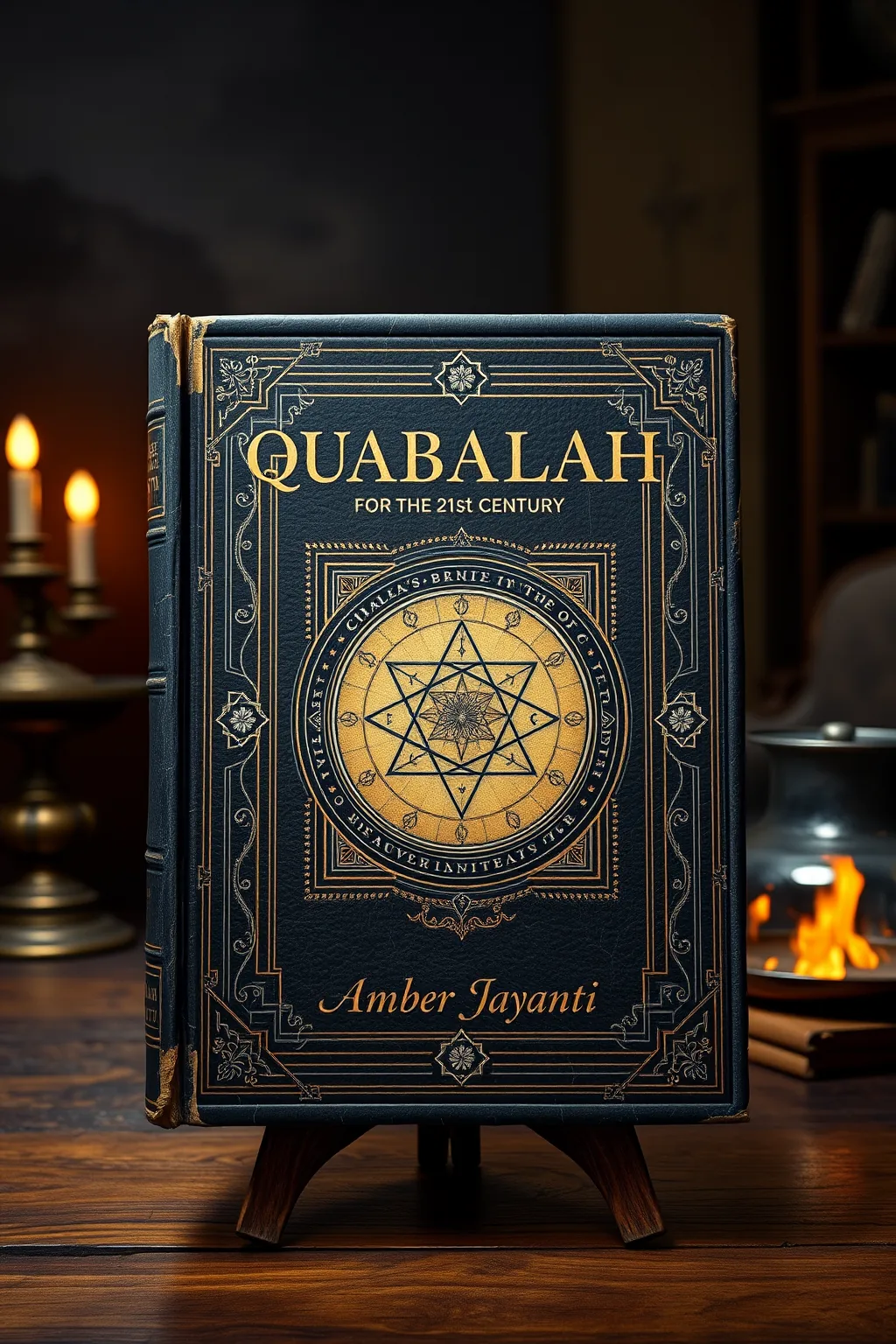
QABALAH for the 21st CENTURY
 61
61

QABALAH for the 21st CENTURY


Aurelia Blackwood (Occult Philosophy Critic) — Amber Jayanti's 'QABALAH for the 21st CENTURY' is a luminous beacon for those navigating the complex currents of modern spirituality. Jayanti offers an accessible yet deeply profound interpretation of Kabbalistic principles, illuminating the Tree of Life as a potent tool for psychological integration and spiritual ascent. Her ability to distill millennia of esoteric knowledge into actionable wisdom is remarkable. This book is an indispensable resource for serious students of mysticism, offering a clear roadmap for manifesting higher consciousness and understanding the interconnectedness of all things. It excels in bridging ancient insights with the demands of contemporary life, making the profound accessible.
📝 Description
61
Amber Jayanti's 2022 book explains the Kabbalistic Tree of Life as a map for modern consciousness.
QABALAH for the 21st CENTURY, published in 2022, reinterprets the Kabbalistic Tree of Life. Amber Jayanti presents it not just as a symbolic diagram, but as a framework for understanding the universe and the human mind. The author unpacks the esoteric symbols, showing how they can guide spiritual growth and personal change.
This book is written for contemporary individuals seeking spiritual understanding. It connects established metaphysical ideas with current life issues. Jayanti provides a guide to achieving greater awareness and realizing untapped abilities. The work invites readers to consider the fundamental structure of reality and connect with the forces that influence our lives, moving toward self-discovery.
This book engages with Kabbalah, a Jewish mystical tradition that uses the Tree of Life diagram to visualize the structure of the universe and the divine emanation. It follows in a lineage of esoteric interpretations that seek to find universal spiritual principles within these ancient teachings. Jayanti’s approach specifically aims to make these concepts accessible and relevant to individuals living in the 21st century, bridging historical mystical frameworks with contemporary psychological and spiritual inquiry.
💡 Why Read This Book?
Unravel the ancient secrets of the Tree of Life and its profound relevance to your inner world. 'QABALAH for the 21st CENTURY' provides practical tools for psychological growth and spiritual awakening. Ideal for seekers yearning for deeper meaning, scholars interested in esoteric traditions, and practitioners seeking to enhance their spiritual disciplines with powerful Kabbalistic insights.
⭐ Reader Reviews
Honest opinions from readers who have explored this book.
❓ Frequently Asked Questions
Is this book suitable for beginners with no prior Kabbalistic knowledge?
Absolutely. Amber Jayanti's clear prose and step-by-step approach make 'QABALAH for the 21st CENTURY' highly accessible to newcomers, while still offering depth for experienced practitioners.
How does this book apply Kabbalah to modern psychology?
The book integrates Kabbalistic concepts with psychological frameworks, demonstrating how the Tree of Life can illuminate subconscious patterns, emotional development, and the journey toward wholeness.
What are the primary benefits of studying the Tree of Life?
Studying the Tree of Life offers a profound understanding of the divine emanations, the structure of consciousness, and practical methods for personal transformation, spiritual growth, and aligning with universal energies.
Can this book be used for meditation or practical spiritual exercises?
Yes, the book provides insights and exercises that can be directly applied to meditation, visualization, and self-inquiry, fostering a deeper engagement with Kabbalistic principles.
What makes this book unique compared to other Kabbalah texts?
Its unique strength lies in its contemporary relevance and practical application, seamlessly blending ancient esoteric wisdom with modern psychological understanding for actionable self-improvement and spiritual advancement.
🔮 Key Themes & Symbolism
The Tree of Life as a Cosmic Blueprint
This theme explores the Sephiroth and pathways of the Kabbalistic Tree of Life not just as abstract symbols, but as a dynamic, living map of creation and consciousness. Jayanti reveals how this ancient diagram mirrors the energetic architecture of the universe and the human soul, providing a profound framework for understanding divine principles, cosmic order, and the interconnectedness of all existence. Readers will learn to perceive the Tree as a guide to reading through the subtle realms and understanding the flow of spiritual energy.
Psychological Integration and Self-Mastery
The book powerfully connects Kabbalistic teachings to modern psychological concepts, presenting the Tree of Life as an invaluable tool for personal growth and self-discovery. It studies how understanding the Sephiroth can illuminate our inner landscape, help us to identify and integrate shadow aspects, and foster emotional balance. Jayanti offers practical techniques for applying these insights to overcome limiting beliefs, enhance self-awareness, and achieve a state of holistic well-being and mastery over one's inner world.
Esoteric Symbolism and Practical Application
This theme focuses on deciphering the body of esoteric symbolism embedded within Kabbalistic lore, making it accessible and relevant for the 21st century. Jayanti moves beyond mere academic study, demonstrating how these ancient symbols can be activated and utilized in daily life for spiritual evolution. Readers will discover how to employ visualization, meditation, and contemplative practices to engage with the archetypal energies of the Sephiroth, thereby accelerating their journey towards higher consciousness and practical manifestation of spiritual principles.
💬 Memorable Quotes
Direct passages from the work, attributed to the author.
“Within each Sephiroth lies a divine spark waiting to be ignited.”
— Highlights the inherent potential for spiritual awakening within each facet of existence and the human psyche, accessible through Kabbalistic study.
“The pathways of the Tree are not merely lines, but energetic currents of transformation.”
— This emphasizes the practical, energetic dimension of the Kabbalistic pathways, suggesting they are conduits for profound personal change.
“Embrace the divine geometry that shapes your reality.”
— An evocative call to recognize and interact with the underlying spiritual order of existence as revealed by Kabbalistic principles.
💡 Key Ideas
Editorial paraphrase of the work's core concepts — not direct quotes.
The Tree of Life is not a static diagram, but a living, breathing map of the soul's journey.
This quote emphasizes the dynamic nature of the Kabbalistic model, portraying it as an active guide rather than a passive representation of spiritual concepts.
To know oneself is to know the universe.
A core tenet of many esoteric traditions, this quote underscores the profound connection between inner exploration and understanding the macrocosm.
🌙 Esoteric Significance
Tradition
This work is deeply rooted in the Hermetic and Lurianic Kabbalah traditions, while also drawing upon Neoplatonic and Gnostic influences. It presents the Kabbalistic Tree of Life and its associated Sephiroth and pathways as a universal system of spiritual development, accessible to all seekers regardless of their religious background. The emphasis is on the esoteric understanding of these concepts as tools for inner transformation and communion with the Divine.
Symbolism
The core symbolism revolves around the Tree of Life, a diagram depicting ten Sephiroth (divine emanations) and twenty-two paths. Each Sephirah represents a distinct energetic principle or state of consciousness, while the paths describe the dynamic interplay and transition between them. Jayanti deciphers symbols such as the Hebrew alphabet, the four worlds, and archetypal imagery associated with each Sephirah, revealing their deeper psychological and spiritual meanings.
Modern Relevance
In the 21st century, 'QABALAH for the 21st CENTURY' offers a profound framework for reading through the complexities of modern life. Its emphasis on psychological integration and self-mastery resonates deeply with individuals seeking to understand their inner world and cultivate resilience. The book provides practical tools for spiritual growth, stress management, and fostering a sense of purpose, making ancient Kabbalistic wisdom a relevant guide for contemporary challenges and personal fulfillment.
👥 Who Should Read This Book
This book is a vital resource for a diverse audience. **Beginners** will find an accessible entry point into the profound mysteries of Kabbalah, guided by Jayanti's clear explanations. **Scholars** and serious students of mysticism will appreciate the depth and nuanced interpretation of traditional Kabbalistic concepts. **Spiritual seekers** yearning for a deeper understanding of themselves and the universe will discover practical pathways to enlightenment. **Practitioners** of various contemplative disciplines will find invaluable tools to enhance their meditation, visualization, and self-awareness practices, enriching their spiritual journey with ancient esoteric wisdom.
📜 Historical Context
Amber Jayanti's 'QABALAH for the 21st CENTURY' emerges in an era marked by a resurgence of interest in ancient wisdom traditions and a global search for meaning beyond materialistic paradigms. The late 20th and early 21st centuries have witnessed a growing awareness of the limitations of purely rationalistic thought, leading many to explore esoteric philosophies that offer deeper insights into consciousness, spirituality, and the human condition. Kabbalah, with its rich symbolic language and intricate cosmology, has seen a significant revival, moving from the exclusive domain of scholarly and religious circles into broader public consciousness. Jayanti's work taps into this contemporary hunger for accessible yet profound spiritual knowledge, situating Kabbalistic wisdom within a context of psychological self-help and personal empowerment, reflecting a broader trend of integrating ancient mystical practices with modern therapeutic and self-development approaches.
📔 Journal Prompts
Reflect on the Sephirah that most appeals to your current life circumstances. What lessons does it offer?
Consider a challenging aspect of your personality. How can the corresponding Sephirah or pathway in the Tree of Life offer insight and transformation?
Visualize yourself walking a specific path on the Tree of Life. What energies do you encounter, and how do they affect you?
How can the principle of divine emanation, as described by the Sephiroth, help you to better understand your own creative potential?
Identify one practical application of Kabbalistic symbolism from this book that you can integrate into your daily life for personal growth.
🗂️ Glossary
Sephirah (plural: Sephiroth)
In Kabbalah, these are the ten divine emanations or attributes through which God manifests and interacts with the created universe. They represent distinct energetic principles and stages of consciousness.
Tree of Life
A central diagram in Kabbalah, consisting of ten Sephiroth connected by twenty-two paths. It serves as a map of creation, consciousness, and the path of spiritual development.
Keter
The first Sephirah, representing the highest level of divine will, nothingness, or pure potentiality. It is the Crown, the ultimate source of all existence.
Chokmah
The second Sephirah, representing divine wisdom, masculine energy, and the initial spark of creation. It is the active force that brings potential into being.
Binah
The third Sephirah, representing divine understanding, feminine energy, and form. It is the receptive principle that gives structure and limitation to Chokmah's energy.
This book appears in 1 collection
🔮 Readers Also Liked
Browse all →








More by Amber Jayanti
All books →



From the “Kabbalah” Collection
View all →








More Free Kabbalah & Jewish Mysticism Books
View all →