The Chicken Qabalah of Rabbi Lamed Ben Clifford
 81
81

The Chicken Qabalah of Rabbi Lamed Ben Clifford
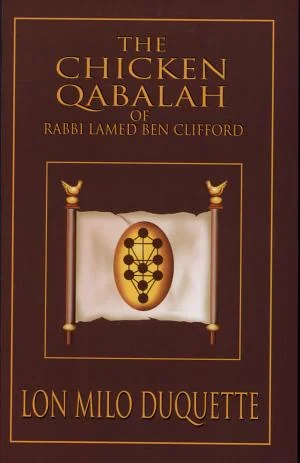
Duquette’s "Chicken Qabalah" bypasses the usual reverential solemnity that often encumbers introductions to Kabbalistic study. It’s a breath of fresh air, utilizing the author’s characteristic wit to render complex ideas palatable. The strength lies in its sheer accessibility; concepts like the Sephiroth are explained with analogies that stick, such as the "chicken" itself being a metaphor for the divine manifestation. However, this very approach can be its limitation. For serious scholars of traditional Kabbalah, the playful tone might feel trivializing, and the practical applications, while engaging, may lack the depth sought by those steeped in more rigorous magical or philosophical systems. A particular passage illustrating the interconnectedness of the Sephiroth through the metaphor of a "chicken's digestive tract" is memorable for its audaciousness, encapsulating the book's unique blend of the sacred and the absurd.
Ultimately, it succeeds as an engaging gateway, if not a definitive map, to Kabbalistic thought.
📝 Description
81
Lon Milo Duquette's 2001 book reinterprets Kabbalah with humor and everyday analogies.
Published in 2001, Lon Milo Duquette's "The Chicken Qabalah of Rabbi Lamed Ben Clifford" offers a humorous and accessible introduction to Kabbalistic concepts. Instead of dense academic prose, Duquette uses humor and relatable metaphors to explain the complex structure of Kabbalah. The book serves as a practical primer, making esoteric Jewish mysticism understandable to a broader audience.
This work is suited for individuals interested in esoteric traditions who might be put off by traditional, formal presentations. It appeals to those who prefer a lighthearted yet informative approach to spiritual frameworks. Readers looking for a more experiential and less dogmatic entry into Western esotericism will find its methods particularly useful. It also serves as a good introduction for those already familiar with Duquette's other writings.
Kabbalah, originating in medieval Jewish mysticism, entered Western esoteric thought during the Renaissance. Figures like Eliphas Lévi and later groups such as the Hermetic Order of the Golden Dawn incorporated Kabbalistic ideas into their magical systems. Duquette's 2001 book reflects a modern approach to these ancient traditions, reinterpreting them through contemporary psychological understanding and accessible language.
💡 Why Read This Book?
• You'll discover a unique, humor-infused method for understanding the foundational concepts of the Kabbalah, making the Tree of Life feel less like an abstract diagram and more like a relatable map for life. • Gain practical, actionable techniques derived from Kabbalistic principles, presented through Duquette's engaging narrative style that encourages personal experimentation and insight. • Experience an esoteric tradition stripped of pretension, offering a fresh perspective that might unlock your understanding if traditional texts have felt inaccessible or overly academic.
⭐ Reader Reviews
Honest opinions from readers who have explored this book.
❓ Frequently Asked Questions
Is "The Chicken Qabalah" a serious academic text on Jewish Kabbalah?
No, the book is a humorous and practical introduction to Kabbalistic concepts, adapted for Western esoteric practitioners. It's not intended as a scholarly analysis of traditional Jewish mysticism but rather a playful exploration of its structure.
Who is Rabbi Lamed Ben Clifford?
Rabbi Lamed Ben Clifford is a fictional character created by Lon Milo Duquette. He serves as a humorous persona through whom the author explains Kabbalistic principles, offering anecdotes and metaphorical teachings.
What year was "The Chicken Qabalah of Rabbi Lamed Ben Clifford" first published?
The book was first published on August 1, 2001, by Weiser Books.
What is the main difference between this book and traditional Kabbalah texts?
The primary difference lies in its tone and approach. Traditional texts are often dense and steeped in religious or philosophical discourse, while Duquette's work uses humor, relatable metaphors (like chickens), and a focus on practical application for Western occultists.
Does the book require prior knowledge of Kabbalah?
While prior knowledge can enhance understanding, the book is designed as an accessible introduction. It aims to explain core concepts like the Sephiroth and the Tree of Life to readers who may be new to the subject.
What are the 'Chicken Qabalah' principles?
The 'Chicken Qabalah' refers to Duquette's unique, lighthearted interpretation and application of Qabalistic principles, often using chicken-related analogies to explain esoteric ideas in a more digestible and practical way.
🔮 Key Themes & Symbolism
Accessible Esotericism
Duquette masterfully strips away the intimidating jargon often associated with Kabbalistic study. By employing humor and everyday analogies, such as the titular chicken, he makes profound concepts like the Sephiroth and the Tree of Life readily understandable. This approach democratizes esoteric knowledge, inviting those who might typically shy away from such subjects to engage with them confidently and without trepidation.
Practical Application
Beyond theoretical explanations, the book emphasizes the practical utility of Kabbalistic wisdom. It suggests methods for integrating these principles into daily life, fostering personal growth and spiritual development. The focus is not merely on intellectual understanding but on experiential application, encouraging readers to actively work with the material presented.
Humor as a Teaching Tool
The distinctive feature of this work is its pervasive use of humor. Duquette leverages witty anecdotes and playful metaphors to illustrate complex ideas, making the learning process enjoyable. This unconventional pedagogical approach serves to clarify the arcane, demonstrating that profound spiritual insights can be conveyed through lightheartedness and wit, rather than solely through solemnity.
Western Esoteric Adaptation
This book represents a modern interpretation of the Kabbalah, specifically tailored for the Western esoteric tradition. It draws upon the framework of the Tree of Life but recontextualizes it through a lens informed by 20th and 21st-century occultism, psychology, and a general inclination towards practical magic and self-discovery.
💬 Memorable Quotes
Direct passages from the work, attributed to the author.
“The Kabbalah is a system of trees and numbers and letters and paths and all that. It’s a map of the universe, and it’s a map of your own psyche.”
— This interpretation highlights the dual nature of the Kabbalistic system as presented by Duquette: both an external cosmology and an internal psychological landscape, accessible through its symbolic language.
“You don’t need to be a rabbi or a mystic to understand this stuff. You just need a sense of humor and a willingness to look at things differently.”
— This emphasizes the book's core philosophy: explaining esoteric knowledge and making it accessible to anyone, regardless of their background, provided they approach it with an open mind and a light heart.
“The chicken, you see, is the universe. And we are the bits and pieces that make it up.”
— This concise metaphor captures the book's central, playful analogy, suggesting that the entirety of existence can be understood through the simple, albeit unconventional, image of a chicken.
“The Qabalah is a language, and like any language, you learn it by speaking it, by playing with it.”
— This interpretation stresses the active, participatory nature of learning the Qabalah as presented in the book, encouraging readers to engage directly with its symbolic and conceptual framework.
💡 Key Ideas
Editorial paraphrase of the work's core concepts — not direct quotes.
It’s not about memorizing charts; it’s about feeling the flow between the different levels of reality.
This paraphrased concept underscores the book's focus on experiential learning over rote memorization, advocating for an intuitive grasp of the interconnectedness within the Kabbalistic system.
🌙 Esoteric Significance
Tradition
The work is firmly rooted in the Western Esoteric Tradition, specifically drawing from the Kabbalah as adapted and popularized within occult circles since the Renaissance. It engages with the Hermetic Qabalah, which synthesizes Jewish Kabbalistic concepts with elements of Hermeticism, Neoplatonism, and Christian mysticism. Duquette's contribution lies in his unique, often humorous, reinterpretation of these established structures, making them more accessible and pragmatically oriented for contemporary practitioners.
Symbolism
Central to the book's symbolism is the reinterpretation of the Tree of Life, the foundational diagram of Kabbalistic cosmology. Duquette employs the metaphor of the chicken not just as a humorous device but as a symbol for divine manifestation and the interconnectedness of all things. Other symbols, like the Hebrew letters and the Sephiroth, are presented through relatable, often mundane, analogies, aiming to reveal the underlying archetypal patterns within everyday existence.
Modern Relevance
Contemporary practitioners of Western esotericism, particularly those interested in practical magic, comparative mysticism, and psychological applications of spiritual systems, continue to find value in Duquette's approach. His work appeals to modern seekers who appreciate accessible, non-dogmatic pathways to understanding esoteric concepts. It serves as a gateway for many into the broader field of Kabbalistic study and occult philosophy, encouraging a personal, experiential relationship with these ancient frameworks.
👥 Who Should Read This Book
• Absolute beginners to Kabbalah seeking an unintimidating and enjoyable entry point, who might be put off by traditional, dense texts. • Practitioners of Western esotericism looking for fresh, practical applications of Kabbalistic principles presented with a unique sense of humor. • Readers familiar with Lon Milo Duquette's other works who appreciate his distinctive blend of scholarship, wit, and accessible magical philosophy.
📜 Historical Context
Published in 2001, Lon Milo Duquette's "The Chicken Qabalah of Rabbi Lamed Ben Clifford" emerged during a period of significant popular interest in esoteric subjects, fueled by the burgeoning internet and a growing desire for accessible spiritual paths. The late 20th and early 21st centuries saw a trend toward reinterpreting traditional mystical systems for modern Western audiences, moving away from strictly religious dogma towards practical application in personal development and magical practice. This era saw figures like Israel Regardie and Dion Fortune's works widely read, but Duquette's approach stood apart with its overt humor. It followed in the footsteps of earlier Western Kabbalistic adaptations by groups like the Hermetic Order of the Golden Dawn, which integrated Kabbalah into ceremonial magic, but Duquette intentionally simplified and playfully deconstructed these complex systems. The work reflects a broader cultural shift towards secularized spirituality and a demand for esoteric teachings presented without the dense academic or religious frameworks that had historically dominated the field.
📔 Journal Prompts
How does the metaphor of the 'chicken' relate to your personal understanding of creation or divine order?
Reflect on a time you found humor helpful in understanding a difficult concept.
Which Sephiroth or path on the Tree of Life currently seems most relevant to your life, and why?
Consider a mundane aspect of your daily life that could be viewed through a Kabbalistic lens.
What practical applications of the Kabbalah might you explore after reading this book?
🗂️ Glossary
Qabalah/Kabbalah
An esoteric system of mystical interpretation, originally from Jewish tradition, focusing on divine emanations (Sephiroth) and their relationship to the created universe, often visualized on the Tree of Life.
Sephiroth
The ten divine attributes or emanations described in Kabbalistic cosmology, representing stages of creation and aspects of the Godhead, typically depicted on the Tree of Life.
Tree of Life
A central diagram in Kabbalistic symbolism, consisting of ten Sephiroth connected by 22 paths, representing the structure of the cosmos and the path of spiritual ascent.
Hermetic Qabalah
A Western esoteric tradition that synthesizes Jewish Kabbalistic concepts with elements of Hermeticism, alchemy, astrology, and other mystical traditions.
Esoteric
Relating to or accessible only by a small number of people with a specialized knowledge or interest; often pertaining to mystical or occult subjects.
Archetype
In psychology and philosophy, a fundamental, universal pattern or image that is part of the collective unconscious, often explored in esoteric systems.
Gematria
A method of Kabbalistic interpretation where Hebrew letters are assigned numerical values, allowing for the discovery of hidden meanings and connections between words.
This book appears in 2 collections
🔮 Readers Also Liked
Browse all →









From the “Qabalah” Collection
View all →






More Free Occult Philosophy Books
View all →