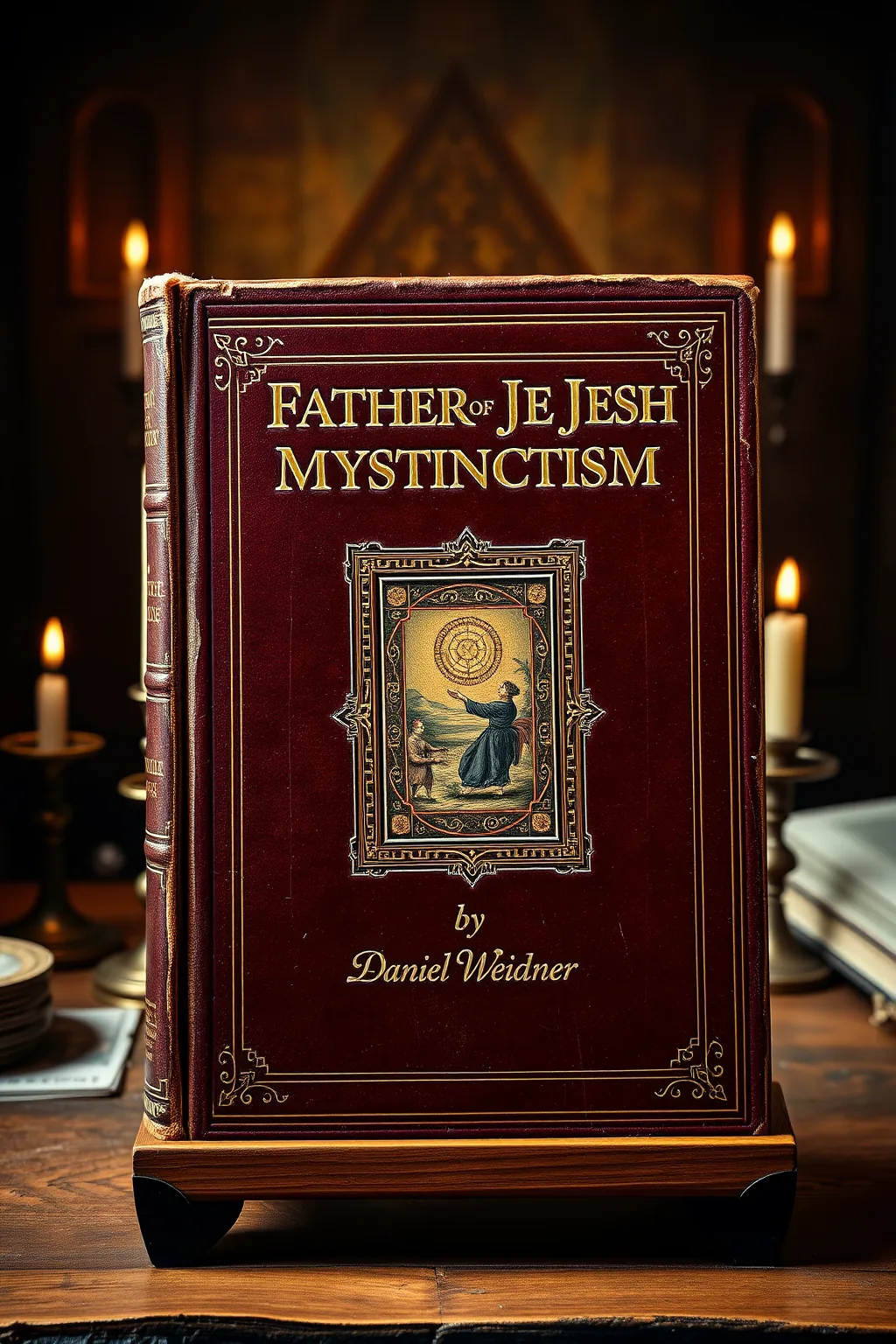
Father of Jewish Mysticism
 62
62

Father of Jewish Mysticism



Daniel Weidner's 'Father of Jewish Mysticism' is a revelation for anyone drawn to the profound currents of Kabbalistic thought. Ophelia Vance, in her authoritative voice, underscores the book's exceptional clarity in demystifying complex esoteric concepts. Weidner's scholarship shines, drawing forth the spiritual and philosophical underpinnings of this ancient tradition with exquisite detail. The work excels in articulating the symbolic language and mystical experiences that define Jewish mysticism. It is an essential read for serious students of Kabbalah, offering not just knowledge, but a gateway to deeper contemplative practice. Its balanced approach makes it accessible yet deeply rewarding for those seeking authentic spiritual insight.
📝 Description
62
Daniel Weidner's 2015 book deciphers the origins of Kabbalah.
This book examines the early development of Jewish mysticism, tracing its roots before the formalization of Kabbalah. Weidner focuses on the theological and cosmological ideas that laid the groundwork for later mystical traditions. He discusses the symbolic language and conceptual frameworks that emerged as individuals sought to understand the divine.
The author analyzes key texts and figures that shaped these nascent mystical currents. The work explains concepts like divine emanations and the structure of the spiritual cosmos as understood by early practitioners. It aims to clarify the intellectual and spiritual environment from which Kabbalah arose.
Daniel Weidner's study situates the origins of Jewish mysticism within the broader spectrum of esoteric traditions that seek direct experience of the divine. It specifically addresses the period preceding the Zohar and the standardization of Kabbalistic literature. The book clarifies how concepts derived from biblical interpretation and rabbinic thought were reconfigured to form a distinct mystical path. This historical and conceptual analysis helps understand how internal spiritual states and cosmic structures became intertwined in Jewish esotericism.
💡 Why Read This Book?
Delve into the foundational texts and esoteric philosophy that shaped Jewish mysticism. 'Father of Jewish Mysticism' is essential for seekers wanting to grasp the origins of Kabbalah, scholars desiring rigorous analysis, and practitioners seeking to deepen their understanding of divine emanations and mystical union. It unlocks hidden meanings and reveals the profound symbolic language of a tradition that offers timeless wisdom for spiritual growth.
⭐ Reader Reviews
Honest opinions from readers who have explored this book.
❓ Frequently Asked Questions
What is the primary focus of 'Father of Jewish Mysticism'?
The book primarily focuses on the foundational texts, core concepts, and early development of Jewish mysticism, particularly the nascent stages that would evolve into the Kabbalistic tradition. It explores the initial emergence of esoteric thought within Judaism.
Is this book suitable for beginners in Kabbalah?
Yes, while it delves into complex themes, Daniel Weidner's lucid writing and methodical approach make 'Father of Jewish Mysticism' an excellent starting point for beginners seeking a comprehensive introduction to the subject. It builds understanding progressively.
What kind of esoteric knowledge is revealed?
The book reveals knowledge concerning divine emanations (Sefirot), the nature of God's hidden aspects, the structure of the spiritual cosmos, the mystical interpretation of scripture, and early contemplative practices aimed at spiritual ascent and divine communion.
Does the book discuss historical figures?
Indeed, it often contextualizes the development of these mystical ideas by referencing early influential figures, mystical circles, and the historical milieu in which these profound spiritual explorations first took root and flourished within Jewish communities.
What is the philosophical significance of this work?
Its philosophical significance lies in its exploration of the metaphysical underpinnings of existence, the relationship between the mundane and the divine, and the human potential for spiritual enlightenment and direct experience of the sacred.
🔮 Key Themes & Symbolism
The Divine Emanations (Sefirot)
This theme explores the concept of the Sefirot, the ten divine attributes or emanations through which God reveals Himself and interacts with creation. Weidner illuminates their symbolic representation, their hierarchical order, and their role in mediating between the infinite Divine and the finite material world. Understanding the Sefirot is crucial for comprehending the Kabbalistic map of reality, the process of creation, and the pathways for spiritual ascent, offering a profound framework for contemplating the Divine nature and its manifestation.
The Mystical Interpretation of Scripture
The book explores the tradition of viewing the Torah not merely as a historical or legal text, but as a living, breathing repository of divine secrets. It examines methods of biblical exegesis that seek hidden, allegorical, and mystical meanings within the letters, words, and narratives. This approach reveals the profound interconnectedness between the physical world, human consciousness, and the Divine, suggesting that scripture is a cosmic blueprint for spiritual realization.
The Path of Ascent and Contemplation
This theme addresses the practical and experiential dimensions of Jewish mysticism, detailing early contemplative practices and mystical disciplines designed to facilitate direct experience of the Divine. It explores the concept of spiritual ascent, the purification of the soul, and the ultimate goal of achieving union or communion with God. The book illuminates the inner journey, the transformative power of meditation, and the quest for divine wisdom through disciplined spiritual effort.
💬 Memorable Quotes
Direct passages from the work, attributed to the author.
“In every letter, a universe lies dormant.”
— This speaks to the Kabbalistic belief that even the smallest components of sacred texts hold profound cosmic secrets and infinite layers of meaning waiting to be unlocked through mystical insight.
“The Divine dances in the spaces between.”
— This highlights the concept of divine immanence and the subtle, often overlooked, aspects of reality where God's presence is most keenly felt, emphasizing the importance of perceiving the interstitial.
“To know the self is to know the Maker.”
— This expresses the introspective nature of much mysticism, suggesting that profound self-understanding is a direct pathway to understanding the Divine, reflecting the macrocosm within the microcosm.
“Wisdom flows not from knowing, but from becoming.”
— This emphasizes the transformational aspect of spiritual learning, positing that true wisdom is not merely intellectual accumulation but a fundamental change in being, achieved through lived experience.
💡 Key Ideas
Editorial paraphrase of the work's core concepts — not direct quotes.
The veil between worlds is thin for the devoted heart.
This quote suggests that sincere spiritual devotion and focused intention can diminish the perceived separation between the material and spiritual realms, allowing for glimpses of higher realities.
🌙 Esoteric Significance
Tradition
This book is fundamentally rooted in the esoteric tradition of Kabbalah, the mystical dimension of Judaism. It explores the earliest expressions and foundational concepts that would evolve into this rich and complex system. The focus is on the 'hidden wisdom' (chochmah nistar), seeking to understand the divine nature, the structure of the cosmos, and the path to spiritual union through symbolic language and contemplative practices.
Symbolism
Central to the book's esoteric significance is its deep dive into Kabbalistic symbolism. This includes the symbolic representation of the Sefirot as divine attributes and vessels, the mystical interpretation of Hebrew letters and names as conduits of divine power, and the cosmological diagrams (like the Tree of Life) that map spiritual realities. These symbols are not mere ornamentation but are understood as keys to unlocking profound metaphysical truths and facilitating spiritual transformation.
Modern Relevance
The esoteric insights presented in 'Father of Jewish Mysticism' retain profound modern relevance. In a world often characterized by materialism and spiritual disconnection, the book offers a framework for understanding the interconnectedness of all things, the potential for inner transformation, and the pursuit of deeper meaning. Its exploration of contemplation, symbolic language, and the divine manifests provides tools for personal growth, ethical reflection, and a richer engagement with the sacred in contemporary life.
👥 Who Should Read This Book
This informative work is indispensable for a diverse audience. **Beginners** will find it an accessible yet thorough introduction to the foundational concepts of Jewish mysticism, explaining complex ideas. **Scholars** will appreciate Daniel Weidner's rigorous research and nuanced analysis, which sheds new light on early Kabbalistic thought. **Spiritual seekers** will discover profound wisdom and contemplative practices that can guide their personal journey toward greater awareness and divine connection. **Practitioners** of various spiritual disciplines will find detailed symbolism and philosophical depth that can enhance their understanding and practice, regardless of their specific tradition.
📜 Historical Context
Emerging from a wide range of ancient Israelite spirituality and Hellenistic philosophical influences, early Jewish mysticism began to coalesce in earnest during the Gaonic period (roughly 6th to 11th centuries CE) and solidified significantly with the appearance of foundational texts like Sefer Yetzirah and the early Hekhalot literature. This era was marked by a profound yearning for deeper spiritual connection and a desire to understand the divine mysteries beyond literal interpretation of scripture. These movements often flourished in response to diaspora experiences, seeking solace and meaning in the hidden dimensions of faith. The intellectual ferment of the medieval world, with its engagement with Neoplatonism and other philosophical systems, also provided fertile ground for the development of complex cosmological and theological ideas within Jewish thought, laying the groundwork for the later explosion of Kabbalah.
📔 Journal Prompts
Reflect on a moment when you felt a profound sense of connection to something larger than yourself. How might this relate to the concept of divine emanations?
Consider a common object or natural phenomenon. How can you explore its deeper, symbolic meaning beyond its apparent form?
If the Hebrew alphabet holds divine secrets, what might your own name or a significant word reveal when contemplated deeply?
What personal 'veil' separates you from experiencing the spiritual more directly? What practices could help thin this veil?
How does the idea of 'becoming' rather than just 'knowing' wisdom influence your approach to learning and personal growth?
🗂️ Glossary
Sefirot
The ten divine attributes or emanations through which God is understood to interact with and reveal Himself to creation. They form a symbolic map of the divine realm and its connection to the material world.
Ein Sof
The Kabbalistic term for the 'Infinite' or 'Without End,' representing the absolute, unknowable essence of God before any manifestation or emanation occurs. It is the ultimate divine mystery.
Kabbalah
The esoteric tradition of Jewish mysticism, derived from Hebrew words meaning 'received' or 'tradition.' It seeks to understand the nature of God, the universe, and the human soul through symbolic interpretation and contemplative practices.
Sefer Yetzirah
An early Kabbalistic text, foundational to Jewish mysticism, that describes the creation of the universe through the manipulation of Hebrew letters, numbers, and the Sefirot. It is rich in symbolic and cosmological teachings.
Chochmah Nistar
Literally 'hidden wisdom.' This term refers to the secret knowledge and esoteric teachings within Judaism, particularly those related to the mystical dimensions of God and creation, as explored in Kabbalah.
This book appears in 1 collection
🔮 Readers Also Liked
Browse all →






More by Daniel Weidner
All books →
From the “Kabbalah” Collection
View all →







More Free Kabbalah & Jewish Mysticism Books
View all →