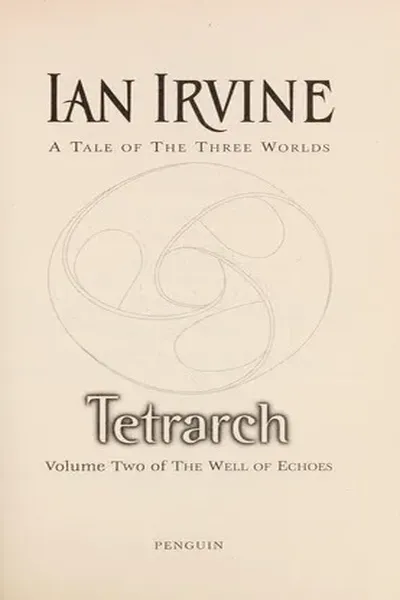
Tetrarch

 78
78

Tetrarch
Ian Irvine’s Tetrarch is an ambitious undertaking, presenting a world that feels both alien and disturbingly familiar. Its strength lies in the sheer scale of its conceptual architecture; Irvine constructs a narrative framework that allows for deep exploration of power dynamics and the subjective nature of truth. However, the density of its world-building, while impressive, can at times become a barrier to immediate engagement. The pacing occasionally falters under the weight of exposition, requiring significant reader investment to fully grasp the intricate web of relationships and historical antecedents. A particular passage detailing the ritualistic transfer of power, while conceptually rich, demands several re-reads to fully unpack its symbolic weight. Despite these challenges, Tetrarch offers a rewarding experience for those willing to commit.
Irvine’s meticulous construction makes Tetrarch a significant, if demanding, piece of literature.
📝 Description
78
Ian Irvine's 2003 novel Tetrarch weaves political intrigue with existential questions.
Tetrarch is a complex narrative that examines power, belief systems, and the human condition. Published in 2003, the novel does not present a straightforward story but instead layers political machinations with deeper philosophical and existential inquiries. Irvine constructs a richly imagined world where events unfold on multiple levels, demanding close attention from the reader.
This book is suited for those who appreciate detailed world-building and elaborate plotting. Readers who enjoy narratives that require careful consideration of particulars and offer rewards for sustained focus will find Tetrarch engaging. It will appeal to individuals interested in the dynamics between personal agency and broader societal structures, and those seeking literature that questions the nature of reality and perception.
Published in 2003, Tetrarch appeared during a time when speculative fiction authors were actively experimenting with narrative structures and engaging complex philosophical ideas. Irvine's work dialogues with a tradition of writing that explores intricate mythologies and the fallout from unrestrained ambition. The novel's focus on the 'tetrarch'—a ruler of a fourth part—hints at themes of division and unstable governance, inviting reflection on how societies and individuals confront inherited systems, the temptation of forbidden knowledge, and the personal costs associated with seeking control or understanding within an ambiguous world.
💡 Why Read This Book?
• You will learn about the mechanics of imposed societal structures by examining the fictionalized 'tetrarchy' system, understanding how leadership is defined and contested within the narrative. • You will gain insight into the philosophical concept of subjective reality through the characters' struggles with differing perceptions of historical events and magical phenomena. • You will feel the weight of historical consequence as the narrative demonstrates how past decisions, particularly concerning the Great Schism, directly impact the present conflicts and character motivations.
⭐ Reader Reviews
Honest opinions from readers who have explored this book.
❓ Frequently Asked Questions
What is the primary genre of Ian Irvine's Tetrarch?
Tetrarch is primarily classified as speculative fiction, blending elements of fantasy, political thriller, and philosophical exploration. It was first published in 2003.
Who are the main antagonists or sources of conflict in Tetrarch?
Conflict arises from a complex interplay of political factions vying for control, ancient prophecies, and the internal struggles of characters grappling with forbidden knowledge and their destinies.
Does Tetrarch involve magic or supernatural elements?
Yes, the work incorporates elements of magic and explores esoteric concepts, integral to the plot and the characters' understanding of their world and its history.
What are the central themes explored in Tetrarch?
Central themes include the nature of power, the manipulation of perception, historical cycles, the consequences of ambition, and the search for truth in a fragmented reality.
Is Tetrarch part of a series?
While Tetrarch was first published in 2003, it stands as a distinct work within Ian Irvine's broader bibliography. Specific series information may require further research into its publication history.
What kind of world does Tetrarch take place in?
The novel is set in a meticulously crafted fictional world with its own history, political structures, and unique cosmological or magical underpinnings, first explored in 2003.
🔮 Key Themes & Symbolism
The Tetrarchy of Power
The concept of the 'tetrarch' itself, a ruler of a fourth part, is central to understanding the novel's exploration of fractured authority and divided rule. Irvine uses this structure to dissect how power is consolidated, challenged, and maintained across different factions. The narrative examines the inherent instability and the psychological toll of such segmented governance, where each 'part' vies for dominance or survival, often through manipulation and hidden agendas. The societal implications of this divided rule are explored through the lives of various characters.
Perception as Reality
A significant theme in Tetrarch is the malleability of reality through perception. Characters often operate under false assumptions or deliberately manipulated viewpoints, leading to profound misunderstandings and conflict. The work questions how collective beliefs are formed and maintained, and the consequences when these perceived realities are challenged by inconvenient truths or alternative interpretations. This theme is crucial for understanding the characters' motivations and the novel's philosophical underpinnings regarding objective versus subjective experience.
Cycles of History and Prophecy
Irvine ties a narrative deeply concerned with the elements of the past and the inevitability of historical cycles. The presence of prophecies and ancient lore suggests a predetermined path, yet the characters' choices continually test this framework. The novel explores whether history repeats itself due to inherent patterns or the persistent actions of individuals driven by similar desires and flaws. The concept of the Great Schism serves as a key historical event whose repercussions shape the present.
The Burden of Knowledge
The pursuit and acquisition of knowledge, particularly forbidden or esoteric lore, presents a recurring challenge for the characters. This knowledge often comes at a great personal cost, leading to isolation, paranoia, or moral compromise. Tetrarch probes the idea that some truths are dangerous, and that ignorance, while seemingly a weakness, can sometimes be a shield. The narrative questions the ultimate value of enlightenment when it brings suffering or destruction.
💬 Memorable Quotes
Direct passages from the work, attributed to the author.
“The crown weighed heavier than any stone.”
— This statement expresses the burden of leadership and the psychological toll of power. It suggests that the responsibilities and pressures of ruling are more significant than any physical object, highlighting the internal struggles of those in authority.
“History is written by the survivors, but remembered by the poets.”
— This aphorism speaks to the dual nature of historical narrative: the factual, often brutal, account of events versus the embellished, mythologized, or emotionally resonant interpretation that shapes cultural memory.
“They saw the same sky, yet lived in different worlds.”
— This highlights the profound disconnect that can exist between individuals or groups, even when sharing the same physical space or temporal moment. It emphasizes how personal experiences and beliefs create distinct realities.
“The path to truth is paved with shattered illusions.”
— This interpretation suggests that the process of uncovering genuine understanding requires confronting and discarding deeply held beliefs or comforting falsehoods, a often painful but necessary undertaking for enlightenment.
“A shadow can hold more power than the light it conceals.”
— This speaks to the potent influence of the unknown, the hidden, or the suppressed. It implies that what is concealed, whether intentionally or through circumstance, can exert a significant, often unseen, force.
🌙 Esoteric Significance
Tradition
Tetrarch does not align strictly with a single esoteric lineage but draws from a broad spectrum of Western esoteric thought, particularly Gnosticism and Hermeticism, in its exploration of perception, hidden knowledge, and the nature of reality. The emphasis on fragmented truths and the potentially illusory nature of the material world echoes Gnostic cosmology, while the underlying themes of cosmic order and the pursuit of understanding align with Hermetic principles. Irvine’s work departs by embedding these concepts within a complex, secularized political and social framework, rather than a purely mystical one.
Symbolism
The concept of the 'tetrarch' itself functions as a potent symbol of divided authority and fractured dominion, suggesting inherent instability. The 'Great Schism' serves as a symbolic representation of a foundational rupture, a historical trauma that continues to shape the present. Furthermore, the recurring motif of hidden texts or forbidden knowledge symbolizes the dangerous allure of ultimate understanding, representing both enlightenment and potential destruction.
Modern Relevance
Contemporary interest in Tetrarch lies in its nuanced portrayal of power structures and the subjective construction of reality, themes highly relevant in today's fragmented media landscape. Thinkers and practitioners exploring critical theory, post-structuralism, and the philosophy of perception may find resonance in Irvine's deconstruction of narrative and truth. Its exploration of cyclical history and the consequences of historical division also speaks to ongoing debates in political philosophy and sociology.
👥 Who Should Read This Book
• Students of political philosophy and power dynamics: Readers interested in how authority is constructed, contested, and maintained within complex systems will find Tetrarch's exploration of the 'tetrarchy' compelling. • Seekers of philosophical speculative fiction: Those who enjoy literature that probes the nature of reality, perception, and truth, and are drawn to challenging, intricate narratives. • Fans of intricate world-building: Readers who appreciate meticulously crafted fictional worlds with deep historical backstories and complex social structures will be rewarded by Irvine's detailed construction.
📜 Historical Context
Ian Irvine’s Tetrarch, first published in 2003, emerged during a period where speculative fiction was increasingly embracing complex, philosophical narratives. The early 21st century saw a continued trend away from straightforward genre tropes towards intricate world-building and thematic depth, influenced by authors like Iain M. Banks and China Miéville who were similarly pushing boundaries. Irvine’s work can be seen as part of this broader movement, engaging with ideas of power, perception, and historical cycles that were prevalent in contemporary literary discourse. While direct reception events like major awards or significant critical controversies for Tetrarch specifically are not widely documented, the novel's intricate structure and thematic ambition placed it within the context of ambitious speculative fiction of the era, contrasting with more traditional fantasy narratives. In the intellectual field of 2003, it offered a counterpoint to the prevailing optimism found in some mainstream genre fiction, instead studying darker, more ambiguous territories.
📔 Journal Prompts
The concept of the tetrarchy as a system of rule.
Personal reflections on the shattering of illusions.
How characters perceive the Great Schism differently.
The burden of holding forbidden knowledge.
Analyzing the weight of a leader's crown.
🗂️ Glossary
Tetrarch
Literally, a ruler of a fourth part. In the context of the book, it signifies a specific form of divided governance or a leader holding a significant but partial share of power.
Great Schism
A key historical event within the book's lore, representing a profound division or rupture that has lasting consequences for the world and its inhabitants.
Perception
The way in which individuals or groups interpret and understand the world around them; a key theme in Tetrarch, highlighting subjective realities.
Forbidden Knowledge
Information or lore that is dangerous, secret, or considered taboo within the narrative's society, often sought after by characters with significant consequences.
Historical Cycles
The idea that patterns of events, societal structures, or human behavior tend to repeat over time, a concept explored through the book's engagement with past events.
Subjective Reality
The reality as experienced and interpreted by an individual, contrasted with objective reality; central to the characters' struggles and understanding in the novel.
Authority
The power or right to give orders, make decisions, and enforce obedience; a core theme explored through the various rulers and factions within the book.
🔮 Readers Also Liked
Browse all →







More by Ian Irvine
All books →



More Free Occult Philosophy Books
View all →