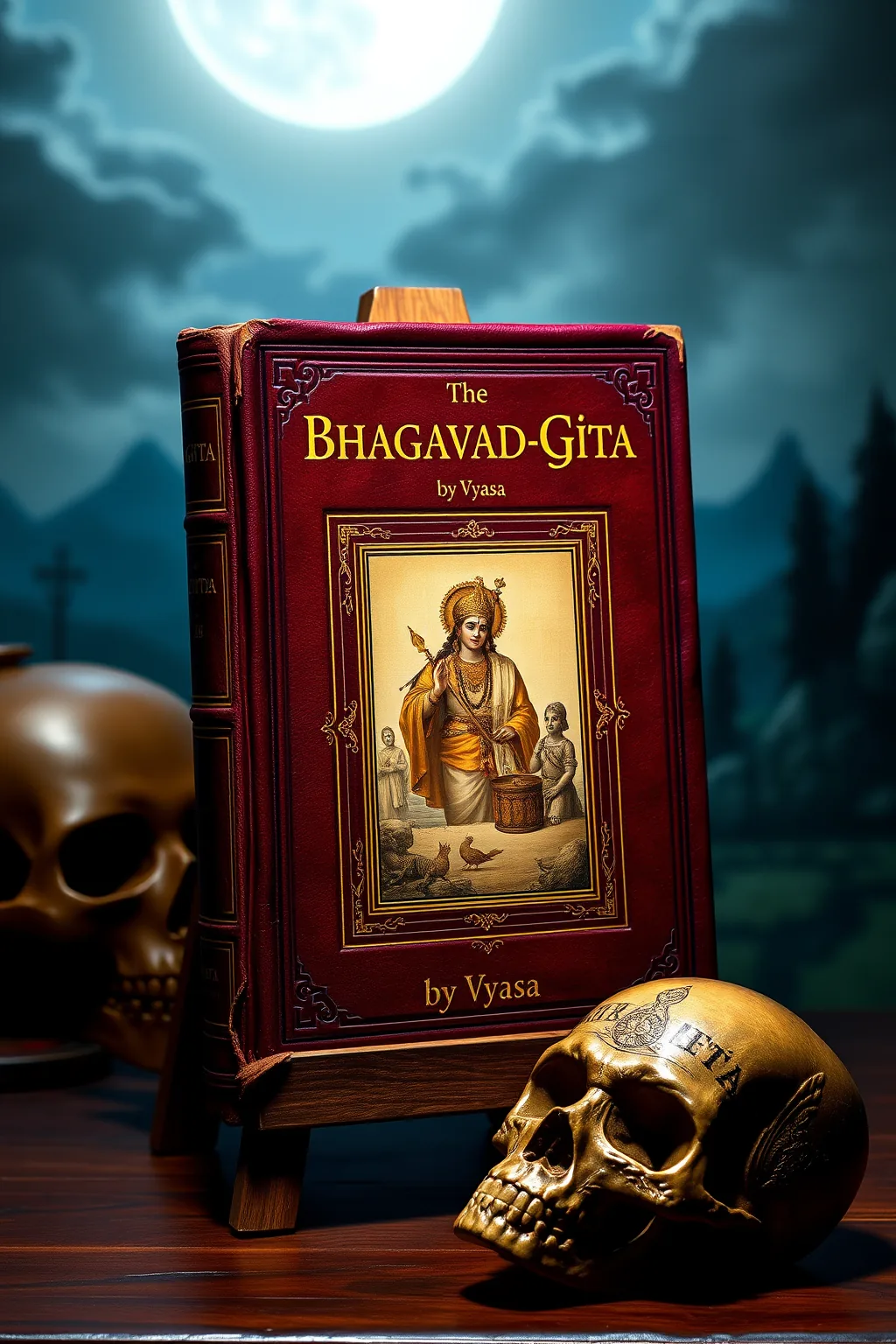
Bhagavad-Gita
 75
75

Bhagavad-Gita
The Bhagavad-Gita's enduring power lies not in its narrative arc, which is secondary to its philosophical discourse, but in its direct confrontation with Arjuna's crisis of conscience. Krishna's counsel, particularly his exposition on performing *dharma* without attachment to outcome, offers a potent framework for understanding action in the world. While the text's devotional aspects are paramount, its philosophical arguments, especially concerning the nature of the self (*Atman*) and its relation to the divine, are meticulously laid out. A potential limitation for some modern readers might be the inherent cultural specificity of its framework, requiring careful contextualization. The discourse on *nishkam karma* (action without desire for fruits) in Chapter 2 provides a compelling model for ethical engagement amidst turmoil. It remains a foundational text for understanding Hindu philosophy and its practical applications.
📝 Description
75
Written by Vyasa, the Bhagavad-Gita is a Sanskrit scripture embedded within the Mahabharata epic.
This text presents a dialogue between the prince Arjuna and his charioteer, Lord Krishna, on the eve of a great battle. Set against the backdrop of the Kurukshetra battlefield, their conversation addresses Arjuna's moral quandaries regarding his duty and the conflict ahead. Krishna's responses form the core of the work, offering insights into the nature of reality, righteousness, and the human condition.
The Bhagavad-Gita synthesizes earlier Vedic and Upanishadic thought with emerging devotional practices. It likely emerged between the 5th and 2nd centuries BCE, a period of significant intellectual and religious change in India. The scripture proposes a path to spiritual liberation through the diligent performance of one's prescribed actions, emphasizing detachment from the outcomes.
It is a central text for students of comparative religion, philosophy, and ancient Indian traditions. The teachings hold particular appeal for those grappling with ethical challenges, seeking inner peace amidst obligation, or exploring the spiritual quest for freedom.
The Bhagavad-Gita is a key scripture within the Hindu tradition, often studied alongside the Upanishads. It articulates a synthesis of knowledge (Jnana Yoga), action (Karma Yoga), and devotion (Bhakti Yoga) as paths to spiritual realization. Its concept of the Atman, the eternal self distinct from the physical body, aligns with ideas found in various contemplative traditions seeking to understand the nature of consciousness and its ultimate freedom from material existence.
💡 Why Read This Book?
• You will learn a framework for ethical action and duty, as exemplified by Krishna's teachings on *dharma* and *nishkam karma* to Arjuna before the battle of Kurukshetra. • You will gain insight into the concept of the *Atman*, the eternal self, and its liberation from the cycle of birth and death, a core tenet of Indian spiritual thought. • You will explore the path of *Bhakti Yoga*, or the yoga of devotion, as demonstrated by Krishna's instruction to surrender to the divine, offering a distinct route to spiritual realization.
⭐ Reader Reviews
Honest opinions from readers who have explored this book.
❓ Frequently Asked Questions
When was the Bhagavad-Gita likely composed?
Scholarly consensus places the composition of the Bhagavad-Gita between the 5th and 2nd centuries BCE, a period of significant philosophical development in ancient India.
What is the primary conflict in the Bhagavad-Gita?
The central conflict is Arjuna's moral and ethical dilemma about fighting his own kin on the battlefield of Kurukshetra, and Krishna's subsequent philosophical and spiritual guidance.
What does 'Dharma' mean in the context of the Bhagavad-Gita?
Dharma refers to one's duty, righteousness, or intrinsic nature. The Gita emphasizes performing one's prescribed dharma without attachment to the results.
Who is Lord Krishna in the Bhagavad-Gita?
Lord Krishna is presented as a divine charioteer and teacher, understood as an avatar of the god Vishnu, imparting spiritual wisdom to Arjuna.
What is the concept of 'Karma Yoga'?
Karma Yoga is the path of selfless action. It involves performing one's duties diligently and with detachment from the fruits of labor, leading to spiritual purification.
Is the Bhagavad-Gita considered a philosophical or religious text?
It is both. The Bhagavad-Gita is a foundational text in Hindu philosophy, exploring metaphysics and ethics, while also being a central scripture in devotional religious practice.
🔮 Key Themes & Symbolism
The Nature of Duty (Dharma)
The Gita profoundly examines the concept of Dharma, not merely as societal obligation but as an individual's intrinsic righteous path. Arjuna's crisis stems from a perceived conflict in his duties. Krishna's counsel focuses on understanding and fulfilling one's specific Dharma, particularly the Kshatriya duty of a warrior, without personal attachment to the outcome. This elevates action from a mere task to a spiritual practice, integral to one's cosmic role.
Action Without Attachment (Nishkam Karma)
A central teaching is Nishkam Karma, or 'action without desire for its fruits'. The text argues that attachment to results breeds anxiety and bondage. By performing actions as a duty, offered to the divine, one can achieve inner peace and spiritual freedom. This principle is crucial for understanding how to engage with the world actively yet remain detached from its ephemeral outcomes.
The Eternal Self (Atman)
The Bhagavad-Gita posits the existence of an eternal, unchanging soul, the Atman, distinct from the temporary physical body. Krishna explains that the Atman is unborn, immortal, and beyond destruction. Understanding this fundamental truth is presented as key to overcoming fear of death and attachment to worldly phenomena, facilitating the pursuit of liberation (Moksha).
Paths to Liberation (Yogas)
The scripture delineates multiple paths to spiritual realization, or Moksha. These include Karma Yoga (the path of action), Jnana Yoga (the path of knowledge), and Bhakti Yoga (the path of devotion). While each path is valid, the Gita particularly emphasizes the power of devotion to the divine (Krishna himself) as a means to attain spiritual union and liberation, accessible to all.
💬 Memorable Quotes
Direct passages from the work, attributed to the author.
“You have a right to perform your prescribed duty, but you are not entitled to the fruits of your actions.”
— This is a concise articulation of Nishkam Karma. It suggests that one's focus should be on the righteous execution of one's responsibilities, rather than on the rewards or outcomes that may follow.
“Whatever action a great man performs, common men follow. Whatever standards he sets, the world adopts.”
— This highlights the concept of exemplary action and leadership. It suggests that the conduct of influential individuals sets precedents and shapes societal norms and behaviors.
“He who sees the Supreme Lord dwelling in all beings and all beings in the Supreme Lord, attains the highest spiritual level.”
— This statement emphasizes the interconnectedness of all existence and the divine. It points towards a non-dualistic understanding where the divine permeates everything, and seeing this unity is the path to ultimate spiritual attainment.
“The mind is restless and agitated, difficult to restrain. It is like the wind.”
— This is an interpretation of Krishna's description of the human mind's inherent turbulence. It acknowledges the challenge of controlling one's thoughts and emotions, a common struggle on the spiritual path.
💡 Key Ideas
Editorial paraphrase of the work's core concepts — not direct quotes.
The soul is never born and never dies, nor does it exist and then cease to exist. It is unborn, eternal, ever-existing, and primeval. It is not slain when the body is slain.
This passage directly addresses the nature of the Atman, the eternal self. It asserts the soul's immortality, independent of the physical form, aiming to alleviate fear of death and attachment to the material existence.
🌙 Esoteric Significance
Tradition
The Bhagavad-Gita is a foundational text within the broader spectrum of Indian spiritual traditions, particularly Vedanta and Yoga. While not strictly fitting into Western Hermetic, Gnostic, or Kabbalistic frameworks, its emphasis on the inner journey, the nature of consciousness, and the union of the individual soul with the divine speaks to esoteric aspirations across cultures. It offers a sophisticated map for self-realization through disciplined practice and philosophical inquiry.
Symbolism
Key symbols include the battlefield of Kurukshetra, representing the arena of life's moral and spiritual struggles. Krishna, the divine charioteer, symbolizes the indwelling divine guide or higher consciousness. Arjuna's chariot itself can symbolize the human being, with senses and mind needing to be controlled by reason, guided by the divine. The conch shell, often blown to signal the start of battle, symbolizes the awakening of spiritual consciousness.
Modern Relevance
Contemporary thinkers and practitioners in fields ranging from psychology and mindfulness to leadership studies and comparative religion draw heavily on the Gita. Its concepts of selfless action, detachment, and the importance of inner balance are applied in secular contexts. Schools of Yoga and Vedanta worldwide continue to interpret and teach its principles, influencing global interest in Eastern spirituality and contemplative practices.
👥 Who Should Read This Book
• Students of comparative philosophy and religion: To understand a central text in Indian thought that bridges theological, ethical, and metaphysical discourse. • Seekers of spiritual guidance: For those exploring paths to inner peace, ethical living, and understanding their purpose in the world. • Practitioners of Yoga and meditation: To deepen their understanding of the philosophical underpinnings and diverse yogic paths presented in the text.
📜 Historical Context
The Bhagavad-Gita, likely composed between the 5th and 2nd centuries BCE, emerged from a period of intense philosophical and religious innovation in ancient India. It synthesized earlier Vedic traditions and Upanishadic thought with the burgeoning ascetic and devotional movements of the era. Its philosophical stance engaged with, and offered an alternative to, purely ritualistic Brahmanism and extreme asceticism. The text provided a more accessible synthesis of knowledge, action, and devotion. Its integration into the Mahabharata epic, attributed to Vyasa, ensured its wide dissemination and enduring influence, becoming a central to Hindu thought, even as competing schools like early Buddhism offered different paths to liberation.
📔 Journal Prompts
Arjuna's dilemma on the battlefield.
The concept of Dharma as one's duty.
Krishna's discourse on the Atman.
The practice of Nishkam Karma.
The role of Bhakti in spiritual liberation.
🗂️ Glossary
Atman
The eternal, unchanging soul or self, considered to be distinct from the physical body and mind. It is the true essence of an individual.
Bhakti Yoga
The path of devotion, characterized by love, surrender, and service to the divine. It is considered a potent means for spiritual liberation.
Dharma
One's duty, righteousness, moral law, or essential nature. It encompasses social obligations, ethical conduct, and one's inherent purpose.
Jnana Yoga
The path of knowledge, emphasizing wisdom, discrimination, and understanding the true nature of reality and the self.
Karma
Action, deed, or work, and its principle of cause and effect. Actions create impressions that influence future experiences and rebirths.
Karma Yoga
The path of selfless action, performed without attachment to the results. It aims to purify the mind and lead to spiritual growth.
Moksha
Liberation or release from the cycle of birth, death, and rebirth (samsara). It is the ultimate goal of spiritual realization.
Nishkam Karma
Action performed without any expectation or desire for the fruits or outcomes. It is a key principle of Karma Yoga.
Samsara
The continuous cycle of birth, death, and rebirth, driven by karma and ignorance. Liberation from samsara is known as Moksha.
🔮 Readers Also Liked
Browse all →









More by Vyasa
All books →


More Free Occult Philosophy Books
View all →